
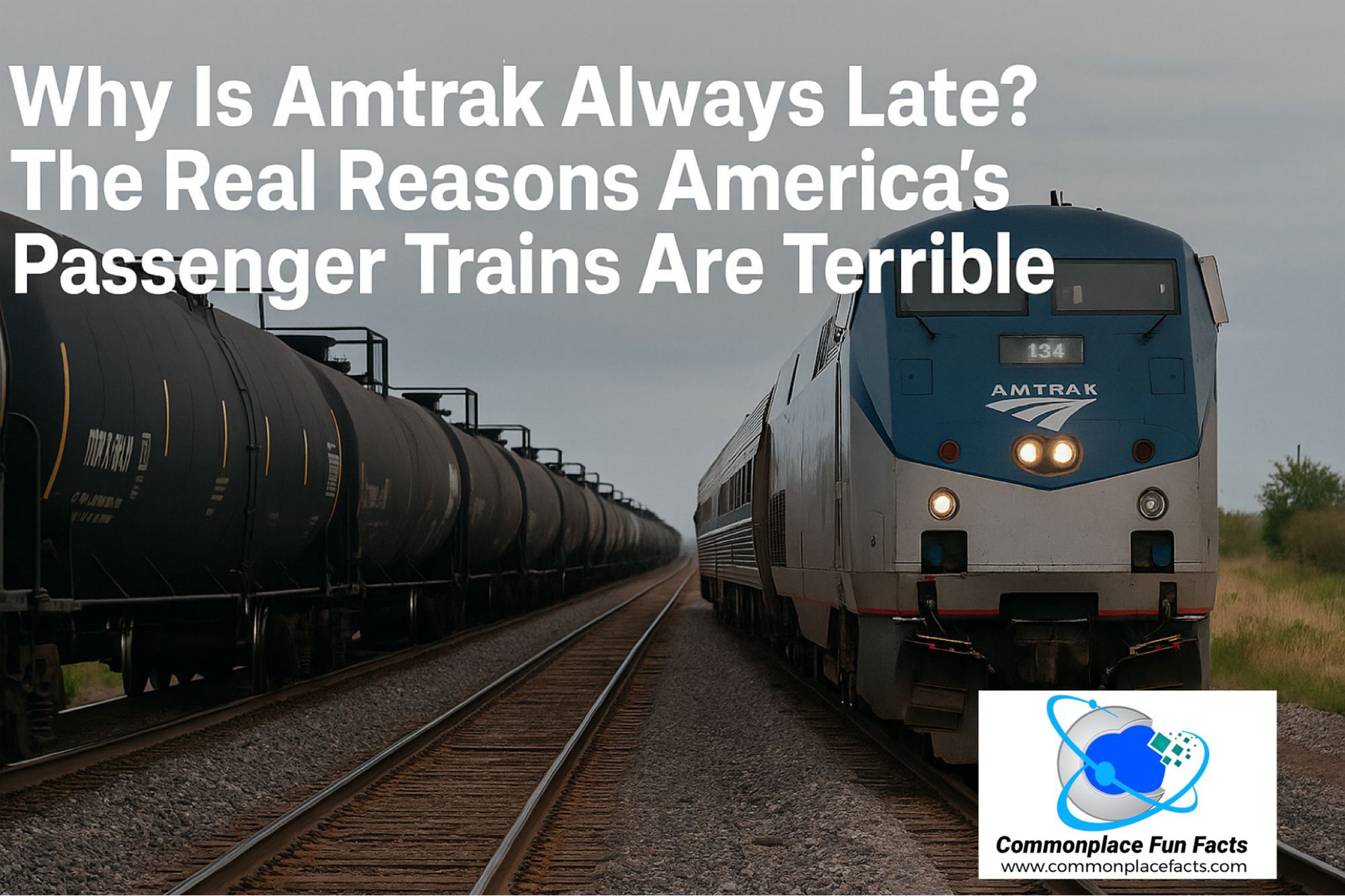

It’s the holiday season, which means the airports look like someone shook a snow globe full of stressed humans, the highways have become one continuous brake-light sculpture, and interstate bus travel remains an activity reserved exclusively for the brave, the desperate, or people who have lost a bet. Naturally, at some point in this festive chaos, a reasonable thought crosses your mind: “Why don’t I just take the train?”
If that has ever been you, please allow us to gently pat your head in sympathy. That kind of optimism is precious. It’s the sort of innocence usually found in small children, golden retrievers, and anyone who assumes U.S. passenger rail operates at anything resembling First World standards. This sweet, hopeful belief dissolves the moment you actually try planning an Amtrak trip and discover the truth hiding behind the brochure: train travel in America is exactly like flying or driving—if you made it slower, more expensive, harder to predict, and then sprinkled in enough delays to qualify as performance art.
And did we mention it’s slow? Because it’s very slow. Slow enough that time becomes a suggestion rather than a measurement. Slow enough that you will begin to question whether the train is moving forward or simply relying on plate techtonics to carry the train forward at the pace of continental drift.
Welcome aboard. The adventure begins.
Contents
Why Is Amtrak Always Late?
If you’ve ever tried to schedule a trip by train, wondered why is Amtrak always late, and thought, “Surely this level of dysfunction must have taken real effort,” congratulations. You’re beginning to understand American rail.

For a country that once prided itself on conquering continents, we’ve somehow ended up with a passenger rail system that moves with the confidence of a nervous squirrel crossing the interstate. It wasn’t always like this. There was a time—recent enough that your grandparents still complain about it—when traveling by train wasn’t an act of optimism or character-building. It was just how you got places. Fast. Reliably. Without submitting yourself to the spiritual anguish of airport security.
Today? The system feels like someone took the nation’s entire rail network, folded it into an origami crane, and then accidentally set it on fire.
You can’t blame people for thinking Amtrak is simply “bad at trains.” It’s an easy narrative. Comforting, even. But as we’re about to discover, the truth is a little more complex and a lot more absurd. Amtrak isn’t late because it wants to be. Amtrak is late because America built a rail system where the passenger train must politely tip its hat and step aside while a two-mile-long freight train contemplates the mysteries of existence at eight miles per hour.
And somehow, that’s the simple part.
So settle in. We’re taking a trip through history—slowly, of course, in the spirit of authenticity—to figure out how a country that once dominated the rails managed to derail itself so thoroughly that even its timetables have given up hope.
America’s Railroads: Built Fast, Merged Faster, Broke Fastest
The late 1800s were a fever dream of railroad mania. Companies built track the way toddlers draw with crayons—enthusiastically, rapidly, and with no regard for whether they were scribbling over someone else’s work. Federal land grants, cheap labor, and a national obsession with expansion meant the mileage nearly doubled three decades in a row. It was chaotic, redundant, and, on occasion, lightly armed. Competing companies didn’t always limit themselves to lawsuits; sometimes they just shot at each other and called it “market competition.”

But eventually, the chaos had to evolve into something resembling adulthood. Enter the age of “efficiency,” which in practice meant “make the investors happy.” J.P. Morgan—Mr. Monopoly in human form—didn’t build much track. Instead, he deleted it. He merged companies, killed unnecessary lines, standardized routes, and optimized everything for profitability. Railroads discovered a delightful truth: they could make more money running fewer trains more slowly, provided those trains were long, heavy, and packed like the world’s most depressing piñata. The Great Northern practically invented the spreadsheet-friendly concept of “run only when full,” which was a stroke of brilliance for investors and a disaster for passengers.
By 1900, railroads were serving two very different masters:
- The American public, who needed trains to conduct normal human life.
- The investors, who wanted trains run as cheaply and profitably as human ingenuity and creative accounting could allow.
Balancing these two missions was tricky even before cars rolled onto the scene. After the automobile? Forget it. Passenger rail didn’t simply dip; it swan-dived. Americans loved the independence of their personal automobiles. (Read “The Epic History of the Interstate Highway System: Dirt, Detours, and Dwight D.” for more about that chapter of transportation history.) Businesses loved the flexibility of trucks. Passenger trains became sentimental. Freight trains became profitable. And railroads behaved exactly how you’d expect a profit-driven industry to behave: they slashed passenger service and chased freight money like a golden retriever chasing a tennis ball.
There was just one problem: the regulators wouldn’t let them.
The ICC: Saving Passenger Rail to Death
The Interstate Commerce Commission (ICC), designed to protect consumers, instead became the iron ball chained to the ankles of America’s railroads. Passenger routes—even the spectacular money-losing ones—couldn’t be abandoned without permission. And the ICC did not believe in letting anything die with dignity. So railroads kept running ghost trains through empty stations, bleeding money like a Victorian heroine in need of smelling salts.
By the late 1960s, the entire system was collapsing with the structural integrity of a poorly assembled Lego tower. Bankruptcy filings were everywhere. Maintenance was deferred to the point where the tracks themselves were considering early retirement. The mergers went from “strategic” to “please, somebody save us.”
Something had to give.
Amtrak Arrives… and Immediately Gets Kneecapped
Amtrak, formally known as the National Railroad Passenger Corporation, was created in 1970 when Congress looked at the collapsing passenger rail industry and said, essentially, “Alright, fine, we’ll fix it.” Private railroads had spent years begging to abandon their money-losing passenger lines, but the Interstate Commerce Commission wouldn’t let them. The result was a fleet of exhausted trains, a network held together with optimism and rust, and railroad executives who would’ve happily pulled their own locomotives apart with their teeth if it meant never running another sleeper car. So the federal government passed the Rail Passenger Service Act, scooped up the failing passenger operations, and launched Amtrak on May 1, 1971. In theory, this would modernize rail travel. In practice, it was more like adopting an elderly, underfed dog and then asking it to win the Westminster Dog Show.
What makes Amtrak unusual—besides everything—is that it’s a public corporation operating mostly on private freight infrastructure, which is the transportation equivalent of renters being told they have to mow the landlord’s lawn, repair the plumbing, and also yield the hallways to a herd of passing buffalo. Despite being “national,” Amtrak doesn’t own most of the tracks it uses, doesn’t control the dispatching on those tracks, and is occasionally treated by freight railroads the way a cat treats a laser pointer: technically it can chase it, but the odds of catching anything are grim.

As for other major passenger train companies in the United States—no, not really. Amtrak is the only long-distance and national passenger rail provider. There are regional commuter systems (like Metra, Caltrain, NJ Transit, and the MBTA), and there are small private experiments like Brightline in Florida and Nevada, which proves that America can build decent passenger rail… as long as it’s in one state, on one corridor, and priced like theme-park admission. But when it comes to crossing state lines or moving people across the country, it’s Amtrak or nothing—an arrangement that works beautifully, assuming your definition of “beautifully” includes delays, freight interference, and the occasional existential crisis about why your train’s top speed can be measured with Carbon-14.
The federal government’s bold plan to fix the passenger train service included:
- Let freight railroads drop their passenger responsibilities.
- Allow Amtrak to use freight-owned tracks for a “reasonable fee.”
- Everything will magically break even within four years.
It was adorable. Truly.
Yes, Amtrak got the trains. But the freight railroads kept the tracks.
This is the beginning of the great American tragedy: passenger trains run by one entity depend completely on track owned by another entity that would rather host a family of raccoons than an Amtrak timetable.
Realizing that passenger trains would always take a back seat to freight trains in this scenario, Congress passed the Amtrak Improvement Act of 1973, declaring—quite boldly—that Amtrak should get priority over freight trains.
That’s the law.
And here’s how it works in practice:
The law is ignored with a level of commitment normally reserved for Olympic training. Freight railroads insist the statute is vague. Amtrak files complaints like clockwork. And the Department of Justice observes the entire spectacle the way a cat watches a sandwich fall off a counter: vaguely curious, absolutely inert.
In fact, the DOJ has enforced Amtrak’s legal priority exactly once. In 1979. Apparently it was tired afterward.
So the predictable happens: freight dispatchers—armed with every incentive to delay passenger trains and not a single incentive to let them run on time—control the entire system.
When Amtrak says their trains are late because of freight interference, they aren’t offering an excuse. They’re stating a mission philosophy.
The Awkward Marriage: When the Government Told Freight Railroads to Share Their Toys
To fully appreciate the chaos of American passenger rail, you have to understand the extremely delicate, extremely unbalanced relationship at the heart of it: the federal government told private freight railroads that they had to let Amtrak use their tracks… pretty much forever… for a fee that is, in most cases, less than the cost of a moderately fancy dinner.

Imagine buying a house, maintaining the yard, replacing the roof, upgrading the plumbing, paying the taxes, and then being told by Congress that—surprise!—a national roommate will now be living in your hallway. And legally, they get to walk through your bedroom whenever they’d like. And no, you cannot charge them market rent. Be reasonable.
From the freight railroads’ perspective, the whole arrangement feels a bit like being punished for doing your job too well. They poured private money into building tracks, bridges, tunnels, sidings, yards, and signaling systems. They maintained them. They modernized them. They spent decades turning freight operations into the logistical equivalent of a Swiss watch—if Swiss watches routinely hauled 14,000 tons of Wyoming coal.
Then, overnight, they were told those same tracks now had to carry passenger trains they did not ask for, do not control, and—let’s be honest—do not love.
The real tension boils down to this:
Freight railroads own the infrastructure.
Amtrak needs it to survive.
The government told the owners to share.
And nobody ever clarified how sharing is supposed to work.
Legally, freight companies must charge Amtrak a “reasonable” access fee. Practically, “reasonable” is defined somewhere between “symbolic gesture” and “please don’t be mad at us, Congress.” Freight railroads spent billions building and maintaining infrastructure, only to be told their return on investment now involves being the world’s least enthusiastic Airbnb hosts.
And then came the pièce de résistance: the 1973 rule declaring that Amtrak trains get priority over freight. Meaning freight railroads should, theoretically, pull over their mile-long, revenue-generating trains so that a lightly loaded, chronically late passenger train can glide by.
This is, as the kids say, “a vibe,” but not one the freight companies enjoy.
The result is a structural conflict you could see from space:
- Freight railroads make money moving slow, heavy cargo.
- Passenger trains need to move fast and on time.
- They both have to use the same tracks.
- Only one of them actually owns those tracks.
It’s the transportation equivalent of forcing a Formula 1 car and a parade float to share a single lane, and then getting angry when the parade float refuses to swerve into a ditch to let the Ferrari through.
None of this is to say freight railroads are hapless victims. They are wildly profitable, strategically ruthless, and occasionally allergic to infrastructure maintenance. But the core unfairness is real: no other industry in America is required to host a parallel public service on private property, indefinitely, while pretending it’s all fine.
And the part that makes it even stranger?
This awkward marriage wasn’t designed with long-term stability in mind. It wasn’t even designed with short-term stability in mind. It was a stopgap solution—an emergency patch on a collapsing rail network—and it somehow became permanent. Like putting duct tape on a submarine and declaring the issue resolved.
The tension was baked in from day one, and every year since has been one long argument over who gets to use the tracks, who pays for improvements, and who’s responsible when everything inevitably runs late.
Spoiler: the answer is always “Amtrak,” even when it absolutely isn’t.
Freight Rail: Bigger, Heavier, Slower, and Deeply Uninterested in Company
Modern freight rail has engineered a system that is a marvel of efficiency—if you’re a coal train. If you’re a passenger, it’s more like being trapped in someone else’s nightmare PowerPoint presentation. Every design choice freight railroads make is brilliant for freight and catastrophic for anyone hoping to get somewhere by dinner.
Here’s the recipe:
1. Build trains so long they qualify as geological formations.
The magic number in freight world is gross tonnage per train. The more cars you cram together, the cheaper each one is to move. So trains grew. Then they grew again. Then they reached a size where most sidings—the places trains pull over to let others pass—are too short to hold them. This means when Amtrak gets stuck behind one, it’s not a delay. It’s a vigil.
2. Serve only the customers who ship in biblical quantities.
Coal is the ideal customer: one origin, one destination, infinite volume, zero drama. Container ports are close seconds—entire mountains of cargo delivered at once, perfectly packaged for mass movement.
Small-town customers? Local factories needing a few cars moved? Anyone whose shipping needs don’t involve a forklift the size of a bungalow?
Eliminated. Trimmed. Pruned like an unwanted shrub.
Freight railroads shut down branch lines, funneled everyone into mega-corridors, and declared victory for efficiency. Which it was—unless you happen to be running a national passenger train system on the same tracks.
3. Worship the operating ratio like it’s the 11th commandment.
Operating ratio—expenses divided by revenue—is the religion of modern freight rail. And the only path to holiness is austerity:
- cut staffing
- defer maintenance
- avoid expansion
- let speed restrictions sprout like spring weeds
Great for shareholders. Great for quarterly earnings calls. Not so great if your business model involves trains that move faster than continental drift.
Why This Breaks Amtrak
When a freight railroad decides to run a two-mile-long coal train down a single-track line with sidings built in the Eisenhower administration, there are only two theoretical choices:

- Let the giant freight train go first, because it is simply the only option that doesn’t require rewriting the laws of physics.
- Stop the freight train, break it into pieces, move those pieces, let Amtrak pass, reassemble the whole thing, and then continue on as if this were a normal, sustainable idea.
You already know which option they choose.
The law says Amtrak is supposed to have priority. Reality says “that’s adorable.” And in the ancient struggle between legislation and physics, physics wins every time.
The results are exactly what you’d expect:
- Amtrak long-distance routes achieve on-time performance that sometimes dips to 28%, which is less “service reliability” and more “arrival time can best be discerned through a magical process that involves divining the future with bird entrails.”
- Passengers sit parked on sidings for an hour while a freight train crawls past with the urgency of a bored tortoise.
- First-time riders become former riders before they’ve even reached their destination.
It’s no wonder the Federal Railroad Administration estimates that simply improving punctuality to 85%—a number other countries would consider a national embarrassment—would cut Amtrak’s annual operating losses by 30%. Reliability is everything. And Amtrak currently has all the reliability of a Victorian séance.
The Tragic Marriage: Two Industries, One Set of Tracks
At this point, expecting freight and passenger rail to happily coexist on the same infrastructure is like asking a marching band and a cat-napping toddler to share a studio apartment. One is big, loud, and slow-moving. The other needs speed, predictability, and the ability to arrive on time without a fight.

Putting both on the same tracks wasn’t a compromise. It was a cry for help disguised as public policy.
And yet, opportunities still shine through—Colorado’s Front Range, Los Angeles to Las Vegas, Phoenix to Tucson, Chicago to Louisville. The tracks exist. The customers exist. The demand is practically begging for a timetable.
What stands in the way is everything else.
Until the country acknowledges that freight and passenger rail have fundamentally different needs—and that the latter cannot simply hitch a ride on infrastructure designed for the former—we’ll keep reminiscing about the America that once existed instead of boarding trains in the America that could exist.
But here’s the encouraging part: we built that golden-age network once. We can build it again. Perhaps we can begin by abandoning the quaint notion that the federal government can simply wave a wand and decree something that basic economics has proven to be unlikely.
Because underneath the coal trains, the spreadsheets, and the world’s longest rolling traffic jams, there’s still an America where you can go anywhere by rail.
And it’s worth fighting for.
You may also enjoy…

The Epic History of the Interstate Highway System: Dirt, Detours, and Dwight D.
Discover the surprising history of the U.S. Interstate Highway System—from muddy 1919 convoys to engineering marvels and Cold War strategy. Explore how America’s roads transformed travel, economy, and national defense.

How a Missed Train Saved a Life and Changed a Nation
John was running late, and the timing could not be worse for him. He was preparing for the biggest meeting of his life. It was a meeting with one of the most important men in the country, and the outcome would decide the fate of his fledgling business. Already on a very tight schedule, it…

The Secret Train Station in New York: A Hidden Slice of History
Beneath the busy streets of Manhattan lies a hidden piece of history: a secret train station under the Waldorf Astoria. Built for the convenience and privacy of America’s elite, this clandestine platform served presidents and celebrities. While its current use remains a mystery, it may still be in operation. This secret reminds us of a…





Leave a Reply to How America’s Passenger Trains Went Off Track – In The Shadow of YesterdayCancel reply