
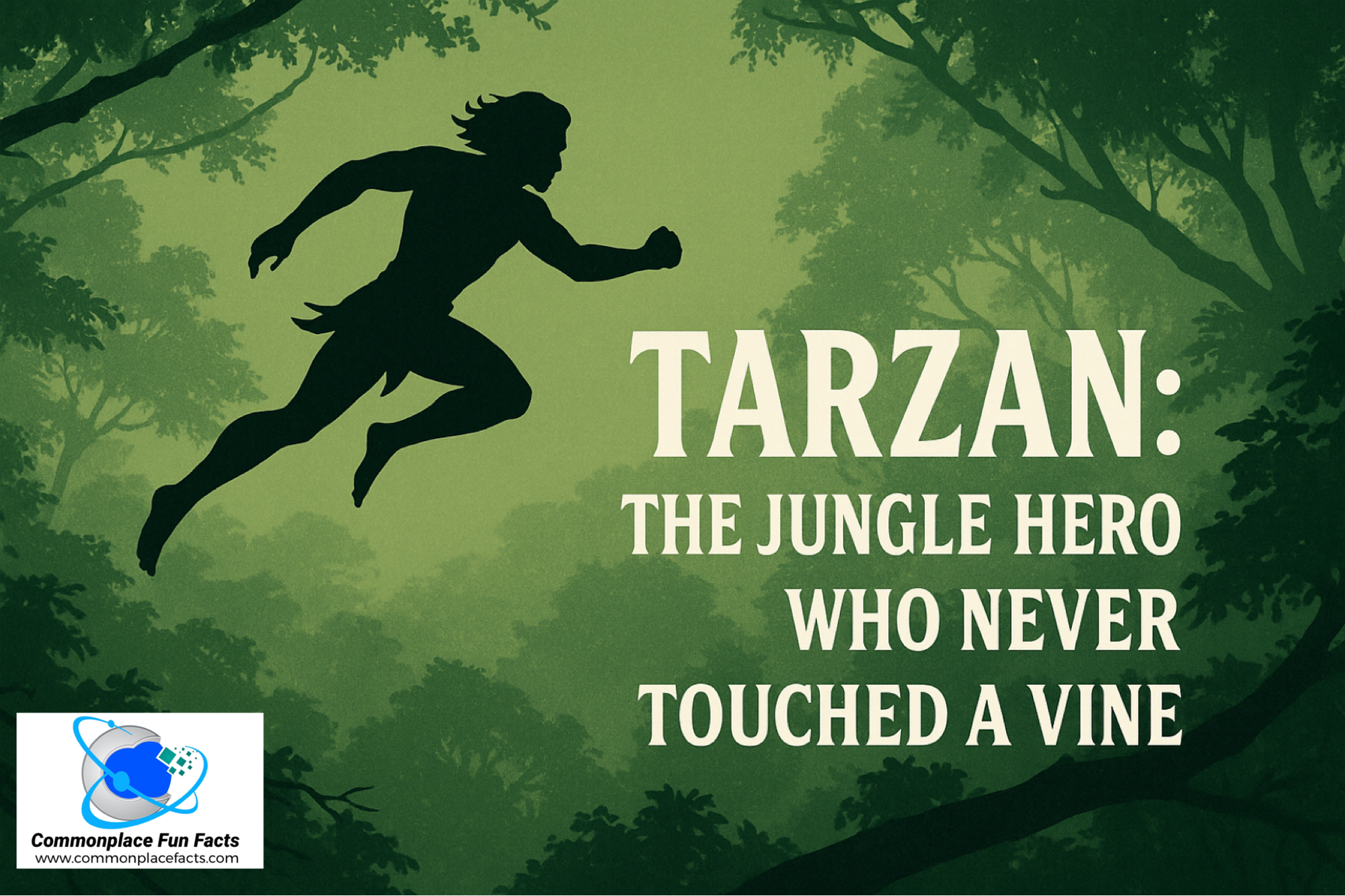

Close your eyes and picture Tarzan for a moment. Now open them. Right — we probably should have clarified that the “close your eyes” part wasn’t meant to be a long-term lifestyle choice. If you kept them shut long enough to miss that second instruction, you’re not reading these words, and the time we spent writing the next 2,000 words would have been better spent trying bold new adventures like going outside, playing sports, or attempting to make friends.
Let’s start over.
Try a little experiment. Picture Tarzan. Go on, summon him to mind: the loincloth, the dramatic leap, the vine that looks suspiciously like it was installed by the Jungle Parks Department. All set? Good. Now forget every bit of that, because the actual Tarzan from the books wouldn’t recognize the guy you just imagined unless he introduced himself by yodeling.
The truth is far stranger, far funnier, and far more satisfying than the Hollywood version most of us grew up with. So let’s take another swing at this — metaphorically, of course. The real Tarzan never trusted vines.
The original Tarzan created by Edgar Rice Burroughs is not a monosyllabic vine enthusiast. He never swings on a vine in the books, he isn’t raised by gorillas, he is highly literate, speaks multiple languages, has a British title, and occasionally treats a lost city’s treasure vault like his personal ATM. Popular culture took a complex, weirdly specific character and converted him into Jungle Himbo™.
So let’s head into the jungle and meet the real Tarzan: the aristocratic polyglot who never touched a vine and whose famous yell may have been part human, part sound engineer having a very creative day.
Contents
Did Tarzan Swing on a Vine? The Myth That Refuses to Let Go
We may as well start with the most persistent misconception: Tarzan, the original, text-based version, does not swing on vines. At all. In Burroughs’ novels, Tarzan travels through the trees by brachiation, swinging from branch to branch like an extremely athletic physics experiment, or by making 20-foot leaps across the canopy when branches aren’t conveniently placed.
That’s impressive. It is also a problem when you try to film it.
When the original story, Tarzan of the Apes was adapted for film in 1918, the director ran into a depressing reality: no human being, no matter how fit, was going to vault from branch to branch across a real jungle without either dying or suing the studio. So the filmmakers came up with an easier solution: vines. A long vine, a handy tree, a dramatic swing, no broken actors.
There was just one tiny issue. It’s not how vines work.
Vines don’t grow as convenient jungle zip-lines. They grow from the ground up, climbing trees and structures. They only hang down when there’s enough extra length to drape over a branch or sag under their own weight. One wrong grab and your heroic jungle lord is no longer swinging dramatically through the treetops. He’s starring in an impromptu reboot of George of the Jungle, except instead of “Watch out for that tree!” the script cuts off at “You’re going to hit the gr—” followed immediately by a very discouraging thud.
In real life, vine-swinging is biomechanically risky and botanically unreliable. In pulp fiction and Hollywood? It’s cinema gold. The vine stuck, and the branch-swinging original quietly got rewritten in the public mind.
Tarzan, the Apes, and the Species That Never Existed
Another popular misconception: Tarzan is raised by gorillas. That’s what a lot of posters, cartoons, and childhood memories say. Burroughs, however, had something more peculiar in mind.

The apes that adopt Tarzan are not gorillas at all. They’re Mangani: a fictional species of great ape invented by Burroughs. The Mangani are described as more intelligent than ordinary apes, walking semi-upright, using tools, and having a structured society and language. They are somewhere between ape and early hominid, occupying exactly that sweet spot a writer needs when he wants an “ape” tribe capable of raising a human child and giving him a culture.
In the Mangani language, Mangani basically means “great apes,” while humans get labeled as variations on the theme: tarmangani for white humans and gomangani for Black humans. The Mangani consider themselves the default model; humans are just oddly hairless offshoots with poor tree skills.
As for “Tarzan” himself, the name isn’t a random jungle noise. Kala, his ape-mother, names him “Tarzan” because in Mangani, tar means “white” and zan means “skin.” That’s right: one of literature’s most famous heroic names translates to “White-Skin.” Subtlety and political correctness were not invited to this naming ceremony.
How a Failed Pencil-Sharpener Salesman Created a Legend
Tarzan exists because Edgar Rice Burroughs had a bad run at being a respectable adult.

Before becoming one of the most successful authors of the 20th century, Burroughs drifted through a series of jobs, including ranch hand, cavalryman, department store manager, and, most gloriously, a salesman of pencil sharpeners. None of these ventures were especially profitable. Burroughs, short on money and long on opinions, started reading pulp magazines and came to a dangerous conclusion: the stuff being published wasn’t very good, and if people were paying for that, he might as well try writing some “rot” himself.
So he did.
His early drafts of the story that would become Tarzan of the Apes were written on the backs of used letterheads and scrap paper. He experimented with names like “Zantar” and “Tublat Zan” before finally landing on “Tarzan.” It sounds like a small decision, but it’s the difference between a household name and something that sounds like a dental instrument.
Tarzan of the Apes was published in 1912. It was an immediate success. The public fell in love with the idea of a nobleman raised by apes in an African jungle, and the pulp hero quickly migrated out of magazines and into novels, comic strips, stage plays, and eventually film.
Burroughs, who had once struggled to make a living selling pencil sharpeners, ended up incorporating himself as “Edgar Rice Burroughs, Inc.” and buying a ranch in California which he named… Tarzana. The surrounding community later took the name as well. Tarzan didn’t just conquer the jungle. He colonized the map.
Tarzan Bread, Tarzan Gasoline, and the First Multimedia Brand
Tarzan was more than a hit character. He was a marketing bonanza.
By the 1930s, the Tarzan franchise had exploded far beyond the jungle. There were Tarzan comic strips, Tarzan radio dramas, Tarzan toys, Tarzan club memberships, Tarzan-branded food products, and, most famously, Tarzan Bread—a real promotional tie-in that came with collectible cards tucked inside the wrapper. Newspapers from the era treated it as if every American child was eating sandwiches endorsed by the Lord of the Jungle.

It wasn’t just a loaf-of-bread gimmick, either. Edgar Rice Burroughs was one of the earliest authors to fully embrace character licensing, and Tarzan became one of the first multimedia, mass-marketed fictional brands in history. Kids could read Tarzan in the morning paper, listen to Tarzan on the radio that afternoon, and play with Tarzan merchandise in between. Modern franchises brag about cross-platform marketing; Tarzan was doing it before “branding” had its own department.
Adults filled their car with gasoline that promised to deliver “The Power of Tarzan,” and keeping true to the original source material, no vine-swinging was required. Burroughs turned Tarzan into a commercial empire without a single energy drink, sneaker collaboration, or cinematic universe—proving that sometimes all you need is a loincloth, a jungle, and a surprisingly aggressive licensing strategy.
Tarzan, Proto-Superhero
Tarzan isn’t usually shelved next to Superman, but the connection is closer than it looks.
In the original Tarzan of the Apes, Jane Porter describes Tarzan as a “superman,” years before Superman the comic character would exist. The term itself was already floating around in culture, but Jerry Siegel, co-creator of Superman, later cited Tarzan (and Burroughs’ other hero, John Carter of Mars) as influences on his own character.
Just like Tarzan, Superman is an orphan raised outside of normal human society, gifted with extraordinary physical abilities, struggling with questions of identity and belonging, and toggling between a hidden “true” self and a public persona. The jungle lord and the Man of Steel are distant cousins in the pop-culture family tree: one raised by apes, the other by Midwestern farmers, both redefining what a “man” can be.
Johnny Weissmuller: The Swimmer Who Became the Ape Man
Hollywood found its most famous Tarzan in a place you might not expect: the swimming pool.
Johnny Weissmuller, born Johann Weissmüller, was a sickly child who, according to some reports, contracted polio around the age of nine. A doctor told him to take up swimming to build his strength. He did, and then enthusiastically refused to stop. Weissmuller went on to become one of the greatest swimmers of the 20th century, winning five Olympic gold medals and a bronze between 1924 and 1928, and setting dozens of world records.
In his competitive career, he never lost a race in official competition. It was as if someone took Tarzan’s superhuman physicality and simply dropped him into a chlorinated jungle.
Hollywood came calling. From 1934 to 1948, Weissmuller played Tarzan in 12 films, defining the screen version of the character for generations. He had the athleticism, the physique, and the presence. He also had something Burroughs definitely did not write: the Tarzan yell.
The Yell That Launched a Thousand Parodies
Weissmuller recorded the original Tarzan yell for MGM, and the story of what exactly that sound is has been tangled ever since. Weissmuller insisted it was simply him yodeling, drawing on a skill learned in his youth. Sound historians, on the other hand, have suggested that the final product might be a heavily engineered blend: possibly his voice, plus manipulated animal sounds, plus studio trickery involving reversed audio or layered tones. You can read all about it in “The Tantalizing Tale of the Trademarked Tarzan Yell“.
Whatever the ingredients, the result is one of the most recognizable audio signatures in film history. It became so iconic that during World War II, American GIs requested the Tarzan yell be broadcast on Armed Forces Network radio to remind them of home. The MGM version was copyrighted and is still controlled by Burroughs’ estate, which is probably the only time in history a scream has needed legal representation.
Weissmuller himself claimed that the yell once saved his life. During the Cuban revolution in 1959, he was reportedly stopped at a checkpoint. The soldiers were skeptical of his identity. So he did the logical thing: he performed the Tarzan yell. The rebel troops recognized him and let him pass.
Imagine the chaos at the airport if we all had to perform a trademark scream to prove who we are.
“Me Tarzan, You Jane”? Not So Much.
Few lines in movie history feel as inevitable as “Me Tarzan, you Jane.” It’s quoted, parodied, and referenced endlessly.
It is also, annoyingly, never actually spoken in any of the Weissmuller Tarzan films.
The line that lodged itself in cultural memory seems to be a compressed, misquoted version of the simple English Tarzan uses when he begins learning to talk in the first film. Weissmuller did say “Me Tarzan, you Jane” at least once in an interview, which probably helped harden the misquote into tradition. But if you go hunting for it in the actual scripts, you’ll find yourself disappointingly vine-less again.
We have, once more, created a Tarzan that exists mostly in our collective imagination, built from half-remembered scenes and parodies rather than the original text.
The Aristocratic Polyglot of the Jungle
The Tarzan of the books would have been deeply confused by the idea that he couldn’t form complete sentences.
In Burroughs’ novels, Tarzan is actually John Clayton, Lord Greystoke, an English aristocrat’s son abandoned in the African jungle when his parents die. He teaches himself to read English from books left in his parents’ ruined cabin, long before he hears the language spoken. When he eventually encounters human beings, he goes on to master multiple languages: French, English, several African languages, plus the Mangani tongue and various animal “languages” in the sense of understanding their calls and emotions.
By the time he’s fully grown, Tarzan is fluent in at least nine spoken languages and more than twenty dialects. While the movie Tarzan wrestles crocodiles and shouts, book-Tarzan can do that and conduct a multilingual diplomatic conversation about it afterward.
He can also handle his finances.
Tarzan’s Very Unconventional Banking Arrangement

Among Tarzan’s many adventures, one of the more memorable involves the lost city of Opar. Opar is an ancient, decaying outpost of a forgotten civilization, complete with human sacrifices, crumbling architecture, and, more importantly for Tarzan’s purposes, enormous vaults of gold and jewels.
We first encounter Opar in the 1913 novel The Return of Tarzan, which, distressingly, has a cover that depicts him swinging on a vine, despite never actually doing that, as we have already pointed out. Even in 1913, symbolism mattered more than substance.
Tarzan essentially discovers a private reserve of unlimited wealth. When he needs money to maintain his estates or pursue a mission in civilization, he returns to Opar, dodges its less-than-hospitable residents, and removes a fresh shipment of gold. There is no paperwork, no interest, and no customer-service hold music. As schemes go, it involves a lot more effort than cryptocurrency, but it’s probably less risky.
It is hard to square this urbane, financially savvy, multilingual nobleman with the grunting “fairground chump” that made his way onto the screen.
What Burroughs Thought of Hollywood’s Tarzan
Burroughs was delighted that Tarzan made him successful. He was less delighted with what the movies did to his character.
In the novels, Tarzan is intelligent, articulate, and morally complex. In the popular films, especially in the early decades, he is simplified into a nearly wordless jungle man who communicates with simple phrases and animal cries. Burroughs’ daughter once recalled going to a Tarzan film with him. When the audience applauded at the end, her father remained in his seat, shaking his head sadly.
Even Johnny Weissmuller, who owed his acting career to Tarzan, had his limits. He once mused that his lines “read like a backward two-year-old talking to his nurse.” He did the job, he swung the vines, he shouted the yell, but he knew the original character was smarter than the scripts allowed.
The Tarzan Who Refuses to Die
By any reasonable standard, Tarzan should have faded by now. He was born in 1912, the product of an era obsessed with lost worlds, noble savages, and colonial adventure fantasy. A century later, we’ve re-examined a lot of those assumptions, questioned the politics behind them, and yet… Tarzan lingers.
He persists because he taps into a durable fantasy: the idea that a human being, stripped of society, could become something more, not less. Tarzan is strong, but he is also kind (most of the time), honorable (eventually), and capable of moving between worlds. He belongs fully to neither the jungle nor civilization, which makes him oddly relatable to anyone who has ever felt like they don’t quite fit either.
He also helped pave the way for the modern superhero. Before capes and laser eyes, there was a man in a loincloth who could climb faster, fight harder, and think more clearly than anyone else on the page.
The Real Tarzan vs. the Pop-Culture Tarzan
So who is Tarzan, really?
On the one hand, we have the movie Tarzan: vine-swinging, yell-shouting, grammar-optional, raised by gorillas, summarized into a single line that he never actually said.
We’d be remiss if we didn’t point out that he also inspired the totally-brilliant Ray Stevens’ song “Guitarzan.”
On the other hand, we have Burroughs’ Tarzan: an English lord raised by a fictional species of apes, named “White-Skin” in their language, who never swings on a vine, teaches himself to read, learns nine languages, raids an ancient city’s gold reserves for pocket money, and helped inspire Superman.
The cinematic version is iconic, but the literary version is stranger, richer, and much harder to forget once you’ve met him.
So the next time someone belts out the Tarzan yell or confidently repeats “Me Tarzan, you Jane,” you can enjoy the private satisfaction of knowing they’ve got the wrong guy. The real Tarzan didn’t grunt, didn’t vine-swing, and wasn’t about to trust his life to a plant with the structural integrity of a shoelace. He deserved better. Frankly, so do we.
You may also enjoy…

The Tantalizing Tale of the Trademarked Tarzan Yell
Learn the complicated and interesting story of the Tarzan yell and how it came to be one of the most recognized sounds in the world.

Pulgasari: the Crazy Story of North Korea’s Godzilla Rip-Off
“Pulgasari” is a North Korean film created by kidnapped director Shin Sang-ok as a rip-off of “Godzilla.” It follows a monster born from rice that grows to immense size, ultimately consuming both liberators and their tools. The film reflects North Korea’s oppressive regime and was later released internationally under Kim Jong-il’s oversight.

The Surprising Origin of Superman: How a 1933 Villain Named Bill Dunn Evolved Into the Superman We Know Today
Discover the little-known origin of Superman — how Bill Dunn and the 1933 story Reign of the Superman shaped the legend before Action Comics #1.




Leave a Reply to ScottCancel reply