
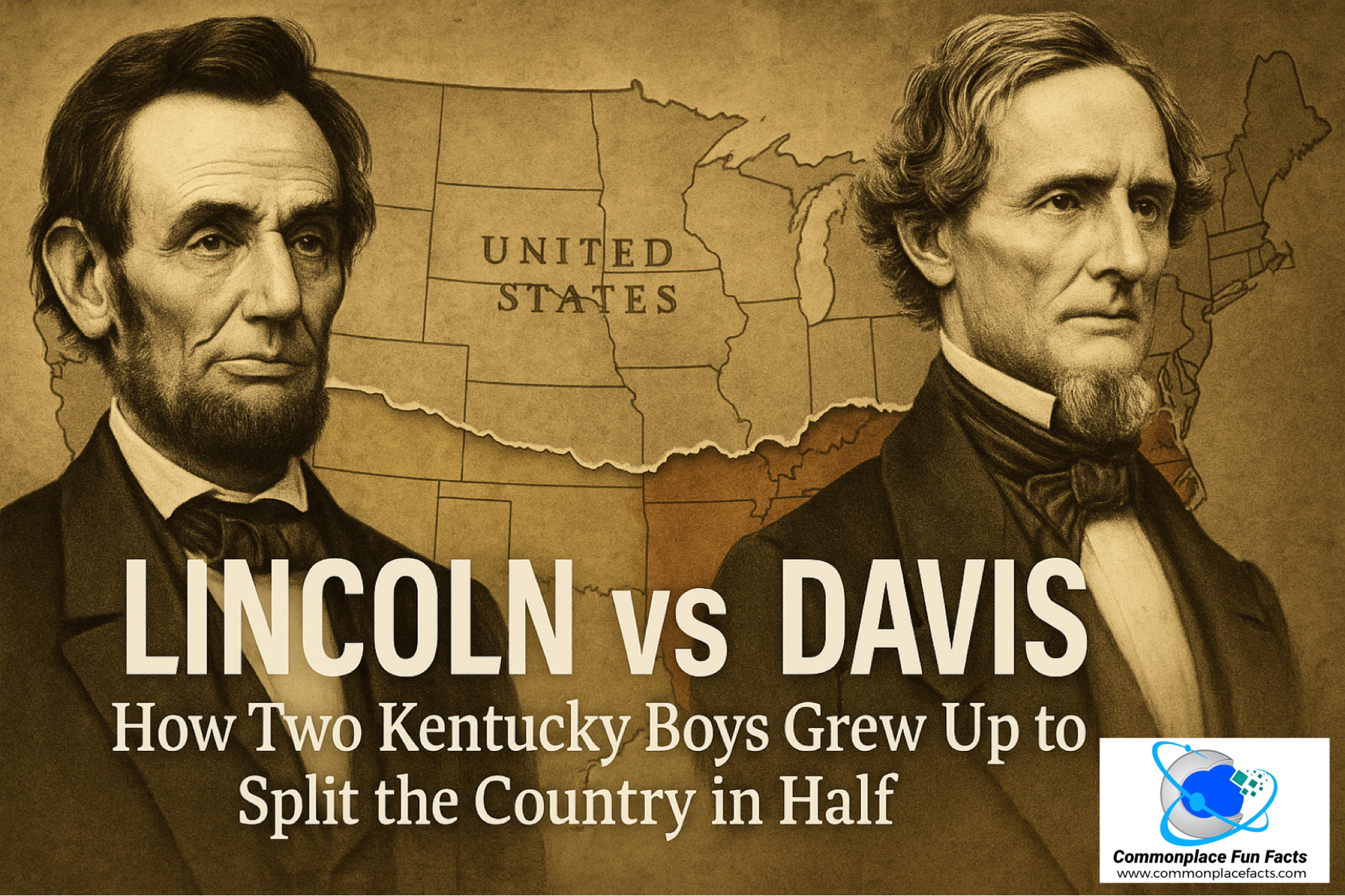

Lincoln vs Davis: Before They Were Legends, They Were Two Boys From Kentucky
History has a bad habit of turning people into symbols. Once that happens, nuance tends to be politely escorted out of the room. A person becomes either a hero to be admired without reservation or a villain to be condemned without curiosity. A life is flattened into a highlight reel—or a rap sheet—and everything else is treated as inconvenient background noise.
This is emotionally satisfying, but it is also intellectually lazy. People do not emerge fully formed from the ether, carrying timeless moral clarity like a personal accessory. They are shaped—sometimes gently, sometimes aggressively—by the assumptions, incentives, fears, and blind spots of the world they grow up in. Culture sets the menu long before anyone gets to choose what they’re ordering.
This matters because we are not exempt from the same process. We like to imagine that we would have seen clearly where others failed, that we would have stood on the right side of history if only we had been there. Future generations may not be so generous. They will judge us with the benefit of hindsight we do not possess, and they will wonder how we managed to miss things that will seem painfully obvious to them. The uncomfortable truth is that we are all, to some degree, prisoners of the moment we inhabit.
Nowhere is this temptation stronger—or the stakes higher—than in the American Civil War. Abraham Lincoln and Jefferson Davis are often presented as fixed opposites: one the embodiment of national virtue, the other the face of national sin. There is some truth in that contrast, but it also conceals something important. Both men were products of their environments long before they became leaders of rival republics.
Before there were heroes and villains, there were two boys from Kentucky, born just months and miles apart. Their origin stories begin almost identically. What follows is a slow drift apart, helped along by geography, economics, and a series of ordinary decisions that did not feel momentous at the time.
To understand how two men born so close together ended up guiding the country toward its greatest fracture, it helps to step back from verdicts and look instead at beginnings. Not to excuse choices or erase responsibility, but to recognize how powerfully time, place, and upbringing shape what people believe is normal, acceptable, or inevitable.
Contents
If a novelist had written what came next as a plot device, an editor would probably have sent it back with a polite note: Dial it back a little. The coincidence strains credibility. History, however, has never been especially concerned with plausibility.

In the early years of the nineteenth century, two boys were born in frontier Kentucky, less than 130 miles apart and just eight months apart. They would grow up to become presidents of rival republics during the greatest crisis the United States would ever face. One was Abraham Lincoln, President of the United States. The other was Jefferson Davis, President of the Confederate States of America. Same birthplace, same generation, very different performance reviews.
At the time, none of this was visible. There were no rival destinies, no looming civil war—just two families trying to make a living in a difficult place. When the boys were still young, both families did what countless Americans before and after them had done: they packed up and left Kentucky in search of better prospects.
This is where the paths quietly begin to diverge. The Lincolns pointed their wagon north, first to Indiana and later to Illinois. The Davises turned south, eventually settling in Mississippi. You already know how this story ends, or at least the version that comes with battle maps, casualty figures, and sepia photographs. The earlier chapter—the moment those wagons rolled away in opposite directions—is easier to miss, even though it may have been one of the most consequential road trips in American history.
Kentucky: Cradle of the Union and the Confederacy
Jefferson Davis was born near Fairview, Kentucky, on June 3, 1808. Abraham Lincoln followed eight months later, on February 12, 1809, near Hodgenville, roughly 120 miles away. Early nineteenth-century Kentucky was sparsely populated and not generally expected to produce future presidents, let alone the leaders of warring nations. That it managed to produce both suggests that history occasionally enjoys showing off.
Both boys were born into families that understood financial uncertainty firsthand. Lincoln’s father was a struggling farmer and carpenter who never quite made peace with Kentucky’s notoriously tangled land titles. Davis’s father was a small-scale planter—ambitious, upward-looking, and not yet part of the plantation elite he clearly hoped to join.
In both cases, Kentucky was a beginning rather than a destination. The land was difficult, the prospects unreliable, and the opportunities limited. The solution, in the time-honored American tradition, was simple enough: load up the wagon and see if opportunity might be having better luck somewhere else.
When the Wagons Turned Different Directions
In 1816, the Lincoln family pointed their wagon north and crossed the Ohio River into Indiana. A few years later, they moved again, into Illinois. The Davises pointed their wagon in the opposite direction, first to Louisiana and then to Mississippi.

This is the great sliding-doors moment that never gets a montage. Two families made local, practical decisions about land, work, and the faint hope of a better harvest, with no idea that half a century later their sons would be staring at each other across a civil war. Had the Lincolns headed south and the Davises north, the cast list of American history might look very different.
Historians have occasionally indulged the temptation to play “What if?” with this scenario. It is not hard to see why. A North led by Jefferson Davis and a South led by Abraham Lincoln sounds like the kind of alternate-history novel that acquires a devoted following and at least one aggressively long Reddit thread.
Similar Beginnings, Very Different Stories
For all their later differences, Lincoln and Davis shared more in common than the usual shorthand suggests.
They Were Both Bookworms (of Very Different Types)

Lincoln had very little formal schooling. He responded by reading everything he could get his hands on: the Bible, Shakespeare, law books, newspapers, and—because he was that kind of person—Euclid’s Elements for fun. His education was improvised, self-directed, and relentlessly practical. He wanted to understand how things worked: law, language, geometry, politics, people.
Davis took the more conventional route. He attended good schools and eventually graduated from West Point. His reading leaned toward history, politics, and military theory. If young Lincoln built his mental library out of borrowed books and candlelight, young Davis had one handed to him, leather bindings included.
Both Men Knew Pain Up Close
Neither man had an easy life. Lincoln struggled with episodes of what we would now likely recognize as depression and suicidal thoughts. Davis spent much of his life battling illness, including malaria and severe neuralgia, and endured profound personal losses early on, including the death of his first wife just three months into their marriage. Over time, these experiences hardened into a reputation for stubbornness and thin skin. He was not, by temperament, a man who welcomed collaborative feedback.
Their experiences shaped them. Lincoln’s melancholy fed a deep sense of empathy and patience. Davis’s pain and loss contributed to rigidity and defensiveness. Two boys from Kentucky, two very different ways of turning suffering into personality.
Two Presidents, Two Management Styles
When the war finally arrived, those differences hardened into a study in contrasting leadership.
Lincoln: The Reluctant Wartime Therapist-in-Chief
Lincoln did not set out to be a war president. His goal in 1860 was to stop the spread of slavery and somehow keep the Union from flying apart. When the Union promptly began flying apart anyway, he spent four years herding politicians, generals, public opinion, and foreign governments while trying to keep a fragile coalition intact.
His approach was deceptively simple. He listened. He told stories. He tolerated criticism to an extent that astonished even his allies. He appointed rivals and then patiently nudged, cajoled, and occasionally outmaneuvered them. It was not elegant. It was effective.
Davis: The Micromanager-in-Chief

Davis entered office with clear ideas and firm convictions. He believed the Confederacy was constitutionally and morally justified, understood military affairs, and intended to run a disciplined operation. He also tended to micromanage, cling to underperforming generals out of personal loyalty, and hold grudges with professional dedication.
Where Lincoln delegated and improvised, Davis centralized and controlled. That approach can work in a small organization. It works less well when your strategic challenges include fighting a larger enemy with fewer factories and less food.
What If They Had Changed Places?
This brings us back to those wagons creaking out of Kentucky.
Could Lincoln, raised in a slaveholding Mississippi or Louisiana, have become a defender of slavery? His worldview was shaped by frontier poverty, wage labor, and the belief that a man should not be permanently locked into the station he was born into. Place him instead in a society where wealth and status flowed from owning other human beings, and even his moral arithmetic might have looked different. The talent would still be there. Only the cause would change.
Could Davis, raised in a Northern free state, have become a fierce Union nationalist? His temperament already leaned toward order, authority, and discipline. Set those instincts loose in a culture that prized wage labor and constitutional unity, and he might well have emerged as a hardline defender of the Union. In that timeline, Northern crowds might have cheered “President Davis” as he crushed a rebellion led by some tall, melancholy lawyer from Mississippi.
Would either version have changed the outcome? Perhaps. Perhaps not. These questions are unanswerable, which is precisely why they remain so entertaining to argue about.
Almost Sharing a Bench in Washington
Lincoln and Davis never debated, never shared a ticket, and never posed together for a photograph. They did, however, overlap in Washington long before the war made them enemies.
Lincoln served a single term in the House of Representatives from 1847 to 1849. Davis arrived in the U.S. Senate in 1847. Both men spent those years wandering the same Capitol corridors, attending the same sessions, and watching the same arguments over slavery, tariffs, and expansion. Somewhere in the congressional record of the late 1840s, you can find their names in adjacent columns, like two actors sharing a stage before anyone realizes they are destined for a much bigger play.
There is no surviving evidence they ever spoke. No diary entry reads, “Met obscure Illinois lawyer today; seems tall, talks a lot.” The two Kentucky boys simply passed each other in the halls of power, each on a path neither fully understood yet.
Meanwhile, Kentucky Stayed in the Middle
Kentucky, having produced both presidents, tried heroically to avoid choosing between them. The state declared neutrality at the start of the Civil War, which went about as well as neutrality usually does when two angry neighbors are fighting on your lawn.
Kentucky sent soldiers to both the Union and Confederate armies. It produced Unionists like Senator (and later Secretary of State) John J. Crittenden, who tried to broker a last-ditch compromise to avert war, and men like John C. Breckinridge, former vice president of the United States, who eventually became a Confederate general and Jefferson Davis’s last secretary of war. The state’s loyalties were as split as its presidential alumni list.
The irony is hard to miss. The birthplace of both wartime presidents could not fully commit to either side. Kentucky was the geographical embodiment of the national argument: divided, conflicted, and painfully aware that whoever won, someone would feel betrayed.
The Quiet Power of Small Decisions
It is tempting to let history do the thinking for us. From a distance, Lincoln and Davis can seem inevitable, as though they were always destined to stand where they did.

Up close, inevitability disappears. Before speeches and armies, there were families making ordinary decisions under ordinary pressures. Two wagons leaving Kentucky. Two ways of understanding work, status, and authority. Those choices did not cause the Civil War, but they helped determine who would be in position to lead when it arrived.
Context does not excuse decisions, but it explains how intelligent people can arrive at radically different conclusions while believing they are acting responsibly.
The dividing lines of history are rarely drawn by monsters and saints, but by people shaped by their time. If there is a lesson in the parallel lives of Lincoln and Davis, it is not that judgment should be abandoned, but that it should be accompanied by humility.
The crossroads they passed through still exist. We are standing at some of them now.
Learn more by visiting the Abraham Lincoln Presidential Library and Museum and the Jefferson Davis Presidential Library.
You may also enjoy…

The Love Story That Linked Jefferson Davis and Zachary Taylor
Discover the surprising love story that linked Jefferson Davis to his future father-in-law, President Zachary Taylor. From a forbidden romance and a heartbreaking loss to two presidents shaped by the same tragedy, this true tale reveals the human drama behind American history.

Abraham Lincoln’s Battle with Depression: Overcoming Suicidal Thoughts and Tragedy
Discover Abraham Lincoln’s struggle with depression and suicidal thoughts, how he faced personal tragedies, and his journey to becoming the “Great Emancipator.”

The Donner Party Invitation: How the Lincolns Missed Out on One of History’s Most Notorious Parties
The Donner Party has gone down as one of the most tragic and infamous events in American History. Learn how Abraham and Mary Lincoln almost became a part of that piece of horrible history.


Leave a Reply