
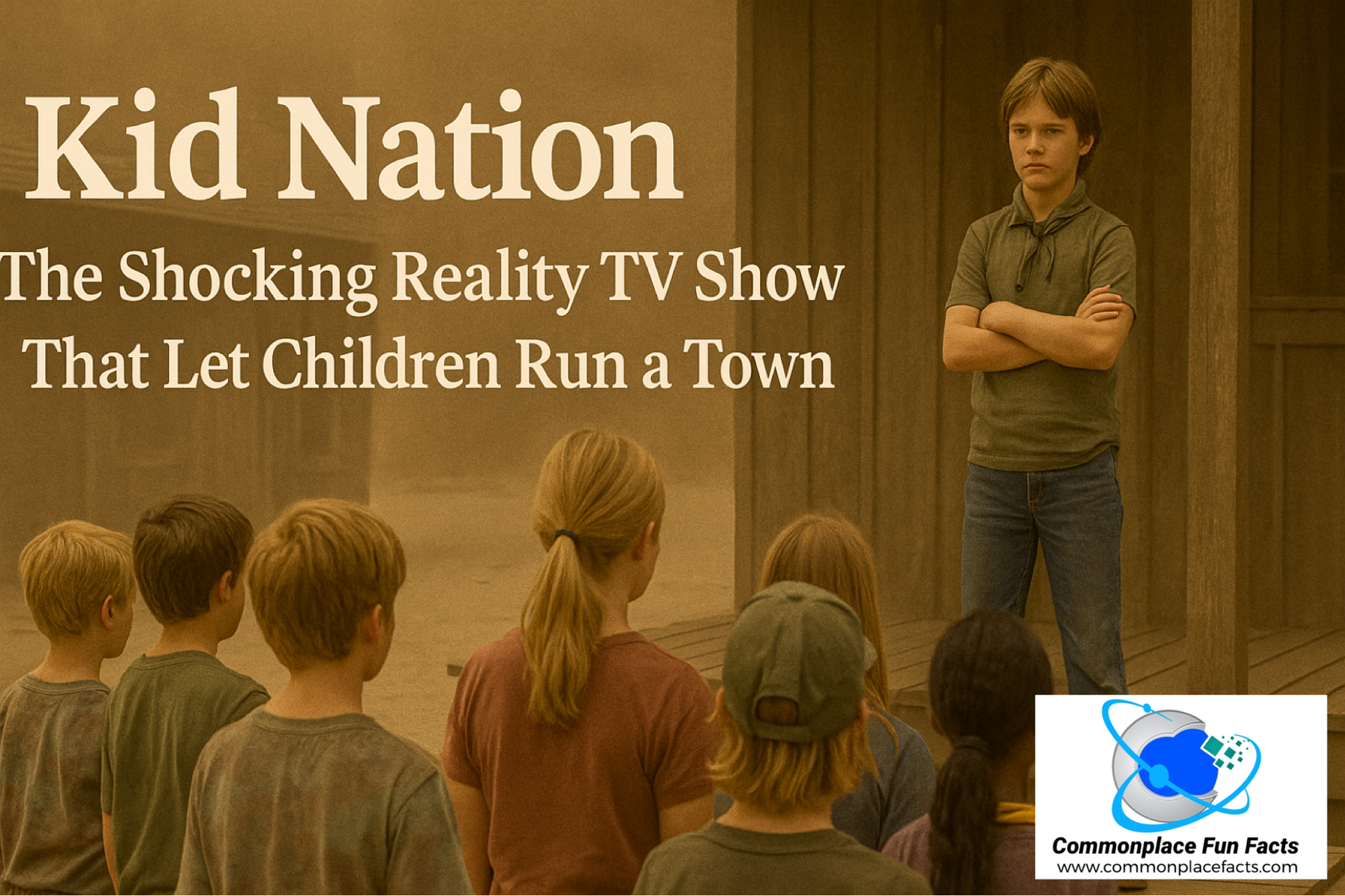

Some television shows age like fine wine. Others age like milk left in a hot car. And then there’s Kid Nation, which ages like a novelty cheese you discover in the back of the fridge and immediately regret learning exists.
If you somehow missed it in 2007 (or were busy doing something healthy, like reading books or touching grass), Kid Nation was a CBS reality show that dropped forty kids—ages 8 to 15—into a dusty New Mexico “town” and told them to build a functioning society for 40 days with “minimal adult help.” The host introduced the concept with the serene confidence of a man who has never had to supervise a single elementary school birthday party.
Yes, the Lord of the Flies comparisons write themselves. The difference is that William Golding did not also have to schedule confessionals, maintain a lighting rig, and explain to network executives why the conch shell needed a sponsor.
Contents
The Pitch Meeting That Should Have Ended in a Long Silence
Kid Nation was a reality TV show built around placing real people in deliberately challenging situations. Unlike Space Cadets, television’s most expensive hoax, which merely tricked a group of adults into believing they were astronauts, Kid Nation raised the stakes by recruiting children as guinea pigs contestants. This was not an experiment conducted on consenting grown-ups with fully formed judgment. It was the same idea, applied to minors.
The premise is almost aggressively simple: take kids from across the country, put them in a frontier-style set called Bonanza City near Santa Fe, and see if they can form a government, create an economy, manage food and sanitation, and avoid collapsing into chaos. That’s a lot to ask of children, but to be fair, it would be difficult to do worse than the way adults manage some of our municipalities.
But CBS went a step further. The show offered prize incentives—“Gold Stars”—worth $20,000 and sometimes $50,000, awarded by a kid-run Town Council. Meanwhile, every child reportedly received a participation payment as well, because even in the desert, the concept of “compensation” stubbornly insists on existing.
From the network’s perspective, this was entertainment. From the perspective of anyone who has ever watched a group of children attempt to agree on a pizza topping, this was a controlled demolition.
Basic show details are easy to confirm: it aired on CBS, premiered on 9/19/2007, ran 13 episodes, and was canceled after one season. The host was Jonathan Karsh. The setting was Bonanza City, New Mexico. The concept was “kids run society.” The audience response was “we are not sure how to feel about ourselves right now.”
Bonanza City: A Ghost Town With a Camera Crew Problem
The show takes place in a reconstructed frontier town, which means the kids are living in a place designed to look like the 1800s. You know, that era famed for its advanced medical care, reliable sanitation, and strong commitment to child welfare.
On screen, the premise is that adults are not helping. Off screen, adults are absolutely helping—because this is television and not an actual abandonment situation. A major theme of Kid Nation is the illusion of a hands-off experiment, maintained by the simple trick of having adults nearby but not in frame.
This is where the Lord of the Flies comparison becomes unavoidable: the kids are isolated from parents, they have to govern themselves, social hierarchies form quickly, and the show invites you to watch morality get negotiated in real time. The twist is that the island also has a production schedule.
The Government: Democracy With Training Wheels (And Occasionally No Wheels)
Kid Nation runs on a repeating structure: the kids work, they argue, they form alliances, they hold meetings, they face challenges, and they get rewards. The central institution is the Town Council, elected by the kids. In practice, this means leadership is determined the way leadership is often determined in real life: by charisma, confidence, and whether you can talk louder than the other person while sounding like you have a plan (See “The Dunning-Kruger Effect: Why People Who Know the Least Yell the Loudest“).
This is also where the show quietly demonstrates something political scientists have been muttering for decades: the main obstacle to utopia is not a lack of ideas. It’s people. People have preferences. People have rivalries. People get tired. People get petty. People form factions. And children, despite their smaller shoe sizes, are very much people.
At various points, the kids grapple with fairness, rule enforcement, labor division, and who gets what. In other words, they reinvent the human condition, but with more crying and fewer municipal bonds.
The Economy: Capitalism Arrives on a Pony
The show introduces a currency system and job assignments. Kids run the saloon, cook meals, clean, and perform basic tasks required for a settlement to function. If you are thinking, “That sounds like work,” congratulations: you have discovered the same thought that popped up in 2007 among unions, labor advocates, and anyone with even a passing familiarity with child entertainment labor laws.
CBS and the production team argued the set was basically a “summer camp,” which is the kind of sentence that makes you wonder whether the definition of summer camp has expanded to include “filming a nationally broadcast reality series with prize money and structured labor.” Contemporary coverage framed it as a child labor controversy almost immediately. ABC News covered the backlash and ethics questions before the show even aired.
Meanwhile, the kids were competing for Gold Stars—big cash prizes awarded by the Town Council. This is a fascinating incentive structure, because it takes childhood and adds one ingredient that makes everything more intense: money. Nothing helps a community thrive like giving its leaders the power to award $20,000 on camera to someone they like, while everyone else stands nearby trying to look supportive and not like they’re planning a coup.
The Waiver: Or, “Please Initial Here to Acknowledge Reality Has No Safety Net”
If you enjoy reading complicated legal documents, you’re in the right place (and you probably spent a very lonely childhood like we did). In many ways, the most revealing social experiment connected to Kid Nation didn’t happen in Bonanza City at all. It happened at kitchen tables across America, where parents sat down, picked up a pen, and agreed—legally, formally, and with surprising enthusiasm—to an astonishing list of risks.
The participant agreement (read it here) is not subtle. It opens by reminding parents, in capital letters, not to sign unless they have read, understood, and agreed to it “in its entirety.” This is never a comforting instruction. It is the contractual equivalent of a doctor saying, “Before I explain your test results, please stay calm and remember that medical science is always evolving.”
In the agreement, the Kid Nation experience appears under the code name “The Manhattan Project.” If invoking the name of history’s most famous government experiment with catastrophic consequences didn’t give anyone pause, it seems unlikely that the rest of the document would. This detail alone does a remarkable amount of work explaining why the rest of the contract proceeds as it does.
What follows is a document drafted with the thoroughness of a lawyer who has imagined every possible way things could go wrong and decided to include all of them. The agreement reads less like a permission slip and more like a declaration of radical optimism about childhood judgment. Parents consented to their children being placed for weeks in a remote location, largely separated from family, tasked with work, governance, and day-to-day survival decisions—all while being filmed for prime-time television.
Parents also waived their right to sue if things went badly. Very badly. The agreement explicitly covered serious injury, illness, disease, and even death during production. This was not buried in fine print. It was central to the deal. The intent was clear: whatever happened in Bonanza City would remain a storytelling problem, not a legal one.
The list of accepted risks only grows from there. Parents agreed to the possibility of pregnancy or sexually transmitted infections occurring while their minor child was under the show’s control. They consented to physical labor, limited access to medical care, and the reality that safety decisions would often be made by children supervising other children. They authorized the producers to make medical decisions on their child’s behalf, including surgery, without firm guarantees about the qualifications of the professionals involved. They also granted perpetual rights to record, edit, and reuse their child’s image and words indefinitely, across all media, long after childhood had passed.
More strikingly, parents also agreed that no one was required to step in if their child engaged in activities that could lead to any of the above-described hazards. The producers were not obligated to intervene, alter conditions, or stop production simply because a situation looked unsafe, unwise, or predictably bad. The assumption was that children, collectively, would manage themselves.
Read generously, the waiver reflects an extraordinary level of trust—both in the producers and in the children themselves. Read less generously, it reflects a belief that kids, placed under stress, isolation, exhaustion, peer pressure, and constant surveillance, will reliably make wise decisions about their health, safety, and boundaries. History, childhood, and basic life experience all suggest this is a hopelessly optimistic theory.
Of course, even though the waiver could not have been clearer that serious harm was possible, that parents understood those risks, and that they agreed not to sue if their children were injured, this did not prevent legal action when one of the children suffered burns to her face. The girl’s mother was shocked—shocked—to discover that her child had been exposed to dangerous conditions during the experience.
In other words, before Kid Nation ever tested whether children could govern a society, it quietly tested whether adults would abdicate responsibility for them. The answer, delivered in ink and initials, was an emphatic yes. This may be the most unsettling detail of all. This wasn’t chaos slipping through the cracks. This was chaos, notarized.
The Safety Issue: When “Frontier Living” Meets Modern Cleaning Products
When a show markets itself as “kids running a town,” the audience expects some hardship: chores, conflict, maybe a little dust. What the audience does not expect is an accidental encounter with household chemicals, because that’s less “Old West” and more “this is why we have a babysitter when Mom and Dad want a night away from the kids.”
One of the most notorious incidents connected to Kid Nation is that a contestant accidentally drank bleach. That’s the thing about trying to recreate a frontier town: you end up with frontier conditions plus modern hazards. In 1870, nobody was labeling a sports drink bottle full of bleach as “lemon-lime.” The Old West was brutal, but at least it didn’t have misleadingly refreshing cleaning solutions.
Lord of the Flies, Sponsored by Network Television
Here is the part where we need to talk about Lord of the Flies more directly, because the comparisons are both fair and funny in the bleak way that makes you stare into the middle distance for a moment.

Golding’s novel is about how quickly civilized behavior can degrade under pressure, especially when social rules evaporate. Kid Nation is about how quickly civilized behavior can degrade under pressure, especially when social rules evaporate—except the pressure is introduced by producers, the rules are replaced by “the Town Council said so,” and the degradation happens in front of multiple camera angles.
The show is a reminder that “society” is not just laws and buildings and slogans. Society also consists of who feels listened to, who feels ignored, who gets power, who gets resentment, who gets the best sleeping space, who gets blamed when something goes wrong, and who learns that leadership is mostly hearing complaints while pretending you’re not tired.
If you ever needed proof that politics is not an adult invention, Kid Nation provides it. The kids form identities and alliances with astonishing speed. Some people become leaders. Some people become critics. Some people become the person in town meetings who says, “I’m just asking questions,” which is a phrase that has caused damage in every era of history.
So Was It Exploitation or a Weirdly Honest Mirror?
One reason Kid Nation still gets discussed is that it sits squarely on the fault line between “social experiment” and “content,” vibrating uncomfortably in both directions. Like the infamous Little Albert experiments—which taught generations of psychology students that maybe traumatizing a child in the name of science isn’t ideal—Kid Nation forces a similar question, only with better lighting and commercial breaks. Is it acceptable to stress, isolate, and emotionally test children if the goal is not knowledge, but entertainment?
The show insists it is examining children’s ability to govern themselves. It is also, unmistakably, a reality competition carefully designed to generate conflict, hierarchy, resentment, and tidy narrative arcs that fit into an hour-long time slot. These two goals are not mutually exclusive, but they are rarely aligned.
It’s tempting to say the kids were “left alone,” because that’s how the show wanted it to feel. It’s equally tempting to say adults were firmly in control, because there were lawyers, producers, and camera crews everywhere. Neither version is quite true. The reality lives in the uncomfortable middle ground where reality television thrives: adults design the environment, choose the incentives, and decide which moments you get to see. Then they step back and describe themselves as observers.
That tension is why Kid Nation remains both fascinating and unsettling. It’s also why people tend to talk about watching it the way they talk about doing something mildly illegal: quietly, defensively, and with the admission that they probably shouldn’t have enjoyed it as much as they did. “I watched it,” they’ll say, lowering their voice. “And I… kind of couldn’t stop.”
The unease wasn’t limited to viewers. Legal scholars later used Kid Nation as a case study in how reality television often fails to protect children, particularly when entertainment incentives collide with labor and safety laws. One law review article from USC even connects the show to changes in New Mexico’s child labor regulations, suggesting that while Kid Nation didn’t exactly reform television, it did at least make lawmakers wince.
The Reception: One Season, Infinite Secondhand Anxiety
Kid Nation premiered on September 19, 2007, and ended on December 12, 2007, with CBS canceling it in 2008 after a single season. It became infamous, then faded, then returned later as a cult curiosity—one of those shows people rediscover and react to like they’ve unearthed a cursed artifact in a museum basement.
In more recent years, it’s resurfaced in retrospectives about the 2000s reality boom, a period when television executives seemed to believe the only ethical boundary was whether the FCC would physically tackle them. Entertainment Weekly has even placed it in lists of reality shows we “can’t believe existed,” which is a polite way of saying, “We were all complicit in this.”
What Kid Nation Accidentally Proved
Here is the strangest part: Kid Nation does contain something like a real lesson, even though it arrived by way of a CBS programming decision.
It demonstrates that governance is hard not because people don’t have good ideas, but because people have competing needs, uneven maturity, limited patience, and wildly different definitions of “fair.” It shows how quickly groups form norms and punish deviance. It shows that incentives matter. It shows that leadership is mostly being blamed for things you did not personally do.
In other words, it shows how society works. It just does it using children, a ghost town, and prize money, which is not how any of the Founding Fathers imagined civic education would go. (Although, to be fair, they also didn’t imagine Wi-Fi, and that hasn’t stopped us from using it badly.)
Conclusion: The Island Had a Call Sheet
Kid Nation is one of those shows that makes you wonder how an entire production team, an entire network, and an entire legal department all looked at the same premise and said, “Yes. This seems reasonable.”
It is easy to mock it, because it is mockable. It is also hard to dismiss it, because it accidentally captures something real: the way community forms, the way it fractures, and the way human beings—small or tall—can be both generous and terrible in the same afternoon.
The Lord of the Flies gave us a fictional warning about what happens when the rules fall away. CBS gave us a reality show that asked the same question and then added a prize budget. The conch shell became a microphone. The island became a set. The moral became a viewing experience.
And somewhere in a network vault, there is probably still footage of a producer staring into the desert sunset, wondering how they ended up explaining bleach safety to a teenager while trying to make “frontier society” entertaining.
You may also enjoy…

Space Cadets: TV’s Most Expensive Hoax
Discover the jaw-dropping story behind ‘Space Cadets,’ the most expensive TV hoax ever, where contestants believed they were trained for space travel. Learn how a reality TV show fooled its participants with Hollywood magic.

The Little Albert Experiment: How a Little Child Was Traumatized In the Name of Science
Who thinks it would be a good idea to traumatize an infant to see if you can condition him to be afraid of fuzzy white things? Welcome to the horrifying and real Little Albert Experiments that changed what we think about the ethics of research.

How One Snow Globe Unraveled TV Reality: The Mind-Bending Tommy Westphall Universe
In the world of entertainment, spin-offs create interconnected universes, such as the Marvel Cinematic Universe. The finale of St. Elsewhere suggests its entire narrative was a figment of a character’s imagination, spawning the Tommy Westphall Universe Theory. This theory connects over 400 shows, proposing they exist within one character’s active imagination.





Leave a Reply to cat9984Cancel reply