

The London Beer Flood: An Ale-Powered Victorian Tragedy
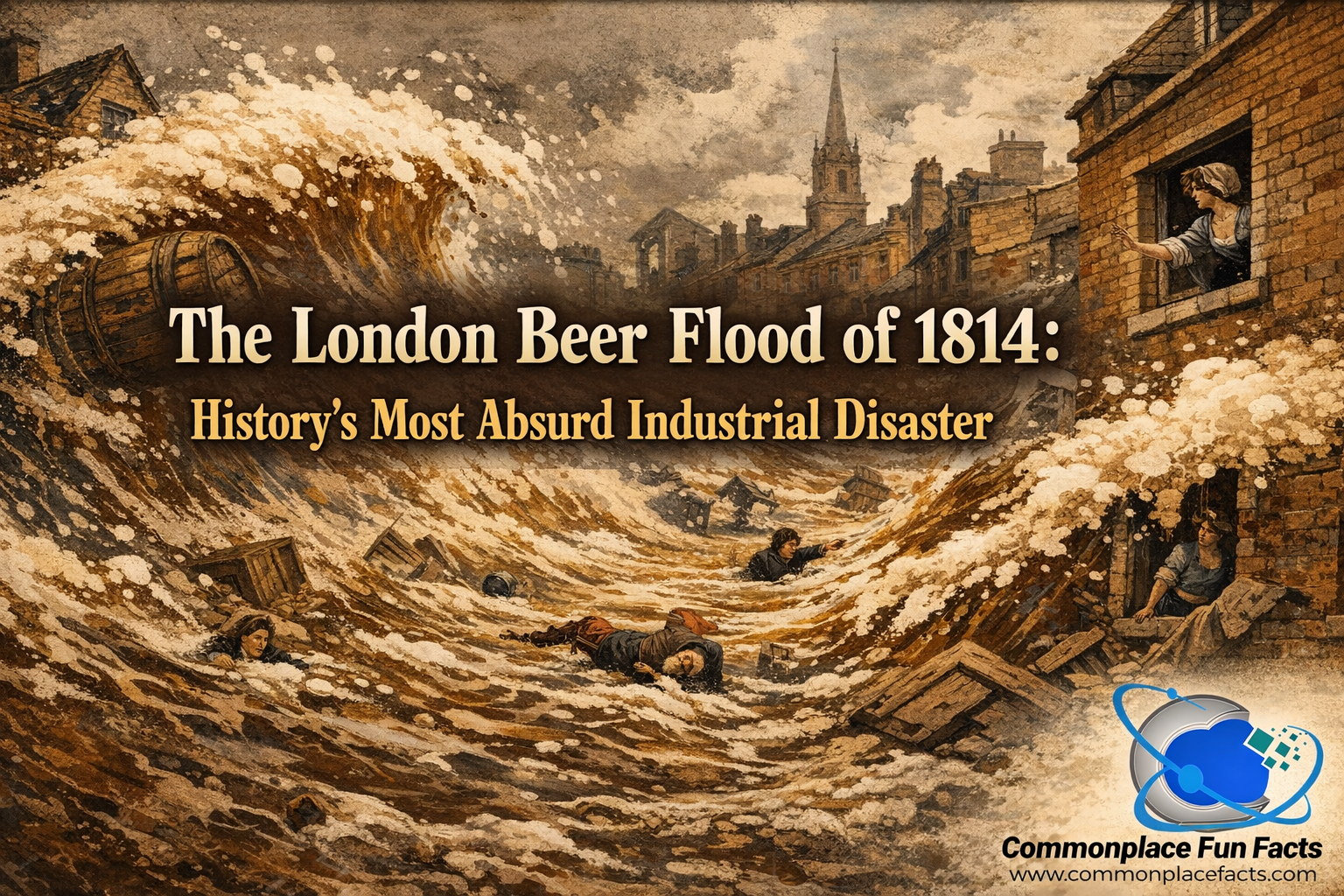
In January of 1814, London experienced something that sounds like a joke, reads like a tall tale, and ends like a Victorian tragedy. A wall of beer—actual beer, brewed for drinking, taxed by the crown, and aged in enormous wooden vats—broke free from its industrial confinement and charged into the streets of the St. Giles neighborhood with all the subtlety of a natural disaster, and about as much inevitability as the man-made kind.
This was not a metaphor. This was not a moral lesson delivered by a pamphleteer. This was not a pub story that got out of hand. This was a literal flood of beer, and it remains one of history’s most unsettling reminders that when humans scale things up, they sometimes forget gravity is still involved.
Contents
The Industrial Age and the “What Could Possibly Go Wrong” School of Engineering
The story begins at the Horse Shoe Brewery on Tottenham Court Road, owned by Meux & Co., one of London’s major producers of porter. Porter was the working-class beer of choice: dark, heavy, filling, and produced in quantities that suggested someone, somewhere, was paid to worry about storage later.
By 1814, “later” had arrived.

At around 4:30 in the afternoon on October 17, George Crick, a storehouse clerk at Meux’s Horse Shoe Brewery, noticed that one of the iron bands encircling a massive porter vat had slipped. This was not a decorative band. It weighed roughly 700 pounds, existed entirely to keep the vat from flying apart, and gave the impression that it had just decided it was no longer interested in that job.
The vat in question was about 22 feet tall and filled to within four inches of the top with 3,555 imperial barrels of ten-month-old porter. That detail matters, because ten-month-old porter is not a gentle substance. It is heavy, pressurized by its own weight and the gases produced during fermentation, and sitting inside a wooden container that really needs to be held together by something more tangible than optimism.
Crick wasn’t particularly concerned. Bands slipped off these vats two or three times a year. This was business as usual. And, as usual, he informed his supervisor, who assured him that “no harm whatever would ensue,” a sentence that history has preserved mainly as a warning to future generations.
Crick was instructed to make a note for Mr. Young, one of the brewery’s partners, so the problem could be addressed later. Which he did. Dutifully. Calmly. Surrounded by several thousand barrels of beer quietly testing the structural limits of nineteenth-century engineering.
Crick never got the chance to deliver his note.
The Vat Fails: An Industrial Detonation
Roughly an hour after the iron hoop slipped, George Crick was standing on a raised platform about thirty feet from the vat, holding the message meant for Mr. Young—the partner who would eventually be told that something might need attention later. The vat gave no warning. No groan. No heroic creak of stressed timber. It simply failed.

The vessel burst.
What followed was not a leak, or a spill, or even what polite society might call a “breach.” It was an industrial detonation. The beer vat explosion unleashed thousands of barrels of porter. Released all at once, it behaved exactly like a liquid under enormous pressure suddenly freed from its obligations. The initial blast was strong enough to knock the stopcock clean out of a neighboring vat, which obligingly joined the chaos and began disgorging its contents as well. Several hogsheads were smashed outright, their beer adding enthusiasm to an already energetic situation.
By conservative estimates, at least 128,000 imperial gallons of porter escaped. Less conservative estimates push the figure past 300,000. Either way, the brewery had successfully created a beer flood large enough to earn its own place in history.
The rear wall of the brewery—25 feet high and two-and-a-half bricks thick—did not hold. It was blown outward with the kind of force usually reserved for earthquakes and bad action movies. Some of the bricks didn’t even fall politely downward. They were launched upward, landing on rooftops along Great Russell Street and giving nearby residents the deeply confusing experience of being shelled by masonry during what had previously been a normal afternoon.
The Wave Hits St. Giles
Then the beer reached the street.

A wave of porter roughly 15 feet high surged into New Street, which was less a street than a narrow corridor lined with small, overcrowded homes. Two of those houses were destroyed outright. Two more were badly damaged. Even this wasn’t enough to slow the advancing tsunami of destruction.
In one of the destroyed houses, a four-year-old girl named Hannah Bamfield was sitting down to tea with her mother and another child. The wave swept the adults into the street. Hannah did not survive. In the second house, an Irish family was holding a wake for a two-year-old boy—already mourning one loss when the beer arrived to add several more. The boy’s mother, Anne Saville, and four mourners were killed when the house collapsed under the force of the flood.
The Beer Flood Victims: The People Caught in Between
Elsewhere, Eleanor Cooper, a fourteen-year-old servant working at the Tavistock Arms, was washing pots in the pub’s yard when the wall of the Horse Shoe Brewery collapsed onto her. Another child, Sarah Bates, was found dead in a nearby house. In total, eight people died. Several of them were children. None of them had done anything more reckless than live near a brewery.
St. Giles was low-lying and poorly drained, which made it an ideal destination for several thousand gallons of escaping porter. Beer poured into cellars—many of them inhabited—and residents took refuge on tables, chairs, and any furniture capable of floating, adapting quickly to the sudden appearance of a rising tide of beer that did not care whether a home was occupied.
Who Survived—and Who Did Not
Inside the Horse Shoe Brewery itself, everyone lived. Three workers had to be rescued from the rubble, and several—including the superintendent—were taken to Middlesex Hospital, but no one inside the building was killed. The disaster, in a final twist of historical irony, proved deadliest to the people who had no involvement in brewing porter whatsoever.
The beer had escaped the building. The damage was done. And London had learned—briefly—that industrial quantities of anything tend to stop being funny the moment gravity gets involved.
St. Giles Rookery: Where the City’s Underside Met Industrial Ambition
To really understand why the London Beer Flood hit so hard—and why its effects were felt most in places no map ever wanted to highlight—you have to look at where it happened: the St. Giles Rookery. This wasn’t a neighborhood in any cushy sense. The word rookery in eighteenth- and nineteenth-century London was slang for what we’d now call a slum. The analogy came from bird rookeries, where nests of every shape and size are jammed together in a tangle of branches. In human terms, it meant overcrowded courts, alleyways, and lodging houses squeezed into a small five-acre patch of ground that grew more chaotic with each passing decade.

St. Giles might have sat near some of London’s more aspirational districts—streets that were becoming the backdrop for genteel commerce and genteel gossip—but it was physically and socially cut from a different cloth. While aristocrats and merchants pursued their fortunes a stone’s throw away, the Rookery was a maze of flimsy housing, open sewers, and cramped basements where whole families lived cheek-by-jowl. There was little incentive for landlords to improve conditions: plots were leased under long terms that encouraged building density over decent construction, and owners rarely felt responsible for anything resembling sanitation or safety.
For generations, St. Giles had absorbed waves of newcomers pushed to the margins of society. Refugees from continental Europe, Irish migrants escaping famine, and Black sailors and servants who had been left without support in London all found themselves resident in the Rookery’s tight quarters. The area was infamous enough that even accomplished painters like William Hogarth and writers like Charles Dickens used it as shorthand for squalor, vice, and desperation in their work.
Contrast that with the neighborhoods just outside: broad streets being reshaped by investment, businesses opening, and middle-class living spreading outward as London’s footprint expanded. A few blocks away from the Rookery, townhouses were being refurbished, markets were humming, and the signs of industrial modernization seemed hopeful if not wholly benign.
In the Rookery, those signs were absent. Narrow lanes muddled without drainage. Chimney smoke and fetid air clung to the buildings. Daily survival required navigating a labyrinth of overcrowding and neglect that the rest of London preferred to pretend didn’t exist. That’s the world into which the torrent of beer poured—into spaces already overflowing with human struggle, in streets where the ground beneath your feet was already metaphorically sinking.
And that sharp contrast—between nearby wealth and local deprivation—helps explain why the disaster’s toll was not distributed evenly. The beer didn’t care about property values, but the very layout of the city ensured that poor cellars filled first, that people with nowhere else to go were trapped below street level, and that the broader metropolis would go on with business as usual even while the Rookery reeled in the aftermath.
The Aftermath: Orderly Crowds and an Official Shrug
For the next several days—October 17 through 19—St. Giles looked less like a neighborhood and more like the aftermath of a small, localized apocalypse.
Later retellings would insist that the London Beer Flood immediately devolved into mass revelry: crowds scooping porter from the streets, widespread drunkenness, and even a death from alcohol poisoning days later. It’s a great story. It just doesn’t appear to be true.
Contemporary newspapers reported nothing of the kind. The press of the time described the crowds as orderly and restrained. This detail matters, because the popular press of early nineteenth-century London was not known for its generosity toward the immigrant Irish population that made up much of St. Giles. If there had been chaos, drunkenness, or public disorder, it would have been reported enthusiastically. The absence of scandal suggests that the disaster was treated, at least publicly, with a degree of sobriety that later generations may have found disappointing.
What the newspapers did report was devastation.
The area behind the brewery was described as a “scene of desolation,” presenting an appearance as awful and terrifying as anything fire or earthquake might produce. Walls were gone. Houses were wrecked. Porter-soaked debris lay everywhere. This, in turn, attracted spectators.
The beer flood victims, meanwhile, were mourned in ways shaped as much by poverty as by grief. The mourners killed in the cellar during the flood were given their own wake at the Ship public house on Bainbridge Street—a wake for people who had died attending a wake, which is the sort of recursion history occasionally indulges in.
Some later retellings claim that relatives couldn’t afford a proper burial for their dearly departed and charged admission to view the bodies. Adding to the tragedy, so many people crowded into the viewing that the floor gave way. However, contemporary newspapers make no mention of this macabre spectacle. What is documented is that watchmen at the brewery charged people to see the destroyed vats, and that families laid out the bodies in nearby yards where the public donated money to help cover funeral costs.
Other bodies were laid out in nearby yards by their families. Members of the public came to view them and donated money toward funeral expenses. Collections were also taken up more broadly to help the surviving families. There was no formal compensation scheme, no insurance payout, and no expectation that the brewery would be held responsible. Charity filled the gap left by law.
The Inquest: Casual, Accidental, and Unfortunate
The official reckoning came quickly.
On October 19, 1814, a coroner’s inquest was held at the Workhouse of the St. Giles parish. George Hodgson, the coroner for Middlesex, presided. The names and ages of the dead were read aloud, a list that made clear just how young many of the beer flood victims were:

Eleanor Cooper, 14
Mary Mulvey, 30
Thomas Murry, 3
Hannah Bamfield, 4 years, 4 months
Sarah Bates, 3 years, 5 months
Ann Saville, 60
Elizabeth Smith, 27
Catherine Butler, 65
Before hearing testimony, Hodgson took the jury to the site itself. They viewed the brewery. They viewed the bodies. Then they returned to hear witnesses.
The first witness was George Crick, the storehouse clerk who had noticed the slipped iron hoop and calmly written a note about it. He testified that iron bands failed on the vats three or four times a year and that this had never caused problems before. His brother, he added, was among those injured during the disaster.
Other testimony came from Richard Hawse, the landlord of the Tavistock Arms—whose young servant had been killed when the brewery wall collapsed—and from several additional witnesses who described the suddenness and violence of the event.
The jury did not deliberate long. Their verdict was that the eight victims had died “casually, accidentally and by misfortune.” The disaster was classified as an Act of God.
This was a convenient arrangement. God could be blamed, and no one else had to be.
From a modern perspective, this feels generous. From a nineteenth-century legal standpoint, it made perfect sense. Industrial accidents happened. The law was not especially interested in punishing progress unless it was being extremely obvious about its malice.
As a result of the ruling, Meux & Co. was allowed to recover the taxes it had already paid on the lost beer. This rebate likely saved the company from bankruptcy, which is a sentence that somehow manages to be both pragmatic and deeply strange.
The Horse Shoe Brewery eventually moved. The vats were phased out. The site would later become the Dominion Theatre, where audiences now enjoy musical performances rather than industrial-scale alcohol catastrophes.
The disaster was classified, in effect, as one of those unfortunate things that happen when large objects fail and poor people happen to be nearby. The law closed the book. The brewery recovered its losses through tax relief. And London carried on.
As it usually does.
Food Disasters: A Genre History Keeps Revisiting
The London Beer Flood is not alone. Humanity has an odd talent for turning food into a public menace when produced in sufficient quantities.
In 1919, Boston experienced the Great Molasses Flood, when a massive storage tank ruptured and sent a wave of sticky syrup through the North End at an estimated 35 miles per hour. Buildings were flattened. Horses drowned. Cleanup took months, and the smell reportedly lingered for years, which is exactly the sort of detail history adds when it wants to be remembered. (Read “The Great Molasses Flood: When Boston Was Nearly Drowned in Syrup” to learn more about this disaster.)
And then there was Wisconsin, which in 1991 managed to set fire to roughly 1.5 million pounds of butter when a cold storage warehouse caught fire. This was not a flood so much as a slow-moving dairy apocalypse. As the building burned, the butter melted, pooled, and escaped into the surrounding area, clogging sewers and turning runoff into something that looked like the world’s least appetizing fondue. It was extinguished eventually, but only after proving—yet again—that when food is produced at industrial scale, it acquires a surprising number of new ways to become a public hazard. (Read “The Great Wisconsin Butter Fire” for more details.)
These stories share a common thread: industrial optimism colliding with physics, followed by humans standing around afterward insisting that no one could have predicted this.
Why We Still Tell This Story
The London Beer Flood persists in public memory because it occupies an uncomfortable space. It is absurd enough to be memorable and tragic enough to resist being treated as a joke. It reminds us that disasters don’t have to involve earthquakes or wars or villains twirling mustaches. Sometimes they involve barrels, paperwork, and the quiet assumption that if it’s important, surely someone will have already taken care of it.
It also reminds us who pays the price when they don’t.
The people who died were not brewery owners or investors. They were residents of one of London’s poorest neighborhoods—women, children, and families already living with very little margin for error. When the Beer Flood came, it did not distinguish between novelty and necessity.
History often focuses on grand decisions and famous names. The Beer Flood lingers because it shows how large systems fail sideways, soaking the wrong people, and then quietly declaring the matter settled.
An Act of God, after all, requires no apology.
You may also enjoy…

The Great Molasses Flood: When Boston Was Nearly Drowned in Syrup
Boston’s Great Molasses Flood of 1919 was a real industrial disaster—millions of gallons of syrup, collapsed buildings, and deadly consequences. Here’s how it happened and why it still matters.

The Wisconsin Butter Fire of 1991: Melted Madness and Dairy Disaster
Discover the shocking story of The Great Wisconsin Butter Fire of 1991, where millions of pounds of butter fueled an epic inferno. Learn how this unusual disaster unfolded, its environmental impact, and the heroic efforts to control a molten butter flood.

Handguns, Hot Sauce, Board Games, Testosterone and Aggression: Discover the Intriguing Link
Explore how handguns and hot sauce impact testosterone and aggression in men. A fascinating study on male behavior.





Leave a Reply to ScottCancel reply