

If you ever dreamed of being a scientist, you probably imagined discovering world-changing breakthroughs in spotless labs, surrounded by lab coats and inspirational string music. At the risk of shattering your childhood dreams (just one more public service we provide), we should probably tell you the truth. A suspicious number of major breakthroughs were born in circumstances that looked less like “research” and more like a household moment that spiraled.
This is a story about two inventions that helped create the modern world: the outboard motor and vulcanized rubber. One begins with melted ice cream on a Wisconsin lake. The other involves a desperate inventor who was equally desperate to avoid getting in trouble with his increasingly exasperated wife.
To be clear, neither of these inventions began as an attempt to change the world. One began with a man trying not to disappoint his girlfriend. The other involved a man trying not to provoke his wife. History, it turns out, is often shaped by people trying to solve domestic problems before they become domestic consequences.
Contents
The Domestic Annoyance Industrial Complex
If you ever want to understand how humans actually innovate, ignore the speeches and look for the irritations. Big ambitions are nice, but nothing motivates like a small, humiliating inconvenience that happens in front of someone you’re trying to impress.
The nineteenth and early twentieth centuries were a golden age for this kind of thing. Inventions weren’t always born in corporate research departments. They were born in sheds, workshops, rented rooms, and kitchens where the landlord had no idea what was going on, but strongly suspected it involved smoke.
Enter Ole Evinrude and Charles Goodyear: two men separated by decades, united by stubbornness, and propelled by the same practical ambition—keeping the women in their lives happy and the household peace intact, even if it required inventing something entirely new.
Ole Evinrude and the Melting Ice Cream Problem
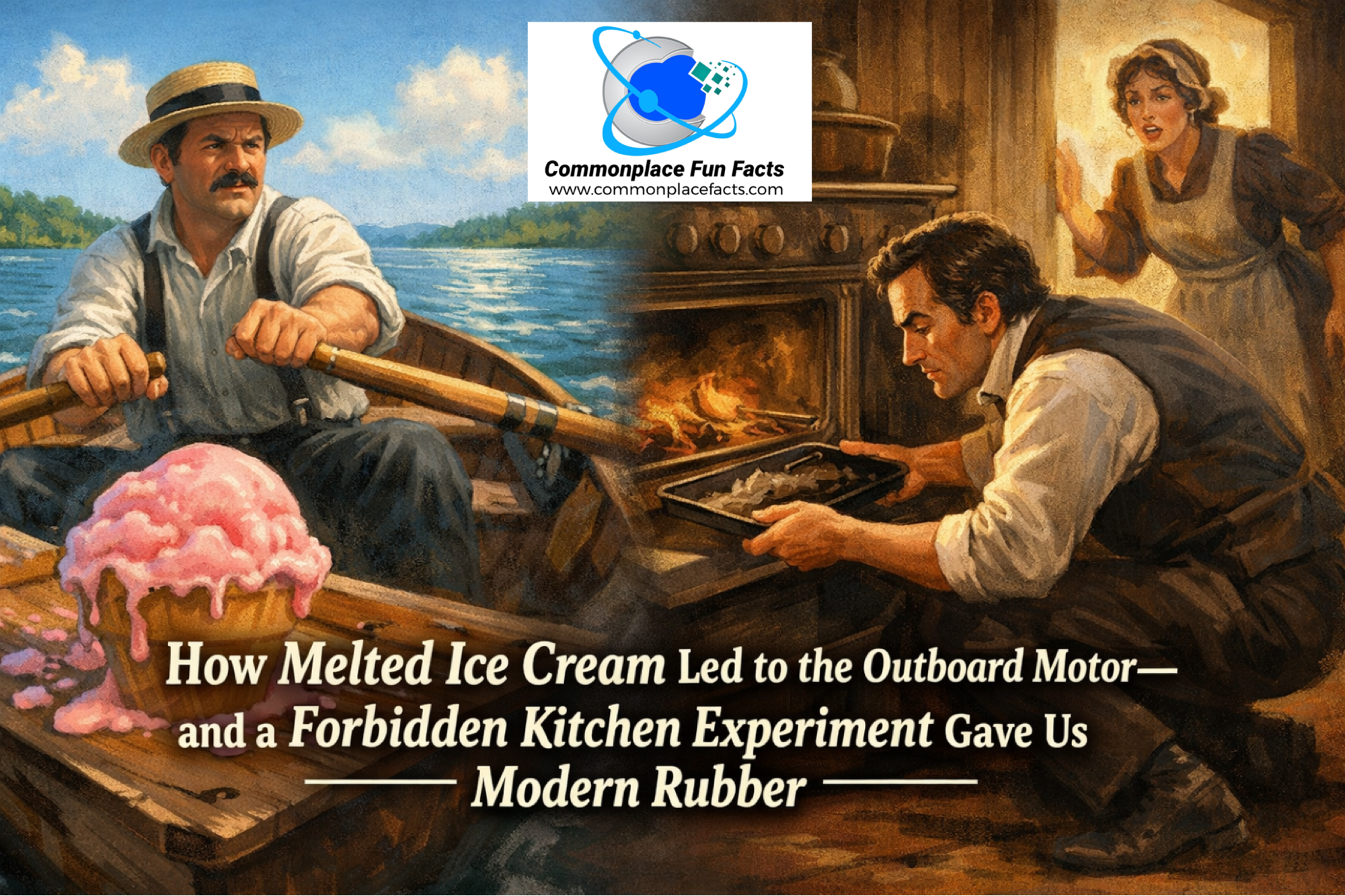
The story goes like this. It’s summer. It’s Wisconsin. There’s a lake, a boat, and a romantic outing. Ole Evinrude is with his future wife, Bess. She expresses a desire for ice cream. Ole does what any devoted man would do: he rows to shore to fetch it.

Then he rows back.
And when he arrives, proud and winded and ready for gratitude, the ice cream has melted. Not slightly softened. Not “still edible if you pretend.” Fully melted into a sticky, sweet liquid apology.
In lesser hands, this would have become an anecdote you tell friends at a barbecue. In Ole’s hands, it becomes a foundational myth for the outboard motor—because Ole looks at this situation and decides that the true villain here is not the sun, or the laws of physics, or the basic reality that rowing takes time.
No. The villain is that the boat does not have an engine.
Whether the ice cream episode happened exactly as told is one of those historical questions that lives in the same category as “Did Newton really get hit by the apple?” The details may be tidied up for storytelling. But the core idea rings true: boating in small craft was slow, labor-intensive, and limited by human muscle and patience. If you could put a lightweight engine on a small boat, you’d transform more than dessert logistics. You’d change how people moved on water.

Evinrude had the right blend of skills for the moment: mechanical talent, an eye for practical design, and the kind of persistence that can only be powered by the need to make the lady in his life happy. He set out to build a compact motor that could be attached to the back of a small boat—something portable, useful, and not absurdly heavy.
By 1909, he had a commercially successful outboard motor. By 1911, he had a patent for it. That word “commercially” is doing a lot of work. People were experimenting with marine engines before Evinrude, but he helped turn the outboard from “interesting contraption” into “thing you can buy and use without turning your boat into a submarine.” It’s hard to overstate how much that mattered.
Suddenly small boats weren’t limited to rowing or sailing. Fishing became easier. Recreation boating expanded. Lakes and rivers became more accessible. And somewhere in all of that, Ole and Bess probably enjoyed properly-frozen ice cream for the rest of their married life.
A Brief Pause to Appreciate How Inventions Actually Happen
This is the part where we zoom out and note something important: innovation often starts with caretaking, convenience, or embarrassment. Not with grand visions of industrial progress.
If this pattern feels familiar, it’s because we’ve seen it before. In one of the most quietly practical inventions in American history, Earle Dickson created the Band-Aid to help his wife—who was, by all accounts, talented and capable and also apparently on a first-name basis with kitchen injuries. If you missed that story, it’s here: “The Accidental Genius Behind Band-Aids: How One Clumsy Wife Helped Heal the World”.
The outboard motor story lives in that same neighborhood. Not “I shall revolutionize boating.” More like: “I would like my small boat to stop humiliating me in front of my girlfriend, and also I would like dessert.”
Charles Goodyear and the Oven That Was Not a Laboratory
Now we turn to Charles Goodyear, a man whose biography reads like a warning label.

In the early 1800s, rubber had a problem: it couldn’t decide what it wanted to be. Natural rubber was sticky in the heat and brittle in the cold. It warped, cracked, softened, stiffened, and generally behaved like a substance that hated being relied upon. People could see rubber’s potential, but it had the temperament of a cat being asked to wear a sweater.
Goodyear became obsessed with fixing it. And when we say “obsessed,” we mean the kind of obsession that ruins your finances, stresses your family, and causes your spouse to question ever saying, “I do.”
He spent years experimenting—mixing rubber with different chemicals, heating it, freezing it, trying to stabilize it. He went broke. He was imprisoned for debt. He dragged his family through repeated financial catastrophes because he was convinced he could solve rubber’s mood swings.
Clarissa Goodyear, his wife, had the unenviable task of being the adult in a household where the primary pastime was “inventing usable rubber while steadily bankrupting the family.” The experiments were constant, the smells were unpleasant, and the results—until very late in the process—were nonexistent. Accounts describe her as understandably furious at the chaos this obsession brought into the home, and at some point she made it clear that the house was not to be used as a laboratory.
This was not, as it turned out, a permanent solution.

According to Goodyear’s later recollections—a category of source historians tend to read with polite interest and a raised eyebrow—the breakthrough came during one of those moments when domestic order collided with scientific stubbornness. Goodyear was working with a mixture of rubber and sulfur when he heard Clarissa returning home unexpectedly. Faced with the immediate prospect of explaining why he was using the kitchen for experimentation that he was not supposed to be doing in the first place, he did what any rational husband would do: he shoved the experimental compound into the oven to get it out of sight.
Heat, it turned out, was exactly what the mixture needed.
When Goodyear retrieved it, the rubber hadn’t melted into a sticky ruin or hardened into a brittle disappointment. Instead, it had changed. The surface charred slightly, but the material remained flexible. It no longer turned gooey in the heat or cracked in the cold. For the first time, rubber behaved like something that could actually be trusted.
That accidental—or hurried—encounter with heat produced what Goodyear had been chasing for years. Rubber had finally become stable across temperature changes. It had, in a very real sense, grown up.
The process would later be named vulcanization, after Vulcan, the Roman god of fire and metalworking (and sadly, not in honor of the first officer of the starship Enterprise). The name is fitting, though it seems unlikely Vulcan ever had to explain to his spouse why the oven had been repurposed for industrial chemistry on short notice.
Vulcanization: The Breakthrough That Made Modern Life Less Ridiculous
Vulcanized rubber changed everything. Suddenly rubber could be used reliably in machinery. It could form durable seals and gaskets. It could be turned into belts that didn’t dissolve into sadness. It could handle heat and cold without falling apart. You can draw a straight line from Goodyear’s breakthrough to industrial expansion, consumer goods, and eventually tires—which means you can also draw a straight line from his breakthrough to your entire relationship with modern transportation.
And yet, because history is a deeply unserious place, Goodyear himself never really profited the way you’d expect. He received a patent for his invention in 1844, spent years fighting patent battles and died in 1860 with heavy debts. The company that later carried his name was founded long after he was gone, which is a little like naming a restaurant after someone who starved to death.
Heat, Food, and the Kitchen as a Recurring Character in Invention History
There’s a weird pattern emerging here, aside from the quest for domestic bliss, and it involves heat and food acting as the universe’s preferred method of delivering engineering insights.
Goodyear’s story has an oven. Evinrude’s story has melting ice cream. And if you need another example of “accidental discovery plus something edible,” we’ve already covered the invention of the microwave oven—born when Percy Spencer noticed that a candy bar melted in his pocket near radar equipment. That story is here: “How the Microwave Oven Was Inspired By a Melted Candy Bar.”
Invention history often pretends it’s powered by lofty intellect. But it’s frequently powered by: heat, snacks, frustration, and someone saying, “Huh. That wasn’t supposed to happen.”
The Unseen Supporting Cast: Spouses and the Cost of Genius
Every invention story has a supporting cast, and they rarely get enough attention. Bess Evinrude becomes the catalyst in the ice cream version of the outboard motor story. Clarissa Goodyear becomes the unwilling landlord to a sulfur-based hobby.

It’s tempting to dress these stories up as charming domestic origin myths, tidy little tales of genius at work. The reality is less romantic and more familiar. Innovation is often driven not by pure scientific curiosity, but by the very human desire to keep loved ones happy—or at least to avoid another pointed conversation about why the house smells wrong and the budget is worse.
History celebrates the breakthrough and politely forgets the months, or years, when that breakthrough consisted mainly of a grown adult turning the household into an ongoing experiment and hoping everyone else would eventually forgive the results.
Why Minor Annoyances Create Major Breakthroughs
There’s a reason these stories stick. We want invention to be noble. But it’s often personal. It’s often petty. It’s often a desire to avoid repeating one specific inconvenience for the rest of your life.
Melted ice cream is not a global crisis. Civilization thrived for millennia without figuring out how to stop rubber from turning sticky. Yet both were deeply annoying in a way that demanded a solution. Evinrude didn’t just invent a motor. He improved small-boat mobility. Goodyear didn’t just fix rubber. He helped make industrial life possible on a scale that would have been absurd without stable materials.
And running quietly beneath both stories is the same truth: people are capable of remarkable creativity when they are motivated by affection, frustration, and the urgent desire to fix a problem before it causes disappointment at home. Give someone a modest annoyance, a set of tools, and a strong incentive to keep a loved one happy—or at least not angry—and history has a habit of moving forward in surprisingly productive ways.
Conclusion: The Modern World Was Built in a Very Strange House
Put all of this together and you get a clearer picture of how the modern world actually came to be. Outboard motors made small boats practical and fast. Vulcanized rubber made rubber reliable instead of temperamental. Band-Aids turned kitchen mishaps into minor inconveniences instead of week-long ordeals. Microwave ovens turned dinner into something you could accomplish without a long-term commitment.
None of these inventions began as a grand plan to reshape society. They began by accident—small, irritating problems that threatened to disappoint, frustrate, or provoke someone important. The motivation wasn’t glory or legacy. It was the much more immediate desire to make life run a little more smoothly at home — or at least figure out why candy bars keep melting.
So the next time something small and annoying happens—something melts, something breaks, something refuses to cooperate—take comfort in the thought that you’re standing in a long and respectable tradition. History has often moved forward not because someone set out to change the world, but because someone was trying very hard to fix a problem before it turned into an argument.
You may also enjoy…

The Accidental Genius Behind Band-Aids: How One Clumsy Wife Helped Heal the World
Discover the heartwarming origin of Band-Aids—how a loving husband’s solution for his accident-prone wife became one of the most iconic medical inventions in history.

How the Microwave Oven Was Inspired By a Melted Candy Bar
Discover how a melted candy bar led to the surprising invention of the microwave oven.

SETI Signals From Alien Civilizations or Signs of Starving Scientists?
Learn how SETI scientists thought they found signs of alien life, only to learn the embarassing truth.






Leave a Reply to ScottCancel reply