
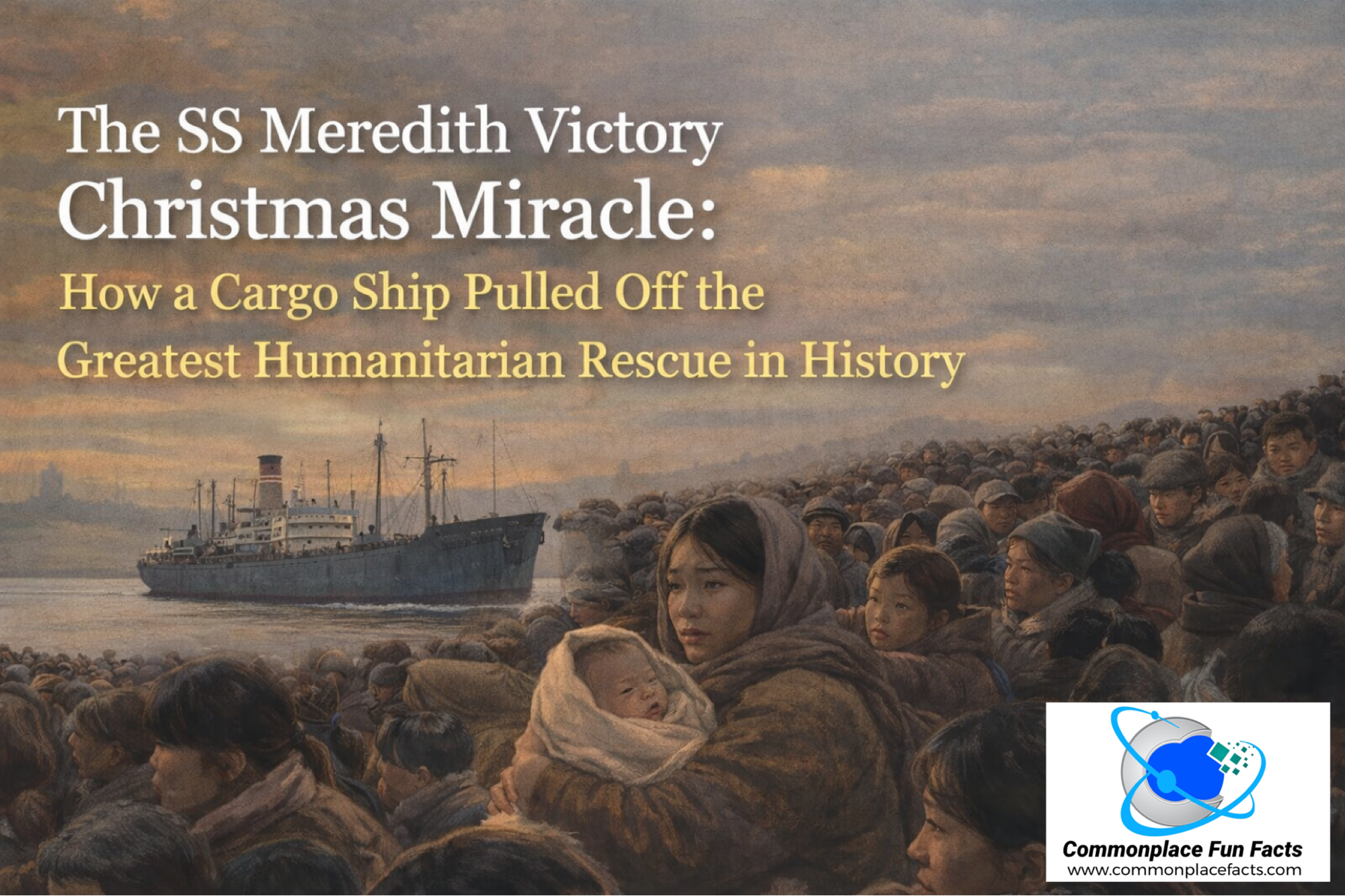

Christmas and miracles are old companions. We tend to picture those miracles arriving with angels, trumpets, and a carefully managed amount of ambient glow. Real miracles, however, rarely bother with presentation. They show up at unexpected moments, in unexpected places, and wearing entirely the wrong costume. Sometimes they arrive not in candlelight, but at a cold dock in the middle of a retreat, with a clock running out and a cargo ship being asked to carry what amounts to a small city.
Which is how we arrive at the SS Meredith Victory Christmas miracle, a story that sounds like someone pitched it in a writers’ room and got told to dial it back because audiences would never buy it. A plain U.S. Merchant Marine cargo ship, built for freight, becomes the unlikely centerpiece of a Korean War Christmas miracle: the greatest humanitarian rescue in history by a single ship, achieved with minimal supplies, freezing weather, and a passenger count that would make any safety inspector immediately walk the plank.
This is not a story about a battlefield triumph. It is a story about refusing to leave people behind. It is also, in the way history sometimes enjoys being obvious, a Christmas story that arrives precisely on Christmas.
Contents
December 1950: Christmas Was Coming, and So Was Everything Else
By December 1950, the Korean War had entered the phase military strategists politely summarize as “an unwelcome reversal of fortune.” (Read “Did Tootsie Rolls Save the Day During the Korean War?” for some details.) The United Nations forces that had advanced north were suddenly retreating under intense pressure, including the entry of Chinese forces into the conflict. Northeastern Korea was bitterly cold, the front lines were unstable, and the port of Hungnam became the focal point of an evacuation that was both military and civilian, orderly and chaotic, planned and improvised, sometimes all within the same hour.
The military part of the Hungnam evacuation gets a fair amount of attention: troops, vehicles, equipment, and the urgent need to get them out before the situation collapsed further. The civilian part is the piece that turns this into a Christmas miracle story. Tens of thousands of civilians were fleeing alongside the retreating forces, terrified of being left behind. These were families, children, elderly parents, and people who had reason to believe that the wrong kind of “liberation” would be waiting if the ships sailed without them.
Hungnam was not a place built to handle that kind of human traffic under that kind of pressure. It was cold, crowded, and desperate. In other words, the setting was perfect for tragedy, and the last place anyone expected a miracle.
Meet the Ship That Was Not Built for Miracles
Allow us to introduce the least festive hero imaginable: the SS Meredith Victory.

She was a Victory-class cargo ship in the U.S. Merchant Marine, designed to do what cargo ships do: move stuff. Supplies, fuel, equipment. The Meredith Victory was not a troop transport. She was not a passenger liner. She was not a floating shelter with bunks and blankets and a soothing onboard playlist called Winter Calm: Maritime Edition.
Her official human capacity was twelve passengers, plus a crew of forty-seven.
That number matters because capacity is the sort of thing reasonable people check before attempting large, complicated tasks. It is why no one asks the coworker with the tiny compact car to handle the office Christmas dinner carpool. Capacity suggests forethought. It implies planning. It comes with forms, signatures, and the comforting belief that someone, somewhere, ran the numbers first. It is also, as it turns out, the kind of number that becomes instantly negotiable the moment reality arrives and begins making demands of its own.
Captain Leonard LaRue and the Decision That Changed the Story
The captain of the Meredith Victory was Leonard LaRue. It’s the sort of name that sounds like it belongs to a swashbuckler in an adventure movie, but there was nothing particularly flamboyant about him. He was a professional mariner, part of the U.S. Merchant Marine Korean War effort, one of those institutions that lives in the background of history doing work politely labeled “support” until it suddenly becomes the only thing standing between people and disaster.
At Hungnam, LaRue faced the kind of decision history loves to drop on ordinary people: the choice between the safe option that follows the rules and the human option that might solve the actual problem in front of you—or go spectacularly wrong if you miscalculated.
There were civilians everywhere, and not enough ships to evacuate them all. The Meredith Victory had vital cargo aboard, including aviation fuel. Cargo ships are not supposed to become refugee ships on short notice. They are certainly not supposed to do it in winter, under threat, through hazardous waters.
LaRue made a snap decision. He ordered much of the cargo unloaded to make room for refugees.
This is the moment when the story becomes a rescue story without ever pausing to give a speech about it. He did not create more time. He did not create more ships. He did not create food, water, blankets, or medical facilities out of thin air. He created one thing: space. And then he used it to hold as many lives as his ship could physically contain.
The Hungnam Evacuation: When the Math Stops Working
The boarding of the Meredith Victory was not elegant. It was not comfortable. It was not a process that would look good in a safety training video.
People poured aboard. Then more. The holds filled. The decks filled. Every inch became standing room. The passenger capacity of twelve did not get revised upward. It got obliterated, as if reality took one look at the number and laughed until it fell over.
By the time the ship departed, roughly 14,000 Korean civilians were aboard.

No, that’s not a typo. Fourteen thousand passengers on a ship designed to carry twelve.
That answers one of the most commonly searched questions about this story: how many people did the Meredith Victory rescue? The answer is astonishing on its own, but it becomes even more absurd when you remember that this was a cargo ship with minimal facilities, limited supplies, and no meaningful way to care for that many people beyond the basics of not sinking.
This was a Korean War civilian rescue on a scale that still makes modern readers squint. It is easy to label it the greatest humanitarian rescue in history and assume we are engaging in holiday hyperbole. It is not hyperbole. It is simply the least dramatic way to describe something utterly dramatic.
A Floating City: The Voyage South
The Meredith Victory sailed south through dangerous waters in winter carrying thousands of civilians with little food, little water, and almost no protection from the elements beyond the fact that a ship is, at minimum, a solid object between passengers and the sea.
This is the point one would obviously expect the story to take a very dark turn. Overcrowding tends to create panic. Shortages tend to produce conflict. Cold, fear, and exhaustion tend to do what they do best. And let’s not forget those heartless killjoys called gravity, buoyancy, and physics.
And yet, the voyage held.
No one died on the crossing.
That fact alone is almost enough to justify describing this as a Christmas miracle. But miracles rarely stop at mere survival, so history supplies one more detail that feels like it was written into the script by an adorable, wide-eyed intern who hadn’t yet been jaundiced by the harsh reality of existence.
Five babies were born during the voyage.
Accounts of the mission note that the crew, not speaking Korean and operating under the “do your best” conditions of a floating emergency, gave the newborns an informal set of nicknames based on one of the few Korean words they knew: kimchi. The babies became known as Kimchi 1 through Kimchi 5. It is simultaneously the most human detail in the story and the most Merchant Marine detail in the story. When you are in the middle of a crisis, you do not always have time for poetic symbolism. Sometimes you have time for one recognizable word and a numbering system.
The result, though, is exactly the kind of detail that makes this story shine even brighter. A cargo ship overloaded with refugees becomes a setting not just for survival, but for new life. Not in a metaphorical sense, but in the very literal sense of brand-new humans arriving into the world under conditions that would normally discourage even the most optimistic stork.
Christmas Eve Arrival, Because History Is Not Subtle
The Meredith Victory reached Busan on Christmas Eve. Because Busan was already overwhelmed, the ship continued on to Geoje Island, where the refugees disembarked on Christmas Day.
History did not have to do this. The dates could have been anything. The ship could have arrived on December 19 or December 28, and the story would still be remarkable. But the mission landed squarely in the calendar space humans reserve for wonder and reflection, which is why it consistently resurfaces as one of the most compelling Christmas wartime stories.
It is a Christmas moment in the most direct sense: thousands of civilians who could have been lost instead stepped onto land alive on Christmas Day. The ship became known as the Ship of Miracles, which sounds like something you would find in a children’s book until you remember the ship was a working cargo vessel and the miracle involved standing shoulder-to-shoulder in freezing weather with minimal supplies while trying not to die.
Why This Was the Most Successful Rescue Mission, and Why It Feels Like a Miracle
We are a skeptical lot here at Commonplace Fun Facts. We generally do not declare miracles lightly. “Miracle” often gets thrown about casually to describe something that is merely impressive. It is a lazy way to describe any outcome that was unlikely or emotionally satisfying.
But sometimes the facts insist.
This was, by any reasonable measure, one of the most amazing rescue stories in history. A Korean War maritime evacuation that loaded nearly 14,000 civilians onto a cargo ship built for less than half of one percent of that number, then delivered them to safety with no fatalities — and five additions — during the voyage. That’s the kind of result that makes probability theory quietly excuse itself from the room.

You will occasionally see claims that as many as a million people alive today can trace their lineage back to the refugees evacuated from Hungnam, including those carried aboard SS Meredith Victory. That figure is impossible to verify with any precision, and no serious historian pretends otherwise. What is verifiable, however, is the broader legacy. Among the refugees were the parents of Moon Jae-in, who would later become president of South Korea, born just a few years later to a family that only existed in the South because of that evacuation. Thousands of civilians were pulled out of immediate danger, went on to build lives, and did what people reliably do when allowed to survive: they formed families. Whether the total number of descendants is hundreds of thousands or something closer to seven figures, the larger point is inescapable. A vast number of people are alive today because a cargo ship was asked to do something unreasonable in December 1950—and, improbably, succeeded.
That is why this remains such a potent Christmas miracle story. It is not a fairy tale. It is a record of what happens when someone chooses compassion over compliance and then follows through under pressure.
What Happened to the SS Meredith Victory?
If you are wondering what happened to the SS Meredith Victory after this mission, the answer is almost disappointingly normal. The ship returned to service and, like most working vessels, eventually left the world without fanfare. She was ultimately scrapped.
That feels wrong, emotionally, because we want physical artifacts of miracles. We want a preserved ship you can tour, preferably with a gift shop that sells tasteful commemorative mugs.
But it also feels appropriate, historically. The Merchant Marine is full of ships that did extraordinary things and then went back to work. They exist to be used. And sometimes they get used in ways no one predicted.
What About Captain LaRue?
Another common question is what happened to Captain Leonard LaRue. The short answer is that he continued as a Merchant Marine captain after making one of the most consequential humanitarian choices of the Korean War.

The longer answer includes the detail that he later left the sea and became a Benedictine monk. People understandably enjoy this epilogue, because it feels like an intentional moral arc: a man who once carried thousands to safety later chose a life of contemplation and service. Whether you read that as poetic or simply as a man responding to the weight of what he had seen, it is a fitting endnote to an already improbable story.
Unsung Heroes: The Merchant Marine and the Civilian Rescue During the Korean War
Stories like this are why “unsung heroes of the Korean War” is not just an internet phrase. The U.S. Merchant Marine’s role was essential, and it rarely gets the spotlight. Merchant mariners were not writing speeches or appearing in victory parades. They were moving people and supplies through dangerous conditions, often with limited protection, doing work that becomes visible only when it goes wrong.
The Meredith Victory story stands out because it went so spectacularly right. It is an episode that highlights something easy to forget in military history: civilian lives and civilian choices are not side notes. They are the story.
Among humanitarian missions, this one remains uniquely powerful because it does not rely on abstraction. It is not “aid delivered” or “resources allocated.” It is human beings physically moved from danger to safety by sea in the middle of winter. It is a Korean War rescue written in steel and saltwater.
FAQ: The Meredith Victory Story in Plain Answers
Because the internet loves clarity and we respect that, here are quick answers to the questions people ask most often when they stumble into this story and immediately suspect it is exaggerated.
How many people did the Meredith Victory rescue?
About 14,000 Korean civilian refugees, during the Hungnam evacuation in December 1950.
How many people were born on the voyage?
Five babies were born during the voyage. The crew reportedly nicknamed them Kimchi 1 through Kimchi 5 because they did not speak Korean and used one of the few Korean words they knew.
What happened to the SS Meredith Victory?
After the war, she returned to service and was eventually scrapped, like many working ships of her era.
Who was Captain Leonard LaRue?
He was the ship’s captain during the Hungnam evacuation mission. He later became a Benedictine monk, a biographical detail that has become part of the mission’s enduring legacy.
Why is it called a Christmas miracle?
The ship delivered thousands of refugees to safety with no deaths during the voyage and arrived on Christmas Eve, with disembarkation on Christmas Day. The timing and the outcome combine into a story that fits naturally into the category of Christmas miracles in history.
A Christmas Miracle That Looks Like Work
There were no Christmas decorations on the Meredith Victory. No warm meals for everyone. No calm, candlelit serenity. There was cold air, crowded decks, fear, exhaustion, and the awkward realization that survival sometimes depends on a cargo ship and its crew doing something wildly outside its job description.
And yet, this remains one of the most moving Christmas stories on record precisely because it does not feel staged. It is not a story about the holiday spirit as a vibe. It is a story about human beings refusing to treat other human beings as expendable.
The legend of the SS Meredith Victory Christmas miracle endures because it is both extraordinary and practical. It is a miracle made of steel, decisions, and sheer stubborn insistence that 14,000 lives were worth the risk, the discomfort, and the paperwork someone would no doubt have been made to file afterward.
History does not promise miracles. Sometimes it just leaves room for them. And every so often, a ship built for cargo sails into December carrying something far more valuable than anything on a manifest.
You may also enjoy…

Did Tootsie Rolls Save the Day During the Korean War?
Did Tootsie Rolls save the day during the Battle of Chosin Resevoir? Find out the truth here.

The Panmunjom Axe Murder Incident (1976): The Tree That Nearly Started a Second Korean War
The Panmunjom Axe Murder Incident of 1976 nearly triggered war between the U.S. and North Korea after a dispute over a tree in the DMZ turned deadly.

Ronald Reagan: The Lifeguard Who Never Stopped Rescuing
Ronald Reagan, who saved 77 lives as a lifeguard, saved a 78th life while serving as Governor of California







Leave a Reply to Commonplace Fun FactsCancel reply