
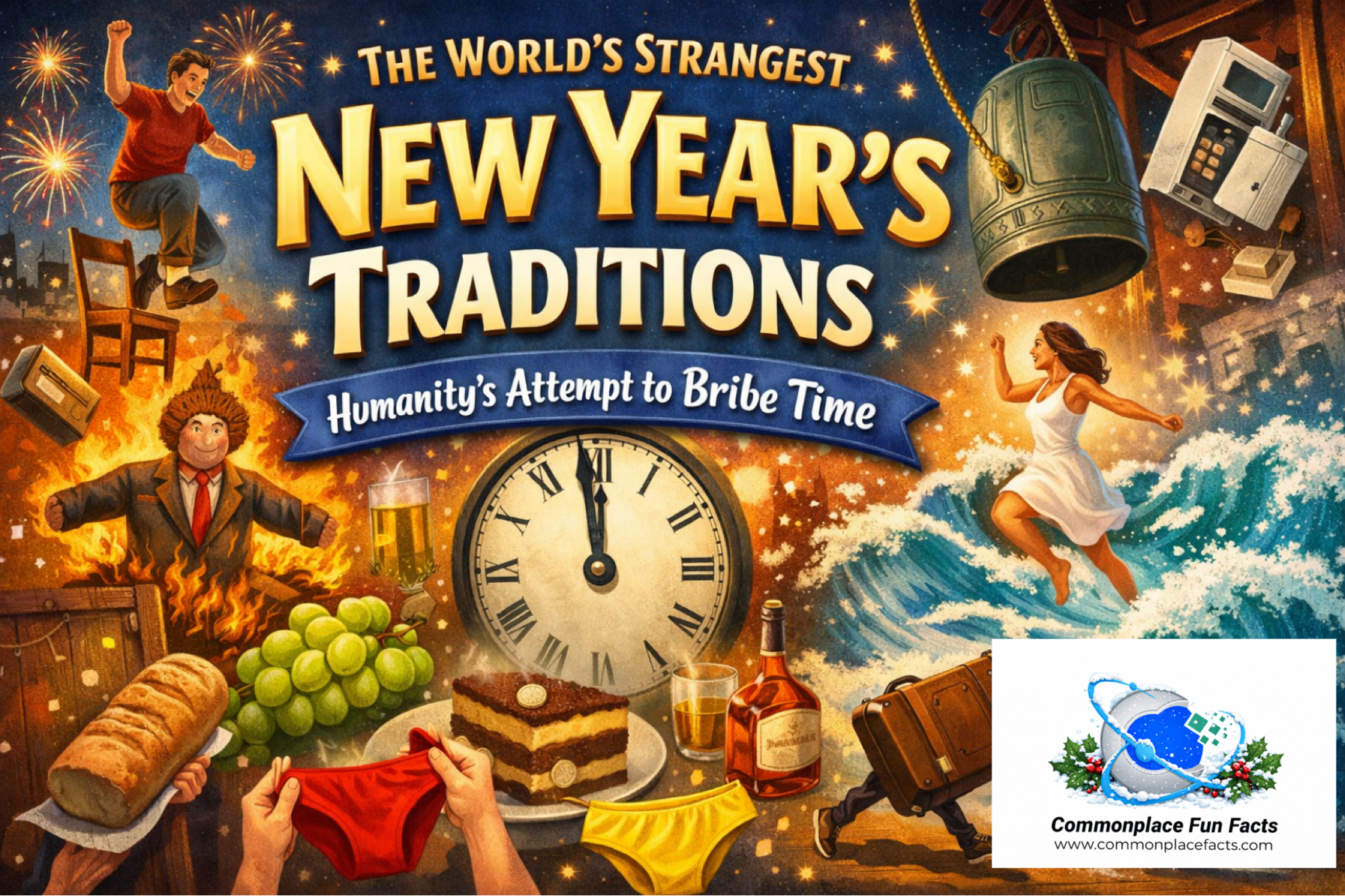

Every culture greets the new year the same way: by briefly acknowledging that time is unstoppable, mysterious, and indifferent—then immediately attempting to negotiate with it anyway.
New Year’s Eve is the one night annually when even the most rational adults abandon dignity and submit to magical thinking. People who will mock astrology for eleven months suddenly believe the future hinges on underwear color, what you eat at midnight, or whether you are standing on furniture when the calendar flips. It’s like the whole species becomes a single panicked customer at a cosmic customer service desk: “Hello, yes, I’d like to exchange last year for a better one. I have my receipt. It’s called ‘regret.’”
Across the world, people have developed rituals that fall into familiar categories. We eat things to influence fate. We make noise to scare off evil. We dress ourselves like we’re trying to impress fortune rather than our co-workers. We perform oddly specific physical tasks in the hope that the universe is watching and taking notes.
And then there are the traditions that seem to escalate beyond symbolism into spectacle—customs that strongly suggest a planning committee where enthusiasm outpaced caution. These are the moments where fire enters the chat, gravity is tested, and women quietly mark the passage of another year by wondering how the men in their lives got through the last one.

New Year’s traditions are basically the human race trying to negotiate with reality using symbolism, snacks, noise, and occasional minor property damage. They differ by country, culture, and climate, but the goals are strangely consistent:
- Get lucky
- Get rich
- Get loved
- Get protected
- Get cleansed, purified, reborn, emotionally exfoliated
- And, in a few cases, get away with throwing furniture out a window
Together, they form a global ritual language built from hope, panic, optimism, superstition, and snacks. This is the story of how humans everywhere attempt to bribe time—one grape, bell, chair jump, and flaming fireball at a time.
Join us on a tour of the world’s more unusual New Year’s traditions—many of which are charming, some of which are deeply confusing, and a handful of which seem to exist solely to kickstart that health insurance deductible that just reset at the stroke of midnight.
Contents
Food Traditions: Because You Can’t Control Fate, But You Flirt With Choking at Midnight
If you’re going to face the unknowable future, you may as well do it with a mouth full of symbolic carbohydrates. Across the globe, people greet the new year by eating things that allegedly influence luck, wealth, longevity, and prosperity. This is how you know the human brain is not built for subtlety. If the future is uncertain, we immediately ask: “What snack could fix this, and can we do anything to make it a choking hazard?”
Spain: The 12 Grapes Challenge (A Timed Swallowing Sport Disguised as Tradition)

In Spain, one of the best-known New Year’s customs is eating 12 grapes at midnight, one for each chime of the clock, representing good luck for each month of the coming year. This is widely presented as quaint and delightful, which is an interesting way to describe what is essentially an annual rite of passage to see if you can start the new year without choking to death.
It’s festive until you realize how clocks work. The chimes do not care about your chewing schedule. The chimes come when they come. Meanwhile, you’re trying to process grape number nine with the focus of a competitive eater and the dignity of a person who definitely did not expect to end the year gagging on produce.
If you succeed, you get luck. If you fail, you get a brief reminder that the universe does not negotiate.
Greece: Vasilopita (Dessert as Destiny, Dental Insurance Recommended)
In Greece, the New Year often begins with Vasilopita, a festive cake or bread baked with a coin hidden somewhere inside. The custom is simple, elegant, and only mildly threatening: the person who finds the coin is said to receive good luck for the coming year.
This is presented as charming, which it is—right up until you remember that it also turns dessert into a trust exercise between fate and your molars.

Every slice is cut ceremonially and distributed with care, because everyone in the room is now engaged in the same thought process: “This could be my year,” immediately followed by, “This could also require emergency dental surgery.”
The tradition walks a delicate line between fortune-telling and hazard introduction. On the one hand, the coin symbolizes prosperity, blessing, and good luck. On the other, it is a solid piece of metal hiding inside something designed to be swallowed. The lucky winner is not guaranteed riches—only the privilege of discovering their fate before their dentist (or proctologist) does.
There is also the small but persistent statistical possibility that the “luckiest” person in the room could choke to death on their good fortune, thereby becoming a cautionary tale remembered every New Year thereafter. In that sense, Vasilopita offers a philosophical lesson rarely addressed by self-help literature: sometimes destiny comes at you at chewing speed.
Still, the tradition endures, because humans are nothing if not optimistic. We believe good luck can be baked. We believe chance can be sliced evenly. And we believe—despite all available evidence—that we are paying attention while chewing.
If nothing else, Vasilopita ensures the new year begins with gratitude, suspense, and a room full of people eating very carefully, which may be the most reliable blessing of all.
Noise Traditions: The Universal Human Belief That Evil Hates Loudness
A surprising number of cultures greet the new year by making noise—bells, fireworks, shouting, banging, crashing, and generally creating the kind of sound that makes dogs question their trust in humanity.
The underlying theory is simple: if you are loud enough, bad spirits will flee. This implies that evil is basically a skittish raccoon.
Ireland: Banging Bread Against the Walls (Where Food and Noise Finally Shake Hands)
Most New Year’s traditions fall neatly into categories. Some involve food. Some involve noise. Ireland, however, looked at those options and said, “Why not both, at the same time, with baked goods?”

In parts of Ireland, there is a long-standing New Year’s custom of banging bread—often a loaf or a piece of bread—against doors and walls to chase away bad luck and malicious spirits. In other words, it’s basically striking your house with baked goods in an effort to improve its moral standing.
As rituals go, it is marvelously economical. You don’t need special equipment. You don’t need a crowd. You just need bread, frustration, and a sturdy doorframe. It also neatly bridges two of humanity’s favorite superstition categories: feeding the future and being loud enough that evil flees.
The underlying theory appears to be that bad luck, like most unwanted guests, can be persuaded to leave if things get noisy and vaguely threatening. The bread provides the tactile component. The wall provides resistance. The message is clear: “We have bread, we have strength, and we are not afraid to use them.”
It is also a deeply relatable practice. After a long year, many people feel an urge to strike something harmless while expressing displeasure at abstract forces. Ireland simply codified that urge and added baked goods.
There is something reassuring about a tradition that requires no explanation beyond “Cleansing the world of evil through weaponized carbohydrates.” In a world of elaborate superstitions, banging bread against a wall stands out as refreshingly direct—part food offering, part percussion instrument, and entirely human.
Japan: The 108 Bell Rings (Spiritual Cleansing, Upper-Body Strength Required)
In Japan, many Buddhist temples ring their bells 108 times on New Year’s Eve in a ritual known as Joya no Kane, meant to cleanse people of the 108 “worldly desires” believed to cause human suffering.
This sounds gentle. Meditative. Possibly involving incense and quiet reflection.
That impression lasts right up until you see the bell.
This is not one of those polite little bells a wealthy baroness might ring to summon a servant for tea. This is not a dainty ding. These temple bells are enormous bronze instruments that appear to have been designed less for music and more for reminding humanity of its insignificance.
At major temples—such as Chion-in in Kyoto—the bell is so massive it cannot be rung by a single person. Instead, it takes a coordinated team of monks hauling a suspended wooden beam back and forth in a synchronized effort that looks suspiciously like a cardiovascular workout designed by a sadistic Marines drill instructor. Chanting, timing, teamwork, gravity, and momentum all have to cooperate just to produce a single strike.
Repeat 107 more times, then reassess your life choices.
Each slow, resonant toll rolls through the night, lingering in the air long enough for you to contemplate your flaws, your regrets, and whether you personally are responsible for at least a few of those 108 desires. By the end of the ritual, the unwanted impulses are symbolically cleansed—and everyone involved has also logged what appears to be a respectable amount of cardio.
Calling it a “bell ringing” almost undersells the experience. It is less a sound and more a physical force, a reminder that self-improvement sometimes involves effort, coordination, and being near a very large object making judgmental noise.
The result is serene, humbling, and loud enough to feel like the universe itself is politely suggesting you try again next year—but maybe with fewer attachments and better posture.
Traditions Best Explained by the Fact That Men Were Probably in Charge
At some point in human history, communities began sitting down to plan their New Year’s celebrations. Someone suggested symbolic food. Someone else suggested quiet reflection. And then—almost inevitably—a group of men said, “What if we added fire, height, or falling objects?”
The following traditions share a certain energy. They involve jumping off furniture, setting large things on fire, swinging flaming objects near crowds, or throwing heavy possessions out of windows. They are exuberant, communal, deeply symbolic—and just dangerous enough that you can practically hear a voice in the background saying, “It’ll be fine.”
These customs likely emerged not because they were necessary, but because someone equated risk with meaning and volume with spiritual authority. While men ring in the new year by leaping, burning, hurling, or otherwise testing the limits of gravity and basic physics, women across cultures appear to be quietly observing their own parallel ritual: remembering why they tend to live longer.
This is not to say these traditions lack value. On the contrary—they are thrilling, memorable, and excellent for community bonding. They also make for wonderful spectatorship, particularly if you are standing at a safe distance, wearing flame-retardant clothing and appropriate protective headgear, and keeping a mental note of who volunteered to plan next year’s celebration.
In short: these are New Year’s customs forged by enthusiasm, confidence, and a generous disregard for personal safety—the holy trinity of history’s most ambitious planning committees.
Scotland: Hogmanay — First-Footing, Fireballs, and Friendships Forged in Flame
Scotland’s New Year celebration, known as Hogmanay, is the sort of holiday that looks at the ordinary idea of “midnight traditions” and says, “Hold my dram.” It’s loud, it’s communal, and it somehow manages to be both welcoming and mildly terrifying.

One of the best-known parts of Hogmanay is first-footing: the first person to cross your threshold after midnight is said to set the tone for the entire year. This immediately introduces a note of anxiety, because ideally this person is not a thief who has decided to begin January 1 by casually rehoming your valuables while you sleep.
In theory, the ideal first-footer is a sturdy, cheerful visitor bearing symbolic gifts—coal for warmth, shortbread for sweetness, and whisky for resilience, stamina, or whatever else the year may require. Dark hair was once considered part of the “good luck” formula as well, a detail which now reads less like folk wisdom and more like the world’s most specific online matchmaking profile.
But if first-footing is about social fortune, Hogmanay has an equally dramatic element that is all about elemental fortune: the famous fireball swinging tradition.
In towns like Stonehaven and other parts of northeast Scotland, locals take long ropes with burning bundles — effectively flaming orbs — and whirl them overhead as part of the New Year’s procession. With sparks trailing behind like fiery comets, the swinging fireballs leap and spin in the winter air while crowds cheer below. It’s beautiful. It’s riotously noisy. It’s also the one New Year’s tradition where you can confidently tell your relatives, “No worries, I’m outside with the flaming sphere.”
The history of the fireball procession is not precisely pinned down — some say it’s linked to ancient purification rituals, others to Viking torchlight processions — but regardless of origin, the visceral thrill of fire twirling against a dark sky gives Hogmanay its unique, slightly combustible flavor.
Denmark: Jumping Off Furniture (Because Symbolism Works Best When It’s Slightly Dangerous)

In Denmark, there’s a tradition of standing on a chair and then jumping off it at midnight. It’s called “jumping into the new year,” and unlike many rituals, it’s refreshingly literal.
You cannot accuse Denmark of being vague. The symbolism is clear. The mechanics are clear. The risk of spraining your ankle is also clear.
It’s like the universe is offering you a choice: “Would you like a fresh start, or would you like to begin the year on crutches?” Also, maybe don’t let Uncle Hans use the wobbly kitchen chair. He and the chair are not nearly as young as they once were.
South Africa (Johannesburg, Hillbrow): Throwing Furniture Out of Windows
In parts of Johannesburg—particularly the neighborhood of Hillbrow—there’s a notorious New Year’s phenomenon where people have, historically, thrown old furniture and appliances out of windows as a way of welcoming the new year.

It is difficult to overstate how aggressively literal this is. It is “decluttering” with impact velocity.
It is also one of the few traditions where the phrase “ring in the new year” could be interpreted as “ring in the emergency services.”
Most of us clean out a closet and feel accomplished. Hillbrow looks at a refrigerator and says, “You had your chance.”
To be clear: this is not a tradition you should casually adopt. It is the kind of ritual that requires a very specific built environment and an extremely patient city government. But as a concept, it’s fascinating—because it reveals the underlying emotional truth of New Year’s: a desire to purge, reset, and physically distance yourself from the mess you lived with last year.
Some cultures do that with a bell. Some do it with grapes. Some do it by launching a microwave into the night.
Ecuador: Burning the Old Year (Año Viejo)

In Ecuador, people often create effigies—called Año Viejo—representing the old year, and then burn them at midnight. These effigies can be symbolic, generic figures… or they can be very specific, sometimes representing public figures, politicians, or whatever else caused people stress.
On paper, this is about purification and renewal. In practice, it is also about the healing power of looking at the last year and saying, “We are done here,” and then setting a papier-mâché embodiment of your frustrations on fire.
It’s therapy, but with more smoke.
One cannot help but admire the efficiency. Many of us carry emotional baggage into a new year like it’s a family heirloom. Ecuador politely reminds us we could also just burn it in the street and move on.
Clothing Traditions: Dressing for the Year You Want Like It’s a Cosmic Job Interview
Some New Year’s customs involve what you wear—because clearly the universe is keeping track of your outfit, and will decide whether to bless you based on how well you coordinated your colors.
This is the part where humans reveal our deepest truth: we are convinced fate is watching us like a judge on a reality show.
Latin America: Underwear Color Coding (The Most Honest Self-Help System on Earth)
In several Latin American countries, there’s a widespread New Year’s belief that wearing certain colors of underwear brings certain outcomes. Most famously:

- Yellow for prosperity and money
- Red for love and romance
This is one of the few traditions that doesn’t pretend to be subtle or intellectual. It is completely transparent about what it is: a ritualized wish list that goes directly on your body.
It also has the advantage of being a private superstition. You can participate without disturbing neighbors, lighting fires, or eating 12 grapes with panic in your eyes. You just quietly dress for success, and the universe either delivers or it doesn’t.
Some people will tell you this is silly. Those people are forgetting that the entire concept of a “fresh start” is also a little silly. We are all doing our best, and sometimes our best involves color-coded undergarments.
Personally, we don’t care what color your underwear is, as long as this isn’t the only day of the year that you change it.
The Philippines: Polka Dots and Round Fruit (Because Coins Are Round, Therefore So Is Luck)
In the Philippines, a common tradition for New Year’s is to wear polka dots and surround yourself with round fruits, because round shapes resemble coins and therefore attract wealth.

It’s one of those pieces of folk logic that makes perfect sense if you don’t think about it too hard, which is where most traditions live.
Some families aim for 12 round fruits, symbolizing the months ahead. This turns your kitchen into a fruit-based vision board. It’s the kind of tradition that makes you look at a bowl of oranges and think, “This is my retirement plan.”
“Action Traditions”: Doing Something Weird So the Universe Gets the Message
Then there are traditions that involve physical actions—walking, jumping, running, throwing, cleansing—because humans love rituals that feel like you’re doing something proactive instead of just waiting for time to happen.
Nothing says “I’m in control” like sprinting down a street with a suitcase at midnight.
Colombia: Running With an Empty Suitcase (Manifestation, But Make It Cardio)

In Colombia and elsewhere in Latin America, some people run around the block with an empty suitcase at midnight to bring travel and adventures in the coming year.
This is one of the most emotionally honest rituals on the planet. It says, plainly: “I want to go somewhere else.”
It also suggests that the universe rewards ambition only if you’re willing to look ridiculous in public while carrying luggage you do not currently need.
There is something oddly beautiful about it. It is hopeful. It is theatrical. It is also a reminder that the new year arrives whether you have a travel itinerary or not, so you might as well do a little sprint and make your case.
Brazil: Jump Seven Waves (Because the Ocean Is Apparently Accepting Requests)

In parts of Brazil, especially on beaches, many people celebrate New Year’s by wearing white and jumping seven waves at midnight. The number seven often appears in ritual contexts around the world, and in Brazil this tradition is sometimes associated with Afro-Brazilian religious practices and offerings, especially connected to Iemanjá (a sea deity honored in Candomblé and Umbanda traditions).
The result is one of the most cinematic New Year’s scenes anywhere: crowds dressed in white at the edge of the ocean, timing their jumps, making wishes, and trying not to misjudge a wave and begin the year with saltwater in places saltwater should not be.
It’s spiritual. It’s communal. It’s also an example of humanity’s willingness to approach a powerful natural force and say, politely, “Hello, yes, could you please bless me?”
Why Any of This Works (Even Though It Obviously Doesn’t)
At this point, a person may reasonably ask: “Do these traditions actually change the future?”
In the literal sense? No. The universe is not sitting in a swivel chair, watching you eat grapes and adjusting your tax bracket according to your underwear color.
But in another sense, traditions do work—because humans are story-driven creatures, and rituals give us a way to convert anxiety into action.
New Year’s is a psychological hinge. It’s an arbitrary boundary, but it feels meaningful because we all agree it’s meaningful. Rituals provide:
- Closure (we are done with last year, even if last year is not done with us)
- Control (we can’t control everything, but we can control whether this piece of furniture is going to remain in the home)
- Community (we’re doing this together, even if “this” is shouting or chipping teeth on hidden coins)
- Momentum (the act itself becomes a starting gun)
In other words, the tradition isn’t changing fate. It’s changing you. And sometimes that’s enough to make the coming year feel a little more possible.
How to Build Your Own “Unusual But Safe” New Year’s Ritual
Because we are responsible adults (at least we have resolved to try to emulate their behavior in the coming year), we recommend a New Year’s tradition sampler that does not require medical attention or a visit from local authorities.
Here’s a safe, sane version of global New Year’s superstition:
- Eat something symbolic (grapes, a lucky cake, round fruit—pick your poison, ideally edible)
- Make a little noise (a bell, a cheer, a toast—something that doesn’t violate local nuisance ordinances)
- Write down something you’re leaving behind and dispose of it safely (burn it in a fireplace, tear it up, recycle it, do not set your carpet on fire)
- Do one small physical action that feels like “movement into the year” (a step outside, a short walk, a jump off a chair if your health insurance is robust)
And if you are determined to wear color-coded underwear, we will not stop you. Just, for goodness’ sake, keep your pants pulled up so that particular tradition remains solely between you and Father Time.
You may also enjoy…

New Year’s Blessings with New Year’s Food
Ringing in the New Year in style may look different, depending on what country’s traditions you wish to honor. Consider the following foods that are considered a vital part of these national culinary New Year traditions: 1. Spain — grapes. To bring prosperity. 2. Germany — pork and suerkraut. The more strands in a bowl,…

It is Never a Happy New Year for Danish Dishes
Happy New Year! This is a day filled with optimism and expectation about the future. Unless you are in Denmark and happen to be a plate. If that is the case, this is the day you have been dreading. An old custom in Denmark is to usher in the new year by smashing dishes against…

A 700-Year Tradition Of Unfriending
Venture for long in the world of social media and you will learn what it means to “unfriend.” You will realize a former social media follower has chosen to turn his or her back on you, or you will be the one who clicks the button, deciding to no longer interact with a person who…







Leave a Reply to cat9984Cancel reply