
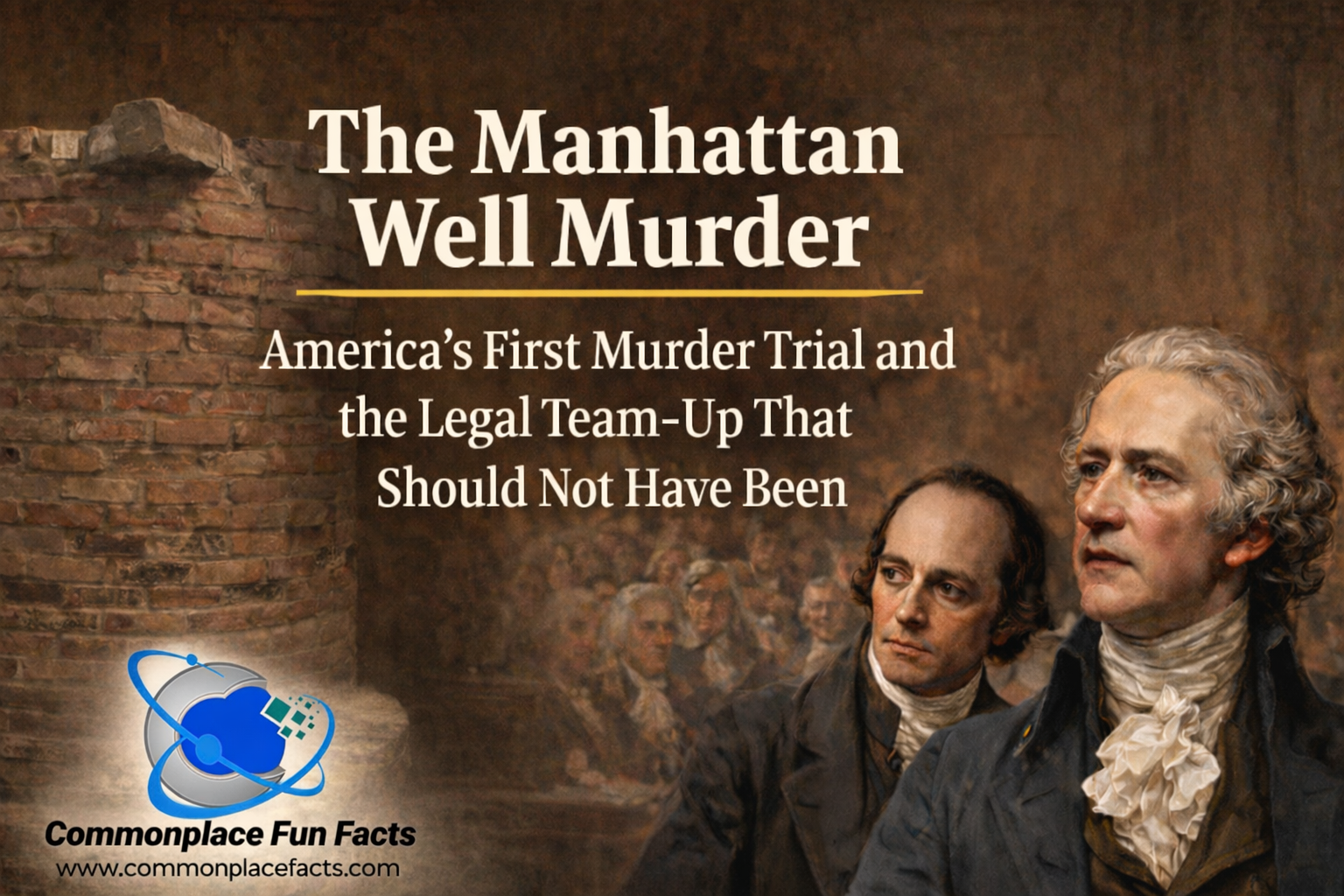

Who doesn’t love a good true crime story? The ideal version is intriguing without being confusing, dramatic without spiraling into conspiracy, and—above all—efficiently resolved within a tidy 30 to 60 minutes, with a scheduled break for a run to the kitchen or bathroom. The best ones feature a colorful cast, mounting tension, a surprise ending and impactful social commentary.
If that formula feels familiar, it may be because America has been chasing it since the very beginning. Our appetite for courtroom drama and moral certainty can be traced back to the first recorded murder trial in the United States: People v. Levi Weeks, more commonly remembered as the Manhattan Well Murder.
This case had everything. A dead woman discovered in a well. A fiancé suspected by everyone but who insisted on his innocence. A jury that deliberated for roughly the length of a modern microwave popcorn cycle. And for an all-star legal lineup, a defense team that included both Alexander Hamilton and Aaron Burr.
This is not the dubious plot for a Broadway musical sequel. This actually happened, and it captivated the attention of a brand new nation.
Welcome to the Manhattan Well Murder.
Contents
New York, 1799: A City Still Under Construction (Physically and Emotionally)
To understand the Manhattan Well Murder, it helps to reset your mental image of New York City. Forget skyscrapers, subways, and anyone jaywalking with confidence. In 1799, Manhattan was still figuring things out—geographically, politically, and emotionally.

The neighborhood at the center of this story, Lispenard’s Meadow, wasn’t prime real estate so much as damp real estate. It was marshy, sparsely developed, and just far enough from the city’s core that bad ideas could flourish without immediate supervision. This was a place where carts bogged down in mud, drainage remained a theory rather than a practice, and infrastructure lagged behind ambition.
One such ambition took the shape of the Manhattan Well.
The well stood near what we now call Spring Street, part of a broader plan promoted by the Manhattan Company. Officially, the company existed to supply fresh drinking water to a rapidly growing city. Unofficially—and more successfully—it did something else entirely. We will return to that. History always insists that we do.
Elma Sands Wasn’t Supposed to Be the Center of the Story
Gulielma “Elma” Sands was not an anonymous victim plucked from obscurity. She lived in a Quaker boardinghouse run by her cousins, Catherine and Hope Sands, and occupied an uncomfortable position within the family. Born out of wedlock, she was tolerated rather than embraced, and her presence carried a quiet social tension that never fully went away.
Elma was also, by contemporary accounts, lively and independent-minded. She liked nice clothes, enjoyed male attention, and showed little enthusiasm for fully adopting the rigid Quaker discipline expected of her. She refused to formally join the Meeting, resisted gentle moral correction, and generally behaved like someone who assumed her life would eventually belong to her.
This mattered. Not just socially, but narratively. Because when Elma disappeared, people already had opinions about her.
The Night Elma Vanished
On the evening of December 22, 1799, Elma told her cousin that she planned to meet her fiancé, Levi Weeks. The two intended to marry in secret—a plan that rarely works out well in relationships of that day and was particularly risky in a city that thrived on gossip.

What happened next is less certain than popular retellings suggest. Elma was heard leaving the house around eight o’clock, but no one definitively saw her leave with Weeks. Levi returned to the boardinghouse later that evening, alone. Some rumors claimed Elma had been seen riding in a sleigh with two unidentified men. Others insisted she had never left with Levi at all.
None of these accounts could be proven. All of them were discussed. There was only one fact everyone agreed upon: Elma never came home.
The Well Enters the Story
A few days later, a boy peering down into the Manhattan Well noticed something unusual. What first appeared to be refuse caught in shadow was soon identified as Elma Sands’ muff—an accessory that functioned less as evidence than as an accusation.
On January 2, 1800, Elma’s body was recovered from the well.
Public opinion made up its mind itself almost instantly. There was no prolonged uncertainty, no sustained deliberation. The city reached its verdict long before the court ever would.
Levi Weeks did it. Because it’s always the boyfriend, isn’t it?
The fact that this conclusion rested almost entirely on inference may have satisfied conventional wisdom, but the legal system stubbornly insisted on a couple of trifling concepts such as due process and presumption of innocence.
America Tries a Murder (For the First Time, On Paper)
The trial of Levi Weeks is often described as the first recorded murder trial in the United States. That designation matters not because murder was new; people had been killing each other since long before the colonies cut their ties with the Crown. This was, however, the first of its kind in the brand new nation, and it was well documented. The full account of the trial survives as the 96-page Report on the Trial of Levi Weeks.
This was America announcing its intention to handle justice “properly,” and then discovering—almost immediately—how unsatisfying that could be.
Weeks was indicted and brought to trial in March of 1800. The charge was murder. The evidence was circumstantial. The audience, however, was anything but skeptical.
A Spectacle Is Born
The trial drew crowds that treated the courtroom less like a civic institution and more like a public theater. Early Americans adored a moral drama, especially one involving secrecy, scandal, and a well that had already become locally infamous.
There were no podcasts, transcripts circulating online, or late-night recap shows, but the instinct was fully formed. Arguments spilled into taverns and parlors. Assumptions hardened into facts. Weeks’ guilt was treated as established truth.
The court, inconveniently, demanded evidence.
The Legal Cast List Gets Extremely Weird
Then came the defense.
Representing Levi Weeks were three men whose names would eventually loom large over American history: Aaron Burr, Alexander Hamilton, and Henry Brockholst Livingston.

If that lineup feels implausible, it should. This was a temporary ceasefire in a political rivalry that would later end in gunfire. But in 1800, Hamilton and Burr stood shoulder-to-shoulder, united by professional obligation and a shared understanding that public opinion does not constitute proof.
The unity, however, was less tidy than it appeared. Burr and Livingston leaned into the possibility that Elma’s death had been a suicide, emphasizing her emotional volatility and the absence of clear violence. Hamilton, by contrast, argued forcefully that someone else must have committed the crime, painting the prosecution’s case as not merely incomplete, but fundamentally mistaken.
The result was not a single, polished narrative, but a legal barrage that overwhelmed the prosecution from multiple angles.
The Prosecution vs. Reasonable Doubt
The prosecution, led by Cadwallader David Colden, presented a theory that resonated emotionally but struggled factually. Elma planned to meet Levi. Elma disappeared. Elma was found dead. Therefore, Levi must have killed her.
The argument was clear. The proof was not.
No witnesses saw the crime. No physical evidence tied Weeks to Elma’s death. This was 1800, an era when forensic science had barely progressed beyond divining the future by reading bird entrails, and interpretation did most of the work.
The defense relentlessly emphasized this gap, reminding the jury that suspicion is not the same thing as evidence. The argument was not that Levi Weeks was likable or sympathetic. It was simply that the prosecution had not proven its case.
The Judge Intervenes
Chief Justice John Lansing Jr. did not mince words. He instructed the jury that the evidence presented was insufficient to support a conviction. He stopped short of directing a verdict, but the message was unmistakable.
The jury now had to decide whether it served the law—or the crowd.
Five Minutes
The jury retired.

Five minutes later, they returned. Unlike the jury that acquitted the murderous wet nurse who worked for Queen Victoria, this jury agreed with the trial judge.
Levi Weeks was acquitted.
Five minutes is barely enough time to sit down and confirm that everyone heard the judge correctly. It was nevertheless enough time to dismantle a city’s assumptions.
The verdict was both legally sound and socially radioactive.
The Price of Legal Innocence
Weeks walked free, but New York did not forgive him. Public opinion rarely appreciates being overruled, especially by pesky little things like due process.
Unable to resume a normal life, Weeks eventually left the city. He relocated to Natchez, Mississippi, where he lived quietly and worked as a builder. The trial faded from daily conversation, but never entirely from memory.
The Infrastructure Wasn’t Neutral
The story becomes stranger when the well itself is examined more closely. The Manhattan Well existed as part of a water project overseen by the Manhattan Company, the same company whose charter was engineered by Aaron Burr. Levi Weeks’ brother, Ezra Weeks, was involved in construction work tied to the project.

These connections did not prove anything criminal. They did, however, ensure that the case would never feel entirely separate from power, money, and infrastructure.
The Manhattan Company’s water ambitions faltered. Its banking ambitions thrived. Over time, the institution evolved—through mergers and reinvention—into what we now know as JPMorgan Chase.
Which means one of the roots of modern American finance passes directly through a well associated with America’s first recorded murder trial.
The Team-Up That History Immediately Rebranded
There is something almost unfair about the Manhattan Well Murder trial: it contains one of the stranger collaborations in early American legal history, and virtually no one remembers it for that. Hamilton and Burr, political rivals who barely trusted each other in daylight, stood on the same side of the courtroom and did what lawyers do best—argue with confidence while pretending certainty is a lifestyle.
But history does not reward footnotes when it can have a duel. Four years after this courtroom alliance, the Burr–Hamilton partnership was permanently reclassified as “prequel content,” overshadowed by the Weehawken shot that killed Hamilton and turned Burr into America’s most infamous vice president. If the Manhattan Well trial was the two men using words as weapons, the duel was the moment the era decided words were taking too long.
And even then, the story still didn’t stay finished. As we’ve noted elsewhere in “Hamilton vs. Burr, Round Two: The Courtroom Battle Fought 30 Years After the Duel” the rivalry managed to stagger back into a New York courtroom nearly three decades later—this time with Alexander Hamilton Jr. stepping in as counsel for Eliza Jumel in her divorce from an elderly, broke, and still-surprisingly-durable Aaron Burr. No pistols, no cliffs, no melodrama—just affidavits, testimony, and the slow grind of legal consequences.
Round one belonged to Burr, at a terrible cost. Round two belonged to Hamilton—fought on paper, won in court, and concluded with the kind of symmetry history almost never provides unless someone waits thirty years and brings a lawyer.
The Well Today (Possibly)

The brick cylinder displayed today in a Spring Street basement is commonly identified as the Manhattan Well. It may, however, be a later cistern built decades after Elma’s death. The original well’s precise location remains uncertain.
This has not prevented ghost stories, whispered legends, or visitors pressing their palms against eighteenth-century brick in search of meaning. History, when denied certainty, has an impressive talent for substituting atmosphere.
In that sense, the well serves as a tidy metaphor for America’s first murder trial. The case itself remains wrapped in inference rather than proof, shaped more by conviction than by evidence. Like the structure people gather around today, it may be authentic, or it may be something partially reconstructed—reinforced over time by rumor, repetition, and the human discomfort with unanswered questions.
The Legacy of the Manhattan Well Murder
The Manhattan Well Murder matters not because it was solved, but because it wasn’t.
The law functioned exactly as designed. Procedure mattered. Evidence—or the lack of it—decided the case. Justice was done, and almost no one was satisfied.
America learned early that closure and legality are not the same thing, and that sometimes Alexander Hamilton and Aaron Burr can stand on the same side of an argument—briefly—before history resumes its preferred trajectory.
And somewhere beneath modern Manhattan, brick and mortar remain as a quiet reminder that in the law, as in medicine, the point is not to comfort suspicion, but to care for the injured—and to leave the well alone.
You may also enjoy…

The First Hollywood Murder Trial and the Fictional Lawyer It Inspired
The scandal captured the headlines of newspapers around the world. The Los Angeles celebrity was accused of trying to kill his wife. The evidence against him was overwhelming. It seemed only a matter of time before he would trade his wealth and fame for a prison cell and disgrace. Every lawyer recommended that he take…

Mary Ann Brough: The Wet Nurse Who Served Queen Victoria—and Killed Six Children
Mary Ann Brough was Queen Victoria’s wet nurse—until a shocking crime made her infamous. A dark Victorian story of motherhood, madness, and respectability undone.

Hamilton vs. Burr, Round Two: The Courtroom Battle Fought 30 Years After the Duel
Few rivalries in American history have enjoyed the kind of afterlife granted to that between Alexander Hamilton and Aaron Burr. It has everything: ambition, resentment, bad blood, politics, and a duel so dramatic it still shows up on Broadway two centuries later. By 1804, that rivalry had reached its famous conclusion on the cliffs of…




Leave a Reply