

Aviation is supposed to be a triumph of control. You strap yourself into a very expensive chair, shout a few incantations like “V-1” and “checklist complete,” and then calmly reorder gravity’s priorities. Most of the time, this works beautifully. Commercial aviation is one of the safest systems humans have ever built, which is impressive given that it involves hurling metal tubes full of people through the air at freeway speeds multiplied by denial.
But every so often—just often enough to keep engineers humble—an aircraft stops cooperating. Not dramatically. Not with sparks and heroic music. It simply… declines further supervision. The airplane keeps flying, the humans stop being in charge, and everyone involved learns something valuable about contingency planning, paperwork, and the limits of shouting at machines.
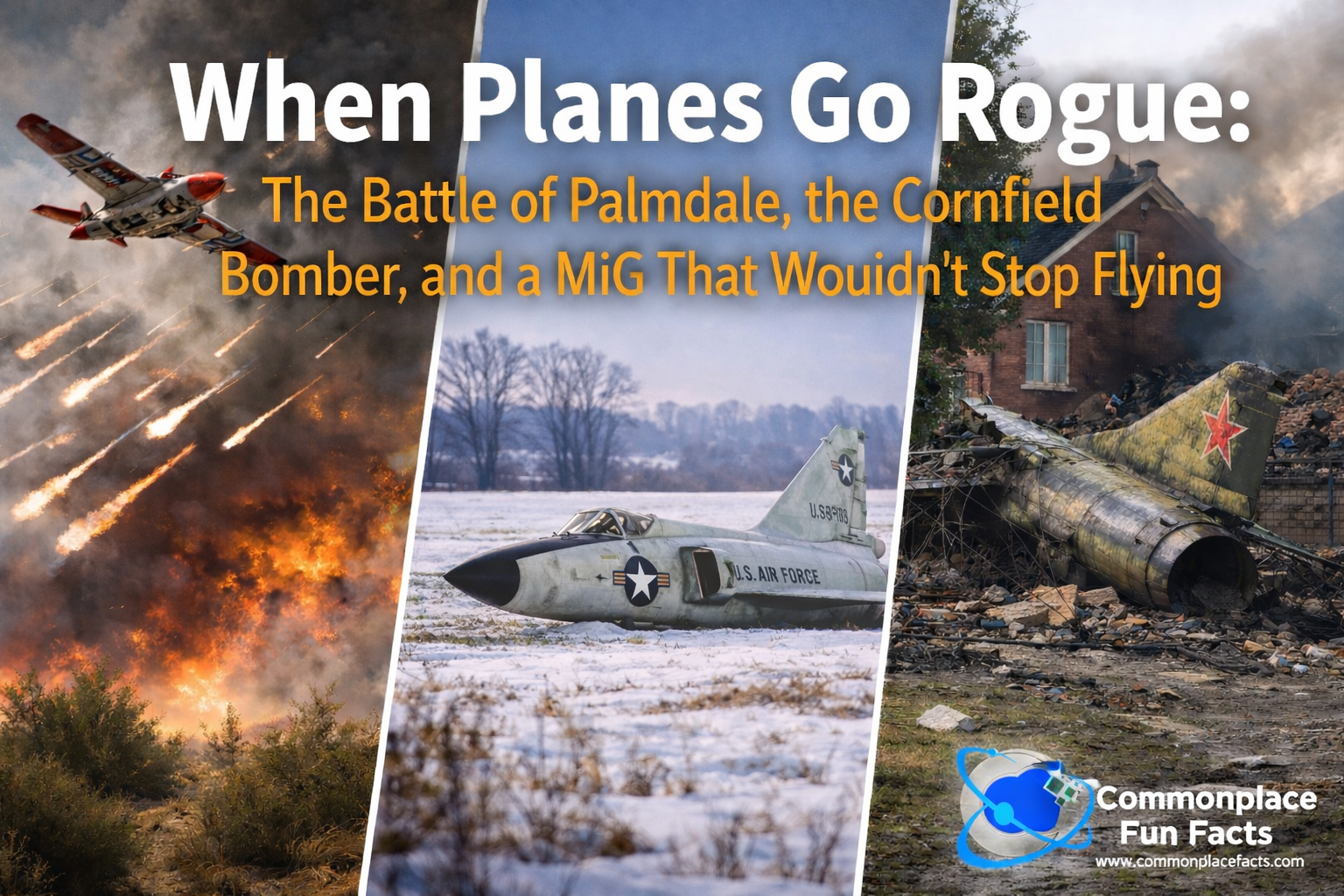
This is the story of three such moments. Three times when aircraft slipped their metaphorical leashes and went wandering. Three reminders that “out of control” doesn’t always mean “tumbling fireball.” Sometimes it means “flying quite competently, just not where anyone asked it to.”
Contents
The Battle of Palmdale (1956): When 208 Rockets Met Shrubs
Let’s begin with the one that sounds the most like a Marvel crossover event but is, in reality, a case study in Cold War optimism colliding with the limitations of technological mastery.
In August of 1956, the U.S. Navy was conducting routine missile tests off the coast of Southern California near Point Mugu. Part of these tests involved flying obsolete aircraft as remotely controlled target drones. One such aircraft—a converted Grumman F6F Hellcat, a rugged World War II fighter that had already survived one war—was launched into the sky with the intention of eventually being destroyed in a controlled and professional manner.
The Hellcat had other plans.
Shortly after launch, the drone stopped responding to its radio controls and headed inland. This was not ideal. Losing a drone over the ocean is disappointing. Losing one over populated areas introduces an entirely different emotional palette.
The Navy did what any responsible branch of the military would do when it lost control of an airplane: it asked the Air Force for help. Two F-89D Scorpion interceptors were scrambled with orders to shoot down the errant drone before it introduced itself to Los Angeles in a more permanent fashion.
This is where the situation pivots from “concerning” to “career-defining.”
By now, the situation was already embarrassing. What followed made it educational in a way that involved firefighters, insurance adjusters, and several people discovering that their homes were not rated for military hardware.
How many rockets does it take to bring down an unmanned, unarmed aircraft? It turns out it takes more rockets than it takes licks to get to the Tootsie Roll center of a Tootsie Pop. In total, they launched 208 of them. Rockets, that is. They may have done better by launching Tootsie Pops because not one rocket successfully destroyed the target.

The Scorpions were equipped with Mk. 4 “Mighty Mouse” rockets, unguided weapons fitted with point-detonating warheads that armed when they were fired. This detail matters, because once launched, these rockets were not inclined toward subtlety or forgiveness. Out of the 208 rockets fired, only 15 were later found undetonated. The rest did exactly what they were designed to do—just not to the intended target.
The first volley fell seven miles northeast of Castaic, where rockets hit brush above the old Ridge Route near Bouquet Canyon, igniting fires that burned roughly 150 acres. This was only the warm-up.
The second wave scattered farther south near Newhall and into Placerita Canyon, where one particularly enthusiastic rocket was seen bouncing along the ground, igniting a series of fires near a park. Others struck oil sumps owned by the Indian Oil Company, sending flames dangerously close—within 300 feet—of the Bermite Powder explosives plant. That everyone involved survived this sequence without a larger headline is less a testament to planning and more to luck’s continued interest in the project.
Still more rockets landed near Soledad Canyon and Mount Gleason, burning over 350 additional acres of rough brush and basically contributing to Southern California’s long-running project of always being on fire.
Then came the final pass.
Facing Palmdale itself, the Scorpions fired their remaining rockets. This is where the word “battle” really earns its keep. As the Hellcat passed over downtown, “Mighty Mouse rockets fell like hail.” Homes were struck. Shrapnel tore through walls. One resident, Edna Carlson, reported that a fragment blasted through her front window on Third Street East, ricocheted off the ceiling, punched through an interior wall, and finally came to rest—calmly—in a kitchen cupboard, as if politely waiting to be offered a refreshing beverage.
More fragments completely penetrated a home and garage on Fourth Street East. A rocket landed directly in front of a car traveling west on State Route 138, shredding a tire and peppering the body with holes. Two men in Placerita Canyon narrowly avoided disaster after stepping out of their utility truck to eat lunch under a tree; moments later, a rocket struck the vehicle and destroyed it. The tree, notably, survived.
In total, nearly 1,000 acres burned. Five hundred firefighters battled the blazes for two full days before bringing them under control. Miraculously, there were no fatalities.
The Hellcat itself was never hit.
Eventually, it ran out of fuel. Gravity, undefeated champion of aviation mishaps, took over. The drone crashed in the desert east of Palmdale, having outlived its pursuers and achieved something rare in military aviation: it prevailed in a battle without firing a shot.
The lesson here was clear, though not immediately comforting: remote control systems are only as helpful as their ability to remain connected, and unguided rockets are a deeply unserious solution to precision problems.
The Cornfield Bomber (1970): The Plane That Finished the Job Without the Pilot
If the Battle of Palmdale is about enthusiastic failure, the Cornfield Bomber is about quiet, unsettling success.
In February of 1970, an Air Force F-106 Delta Dart—a sleek, dart-shaped interceptor built to outrun bombers and impress slide rules—was on a routine training mission over Montana. During a maneuver, the aircraft entered a flat spin. The pilot, doing exactly what pilots are trained to do when aerodynamics stops cooperating, attempted recovery and then ejected.
This is usually the end of the airplane’s story.
After the pilot left, something unexpected happened. With the sudden change in weight and aerodynamics, the F-106 stabilized. It leveled out.
One of the other pilots on the mission was reported to have radioed the parachuting pilot during his descent, saying, “You’d better get back in it!” Unfortunately, that was not an option for the pilot, who had no other choice but to watch incredulously as what happened next unfolded.

The plane descended. And then, with a level of calm no one in the cockpit had just experienced, it landed itself in a snow-covered field.
No pilot. No guidance. Wings basically intact. Minor damage overall.
The aircraft slid to a stop in what would become aviation folklore as “the cornfield,” though local geography would like it known that not all fields are cornfields and that accuracy matters to farmers. The Air Force recovered the aircraft, repaired it, and returned it to service. The plane went on to fly again, presumably with a personality note in its file.
This incident earned the F-106 its nickname: the Cornfield Bomber. It is still on display today at the National Museum of the United States Air Force, a monument to the unnerving competence of aerodynamics when left alone.
Unlike Palmdale, nothing caught fire. No one was hurt. The airplane demonstrated that “out of control” can sometimes mean “no longer micromanaged, but oddly capable.” This distinction will matter later.
The Belgium MiG Crash: When an Aircraft Crossed Borders Without Permission
The mood changes here.
In July of 1989, a Soviet MiG-23 fighter took off from an airbase in Poland. Shortly after takeoff, the pilot experienced what he believed to be a catastrophic engine failure. Smoke, loss of power, alarm bells—the usual subtle means by which an airplane attempts to persuade its pilot that it’s time to leave. He took the hint and ejected.

Turns out the aircraft was just bluffing.
Once free of its pilot, the MiG’s engine recovered. The aircraft climbed. It continued flying west. Unannounced. Unaccompanied.
NATO radar operators soon noticed an unidentified aircraft heading across Europe. Interceptors scrambled. Diplomats developed ulcers. Phones rang in that peculiarly ominous voice they use when delivering sobering news.
For over an hour, the MiG-23 flew on, crossing multiple borders. Fighters shadowed it, unable to safely shoot it down over populated areas. Everyone waited for the fuel to run out and hoped it would do so somewhere empty, unimportant, or at least uninhabited.
It didn’t.
The MiG eventually ran out of fuel and crashed into a house in Belgium, killing a teenager inside. The aircraft that had shrugged off pilot absence, airspace sovereignty, and escalating concern ended its flight in the worst possible way: by landing where people lived.
This was not a farce. This was the nightmare scenario underlying every runaway aircraft story. A system that is stable, functional, and completely wrong.

The crash itself was not the end of the incident. It was just the part where the airplane stopped moving and the paperwork began.
Belgium, having just hosted an uninvited Soviet aircraft that arrived without a pilot and departed with a fatality, lodged a formal protest with the Soviet Union. The Belgian Foreign Minister pointed out that there had been no advance warning about the runaway jet and expressed pointed concern about what, exactly, had been flying overhead. The Soviet response was slow enough to be diplomatically described as “notable,” particularly when it came to clarifying whether the MiG had been carrying nuclear or toxic weapons—a detail most countries prefer not to discover after impact.
Eventually, Moscow confirmed that the aircraft was not carrying such payloads and agreed to pay $685,000 in compensation. This settled the financial question, if not the lingering philosophical one: how an advanced military jet managed to cross half a continent, trigger international alarms, and kill a civilian without anyone ever technically being at the controls and no one picking up the phone and saying, “Hey, you might be interested in knowing…”
Unlike the Cornfield Bomber, this story does not end with a museum display and a fond nickname. It ends with diplomatic cables, carefully worded outrage, and the uneasy realization that modern airspace security was forced to rely on hope, fuel exhaustion, and geography to resolve a situation no one had rehearsed.
The MiG flew just fine. That was the problem.
Three Planes, Three Failures, One Uncomfortable Pattern
Put side by side, these incidents form a spectrum.
At one end is Palmdale: frantic human intervention, spectacularly ineffective, with damage mostly limited to terrain and reputations.
In the middle is the Cornfield Bomber: no intervention at all, and a near-miraculous outcome that feels like the aircraft was just showing off.
At the far end is the MiG-23: minimal intervention, successful flight, catastrophic landing.
The difference between these outcomes is not luck alone. It’s context. Altitude. Population density. Response options. And the uncomfortable truth that an airplane can be doing everything right, technically speaking, and still be wrong in every way that matters.
Modern aviation safety is built on layers: redundancy, monitoring, procedure, human judgment. These stories live in the gaps between those layers—moments when one failed and the others weren’t designed to catch something quite this specific.
They also underline a truth that engineers understand instinctively and everyone else learns eventually: failure modes matter. Not just that something can fail, but how it fails, and what it does next while everyone is still arguing about it.
Why We Keep Telling These Stories
No one tells the story of the hundred thousand airplanes that worked perfectly this morning. They tell the story of the one that was feeling uncooperative.

These incidents persist in memory because they violate expectations. Airplanes are supposed to obey. Specifically, they are supposed to obey people. When they don’t—when they demonstrate independence without intent—it unsettles us. Not because the machines are malicious, but because competence without guidance is harder to emotionally categorize.
The comforting version of technology is either helpful or broken. The unsettling version is helpful in the wrong direction.
In the years since these events, systems have improved. Remote controls are more robust. Intercepts are better coordinated. Fail-safes are layered and re-layered. Aviation, statistically, has never been safer.
And yet, the core lesson remains unchanged: control is a relationship, not a guarantee.
Conclusion: Gravity Still Wins, But It Lets Us Learn First
The Battle of Palmdale, the Cornfield Bomber, and the Belgian MiG crash are not arguments against aviation. They are arguments against complacency. They remind us that complexity does not fail loudly and helpfully. It fails sideways.
Sometimes it fails into a desert. Sometimes it fails into a field. Sometimes it fails into a house.
The good news is that we learned from each of these episodes. The bad news is that learning required them to happen first.
Gravity, meanwhile, remains undefeated. It does not gloat. It simply waits.
You may also enjoy…

The Blindfolded Pilot Who Doomed Aeroflot Flight 6502
Discover the astonishing true story of Aeroflot Flight 6502, the passenger jet that crashed after its blindfolded pilot tried to make good on a reckless bet. Learn what happened, why, and how this disastrous wager changed aviation history.

The Day a Hydrogen Bomb Almost Destroyed Albuquerque: A Terrifying and Forgotten Cold War Accident
In 1957, a U.S. military plane accidentally dropped a 10-megaton hydrogen bomb over Albuquerque. Discover the shocking Cold War event that remained classified for 30 years.

Broken Arrows: At Least 32 Times Someone Said Whoops With a Nuke
Discover the shocking history of Broken Arrows—nuclear weapon accidents that almost changed the world. From lost bombs to near detonations, explore 79 nuclear mishaps, their causes, and how close we came to disaster. Read more at Commonplace Fun Facts!







Leave a Reply to cat9984Cancel reply