

Mind the Gap (Between Your Wallet and Social Class)
There are few concepts in British society as endlessly fascinating—and faintly exhausting—as the obsession with class and good manners. It is mystifying, amusing, admirable, and slightly irritating, often all within the same sentence.
British history is filled with moments where someone is doing something objectively terrible, but doing it politely, and this seems to count for something. An Englishman may be ruined, robbed, or stabbed, but at least it was done without raising one’s voice or inconveniencing the surrounding social order.
This fixation on propriety did not stop at tea tables, drawing rooms, or debates over which fork was meant for fish. It extended—naturally and inevitably—into crime.
At some point, British society looked at the problem of being robbed and decided the true issue was not theft itself, but who was doing the robbing, where they were doing it, and whether they were doing it in a manner befitting a gentleman. Crime, like everything else, required classification. Ideally with tiers.
The result was a remarkably elaborate mental system in which criminals were ranked, labeled, and quietly judged—ideally by the courts, but far more importantly, by society. There were robbers, yes—but also highwaymen, footpads, royal scamps, royal footpads, and other figures who sound less like threats to public safety and more like minor characters in a D&D game.
These distinctions were never about reducing danger. They were about preserving a comforting illusion: that even lawlessness could be tidy, hierarchical, and governed by unspoken rules. If society had to tolerate theft, it strongly preferred theft with posture, boundaries, and decent etiquette.
Modern crime lacks this reassuring absurdity. Today, a mugger is simply a mugger. No horse. No title. No implied moral philosophy beyond “I want your valuables.” This efficiency may be practical, but it is deeply un-British.
So let us return to a time when being robbed came with options, expectations, and opinions about etiquette; when even wrongdoing was filtered through class anxiety and a desperate hope that manners still mattered. Welcome to the era when crime was stratified, etiquette was non-negotiable, and social distinction survived even at knifepoint.
Contents
When Muggers Had a Résumé
Modern crime is terribly unprofessional.
Someone jumps out of the shrubbery, announces a vague threat, and demands your wallet. That’s it. No branding. No specialization. No sense of pride in the craft. Just a blunt, utilitarian “give me your stuff.” Basically, no better than a politician voting for a tax increase.
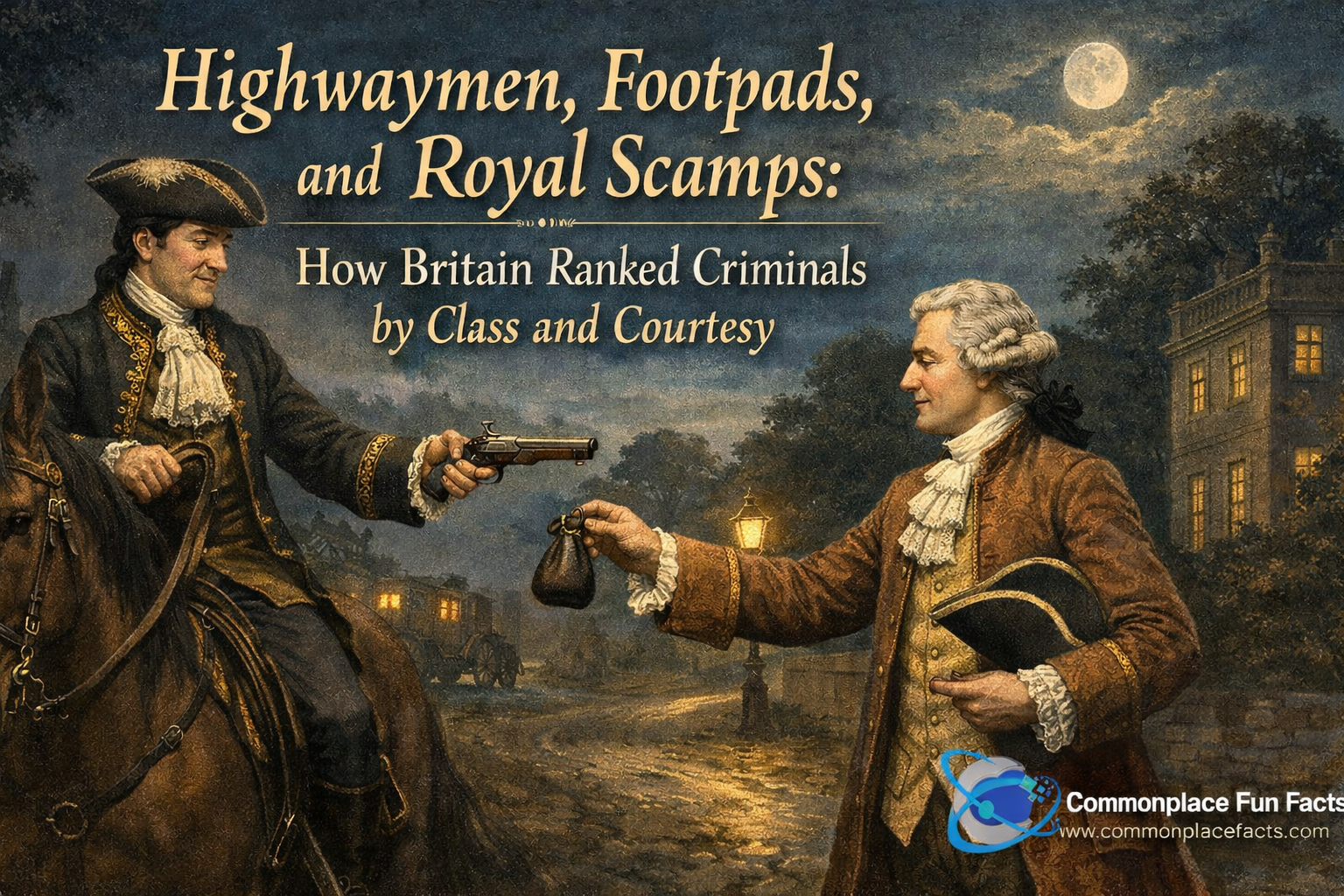
England, however, knew how to do it right. If you were traveling along English roads a few centuries ago and someone intended to separate you from your well-earned possessions, you took some comfort in hoping it wouldn’t be a common robber. Instead, a gentleman or lady might expect to be the victim of larceny at the hands of a highwayman, footpad, or even, if you live in the kind of society that can’t help itself, royal scamp or royal footpad.
Yes, “royal.” You may have been the victim of a criminal, but at least it was one with some class, allowing you to casually remark while sipping your tea, “Yes, Your Majesty, the man who just took my wallet did so with restraint and principles, and I believe he has excellent posture.”
This is the great lost genre of British social life: the idea that wrongdoing wasn’t merely illegal—it was stratified. There were expectations. There were career paths. There were, apparently, branding guidelines.
In the modern world, if you get mugged, you have been mugged. The criminal is a mugger, full stop. In the older world, you could be robbed by a man with a horse, a man without a horse, a man who robbed only on highways, or a man who robbed in alleys.
England, as it turns out, could not simply have criminals. It had to have criminals with strict job descriptions, as if there was a Human Resources Office for the criminal underworld.
The Geography of Getting Robbed
The first thing you need to understand is that the landscape did a lot of the heavy lifting.
Early modern and eighteenth-century England was not built for your safety, your convenience, or your desire to walk somewhere at night without starring in your own cautionary pamphlet. Streets could be narrow. Lighting was inconsistent at best. Some areas were packed with people and commerce, while others were quiet, dark, and conveniently designed for anyone who enjoyed surprise confrontations.

And people developed a theory—an adorable, doomed theory—that different kinds of roads produced different kinds of criminals.
Narrow, dark, unfrequented lanes near towns were thought to be footpad territory: cramped spaces, limited visibility, and plenty of nearby hiding spots. You could wander into one and feel the air change. Not because of anything mystical. Because you had effectively walked into a place where your odds of a “Good evening, sir, and also hand me your money” encounter rose sharply.
Wide open highways between cities had their own menace: highwaymen. If the lane robber was an ambush predator, the highwayman was the theatrical cousin—more space, more drama, more opportunities to loom in silhouette like a morally compromised statue on horseback.
The amusing part is that people could convince themselves this was a kind of logic: sure, the lane is dangerous, but once you reach the open road, you’re safer.
You were not safer.
You had simply moved from “robbed close to town” to “robbed in the middle of nowhere with better production values.”
This is where we meet the wonderfully specific word “agatewards”—a term used for walking someone out of town, as though escorting them toward open country. The implication was that you were guiding a friend through the dark lanes until they reached the more traveled highway.
Which is a bit like saying, “Don’t worry, I’ll walk you past the hungry wolves until we get to the bear habitat.”
It’s also a reminder that urban planning has always been an accomplice. People like to imagine cities as the invention of builders, architects, and civic ambition. In reality, cities are also shaped by fear, poor lighting, questionable drainage, and the fact that if you design enough shadowy passages, someone will inevitably develop a business model around them.
Robbers: The Unbranded Masses
Let’s start with the baseline: the generic robber.
A robber is the criminal equivalent of a plain baked potato. Functional. Common. Lacking flair. A robber is someone who takes your property by force or threat, and that’s the entire job description.

- No horse (which, as we will see, is basically the difference between “criminal” and “criminal, but in a ballad”).
- No code (unless you count “take things” as a moral philosophy).
- No flattering ballads (no one gathers around a fire to sing about the nameless man who shoved you in a ditch).
- No delusions of moral selectivity (he doesn’t claim he only robs the wealthy; he robs whoever looks like they have money and insufficient backup).
Robbers were the unbranded masses—the background noise of danger. If you were robbed in a lane or on a road, you might call the person a robber without needing to refine the label, much the way we now say “guy” when we mean “somebody whose name I didn’t catch and would rather not learn.”
And because England loved hierarchies the way cats love knocking things off tables, this generic robber became the baseline against which other criminals measured their self-esteem.
In other words: if you had ambitions as a thief, you did not want to be merely “a robber.” You wanted to be… something else.
Footpads: Crime on Foot, and Thus Suspicious
Next, we meet the footpad. This is basically a robber, but with zoning regulations. A footpad committed robbery on foot—hence the name. Unlike the common robber who performed his nefarious profession anywhere opportunity permitted, the footpad limited his activities near towns, in streets, alleys, and the kind of transitional spaces where “just a short walk” becomes an episode of survival television.
Footpads tended to be:
- Close-range urban or suburban attackers who relied on surprise and proximity.
- Less romance, more practicality—because there’s nothing glamorous about being shoved into a wall by someone who smells like questionable life choices.
- Unsettling precisely because they were ordinary—they moved in the same spaces you did, on the same two feet you did, having no pride in their work whatsoever.
In crime as in real estate, it’s all about location, location, location. A footpad was a criminal, to be sure, but at least he had the good manners to operate in the city. A robber, by contrast, did not even have the scruples to care about where he acted on his moral ambiguity.
And if you sense class anxiety in that distinction—congratulations, you are reading the room correctly.
Highwaymen: Crime, But With Posture
Enter the highwayman, the criminal with a horse and, more importantly, a public relations department.
The highwayman operated on major roads—wide stretches connecting towns and cities. He was often mounted, which immediately transformed the crime from “petty violence” into “a performance.” A horse suggests investment. It suggests planning. It suggests the kind of person who can maintain a saddle, a weapon, and a dramatic silhouette.
To be clear: a highwayman was still a thief. He still wanted your money. He still improved his evening by making yours worse. But culturally, he was treated as a better class of criminal, partly because his targets tended to be people who had something worth taking.
- Horses as status symbols: A horse isn’t just transportation; it’s a statement. It says, “I am not lurking in a puddle. I am arriving.”
- Targeting travelers who visibly had money: Well-dressed travelers, coaches, merchants—anyone who looked like they might have cash and not too many friends with clubs.
- The belief (mostly aspirational) that they avoided violence: The myth was that the “gentleman highwayman” would rob you politely, perhaps even apologetically, and then allow you to continue your trip with your dignity slightly bruised but intact.
That last one is where reality and storytelling start arm-wrestling. Some highwaymen were courteous. Some were violent. Some were both, depending on whether you complied quickly enough to satisfy the narrative they told themselves about being “civilized.”
But popular culture adored the idea of the refined criminal. Ballads, pamphlets, and trial biographies did most of the heavy lifting here, polishing certain highwaymen into folk characters—dangerous, yes, but stylish. Charming. Maybe even principled.
It wasn’t so much Robin Hood as it was brand management. The highwayman wasn’t merely committing robbery; he was building a persona. And the public, always hungry for a good story, happily helped.
Which says something unsettling about human nature: people will forgive an awful lot if the villain has a strong aesthetic and doesn’t chew with his mouth open.
Royal Scamps and Royal Footpads: Imaginary Titles, Real Attitudes
Now we arrive at the truly bizarre layer: the “royal” criminals.
Royal scamps and royal footpads show up not as legal classifications but in the world of slang dictionaries, satire, and moral commentary—places where society stores its opinions in tidy little labels.

The idea goes something like this:
- Royal Scamps: Highwaymen who allegedly robbed only the rich, and did so without “ill treating” them. In other words, crime, but with customer service standards.
- Royal Footpads: The same fantasy, minus the horse. Like a budget version of gentlemanly robbery: “I would be a refined highwayman, sir, but the economy is difficult and oats are expensive.”
These were not formal categories you’d find in a statute book. They were cultural wishful thinking—evidence that people desperately wanted to believe there was such a thing as ethical theft.
It’s the same impulse that leads people to say things like, “He’s a criminal, but he has a good heart,” as if the moral universe offers a rebate program.
And it also reveals a timeless truth: adding the word “royal” has always been a shortcut to respectability. Put “royal” on something and suddenly everyone assumes it comes with a code of conduct, a uniform, and a reassuringly old building.
Put “royal” on a thief and, apparently, he becomes a thief who only steals from people society already suspects of having too much money.
Whether that was true in practice is almost beside the point. The real story is that people wanted it to be true. They wanted crime to have rules, and criminals to have standards, because the alternative is admitting that danger is random and the universe is not taking notes.
Light as Labor: Link-Boys and the Economics of Darkness
If the highwayman represented crime with posture, the link-boy represented something even more precarious: crime-adjacent gig work.
In America, many boys had their first jobs as newsboys or paperboys. Across the pond, the options were a bit more limited. Link-boys, as you may have deduced by the name, were usually boys. Poor, expendable, and small enough to be ignored until you needed them, they made a living carrying flaming torches through the dark streets of English cities. Their job was to guide pedestrians from place to place, illuminating the path, pointing out obstacles, and, crucially, helping people avoid stepping directly into open sewers.

This alone should tell you something about urban planning.
Their work involved:
- Carrying flaming torches (called “links”) through narrow, unlit streets.
- Guiding people over kennels—the charming old term for open drains full of whatever the city had decided not to deal with that week.
- Navigating alleys and passages that looked like architectural afterthoughts and behaved like traps.
They were paid by tips. Not wages. Tips. Which meant their income depended entirely on society’s fear of darkness and the unshakable belief that going alone would end badly.
And then there was the moon.
Bright moonlight rendered link-boys unnecessary. Streets became visible. Shapes resolved themselves. The entire economic rationale collapsed in a bath of inconvenient celestial illumination.
This is where we get the wonderful term moon-curser: slang for link-boys who were said to curse the moon because it destroyed demand for their services. It is possibly the most honest piece of occupational resentment in recorded history.
When your job requires darkness, the moon is not romantic. It is hostile infrastructure.
Contemporaries did not trust link-boys, and not entirely without reason. They appear frequently in warning pamphlets, moral tracts, and cheerful reminders that “help” often came with conditions.
- Accusations of extortion: guide the customer… or abandon them mid-alley until a higher tip appears.
- Claims of ambush assistance: lighting the way straight toward friends waiting in the dark.
- Reputation for theatrical menace: emphasizing and possibly exaggerating the danger while offering his services to those unfamiliar with the area.
This does not mean every link-boy was a criminal collaborator. It does mean the line between “helpful guide” and “accessory to robbery” was porous, poorly regulated, and operating entirely on vibes.
When your profession exists in the overlap between darkness and fear, people naturally assume there is a causal connection.
Crime, Class, and Comforting Myths
By now, a pattern should be emerging.
British society did not merely endure crime; it organized it mentally. It assigned classes, roles, and imagined standards because the alternative—that violence is chaotic, unfair, and indifferent to manners—was deeply uncomfortable.

It was far easier to believe in “better” criminals.
Highwaymen with principles. Royal scamps with restraint. Footpads with limits. Even link-boys who were suspect rather than outright villains. This taxonomy did not protect victims, but it did protect society’s belief that order existed, even in disorder.
It also helped victims to better cope with the experience. You may have had your purse or wallet permanently separated from you, but if it was done by a royal scamp, it’s because he recognized that you were someone of sufficient class and societal position to be worthy of his attention.
Modern organized crime is still obsessed with structure and titles. We are very keen to know who the Don is, who the underboss is, who the consigliere is, and who is merely an associate who has made some unfortunate life choices.
Movies and television have trained us to admire this hierarchy—to see it as professionalism rather than criminality. Violence becomes palatable when it is procedural. Murder feels less disturbing when it is approved through channels.
This is why fictional mobsters are constantly explaining that nothing is personal. It’s just business. You’re ordering a hit on your brother not because you’re cruel, but because the quarterly profit and loss chart demands it.
The psychology is identical.
Structure reassures us. Titles soothe us. Knowing that someone took your money or your life according to rules and rank feels, somehow, less horrifying than knowing it happened because evil exists and it happened to cross your path.
The problem, of course, is that this hierarchy largely exists in storytelling, not in experience. Victims did not feel more comforted by being robbed by a “gentleman.” Being politely threatened is still being threatened. Being efficiently murdered is not an improvement on being chaotically murdered.
The categories primarily served observers, not participants.
Conclusion: When Theft Had Pretensions
In the end, crime has changed far less than its presentation.
The modern world has stripped away the faux-aristocratic vocabulary. There are no highwaymen, no royal scamps, no link-boys muttering at the moon. There are no horses, no torches, no gentlemanly disclaimers about how this would all be quite civil if you’d just hand over the purse.
There is only crime.
And yet, we still long for structure within it. We still invent titles, ranks, and codes of honor because they allow us to believe that wrongdoing can be contained—that violence can be rationalized—that cruelty might come with etiquette.
The uncomfortable truth is that the past did not have better criminals. It had better excuses.
What we remember as order was often just narrative. What we admire as restraint was often myth. And what feels like lost civility is mostly nostalgia mistaking manners for morality.
The desire to rank wrongdoing says far more about society than about crime itself. We want the world to make sense. We want villains to follow rules. We want chaos to wear a name tag.
And when it doesn’t, we invent one.
For more forgotten words of the English language and their fascinating history, read Horology: A Day’s Jaunt Through the Lost Words of the English Language, by Mark Forsyth.
You may also enjoy…

Feague: Why Your Horse Should Be Worried By This Obsolete Word
Do you know the meaning of “feague”? Find out the interesting — and disturbing — meaning of this obscure word and learn why your horse should be worried.

The IP Address Mapping Error that Made a Kansas Farmhouse a Major Criminal Hangout
Discover how a Kansas farmhouse became the target of FBI raids, angry calls, and scammers, all due to an IP address mapping error. Learn about one family’s geolocation digital nightmare.

Vinegar Valentines: The Victorian Cards For When You Care Enough to Send Something Truly Insulting
Discover the bizarre history of Vinegar Valentines, the Victorian-era trend of sending hilariously insulting greeting cards. Learn about their origins, impact, and cultural legacy.





Leave a Reply to cat9984Cancel reply