

Wars are a constant theme throughout history and have a predictable outcome. The loser has limited options: disappear from the record, reconcile with reality, or quietly sulk for a generation or two while plotting for the sequel.
While that works in most situations, a small subset of the defeated side of the American Civil War chose for another option. After the war ended in 1865, this group packed up, got on boats, and moved to Brazil.
This is the story of how a group of former Confederates decided their best next chapter involved relocating to South America, founding a town called Americana, and recreating as much of the Old South as climate, language barriers, and moral reality would allow.
History is rarely subtle, but occasionally it is aggressively weird.
Contents
When the South Didn’t Rise Again, It Shipped Out
For the South, the Civil War ended with four million of previously-enslaved people freed, the Confederacy dissolved, the implementation of Reconstruction, political upheaval, and the deeply unsettling prospect of not being in charge anymore. For some former Confederates, this was unacceptable on a philosophical level. For others, it was unacceptable on a business level.
These men came to be known as the Confederados: ex-Confederate soldiers, politicians, and planters who decided the response to defeat was emigration. If their states couldn’t secede from the Union, they would just take themselves and their culture out of the Union altogether.
Brazil was their destination of choice for one very large, very unspoken reason: slavery was still legal there.
Brazil would not abolish slavery until May 13, 1888—more than twenty years after the Confederacy collapsed. To a certain subset of defeated Southerners, that made Brazil look less like a foreign country and more like a convenient time machine with better sugarcane.
Brazil’s Pitch: Land, Latitude, and Labor
At the same time, Brazil—still an empire—was actively courting foreign settlers. Dom Pedro II was eager to modernize Brazil’s agricultural economy, particularly cotton production, which had become increasingly valuable on the global market.
Southern planters, freshly unemployed by emancipation and defeat, happened to possess expertise in exactly that area. This was less a cultural exchange and more a transactional relationship powered by agriculture and mutual blind spots.
Brazil offered cheap land, subsidies, and encouragement. Former Confederates offered experience, tools, and an unbounding enthusiasm for replicating the social structures they had just lost a war defending.
This was globalization before the term existed—except instead of multinational corporations, it involved ox carts, malaria, and men writing letters home explaining that everything would be different this time.
The Man With the Map: William Hutchinson Norris
No historical relocation scheme is complete without a guiding figure, and this one had Colonel William Hutchinson Norris, a former Alabama state senator who moved to Brazil in the 1860s and promptly set about scouting land in São Paulo.

Norris was not subtle about his goals. He wanted a place where Southerners could settle together, farm cotton, and maintain familiar social hierarchies. He found land near present-day Santa Bárbara d’Oeste and encouraged others to follow.
They did.
The journey was not easy. Transportation infrastructure was limited. Language barriers were significant. Tropical diseases were enthusiastic participants in the process. Still, several thousand Americans made the move over the following decades, enough to be noticeable and culturally distinct.
Which, as it turns out, is how towns get named.
How You End Up With a Town Called Americana
As American settlers clustered in rural São Paulo, locals began referring to the area as Vila dos Americanos—the village of the Americans. When a railway station was built nearby, the shorthand stuck. Over time, the settlement formally became Americana.
This is one of history’s most efficient naming processes. No mythology. No poetic translation. Just: “There are a lot of Americans here.”
Today, Americana is a modern Brazilian city with hundreds of thousands of residents, most of whom go about their lives without dressing like the 1860s or arguing about states’ rights. But its origins remain quietly, and sometimes loudly, unusual.
What the Confederados Actually Built
The settlers brought cotton cultivation techniques and helped expand agricultural production in the region. They established schools, Protestant congregations, and family farms. Over time, they intermarried, learned Portuguese, and became Brazilian citizens.
This is the part of the story often emphasized by descendants: hard work, adaptation, contribution, and assimilation.
It is all true.
It is also incomplete.
The original motivation for the migration—preserving an economic and racial order that included slavery—does not disappear simply because subsequent generations built churches or improved irrigation. History does not dissolve just because it makes later generations uncomfortable.
The Cemetery That Became a Time Capsule
One of the most enduring symbols of the Confederate presence in Brazil is the American Cemetery in Santa Bárbara d’Oeste.
Protestants could not be buried in Catholic cemeteries at the time, so the community established its own burial ground. Over time, it became both a literal cemetery and a symbolic center of Confederate-descended memory.
Fundraisers were held there. Gatherings followed. Traditions developed.
Eventually, there was fried chicken.
Festa dos Confederados: When Heritage Gets Awkward
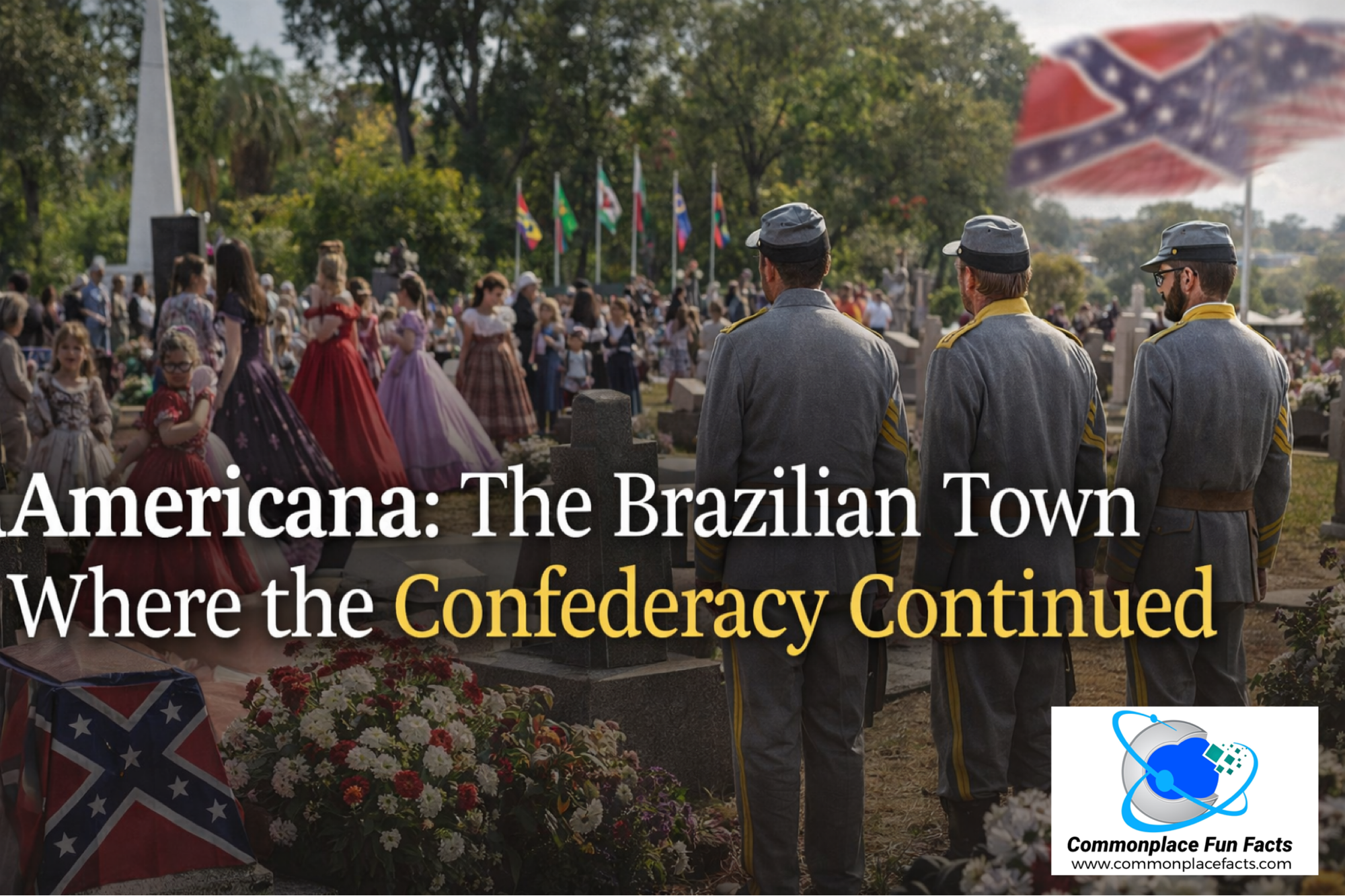
The Festa dos Confederados is an annual festival held near the cemetery. It features period dress, Southern-style food, use of faux Confederate currency, music, and Confederate symbolism.
To most descendants, the symbolism of the Confederacy, such as the flag and images of Confederate heroes, represents ancestry and cultural history, not ideology. To critics, it represents something much more direct, especially in a country that was the last in the Western Hemisphere to abolish slavery.
Over time, Brazilian officials and activists began pushing back. In Santa Bárbara d’Oeste, public displays of Confederate symbols were eventually restricted, reflecting broader global reassessments of how history is commemorated.
Jimmy Carter, Somehow
History occasionally adds a cameo so strange it feels fictional. This story has one, and it involves Jimmy Carter.

During a visit to Brazil in 1972, Carter toured the region. Local officials, eager to highlight the American heritage of the area, leaned hard into Confederate symbolism. This… did not age well.
The symbols were later removed, and Carter’s brief, unintentional role in Brazilian Confederate iconography faded into history, joining a long list of things no one had on their résumé.
The Lost Cause Learns Portuguese
The strangest part of the Americana story is not that defeated people migrated. That happens often. It is that a set of myths known as the Lost Cause—already selective and revisionist in the United States—survived the journey and adapted to a new country.
Distance softened some edges and sharpened others. What began as an effort to preserve culture became, over generations, a heritage debate filtered through memory, nationalism, and selective memory.

The Lost Cause emphasizes certain points and glosses over others. It correctly emphasizes high-minded principles like states’ rights and portrays Confederate soldiers as heroic and virtuous. At the same time it minimizes the horrors and centrality of slavery, and frames Reconstruction primarily as vindictive Northern persecution. These ideas shape public memory, cultural rituals, and identity for generations.
Before judgment hardens too quickly, it is worth noting that a different kind of flattening often appears in modern retellings of the Civil War. In many contemporary narratives, states’ rights, federalism, and constitutional disputes are barely discussed at all, crowded out by a framework in which the preservation of slavery is presented as not just the central cause, but the only cause. Viewed through that lens, everyone associated with the Confederacy becomes morally irredeemable by definition, leaving no room to acknowledge complexity, contradiction, or human inconsistency.
Reality, inconveniently, refuses to cooperate with that kind of moral sorting. Slavery was fundamental to the conflict and cannot be minimized or excused—but history also does not work on a binary system where people are either wholly villainous or wholly virtuous. Cultures, like individuals, carry traits that deserve condemnation alongside traits that are real, human, and sometimes even admirable. A mature understanding of the past requires holding all of that at once, rather than simplifying history into a cast list of heroes and monsters.
What Americana Tells Us About Defeat, Memory, and Denial
You cannot outrun a war by putting it on a boat, but you can change how it is remembered. Americana exists because a defeated group decided geography was easier to change than assumptions, and because another country was willing—at least for a time—to accommodate those assumptions for practical reasons.
What followed was not a frozen Confederate outpost, but something more complicated and more human: a community that blended, adapted, and became Brazilian, while still carrying inherited stories about why its ancestors left and what they believed they were preserving. Over generations, those stories hardened into traditions, softened into nostalgia, and occasionally collided with history’s less forgiving parts.
The lesson of Americana is not that history repeats itself, or that symbols inevitably corrupt everything they touch. It is that memory has momentum. Once set in motion, it can travel astonishing distances, survive language changes, and outlast the conditions that created it. It can also lag behind moral understanding, dragging outdated justifications long after their usefulness has expired.
History does not stay put. It migrates. It adapts. It intermaries. And sometimes it resurfaces generations later in the form of a festival, a flag, or an argument no one planned to have but everyone recognizes.
The past does not stay where you leave it.
It follows.
You may also enjoy…

Lincoln vs Davis: How Two Kentucky Boys Grew Up to Split the Country in Half
Lincoln vs Davis: two Kentucky boys. Two wagons heading opposite directions. One Civil War. How Lincoln and Jefferson Davis became presidents of rival nations—and why it wasn’t inevitable.

The Love Story That Linked Jefferson Davis and Zachary Taylor
Discover the surprising love story that linked Jefferson Davis to his future father-in-law, President Zachary Taylor. From a forbidden romance and a heartbreaking loss to two presidents shaped by the same tragedy, this true tale reveals the human drama behind American history.

Seven Score and Three Years Later, The Last of the Civil War Widows Passes Away
The last widow of a veteran of the US Civil War died on August 17, 2008, at the age of 93. Maudie Cecilia Acklin was 19 years old in 1934 when she married William M. Cantrell, aged 86. Cantrell served in the Confederate States Army, having enlisted at the age of 16. The marriage ended…




Leave a Reply