
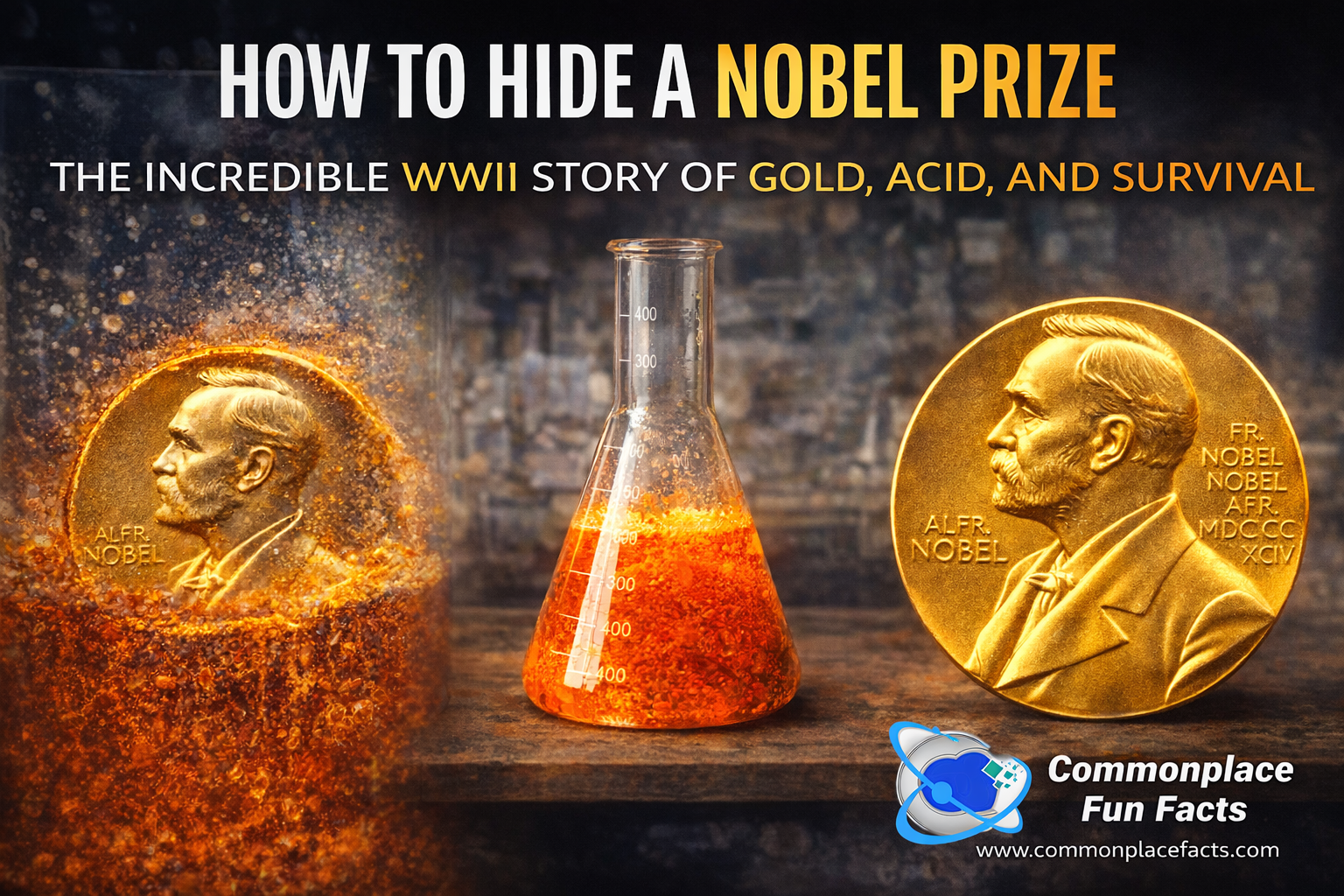

A Nobel Prize medal is the world’s fanciest decorative accessory. It’s heavy. It’s gold. It has your name engraved on it in a way that screams irreplaceable. It is, in every practical sense, the opposite of anything meant to pass unnoticed during difficult times.
Under normal circumstances, this is the point. You are meant to display a Nobel medal. You are meant to let it sit in a velvet-lined case while visitors admire it and you politely pretend you forgot it was even there. It is designed to announce achievement.
Which raises an obvious question. Why would anyone ever think of dissolving a Nobel Prize into something unrecognizable?
A better question follows immediately behind it. After thinking about it—even briefly—why would anyone actually go through with that idea?
The answer involves war, occupied Europe, a chemistry lab in Copenhagen, and the sudden realization that a gold medal engraved with your name is not a symbol of peace so much as a very expensive liability. This is the story of how science helped pull the wool over the eyes of the Nazis—and how gold meant to honor peace was saved from being repurposed for war by temporarily turning it into an unassuming orange liquid.
Contents
Nobel Medals 101: Not Fancy Chocolates, Not Pocket Change
Depending on your background, there are several reasons why dissolving a Nobel Prize sounds insane. For most of us, the idea of intentionally destroying such an iconic and priceless object flatly defies common sense. If your daily work uniform includes a white lab coat and protective goggles, you realize the proposal brings with it a long list of logistical challenges that make it sound only marginally less unhinged.

For most of their history, Nobel medals were made of solid 23-carat gold. Each one weighed roughly 200 grams and measured about 66 millimeters across. This is not the gold-colored plastic medal that you get for doing nothing more than showing up and participating at the annual potato sack race at the county fair. This is a medal made of the stuff that will cause serious injury to your foot if your fingers are slippery.
In 1980, the composition changed. Modern medals are made of 18-carat “green gold”—an alloy that gives off faint electrum vibes—and then plated with 24-carat gold. They’re slightly lighter, usually around 175 grams, depending on category. Even so, they are still very much not pocket change.
A brief aside, because English insists on being unhelpful: gold carats measure purity, while gemstone carats measure weight. Same word. Gold uses other units of measurement that are counter-intuitive. That’s why an ounce of gold weighs more than an ounce of feathers. Same word, but entirely different meanings. English is a fun language invented by people who hated clarity.
There’s another detail that matters here. Most Nobel medals include the recipient’s name clearly engraved on a visible plate. This is wonderful for bragging rights and truly disastrous if you need deniability. You cannot convincingly claim, “No, no, this isn’t my Nobel Prize,” when your name is literally carved into it in Latin.
If someone finds it, they don’t just find gold. They find you.
When a Medal Becomes Evidence
In 1940, Germany was well into its attempted conquest of Europe. Terror spread unevenly across the continent, with millions of people discovering—often too late—that they had very personal reasons to fear the advancing Nazis. For three scientists, that fear had a very specific focus: someone might discover that German law had been violated.
The law was simple. No gold was to leave Germany. Violations were not treated as clerical errors. They were treated as crimes against the state.
Despite that, two German Nobel laureates had quietly done exactly that.

The men were Max von Laue, winner of the 1914 Prize for Physics, and James Franck, the physics laureate of 1925. One was of Jewish descent. The other was an outspoken opponent of the National Socialists. Both understood that their Nobel medals—heavy, gold, unmistakably personal objects—were not symbols of honor under the Nazi regime. They were liabilities.
So they did the only thing that made sense at the time. They sent their medals out of Germany and into Denmark, placing them in the care of a colleague they trusted: fellow physicist Niels Bohr in Copenhagen.
That plan worked—briefly.
When Germany occupied Denmark in April 1940, the calculus changed instantly. Bohr’s Institute of Theoretical Physics had a long and well-known history of sheltering Jewish scientists. The Nazis knew that. Bohr knew they knew. And now, inside his building, sat two illegally exported Nobel medals, clearly engraved with the names “Von Laue” and “Franck.”
They were not just valuable. They were evidence.
If the Gestapo searched the institute—and Bohr had no reason to believe they wouldn’t—the medals would be discovered. There was no explanation that would make them harmless. There was no way to pretend they had wandered in by accident.
They might as well have been death warrants.
For perhaps the first time in his career, Niels Bohr faced a problem physics did not immediately know how to solve.
Aqua Regia: Medieval Alchemy’s Worst Smoothie, Now With Wartime Applications
This is where chemistry enters the story, wearing a lab coat and looking faintly pleased with itself.
Gold is a “noble metal,” which in chemical terms means it is stubborn, aloof, and largely uninterested in reacting with anything. You can expose gold to air, water, and most acids, and it will sit there unchanged, judging the rest of the periodic table.
There is, however, one exception.

Aqua regia is a mixture of nitric acid and hydrochloric acid. Separately, neither acid can dissolve gold. Together, they form a chemical tag team capable of doing what almost nothing else can: convincing gold to stop being solid.
This mixture was known to medieval alchemists, who gave it a suitably dramatic name because they never met a solution they couldn’t mythologize. It smells terrible, fumes aggressively, and does exactly one party trick exceptionally well.
Gold, usually so unreactive, slowly gives in.
If you are tempted to try this at home, don’t. This is not the sort of chemistry one experiments with casually. It belongs firmly in the category of “fascinating to read about and deeply unwise to recreate.”
It does, however, present a golden opportunity for a problem with a very specific set of circumstances. When you’re out of hiding places, it turns out the periodic table can double as a security system.
Hide-and-Seek With an Orange Flask
The person who turned theory into action was a Hungarian chemist working at Bohr’s institute: George de Hevesy.

At the time, de Hevesy was simply a very capable scientist confronted with a very bad problem. A few years later, he would win a Nobel Prize of his own, which retroactively makes this story feel like history winking at itself.
Before resorting to chemistry, the group briefly debated burying the medals. De Hevesy liked the idea. Bohr did not. The ground has an inconvenient habit of being dug up, especially during occupations.
The chemistry plan won.
As German forces occupied the city, de Hevesy placed the medals in aqua regia and waited. Slowly, the gold disappeared, transforming into a bright orange solution. The medals ceased to exist as objects and became chemistry.

The flask went onto a shelf with other bottles full of colorful, unfriendly-looking liquids.
When the Nazis searched the institute, they were thorough. They examined documents, equipment, and anything that looked important. The shelf of chemicals did not register. No one picked up the beaker. No one questioned the orange liquid.
The Nobel Prizes waited out the war as acid soup.
It turns out the safest hiding place in occupied Europe was a chemistry shelf full of substances nobody wanted to touch.
After the War: Un-Dissolving a Nobel Prize
In 1943, Copenhagen became too dangerous even for people who knew how to turn gold into soup. George de Hevesy, by then very aware that his Jewish background made him a particularly poor candidate for optimism, fled Denmark for Sweden.
He left the flask behind.
This detail matters. There was no dramatic last-minute rescue of the solution, no frantic decanting under fire. The dissolved Nobel Prizes simply stayed where they were, sitting on a shelf among other bottles, quietly minding their acidic business while the war dragged on.
When the war ended, de Hevesy returned to Copenhagen and went back to the institute. The shelf was still there. The flask was still there. The orange solution had not been seized, dumped, evaporated, or mistaken for something that needed immediate disposal.

The hiding place had worked.
De Hevesy then did the reverse of something very few people have ever considered doing to a Nobel Prize. He precipitated the gold back out of solution, coaxing it from liquid chemistry back into solid metal. The medals did not magically reappear fully formed. What emerged was raw gold—the same atoms, rearranged, temporarily humiliated, but intact.
That gold was sent to Stockholm, where the Nobel Foundation recast the medals. In 1952, more than a decade after they had vanished into acid, new medals were presented to James Franck and Max von Laue.
They were not the same medals.
They were the same gold.
As a small twist in an already strange story, Niels Bohr’s own Nobel medal never joined the beaker. In early March of 1940, just weeks before the invasion of Denmark, Bohr and fellow laureate August Krogh donated their medals to a Finnish relief auction to raise funds during the Winter War. Those medals survived a very different journey and eventually ended up in a Danish museum at Frederiksborg.
Bohr’s medal did not stop traveling there.
In 2023–2024, it even made a trip to space aboard the International Space Station with Danish astronaut Andreas Mogensen. Apparently, once you’ve survived one global catastrophe, the vacuum of orbit feels like a reasonable next stop.
Related Tidbits & Miserable Medals: Nobel Problems Nobody Mentions at the Banquet
Nobel Prizes inspire reverence, speeches, and formalwear. They also attract confusion, theft, and the occasional international incident.
Explaining a Medal and Physics to Airport Security
Not all Nobel-related trouble comes from occupying armies. Sometimes it comes from airport security in North Dakota.
In 2011, physics laureate Brian Schmidt had what is perhaps the most Fargo experience a Nobel Prize has ever had. While visiting family, his grandmother asked a reasonable and entirely human question: could she please see the Nobel medal? Schmidt, obliging, brought it along.
On the return trip, the medal went through airport security’s X-ray machine. On the screen, it appeared as a perfectly opaque black disk—because gold is extremely dense and airport scanners are not calibrated for symbols of human achievement. Security officers, understandably concerned, asked what it was.
Schmidt explained that it was a gold medal.
They asked who had given it to him.
Schmidt replied, quite accurately, “The King of Sweden.”
This did not help.
When asked why the King of Sweden had given him a gold medal, Schmidt answered, “Because I helped discover the expansion rate of the universe was accelerating”—a statement that is both true and wildly ineffective in calming an airport security situation.
Eventually, everything was sorted out. The Nobel Prize was allowed to board the plane. The universe continued expanding. Fargo remained Fargo.
Excuse Me, But I Think You Have My Nobel Prize
In 1975, two Nobel laureates in economics managed to create a problem no one anticipates on awards night: they went home with each other’s medals. The recipients were Leonid Kantorovich, a Soviet mathematician and economist, and Tjalling Koopmans, a Dutch-American economist. Both men were awarded the Nobel Prize in Economic Sciences for their work on optimal allocation of resources. At some point amid the ceremony, photographs, and formal congratulations, each left Stockholm holding a Nobel medal that was entirely authentic—and entirely wrong.
The mistake went unnoticed at first. Nobel medals are identical on the front, and checking the inscription on the reverse is not usually part of the post-banquet routine. By the time the error was discovered, the laureates had returned home—one to the United States, the other behind the Iron Curtain.
Correcting the problem turned out to be far more complicated than causing it. Exchanging medals now required official permissions, diplomatic correspondence, and the careful navigation of Cold War bureaucracy. What should have been a simple swap instead stretched on for several years, with both economists technically in possession of a Nobel Prize that did not belong to them.
The medals were finally exchanged in 1978. Order was restored. History moved on. The episode remains a quiet reminder that even humanity’s highest intellectual honors are still physical objects—and that once symbols like these leave the ballroom, we are not especially well equipped to manage them without forms, stamps, and delays measured in years.
Some medals have been stolen outright, including one belonging to a famous American writer, which vanished and later reappeared like a lost library book with an exciting backstory. Others have been sold, pawned, misplaced, or quietly worried over by estates realizing that their inheritance includes something both priceless and exceptionally easy to mismanage.
The uncomfortable throughline here is not that gold is dangerous.
It’s that people are.
The Gold Standard of Hide-and-Seek
The Nobel Prize was never intended to be a liability. It was designed to honor discovery, reward insight, and sit quietly in a display case while history admired itself.
But history has a way of repurposing objects without asking permission.
In occupied Europe, a gold medal with a name engraved on it stopped being an honor and started being evidence. It marked its owner. It marked its custodian. It proved laws had been broken and loyalties declared. Left in plain sight, it would have done exactly what the regime expected gold to do: be seized, melted down, and put to work for violence.
Instead, it was neutralized—not by force, not by secrecy, but by chemistry. The medals survived because someone understood that the safest place for conspicuous gold was not underground or behind locked doors, but somewhere no one thought to look: among ordinary chemicals, doing nothing interesting at all.
The Nazis searched for weapons, documents, and people. They did not search for flasks that looked like experiments gone nowhere.
When the war ended, the gold emerged unchanged in every way that mattered. It was recast. The names returned to their rightful owners. The medals resumed their intended role as symbols of achievement rather than proof of defiance.
It’s tempting to frame this as a triumph of chemistry, or cleverness, or even luck. In truth, it’s a reminder of something simpler and more unsettling: ideas last, symbols endure, and the people who understand both are often forced to make quiet, improvised decisions that never appear on plaques.
For a few years in Copenhagen, peace was hidden in plain sight—bright orange, politely ignored, and waiting for a world that could recognize it again.
You may also enjoy…

Sir Nevill Mott: The Absent-Minded Nobel Laureate
Sir Nevill Francis Mott (1905-1996) won the Nobel Prize for Physics in 1977. He was a professor at the University of Manchester, Cambridge, and the University of Bristol. His students remember him as brilliant — and a bit batty. He was, by all accounts, the quintessential absent-minded professor. While teaching at Bristol, he started the…

IG Nobel Prize Honors the Wild Discovery That Some Mammals Can Breathe Through Their Anuses (And Other Breakthroughs In Quirky Science)
The IG Nobel Prizes celebrate quirky and humorous scientific achievements, addressing unusual questions and offering entertaining insights. This year’s winners included studies on mammal respiration, pigeon missile navigation, and plant imitation. The awards feature absurd demonstrations, while winners received symbolic prizes, highlighting the amusing side of scientific inquiry and curiosity.

Olympic Competition Couldn’t Divide This Eternal Friendship
What happens when two highly-competitive friends go head-to-head in the biggest competition in the world? Something has to give; will it be friendship or Olympic-sized dreams? When the world’s top athletes gathered in Berlin for the 1936 Olympic games, two Japanese pole vaulters proved that friendship was something more precious than a medal. When American…






Leave a Reply