

Nuclear War False Alarms: The Bad News That Could Be a Lot Worse
People do not enjoy hearing bad news. This is not a controversial statement.
We develop elaborate social rituals around its delivery. There is a tone for bad news. A posture. A facial expression. There are chairs involved. Possibly a clipboard. Very often, a deep breath just before the sentence begins.
If your doctor needs to tell you that it is time to put your affairs in order, you expect the message to be delivered with appropriate seriousness. You do not expect it to arrive via a singing telegram. You do not expect it as an emoji-laden text message containing a skull, a stopwatch, and an aggressively upbeat thumbs-up.
More importantly, you expect the doctor to be sure.
You assume the lab results belong to you and not the patient in the next room. You assume the charts have not been mixed up. You assume that your hangnail has not been misread as a sign that it’s probably time to get a jump on your Christmas shopping and cancel any long-term plans.
In short, when the news is irreversible, you expect professionalism and accuracy to be doing some heavy lifting.
We carry those same expectations into much larger, more abstract territory. If the end of the world is imminent—if civilization itself is about to wrap things up—we assume the announcement will be handled carefully. Deliberately. By people who are very, very sure. We expect redundant checks, clear authority, and procedures designed specifically to prevent anyone from delivering that message by accident.
History suggests this confidence may be optimistic.
This is an article about the times the word has gone out that the end is nigh—and about how even the most carefully designed systems for delivering humanity’s worst news have a habit of going sideways. It is about trust, procedures, and the deeply uncomfortable fact that civilization rests on systems built by people who occasionally mix up files, misread signals, and press the wrong button while meaning well.
Contents
Authority by Signal: When Silence Becomes Data
One of the strangest — and most revealing — examples of this faith in systems comes from the United Kingdom’s nuclear deterrent policy.
British nuclear missile submarines operate under the assumption that in the event of a catastrophic attack, they may be completely cut off from command. No radio contact. No instructions. No confirmation that the government even exists anymore.

Although the British government is oddly unwilling to share its most classified national security procedures with us, it is widely reported that submarine commanders have been given an almost charmingly mundane way to resolve the uncertainty. They are instructed to listen for the BBC’s Today program on Radio 4.
If Today is broadcasting as usual, the assumption is that Britain still exists in some functional form. Parliament may be stressed. London may be having a bad day. But the state is still alive.
If Today disappears for three consecutive days, however, the assumption shifts. At that point, commanders are meant to presume that the British government has ceased to function. Only then are they authorized to open the prime minister’s sealed “Letters of Last Resort,” instructions written in advance for what to do with a nuclear arsenal if the country itself has vanished.
Pause for a moment and appreciate the audacity of this system.
Not satellites. Not encrypted command signals. A morning radio show.
That is how state authority is confirmed. If a presenter is still discussing traffic delays, the apocalypse has been postponed.
Yes, this is policy.
Even better: in 2004, a technical issue caused about fifteen minutes of unexpected silence during Today. It triggered concern — but not panic — because the protocol doesn’t react to minutes or hours. It reacts to three full days.
The end of the United Kingdom, according to this system, must be persistent enough to outlast weekend scheduling quirks.
This is both reassuring and alarming, depending on how much faith you place in radio transmitters.
Emergency Broadcast System: A Machine Built for Bad News
In the United States, Cold War confidence took a different form: the Emergency Broadcast System, or EBS.
EBS was designed to interrupt radio and television programming nationwide in the event of a catastrophic emergency. Nuclear war was the implied headline, but the system could also be activated for any crisis serious enough to warrant immediate federal attention.

This was not a sleek system. It existed during the teletype era. Alerts arrived as clattering strips of paper printed by machines that sounded like they were reliving their own trauma in real time.
The system relied on authentication codes. This was critical. Without them, the entire enterprise would be a magnet for pranksters, foreign agents, and extremely bored radio technicians.
If the message wasn’t authenticated, broadcasters were meant to ignore it. If it was authenticated, they were meant to treat it as real.
On paper, it was foolproof.
Paper has never met a human being.
February 20, 1971: The Wrong Tape
On a quiet Saturday morning in February 1971, a routine test was scheduled within the Emergency Broadcast System.
It was routine, that is, until a teletype operator loaded the wrong punched tape.
The system behaved as it was supposed to in an actual emergency. It transmitted a real, properly authenticated Emergency Action Notification. No “TEST” label. No clarification. Just the message that, within the logic of the system, meant something unimaginably bad was happening.
The alert went out at approximately 9:33 a.m. Eastern Time with the authentication codeword “HATEFULNESS,” which feels less like a password and more like an emotional assessment of the era.
Broadcasters across the country received instructions that translated to: stop regular programming; a national emergency exists; stand by for further orders.
If you imagine instant panic, imagine again.
When Messages Are Too Big to Believe
When the alert came in, many station managers did not immediately flip the switch and announce the end of everything.
They hesitated. They waited. They tried to confirm what, exactly, they were looking at. This was not an act of rebellion or cowardice; it was the professional equivalent of squinting at a warning label and thinking, that can’t possibly be right.
Part of the problem was that reality itself refused to cooperate. There were no sirens howling outside. No follow-up instructions rushing in. No secondary confirmation suggesting that this was, in fact, the moment civilization had chosen to wrap things up. The message was catastrophic, but the surrounding world stubbornly continued behaving like a normal Saturday morning.
This kind of hesitation is deeply human. When information is catastrophically out of scale, our brains rarely leap straight to action. Instead, they stall. They look for a second source. They check whether anyone else in the room seems alarmed. When reality and instructions disagree violently, instinct demands a receipt.
The mistake went unrecognized for roughly twenty-six minutes. That is not a long time in most areas of life, but it is an eternity for a system that is designed to give people enough time to try to get to shelter or make peace with God. By Cold War standards, that is an uncomfortable amount of time to let a message like that linger.
Retracting a False Warning Is Surprisingly Hard
Once officials realized what had happened, they ran straight into the system’s second, and arguably more impressive, flaw.
Canceling the alert required its own authentication process, complete with a different codeword. Unfortunately, the correct cancellation code was not immediately available. Several attempts to retract the message failed. In terms of system design, this meant that ending the world accidentally was easier than explaining that you did not mean it.
The safeguards meant to prevent false “all clear” messages were working perfectly; they were just working against the wrong problem. The apocalypse, it turned out, was easier to start than it was to stop.
Eventually, about forty minutes after the original alert, a properly authenticated cancellation finally went out using the codeword “IMPISH,” which remains one of the stranger emotional pivots in recorded history. Few words have ever carried so much relief while sounding so unserious.
The crisis ended quietly. Most of the country never noticed. The paperwork, however, told a very different story.
The Crisis That Never Escaped the Room
The strangest aspect of the 1971 false alarm is how little it affected anyone outside professional circles.
The Emergency Broadcast System depended on broadcasters to amplify the message publicly. Broadcasters hesitated. Their skepticism, born of experience and an unwillingness to panic without proof, acted as an accidental failsafe. The absence of corroborating evidence worked like a pressure valve.
In this case, distrust did not weaken the system. It saved it.
False Alarms Are a Genre
This incident was not a historical anomaly. False alarms and near-misses form their own quiet subgenre of Cold War history.

Again and again, disaster has been narrowly avoided not because systems performed flawlessly, but because individuals noticed inconsistencies and chose caution over procedure. Radar glitches. Faulty sensors. Misinterpreted data. Each time, someone had to decide whether the warning in front of them made sense in the context of the world outside the window.
In 1983, Soviet officer Stanislav Petrov famously ignored what appeared to be a confirmed missile launch warning because the scenario struck him as implausible. The system said one thing. His judgment said another. He chose skepticism over protocol.
The world continued, largely unaware of how close it had come to a very different afternoon.
Hawaii, 2018: Same Story, Better Distribution
On January 13, 2018, Hawaii provided a modern demonstration of what happens when hesitation is removed from the chain.
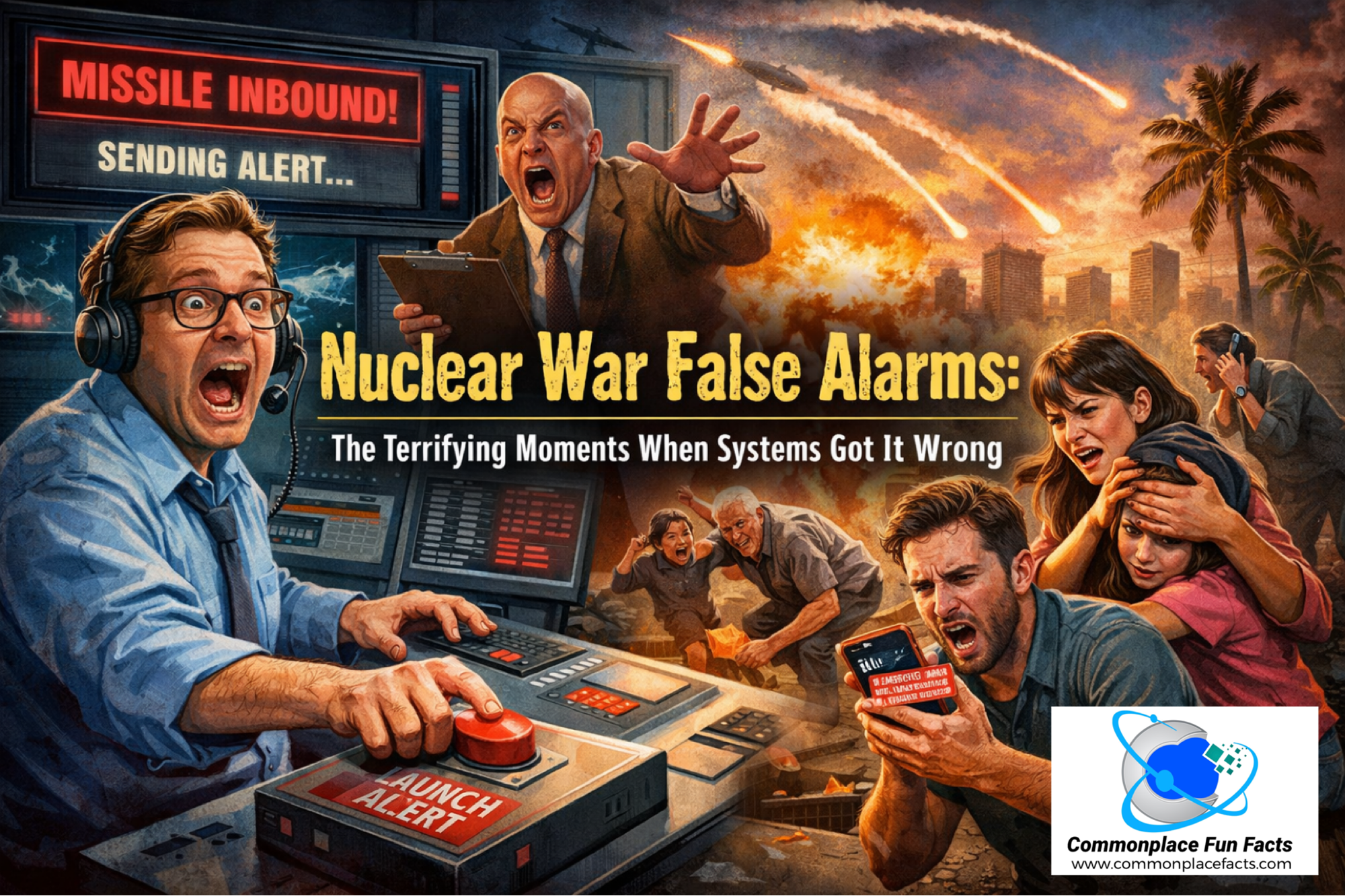
An emergency alert went directly to phones across the state, warning of an inbound ballistic missile and emphatically informing residents that this was not a drill. There were no station managers to pause, no engineers to squint at reality and ask for confirmation.
People panicked immediately. Parents shielded children. Goodbye messages were recorded. Bathtubs were assessed for their bunker potential, a task few people had imagined they would be performing when they got out of bed that morning.
This reaction did not occur in a vacuum. At the time, tensions with North Korea were unusually high, and the Hermit Kingdom had spent months conducting ballistic missile tests in the vague general direction of Hawaii, often without warning. When the alert arrived, it did not read like a hypothetical. It read like confirmation. The natural assumption, for many, was not that the system had failed—but that this time, it was real.
As it turned out, the alert was false. Officials realized this relatively quickly. Letting the rest of the world know, however, took thirty-eight minutes.
Once again, the system proved excellent at sending catastrophe and painfully slow at retracting it. Part of the delay involved internal procedures. Another part famously involved someone not knowing a Twitter password, a detail that becomes less funny the more seriously you think about the stakes involved.
The Real Problem Isn’t Technology
It is tempting to blame old equipment or clumsy interfaces, but that explanation does not survive a comparison across eras.

The real weakness persists whether the system runs on punched tape or smartphone notifications. These are not purely technical systems. They are social ones. They depend on human judgment, interpretation, and the expectation that everyone involved will perform flawlessly under extreme pressure.
They assume clarity where ambiguity thrives and certainty where reality hesitates.
The Uncomfortable Truth
The unsettling lesson threaded through all of these stories is that warning systems are not guardians of truth. They are guardians of authorization.
They are very good at ensuring that messages come from the right place. They are far less reliable at ensuring that the message itself reflects reality. We trust them because we want to believe that when civilization ends, someone will know it has ended.
In practice, the system can only truly be tested when it is actually needed. In all likelihood, that also means there won’t be a lot of people left over to ask what needs to be tweaked for the next time it needs to be used.
The thing that has saved us, repeatedly, is human doubt — the quiet, irritating voice that says, “Let’s confirm this.” That voice slows everything down. It frustrates processes. It annoys people who really want things to run smoothly.
That same doubt, however, could work against us and prevent proper warning and preparation for the real deal.
The end of the world may not come with sirens or trumpets. It may come with a procedure followed perfectly in every way except the most important one.
You may also enjoy…

Nuclear War False Alarms That Almost Triggered World War 3
Discover the shocking real-life nuclear war false alarms that almost led to nuclear war. Learn from these critical moments in Cold War history!

Able Archer 83: The NATO Exercise That Almost Started World War III
In November 1983, NATO’s Able Archer exercise nearly triggered World War III when the Soviet Union mistook it for a real nuclear strike. Discover how a military “war game” brought humanity to the brink — and why no one knew until years later.

Flash Override: Too Big for a Busy Signal
Flash Override was the Cold War’s ultimate priority phone system, letting presidents and generals cut through any call instantly. Discover how AUTOVON worked, who could use it, and why you’ll never get it for pizza delivery.






Leave a Reply to Commonplace Fun FactsCancel reply