
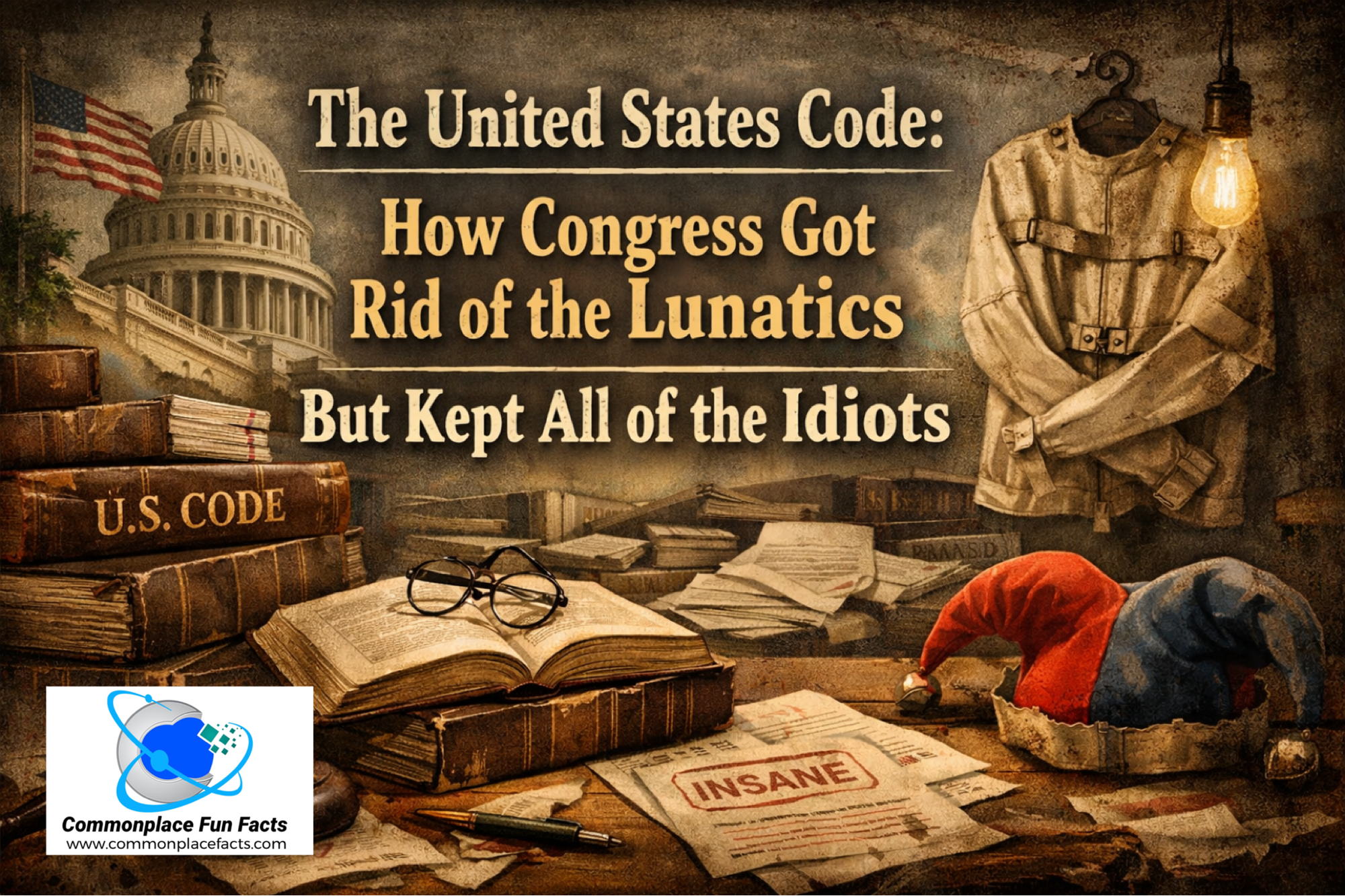

The United States Code: A Love Letter Written by a Photocopier
If you ever decide you’d like to learn all of the federal laws of the United States, there is a source for that. It is called the United States Code. It is available online or you can peruse its printed form. It is not a book (actually it is spread across more than 50 massive volumes) so much as an endurance event disguised as a reference manual, like the Boston Marathon but with footnotes and a higher incidence of passive voice.
The Code is organized into titles, and it has a lot of them. The exact number changes over time, because the federal government is like a person who keeps reorganizing their closet and insisting it’s “a new system,” when really it’s the same pile of stuff with a different label and a faint smell of despair.
Still, if you commit to this journey, the Code does something almost merciful early on: it gives you definitions. This makes sense. If you’re going to read a million pages of law, you should know what the words mean. Or at least what Congress says the words mean, which is an entirely different category of meaning—more like a landlord’s definition of “minor cosmetic issue.”
Contents
The Dictionary Act: Where Congress Explains How Words Work
Very early in the United States Code—before you encounter anything dramatic like crimes, penalties, or agencies with intimidating acronyms—you run into something deceptively modest: a set of rules explaining how to read the rest of the law. Unlike the uncodified British system of classifying criminals according to how classy they are, the U.S. Code attempts to make sure all of our definitions carry the force of law. This is attempted through the Dictionary Act, and its job is not to define every term, but to define how definitions themselves should behave.
Think of it as Congress clearing its throat and saying, “Before anyone starts arguing about what we meant, here are some ground rules.”

This is where you learn that, in federal law, the singular can include the plural, the plural can include the singular, and the present tense can include the future. Masculine words can include feminine words as well, which is admirable in the sense that it’s inclusive, but also hilarious because it comes paired with the unmistakable energy of a bunch of lawmakers muttering, “Fine. Whatever. Just write it down so we can get back to the golf course.”
On paper, it reads like a legal version of a magician’s disclaimer: nothing you are about to see should be taken too literally, except when it absolutely must be. Courts are instructed to follow these definitions “unless the context indicates otherwise,” which is legal code for “use this until it causes a problem, at which point please improvise responsibly and pretend that we knew what we were doing.”
It includes such helpful guidance as:
In determining the meaning of any Act of Congress, unless the context indicates otherwise—
words importing the singular include and apply to several persons, parties, or things;
words importing the plural include the singular;
words used in the present tense include the future as well as the present;
words importing the masculine gender include the feminine as well;
Conceptually, this is a clever system. Rather than redefining these interpretive rules in every law Congress passes, they are centralized in one place. Practically, it means the federal government is still leaning on linguistic scaffolding erected in the nineteenth century and reinforcing it with footnotes.
So when you see definitions like the one above, you are not just seeing statutory language. You are seeing an institutional fossil: something that was once contemporary, then became old, then became awkward, and finally became the kind of thing everyone agrees is strange but nobody wants to rewrite because rewriting law is how you accidentally fund the retirement plans of trial lawyers.
Which is how, nestled among rules about tense and number, you eventually stumble upon the government’s definition of “insane,” sitting there quietly, like a raccoon that has been living in the attic since 1871 and has somehow acquired legal standing.
The Definition That Accidentally Explains Itself
Just as you are questioning your sanity for attempting to read federal law recreationally, Congress anticipates your mental state and provides a definition:
the words “insane” and “insane person” shall include every idiot, insane person, and person non compos mentis;
In case you are wondering, non compos mentis is not the term for members of the exclusive fraternity for members of Congress. It is Latin for “not having control of one’s mind.” Which means Congress has helpfully defined “insane” as including an insane person and a person who is not in control of their mind. So: not sane.
And, yes, we suppose it could also refer to the membership of the exclusive fraternity for members of Congress.
This is like defining “wet” as including water, wetness, and a person who is damp. It’s technically true, but it also suggests the definitions were written at a point in history when a good health plan consisted of a steady supply of leeches.
Still, this is not merely a lazy definition. It is a historical lazy definition. And history, as always, makes everything weirder.
Wait, It Used to Be Worse
As strange as the current definition looks, it is actually an improved version. Until 2012, the same provision read:

the words “insane” and “insane person” and “lunatic” shall include every idiot, lunatic, insane person, and person non compos mentis;
There it is. “Lunatic.” A word that now lives mostly in old novels, cartoon sound effects, and the occasional family group text about someone’s reaction to pineapple on pizza.
For a long time, “lunatic” wasn’t just an insult. It was an actual legal term, with an actual history. It comes from an old belief that the moon could influence a person’s mental state. Hence: luna. Hence: lunatic. Hence: Congress, apparently, doing astrology with paperwork.
Eventually, someone noticed that modern federal statutes probably didn’t need to sound like they were written by a Victorian doctor who also sold patent tonics on the side.
The “21st Century Language Act” (a.k.a. A Bill With One Job)
In 2012, Congress passed something called the “21st Century Language Act.” This title makes it sound like the government finally discovered the internet and is now prepared to address the crisis of people saying “LOL” in official documents.
In reality, the law had a very specific goal: remove “lunatic” from the U.S. Code.
The supporters argued that “lunatic” had become outdated and was used largely as an insult. In other words: Congress noticed that one of its words had become socially radioactive, and it decided to dispose of it responsibly, like you’d dispose of asbestos—carefully, quietly, and without touching anything else in the process.
The law passed. The word “lunatic” was scrubbed from federal law. The United States became, officially, a lunatic-free nation.
The One Man Who Defended “Lunatic”

There was, however, one congressman who voted against this measure.
Texas Representative Louie Gohmert was reportedly the sole holdout. He objected, saying that eliminating “lunatic” from federal law was not a priority when the country faced serious fiscal issues, and that, in fact, the word should be used to describe the people who wanted to continue “business as usual” in Washington.
This is a rare moment in American history where a man attempted to preserve Victorian terminology specifically so he could continue calling other lawmakers lunatics, but with the added benefit of statutory backing.
It did not work. The bill passed anyway. Congress removed “lunatic.” The law survived. The vibes did not meaningfully improve.
Why Did “Lunatic” Go, But “Idiot” Stayed?
Here’s the part that really makes the whole story pop: Congress removed “lunatic” but left “idiot.”
This feels like renovating an old house by installing pipes but still having to use the outhouse.
But there is a reason, and the reason is the same reason the law is full of linguistic relics: once a word becomes a legal category, it lingers. Terms like “idiot” weren’t always just playground insults. In the nineteenth and early twentieth centuries, they were used as formal classifications in law and medicine. They appeared in guardianship standards, competency questions, and institutional policies. The law didn’t keep the word because it was charming. The law kept the word because the law is a hoarder.
The legal system is allergic to changing language because changing language can change outcomes, and changing outcomes is how you get court opinions that begin with the phrase, “This case presents a question of first impression,” which is judge-speak for “We all wish this had been resolved by somebody else.”
So the term remains, not because anyone thinks it’s tasteful, but because replacing it would require a careful sweep of statutes, cross-references, and old interpretive assumptions. And that is work. And Congress has a complicated relationship with work.
In other words, Congress got rid of the lunatics, but decided to keep all of the idiots.
No commentary needed. This one speaks for itself.
This Is Not Unique: The Law Keeps Old Words Like Souvenirs
Once you notice this phenomenon, you can’t unsee it. The law is packed with terminology that still “works” legally even if it sounds bizarre culturally.

Immigration law, for example, has long used the word “alien.” It is a technical term with a long history, and it persists because statutes don’t care if a word sounds like a sci-fi villain. Statutes care whether the word has a settled meaning in case law. If it does, it sticks.
Federal law also loves “shall,” a word that has caused more litigation than tobacco products. “Shall” usually means “must.” Except when it doesn’t. In which case it means “may,” or “should,” or “we meant this as a suggestion,” or “please consult 800 pages of judicial opinions and then return to the beginning with new sadness.”
And then there’s “person,” which can include corporations and associations. This is why you occasionally read a Supreme Court opinion and realize you are living in a society where a paper entity can have speech rights while a human being cannot get a simple customer service call resolved without entering a labyrinth of automated menus.
The law, in short, is less a living language than an archaeological site with filing cabinets.
The Real Joke Is That This Is How We Communicate Power
The enduring weirdness of definitions like this isn’t just about old-fashioned terms. It’s about how institutions speak. Statutory language has a job: it assigns authority, creates categories, distributes rights, and triggers consequences. It’s not trying to be poetic. It’s trying to be enforceable.
And enforceable language tends to be conservative in the literal sense: it conserves. It preserves. It keeps old words around because old words come with old interpretations, and old interpretations reduce uncertainty.
That’s great for stability. It’s awesome for lawyers who want to pay the bills. It is less wonderful for anyone hoping the law might occasionally sound like it was written to be understood by anyone born after the McKinley administration.
So Congress occasionally steps in and modernizes a term—usually when the term becomes an embarrassment. But it does so cautiously, like someone removing a single Jenga block from a tower they didn’t build and don’t fully understand.
And that, basically, is why we got a “lunatic” purge without ridding us of “idiots.”
A Lunatic-Free Nation (and Other Aspirational Statements)
Thanks to the “21st Century Language Act,” the United States is now, by statute, free of lunatics.
The definition of “insane,” however, still includes “every idiot.” Which means that, legally speaking, we have achieved a kind of linguistic minimalism: we removed the moon-based term but kept the one that now functions mainly as a rude comment in traffic.
And maybe that’s the perfect summary of Congress’s relationship with language: it will modernize the parts that make it look bad, while preserving the parts that are useful, entrenched, and difficult to untangle.
The law does not evolve like a conversation. It evolves like a coral reef—slowly, accreting layers, occasionally shedding something when it becomes too sharp, and always capable of producing something startling if you swim too close without protective gear.
If nothing else, this episode should reassure anyone who fears the government is moving too quickly. The United States Code is still out here carrying nineteenth-century vocabulary into the twenty-first century like it’s a family heirloom.
It is not efficient. It is not elegant. It is not even particularly sane.
But it is, unmistakably, the law.
At least we have the comfort of knowing that it’s not overseen by a bunch of lunatics.
You may also enjoy…

Law & Order – Hammurabi’s Code Division
Think you know about Hammurabi’s Code? Learn about its unusual provisions and why it was a lot fairer than the alternatives.

Is the Tomato a Fruit or Vegetable? The Supreme Court Decides
Is the tomato a fruit or vegetable? The US Supreme Court finally answered that all-important question.

The High Court Grapples With “What Is Golf?”
“Either out of humility or out of self-respect (one or the other) the Court should decline to answer this incredibly difficult and incredibly silly question.”



Leave a Reply to Commonplace Fun FactsCancel reply