
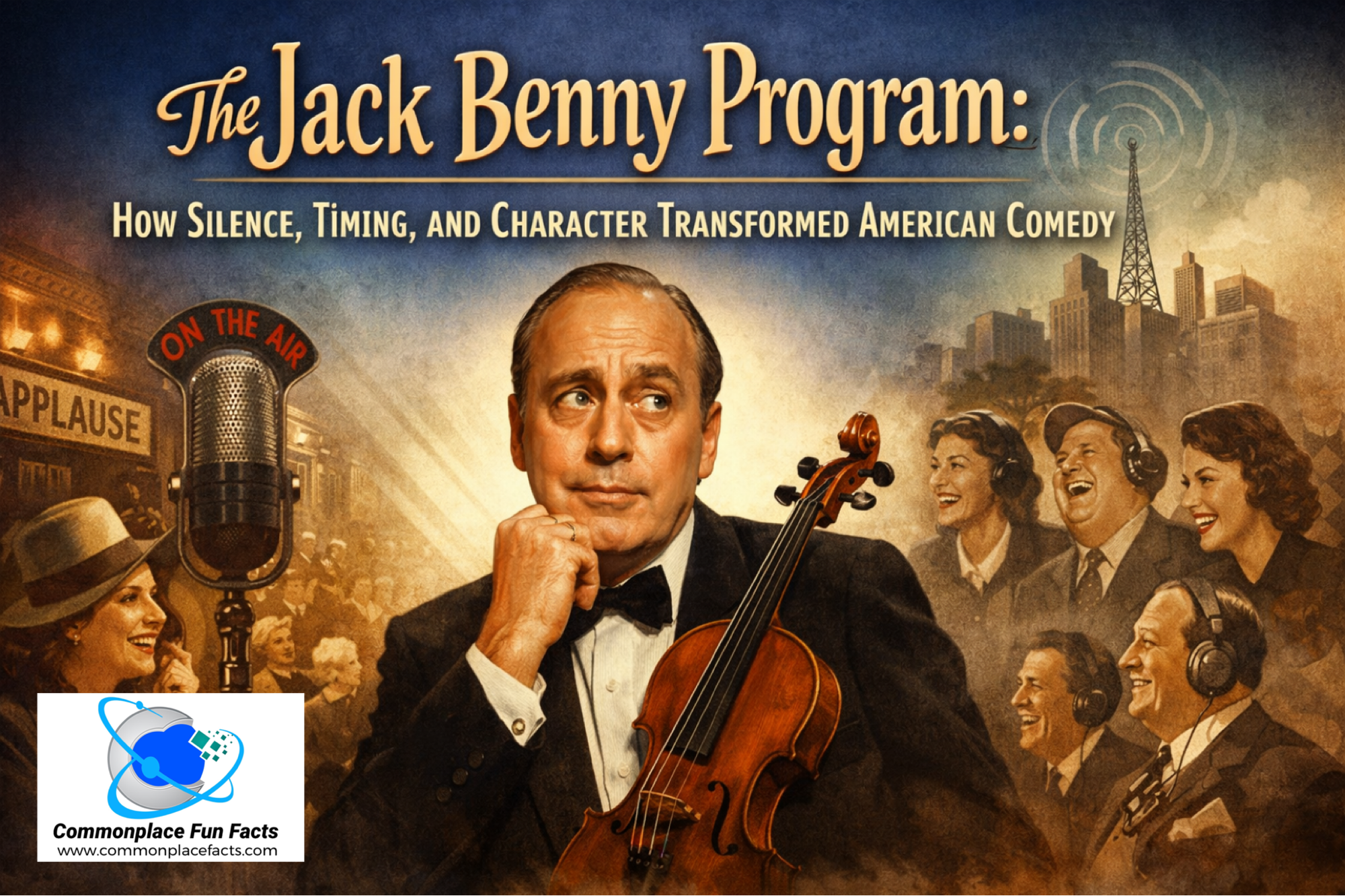

There are many ways to get people to laugh.
You can talk fast. You can pile on jokes until the audience gives up and laughs out of exhaustion. You can raise your voice, drop a punchline every three seconds, or keep everyone moving so quickly that no one notices whether any of it actually landed.
Jack Benny did something different.
He stopped. He said nothing. He just paused and waited.
On the radio.
Think about that for a moment. He did this on a medium that depends entirely upon sound and treats silence the way nature treats a vacuum.
And somehow, impossibly, it worked. It didn’t just work—it succeeded spectacularly and along the way, he managed to single-handedly transform the art of comedy.
This was the great paradox at the center of Jack Benny’s success. His most powerful tool was not a joke, or a prop, or even a particularly memorable catchphrase. It was tempo. A deliberate, unhurried rhythm that trusted the audience to wait—and rewarded them for doing so.
This article isn’t about a hit comedy show, though it certainly was one. It’s about something stranger and more consequential. The Jack Benny Program didn’t just make people laugh. It created the phenomenon of the situation comedy with well-known characters, and it trusted that its listeners were intelligent enough to figure things out on their own. It taught millions of fans how to hear comedy, how to remember it, and how to find humor not in what was said, but in what was about to be said.
Contents
A Genius In Training: Vaudeville, Violins, and Learning What Didn’t Work
Long before Jack Benny taught America how to wait, he learned—to his cost—how easily an audience could lose interest. He did not begin as a master of timing so much as a violinist who discovered comedy by accident.

Born Benjamin Kubelsky in Chicago, in 1894, he started violin lessons as a child and quickly showed promise. By his teens he was playing in vaudeville theaters, where audiences expected immediate engagement and unrelenting sound. He played the violin seriously. And by all accounts, he was… fine. Not extraordinary, but not terrible. Not memorable. Just competent enough to be completely overshadowed by louder, flashier performers. He was trained, competent, and earnest—but mere earnestness on the violin wasn’t going to cut it in the cutthroat world of vaudeville.
The audience response was devastating in its clarity. Occasionally, they were polite. Frequently, they heckled. They were restless. They waited for something else to happen.
Jack couldn’t help but notice this. The breakthrough came when he stopped pretending not to notice. He began to acknowledge the audience’s impatience, first accidentally, then deliberately. He started interrupting his own playing with comments. Then with feigned irritation. Then with jokes.
Across his early years he refined his act—first serious, then increasingly peppered with comic asides, facial expressions, and moments that acknowledged what the audience was thinking. It wasn’t that he found humor so much as that he discovered the absence of humor and learned to exploit it.
Then came World War I and a fateful stay at the Great Lakes Naval Training Center. During an impromptu performance, a crowd of sailors began booing his violin. According to one oft-told story, fellow sailor and future actor Pat O’Brien leaned in and whispered something that changed Benny’s trajectory: “For heaven’s sake, Ben, put down the … fiddle and talk to ’em.”

What followed was a revelation. Benny dropped the pretense of playing, started talking, and the laughs exploded from the audience. In that moment of ad-libbed connection he glimpsed what would become his true vocation: not the perfection of the instrument, but the orchestration of expectation, restraint, and reaction.
This shift—from serious musician to comic persona—didn’t happen overnight, but it set the course. After the war, Benny continued in vaudeville with acts that featured both music and comedy, worked under various names, and even altered his own to avoid confusion with other entertainers. Slowly, the violin became less of a showcase and more of a prop. By the early 1920s, the music had ceded center stage to the humor he now carried naturally.
His comedic giftedness was noticed by his peers. In fact, he was actively courted by the Marx Brothers to join their team. Jack’s style was suited for a different sort of performance, however. He continued to establish himself on the stages of vaudeville, standing out as an unexpectedly hilarious oasis of calm in the midst of vaudeville’s loud and boisterous buffoons.
But while vaudeville taught him how to survive noise, it was radio that taught him how to use silence.
The combination would change everything.
The Jack Benny Program Hits the Airwaves
Radio was, in every respect, a different beast. Gone were visual cues and physical gestures. Personality, timing, and presence now had to come through voice alone. Jack’s early radio appearances, beginning with a guest spot on a show hosted by Ed Sullivan, introduced him to a broader audience and honed his ability to communicate character. His first words on the radio set the stage: “Hello, folks! This is Jack Benny talking. There will be a slight pause while you say, ‘Who cares?’”

No one could have imagined how masterfully this newcomer to radio would use the “slight pause” over the next 42 years.
Crucially, Benny did not abandon vaudeville’s lessons. He refined them. He understood how dangerous silence could be—but he also understood how, when delivered masterfully, it could be incredibly powerful.
Shortly after his first radio appearance, Benny was offered a show of his own. The Jack Benny Program debuted on May 2, 1932.
Benny’s early radio appearances were rough by his later standards. He talked more. He filled space. He behaved like a vaudevillian trying not to disappear. Even then, there was a version of Jack Benny already moving toward what would define him for decades: stingy, vain, slightly pompous, easily wounded, endlessly patient with himself and impatient with others, and quietly confident that if he simply waited long enough, the audience would follow.
The violin remained, but now as a prop rather than a credential. The pauses lengthened. The self-awareness sharpened. The beginnings of an ensemble dynamic started to form.
The instincts learned on stage began to assert themselves. He understood audiences intimately. He knew when they were ahead of him and when he needed to let them catch up. He sensed when the silence was working instead of threatening. Over time, he began to lean into that space rather than fear it.
His was the voice of a comedian who trusted silence as much as sound, who knew audiences better than he knew his own violin, and who was learning—slowly but unmistakably—how to make everyone else’s reactions matter more than any words written on a script.
The Jack Benny Program was the culmination of his philosophy of entertainment: it is not what you say or do that makes people laugh—it’s what you let them imagine when you stop talking.
Radio Before Benny: Noise as a Moral Imperative
To understand just how disruptive Jack Benny’s approach was, it helps to remember what radio comedy sounded like before he arrived.
Early radio inherited its instincts from vaudeville. The pacing was fast. The jokes were frequent. Dialogue moved as if someone were charging by the word. Silence was dangerous. Silence meant something had gone wrong.

Characters talked constantly. Announcers jumped in at the slightest provocation. Sound effects padded every gap. Sponsors hovered close by, ready to rescue any stray second with a cheerful pitch and a promise of intestinal harmony.
Comedy was something delivered at the listener. The show’s job was to stay ahead of dead air. The audience’s job was to keep up.
Radio executives believed—often correctly—that if nothing was happening, people would assume the set had malfunctioned. The volume might get adjusted. The dial might get turned. The show might lose you forever.
It was vitally important that nothing was allowed to slow down.
Another holdover from vaudeville was the character development. That is to say, there wasn’t a lot. In vaudeville, every act was a stand-alone moment in time with the performers taking on whatever persona was needed to get the job done. A comedy duo might appear together as husband and wife in one skit, brother and sister in the next, and total strangers after that.
And then Jack Benny came along. He didn’t burst onto the scene announcing a revolution. He didn’t scold his predecessors or declare radio comedy broken. He simply began to move at a different speed. One slow enough that, at first, it felt wrong.
And then it didn’t.
Knowing the Characters Well Enough to Hear Their Thoughts
To say that Jack Benny trusted his audience is also to acknowledge something else: he assumed the audience trusted him. And trust, in comedy, doesn’t come from cleverness alone. It comes from familiarity. You have to know someone well enough to have a reasonable idea of how they will behave in a given situation.
Jack Benny’s greatest act of craftsmanship may not have been his timing, but the care with which he built character. By the time his pauses became famous, listeners didn’t need anyone to explain what was happening in the silence. They already knew.
They knew what Jack was thinking. They knew when he was offended, when he was calculating, when he was wounded, and when he was quietly deciding whether pride or cheapness would win the next few seconds.
For The Jack Benny Program to work, Benny understood that it could not rest entirely on his shoulders. He needed a cast of characters the audience knew and trusted just as well as they knew and trusted him. That required a deliberate break from the dominant comedy model of the time, which relied on sketches populated by characters who existed for one week and then vanished.
Jack could get a chuckle out of a sketch like that. But if the situation involved characters the audience had lived with for months—then years—those same lines could produce something much bigger.

What might have been a mild laugh became a belly laugh, not because the joke was better written, but because the audience supplied the context themselves.
This approach demanded patience. It required writing for the long game, allowing personalities to deepen, patterns to form, and expectations to harden into certainty. But if anyone was suited for that kind of work, it was the man who would become known as the undisputed master of comedy timing.
The Jack Benny Program didn’t just introduce audiences to memorable characters. It showed what could happen when ensemble comedy was built with intention, consistency, and trust—and why, once that foundation was laid, a pause could do more work than any line ever could.
The Ensemble: A Show Built to Bounce Off Itself
Despite the title, The Jack Benny Program was never a solo act. It was a comedic ecosystem.
Jack Benny may have been the gravitational center, but the humor came from what happened when other people collided with him. The show worked because it was built on friction—between personalities, temperaments, expectations, and patience. Characters interrupted each other. They disagreed. They grew irritated. They waited. Nothing moved smoothly, and that was the design.
In many radio comedies, supporting characters existed to feed setups. Here, they existed to test Jack. To provoke him. To exhaust him. The laughs emerged not from punchlines but from relationships. The show didn’t feel written so much as managed.
Each member of the cast occupied a precise role, and removing any one of them would have collapsed the rhythm the show depended on.
Mary Livingstone: The Voice That Grounded the Room
Mary Livingstone had an important role on and off the microphone. She was Jack’s wife. That wasn’t their relationship in the show, however. On the air, she was the still point of the entire operation.

Her delivery was dry, understated, and often hesitant. She did not project confidence. She did not sound eager to perform. In fact, her audible discomfort became part of the show’s texture.
This was not affectation.
Mary Livingstone famously disliked performing. She was uncomfortable on the air, uneasy with live audiences, and prone to anxiety. Her dislike of performing got to the point where she pre-recorded her lines ahead of time so they could be dubbed into what was otherwise a live performance. Her reluctance slowed the pacing further. Her pauses added weight. Her understated reactions prevented scenes from spinning out of control.
Where Jack fumed, Mary observed. Where others exaggerated, she minimized. Her presence grounded the room emotionally and rhythmically.
Paradoxically, the show needed her restraint. Without Mary, the tempo drifted toward chaos. With her, scenes found balance. She didn’t compete for attention; she absorbed it.
That reluctance—so often treated as a flaw in broadcasting—became essential to the tone. Mary Livingstone didn’t push jokes forward. She held space for them.
Don Wilson: The Announcer Who Became the Joke
Don Wilson began as an announcer, which in radio terms meant that he was supposed to remain invisible. His job was to introduce the program, read the commercials, and wrap things up by saying, “This is the National Broadcasting Company.”

That did not last.
His booming voice, square sincerity, and affable personality made him irresistible comic material. Jack Benny turned the very concept of advertising into part of the show, folding commerce into character.
Wilson’s commercial announcements became sketches. His authority as a broadcaster was gently undermined. The contrast between his confident delivery and Jack’s interruptions created a running tension that audiences recognized instantly.
This was more than a gag. It was an early form of self-aware advertising, decades before anyone pretended to invent the idea. The show acknowledged that it was sponsored, joked about being sponsored, and then sold the sponsor anyway.
In doing so, it dismantled the illusion that advertising and entertainment were separate. Radio sponsorship didn’t weaken the comedy; it became one of its engines.
Don’s girth was also fuel for many memorable moments. Remember that this is radio, and for all any of the listeners knew, Don Wilson could have been built like Charles Atlas. He wasn’t though. Don was a hefty fellow for most of his life, and that became part of his on-air persona, resulting in lines such as the one delivered from a department store during the Christmas shopping season: “I wish I wasn’t so fat. It seems that a piano is missing, and they’ve searched me three times.”
Another time, Jack was buying cufflinks for Don as a Christmas present. Initially, he had one cufflink engraved with “D” and the other with “W.” Later, upon reflection, he changed the engraving so each cufflink bore the initials “D.W.” When asked why he made the change, Jack responded, “With Don, it’s the only smart move. Otherwise, people will see the ‘D’ on one cufflink and will be curious about what’s on the other. And I want to spare them the long trip.”
Phil Harris: Chaos With a Trumpet
Mary Livingstone may have been there to offer stability to the show. Phil Harris was there to upset it.

Harris was the band leader — a role that in most programs wouldn’t even warrant a speaking part. On The Jack Benny Program, however, the band leader was a regular in the script. Harris’s persona was loud, confident, and deliberately excessive. He interrupted scenes. He had no regard for decorum. He challenged Jack’s authority openly. He behaved as if the internal rules of the show applied only to everyone else.
This mattered.
The rhythm of The Jack Benny Program depended on control. Too much control, however, would have suffocated it. Harris supplied unpredictability, injecting bursts of noise into carefully structured silence.
Musical interruptions shattered scenes just as they were settling. Boisterous confidence clashed with Jack’s insecurity. Harris gave the show occasional jolts without ever derailing it.
He was disruption with boundaries. That balance kept the ecosystem healthy.
Rochester: Power, Popularity, and the Limits of Progress
Rochester Van Jones occupied the most complex space on the show.
Played by Eddie Anderson, Rochester quickly became one of the most popular and recognizable characters in radio. He was quick-witted, openly skeptical of Jack, and often emerged as the smartest person in the room.

Importantly, Rochester usually won.
He outmaneuvered Jack verbally. He punctured pretension with ease. He voiced frustrations that others merely hinted at. Audiences loved this, and his popularity reflected it.
At the same time, the constraints of the era were unavoidable. Rochester existed within a servant role. His character was limited by expectations that the show did not fully escape.
What matters historically is the tension.
Rochester pushed boundaries without pretending to erase them. His prominence forced networks and audiences to grapple with contradictions they preferred to ignore. He was both groundbreaking and limited, empowered and constrained.
Smoothing that tension would misrepresent the period. The discomfort is part of the legacy.
Rochester may have done more for the cause of civil rights at that time than any politician. By the time his character was firmly established, the audience was as close to colorblind as anyone could reasonably expect. In short, the color of his skin didn’t matter because his character had made it utterly irrelevant.
Dennis Day: Innocence as a Comic Weapon
Dennis Day occupied a deceptively simple role on The Jack Benny Program.

He was young. He was earnest. He sang sweetly. He trusted everyone, especially Jack, with an optimism that bordered on medical concern.
He was also naïve.
No, that’s not quite right.
Dennis wasn’t naïve so much as spectacularly confident in information he did not understand. At one point, he proudly announced that he had taken an intelligence test and discovered he had an IQ of 158. When Jack expressed astonishment, Dennis quickly reassured him: “Sure—and here’s the card. It also says I have great powers of leadership and will be a great success.”
That’s when Jack cuts him off. “Dennis,” he says, “this is your weight and fortune.”
This aspect of his personality was not an accident, and it was not filler.
Dennis represented something the show needed: a character whose sincerity made Jack’s worst instincts impossible to hide. Where other cast members challenged Jack through sarcasm or irritation, Dennis challenged him through simple naïve honesty and belief.
That belief was the joke.
Dennis Day played innocence so consistently that the audience learned to recognize it immediately. He assumed good intentions. He was, without irony, trying his best.
Because of that, Jack’s pauses around Dennis carried a different weight. The silence wasn’t irritation or wounded pride—it was exasperation or bewilderment. The audience could hear Jack grasping to understand what could possibly be going through the young singer’s head.
Dennis also provided musical contrast that the show used strategically. His sincere singing, often delivered without self-awareness or flourish, highlighted Jack’s catastrophically bad violin playing in ways no verbal joke ever could. The music underscored character rather than interrupting it.
Just as important, Dennis allowed the show to explore a softer form of humor. Not every laugh came from cruelty or confrontation. Sometimes it came from the quiet tension between Dennis’s goodness and the audience’s certainty that things were not nearly as rosy as Dennis thought they were.
This dynamic worked because Dennis Day never winked at the joke. He didn’t signal awareness. He didn’t protect himself with irony. That consistency made him legible, and therefore indispensable.
In ensemble terms, Dennis functioned as a moral tuning fork. His presence sharpened every other character by contrast. He wasn’t there to steal scenes. He was there to reveal them.
And once again, the audience filled in the silence—because they already knew exactly what Dennis was thinking.
Character Dynamics at Work
Each week, the audience knew how Mary would react before she reacted, how Rochester would respond before he opened his mouth, and how the rest of the cast would position themselves around the fallout. It may have been called The Jack Benny Program, but it usually was someone other than the star who brought the comedic goods.
Benny and his writers invested years in creating characters that were consistent, legible, and deeply familiar. Not familiar in a shallow way, but familiar in the way that comes from long association. These were people the audience understood well enough to predict—and enjoy being proven right.
Because of that, the show rarely needed to tell the audience what anyone was thinking. It didn’t need narration or explanation. The characters carried their inner lives so clearly that a pause became a blank canvas.
And into that blank space, the listener’s imagination rushed in.
Consider, for example, an exchange between the announcer, Don Wilson, and guest star Dorothy Kirsten of the Metropolitan Opera in an episode from April 25, 1948. As they discuss a performance of Madama Butterfly, Jack and Mary Livingstone are listening in:
DON: Oh, Miss Kirsten, I wanted to tell you that I saw you in Madama Butterfly Wednesday afternoon, and I thought your performance was simply magnificent.
DOROTHY: Well, thank you—thanks awfully. It’s awfully nice and kind of you, Mr. Wilson. But who could help singing Puccini? It’s so expressive—particularly in the last act, starting with the Allegro vivace assai.
DON: Now that’s being very modest, Miss Kirsten. Not every singer has the necessary bel canto and flexibility, or range to cope with the high tessitura of the first act.
DOROTHY: Well, thank you, Mr. Wilson. And don’t you think that in the aria “Un bel dì vedremo” the strings played the con moto crescendo exceptionally well, and with great sostenendo?
JACK: Well, I thought—
MARY: Oh, shut up.
If you just read those words without context, it’s doubtful that you would even crack a smile. If those lines had been spoken by the characters in any other show or even in the early years of The Jack Benny Program, they would have been wasted. When they were used in this case, the result was magic. Jack would later insist that it generated the longest laugh in the history of the program. It turns out that it wasn’t (see this article to find out which gags surpassed it), but it did generate a whopping 23-second response of sustained laughter.
Twenty-three seconds.
How could that be?
Jack explained it in an interview years later: “The longest laugh, I know, that we ever got in radio, Mary got. And she did it with just three words: ‘Oh, shut up.’ Now the reason it got such a big laugh was because of the long build-up that took place during a conversation between Don Wilson and an opera singer that we had on the show. Now the audience is waiting. Mary knows that I don’t know anything about opera, and so does the audience, because the audience doesn’t think I know about anything. And then I finally start talking, and all I got was, ‘Well, I think…’ and Mary says, ‘Oh, shut up!’ And that’s not even a joke! It’s just three words, but if you take those three words, and put them in the right spot, it’s better than a joke. It’s bigger than a joke. It’s more important than a joke. If you can take three words like that that have no meaning at all except for the long build-up.”
In the context of that episode, the build-up was 41 seconds — a huge amount of time to go without a laugh in a 30-minute program. In reality, the build-up was more than sixteen years of consistent, intentional character development by a man who was willing to play the long game.
Jack Benny once explained his philosophy this way: “The show itself is the important thing. As long as people think the show is funny, it does not matter who tells the jokes.”
He didn’t just say that. He proved it—once, very deliberately.
One episode was built entirely around one of those popular “homes of the stars” bus tours. The driver would announce the next stop—“Here’s the home of Dennis Day”—and the scene would shift inside Dennis’s house for a short sketch. Then it was back on the bus, on to the next star, and into another home for another scene. The device carried the entire program, house after house, character after character.
Jack Benny did not appear in any of them.
At the very end of the broadcast, the driver’s voice returned one last time: “And here is the home of Jack Benny.”
From offstage, a familiar voice finally called out, “Driver, this is my stop!”
That was it. The only line Jack Benny spoke in the entire half hour.
Only someone with absolute confidence in his cast—and a complete lack of anxiety about his own prominence—could attempt something like that. It wasn’t a stunt performed out of ego. It was an act of restraint so complete it became the punchline.
When Jack stopped speaking, the audience didn’t wait passively. They filled the silence themselves. They imagined the internal argument, the offended dignity, the suppressed outrage, the slow decision about how small or devastating the response should be. Every listener wrote their own version of the joke in real time.
The result was something no script could outperform. The pause unleashed a flood of possibilities, each one funnier because it belonged personally to the person listening. By the time Jack finally spoke, the laugh had already happened—triggered not by what he said, but by what everyone knew he was about to say.
This was intimacy on a national scale. Jack Benny didn’t just perform for his audience; he let them inside the heads of the characters. Once that door was open, silence stopped being emptiness.
It became invitation.
The Pause: When Nothing Became the Funniest Thing on the Air
Humans are not comfortable with silence. On radio, that discomfort turns into outright panic.
There is nothing to look at. No raised eyebrow. No nervous shuffle. No visual cue to reassure you that the performer hasn’t vanished, the signal hasn’t failed, or civilization hasn’t quietly ended while you weren’t paying attention. When the sound stops, everything stops.
Jack Benny made that stoppage the joke.
The most famous illustration of this is the “your money or your life” sketch, which works precisely because it violates every instinct radio performers were taught to develop.
In the scene, a robber confronts Jack and demands, “Your money or your life!”

Jack says nothing.
Not a word. Not a reaction. Just silence.
Seconds pass.
The studio audience begins to laugh—not because something funny has happened, but because something funny is happening. Everyone knows exactly what is going on inside Jack’s head. He has heard the question. He understands the stakes. He is quite simply conflicted about which option he prefers.
The pause stretches on long enough for the audience to complete the joke themselves. They imagine the internal debate, the wounded dignity, the arithmetic. They know the decision Jack is making before he ever makes it out loud.
When the robber finally snaps, “Listen, bud! I said, ‘Your money or your life.’” Jack retorts, “I’m thinking it over!”
At that point, the line is almost unnecessary. The laugh has already arrived. The audience didn’t need to be told what Jack was thinking. They had been living inside that silence with him.
This was an astonishing inversion of radio logic. Dead air, once treated as a mortal sin, became a precision instrument. Awkwardness transformed into suspense. Silence stopped being a risk and became a promise.
Importantly, this only worked because Jack had done the hard work first. He trained his audience patiently. Week after week, he demonstrated that when the sound stopped, it meant something. It was never a mistake. It was never an accident. Something was coming—and it would be worth waiting for.
Over time, listeners learned to lean in rather than reach for the dial. They laughed before the punchline because the punchline already existed in their heads. Jack merely confirmed it.
This kind of timing was uniquely suited to radio. There were no visuals to dilute it. No gestures to soften the moment. The pause was pure, unadorned, and shared simultaneously by millions of listeners.
On stage, silence can be physical. On radio, it became communal—and Jack Benny turned it into the loudest sound in the room.
Jack Benny Plays Jack Benny: Persona as Architecture
The pauses worked because the character inside them was unmistakable.
Jack Benny didn’t play a role so much as he occupied an identity—one that was carefully exaggerated, meticulously maintained, and astonishingly durable. This Jack Benny was vain, cheap, insecure, eternally thirty-nine, and sincerely convinced of his own artistic genius despite overwhelming evidence to the contrary.

Just as importantly, he did not change.
This mattered culturally in ways that aren’t immediately obvious. Earlier entertainers often presented themselves as figures to admire. Clever. Competent. Successful. Even when they were comic, they were rarely diminished.
Jack Benny inverted that expectation.
He was not aspirational. He was defensive. He did not improve. He doubled down. His flaws were not hurdles to be cleared but features to be exploited. The joke was not that Jack occasionally behaved badly; the joke was that this was who he was, permanently.
During the 1945-46 season, the program hosted a contest: “I Can’t Stand Jack Benny Because…” in which listeners were invited to write in 50 words or less why they can’t stand him. More than 250,000 entries were submitted. The winning response summed up the enduring appeal of the character Jack worked so hard to establish:
I Can’t Stand Jack Benny Because—
He fills the air with boasts and brags
And obsolete obnoxious gags.
The way he plays the violin
Is music’s most obnoxious sin.
His cowardice alone, indeed
Is matched by his obnoxious greed.
And all the things that he portrays
Show up my own obnoxious ways.
Those words captured the real appeal of Jack Benny. He was able to hold up a mirror to all of us and make us laugh in the process. The man who was quintessentially vain taught us that we shouldn’t take ourselves too seriously.
This type of humor is virtually unknown in today’s world, where everyone seems to be so easily triggered and is quick to take offense at everything. When Jack Benny ruled the airwaves, the comedian-in-chief was able to make the world laugh by teaching it that it first needed to be able to laugh at itself.
Cultural Aftershocks: Benny Everywhere, Even When You Don’t See Him
The Jack Benny Program ran on radio from 1932 to 1955, shifted comfortably into television from 1950 to 1965, and even after that refused to disappear, resurfacing in television specials until the year of Benny’s death in 1974.

By the time The Jack Benny Program ended, its influence had already become ingrained in culture.
Slower pacing. Deadpan delivery. Long-running jokes. Performers defined by consistent flaws. Audiences trained to wait.
These ideas became defaults.
You can hear Benny’s rhythm whenever a laugh arrives before the line. You can feel it when silence lands harder than noise. You can recognize it whenever familiarity, rather than surprise, does the work.
Conclusion: America Learns to Listen
Jack Benny did not conquer comedy by overpowering his audience. He invited them in.
He assumed that listeners were paying attention and that they had functioning brains. That they remembered what came before. That they understood the people inhabiting the space between the jokes. Most radical of all, he assumed they were willing to do some of the work themselves.
That assumption reshaped comedy.
Once audiences learned to recognize characters deeply enough to hear their unspoken thoughts, silence stopped being empty. A pause wasn’t a gap in entertainment—it was a shared moment of understanding. The joke didn’t belong entirely to the performer anymore. It belonged equally to the person sitting by the radio, filling in the space.
This is why Jack Benny’s influence feels so pervasive even when his name isn’t mentioned. His descendants don’t imitate his voice or repeat his lines. They inherit his confidence that restraint can be louder than noise, that familiarity can outgun novelty, and that timing isn’t about speed—it’s about trust.
Jack Benny proved that comedy didn’t need to chase attention. It could wait for it. And in doing so, it taught American audiences something quietly radical: listening closely could be just as funny as laughing out loud.
Sometimes funnier.
AUTHOR’S NOTE: There is a long-standing rule that authors should keep themselves out of nonfiction. In this case, that rule collapses almost immediately. Jack Benny has been an inseparable part of my life since I was a little boy.
As a child, I was painfully shy and socially awkward, the sort of kid who developed ulcers while still in kindergarten, all because of having to interact with anyone outside a very small circle of friends. My mother, sensing either a problem or a project, handed me a couple of cassette tapes. On them were old radio programs. Old Time Radio did two things at once: it sparked a lifelong love of history, and it introduced me to Jack Benny.
I recognized him instantly because I had been seeing him in the mirror all my life.
Jack Benny was a well-meaning guy who routinely put his foot in his mouth and then stood there while everyone else commented on it. He was teased, interrupted, corrected, and outmaneuvered, often by his own friends. That felt familiar. But he was also something else: calm, self-possessed, and quietly in control. He didn’t need to be the one delivering the punchline. Rather than be wounded by the laughs that were directed at him, he used them as a superpower that made him strangely more popular as a result. He was confident enough to let others take the laughs, secure in the knowledge that he was the one shaping the moment.
That was who I wanted to be.
I may have been born with a generous supply of insecurity and a near-pathological reluctance to speak up, but listening to radio comedy taught me that personality didn’t have to be set in stone. There were guides along the way—Fred Allen, Bob Hope, Goodman Ace, among others—but at the top of that list was Jack Benny.
Life, as it turns out, is a situation comedy that loves irony. I eventually found myself in roles and careers that required standing in front of crowds, speaking to rooms full of strangers, and managing situations I once would have fled without apology. Only a few people close to me know how much of that terrified young boy is still very much present.
To everyone else, I have a reputation for being confident, calm under pressure, and reasonably adept at defusing tense moments with humor. What they are really seeing, whether they know it or not, is a long-standing impersonation. They are seeing the influence of the undisputed master of comedy timing—the guy who was best at being the world’s worst violinist, the forever thirty-nine-year-old Jack Benny—still doing his work, quietly and effectively, decades after the last curtain call.
Jack’s first words spoken on the radio in 1932: “Hello, folks! This is Jack Benny talking. There will be a slight pause while you say, ‘Who cares?’”
Ninety-four years later, this is one person who still cares—and is very grateful.
You may also enjoy…

How Jack Benny Nearly Became One of the Marx Brothers – A Forgotten Comedy Connection
Did you know Jack Benny nearly joined the Marx Brothers? Discover the untold story of how paused ambitions and parental intervention shaped a comedy legend.

The War of the Worlds Broadcast: The 1938 Hoax That Became History
Discover the true story behind the 1938 *War of the Worlds* radio broadcast that fooled America. Explore how Orson Welles’ realistic performance, bad timing, and a few poor programming choices sparked nationwide panic—and made media history.

Amos ‘n’ Andy: The Comedy Hit That Changed Broadcasting—and Sparked Debate
Discover the legacy of Amos ‘n’ Andy, the groundbreaking radio and television show that captivated millions. Explore its origins, impact, cast, controversy, and lasting influence on American media.





Leave a Reply to Commonplace Fun FactsCancel reply