

The Transcontinental Airway System and Its Mysterious Massive Arrows
You can be driving through the middle of nowhere—real nowhere, the kind with spiritual cell service but no bars—when suddenly you see it.
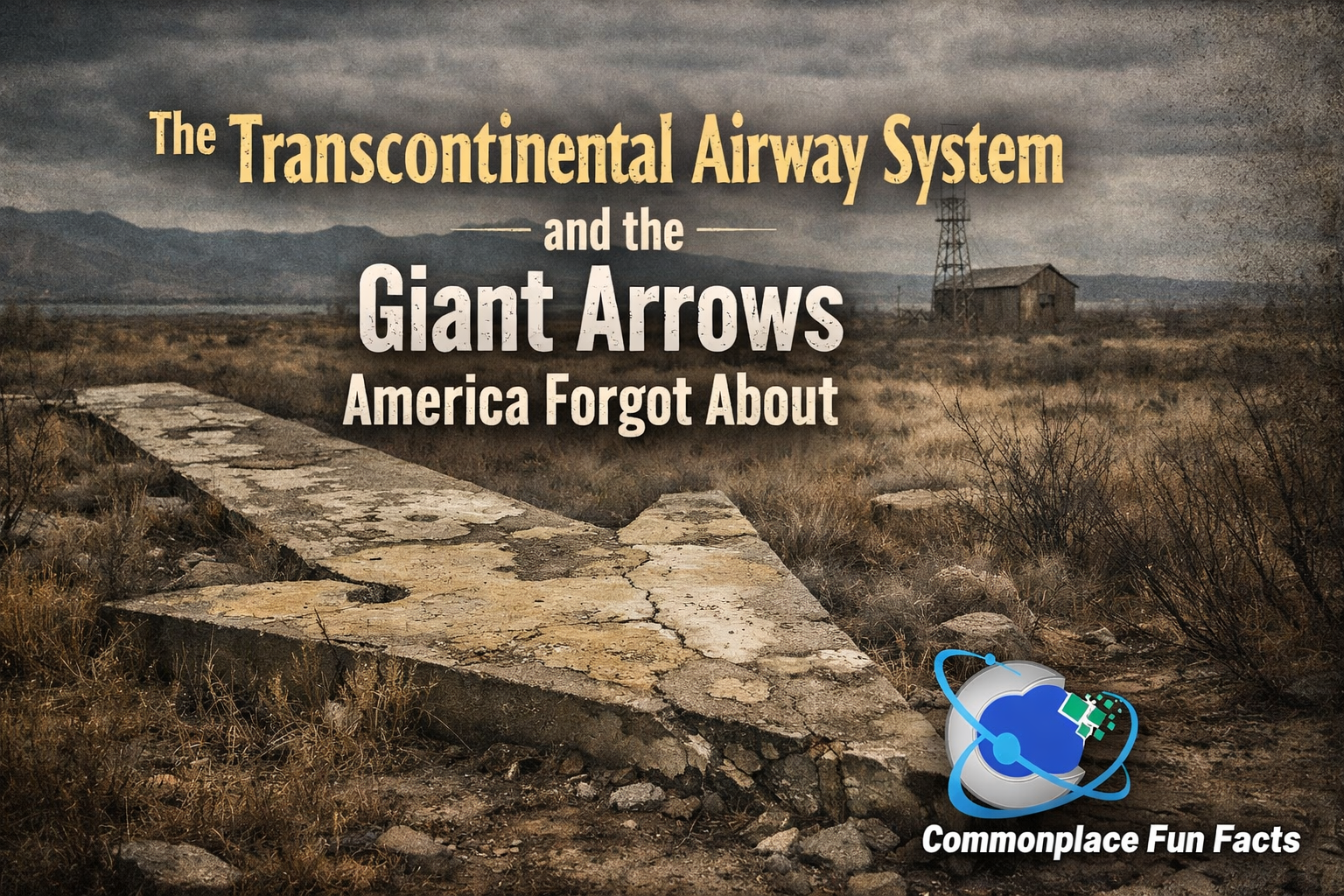
A massive concrete arrow. Lying on the ground. Pointing decisively toward… something.

It is large. It is deliberate. It is extremely confident. It also offers absolutely no explanation. No plaque. No helpful roadside sign. Just an enormous arrow apparently left behind by either the federal government or a civilization of very organized giants.
This is not an isolated experience. Thousands of these arrows exist across the United States, scattered through deserts, plains, farmland, and places best described as “between places.” Some are cracked and crumbling. Some are half-buried. Some look like abandoned set pieces from a Cold War play nobody remembers rehearsing.
They are not art installations. They are not crop circles with direction. They are leftovers from one of the most ambitious—and wonderfully blunt—navigation systems ever devised.
To understand them, we have to talk about early aviation, the mail, and America’s long tradition of solving complex technological problems by yelling directions very loudly.
Contents
Before GPS, Before Radar, Before Anyone Fully Knew What They Were Doing
Mail delivery has always been a competitive sport. The Pony Express rode horses to exhaustion. Railroads stitched the continent together with timetables and soot. Once automobiles showed up, they were immediately handed packages and told not to crash.
Airplanes entered this story almost immediately after they proved they could fly without reliably killing everyone involved.
By 1910—barely seven years after the Wright brothers managed controlled flight—Congress was already flirting with the idea of mail delivery by air. The enthusiasm was not universal. Some newspapers treated the concept as adorable nonsense, describing a future where Cupid flew perfumed aircraft filled with love letters while postmen wore wings.
This was journalism’s polite way of saying, “Absolutely not.”
Keep in mind that sixty-nine days before the first Wright Brothers flight, the New York Times confidently declared that mankind would not be able to fly in the next million years. Lesson to be learned: journalists aren’t infallible.
Still, experimental flights happened. Planes carried mail bags short distances and dropped them onto fields where someone would hopefully be waiting. Pilots such as Charles Lindbergh were officially sworn in as “aeroplane mail carriers,” which sounds prestigious until you remember the aircraft had approximately the structural integrity of a lawn chair.
Congress Eventually Notices the Century Has Changed
By 1917, with the United States suddenly aware that airplanes might matter, funding finally appeared for a permanent airmail service. Early routes connected New York and Washington, D.C., using military pilots and planes.
Cross-country delivery, however, presented an obvious problem: planes were terrible at flying in the dark.

The workaround was a relay system. Planes flew during daylight. Trains took over at night. The result was a coast-to-coast letter in about 79 hours—impressive, but still slower than many people expected from a technology marketed as “the future.”
In 1921, the experiment everyone had been quietly avoiding finally happened: an all-airplane coast-to-coast mail run, day and night. It worked.
Congress responded with funding. The problem remained navigation.
Why Night Flying Had a Habit of Killing Pilots
Early pilots navigated by dead reckoning, which is aviation shorthand for “guessing while hoping landmarks appear.” There was no radar. No GPS. No friendly voice calmly announcing, “In two miles, prepare to panic.”
Flying at night or in poor weather meant pilots frequently got lost. Lost often turned into dead. The average lifespan of an airmail pilot before a fatal crash was grim enough to make even optimistic bureaucrats reconsider.
At one point, it was bad enough that there was talk of canceling airmail altogether.
Instead, America did what it does best.
It built arrows.
The Transcontinental Airway System: Navigation by Extremely Obvious Means
The solution was the Transcontinental Airway System, and its genius lay in its absolute refusal to overcomplicate things.

Starting with an 885-mile stretch between Chicago and Cheyenne, Wyoming, engineers built a literal path through the sky. Emergency airfields appeared roughly every 25 miles. Rotating beacon lights sat atop towers, visible for dozens of miles. Between those fields, smaller flashing beacons guided pilots along a defined corridor.
And then came the arrows.
Beginning in the mid-1920s, massive arrows were added on the ground at beacon stations, pointing pilots toward the next stop. Concrete arrows stretched nearly 60 feet long. They were painted bright white. Beacon numbers appeared on nearby sheds. Route identifiers were color-coded.
This was aviation reduced to its essence.
“Go this way.”
America, From the Air, As a Connect-the-Dots Puzzle
By the early 1930s, the airway system covered roughly 18,000 miles and included more than 1,500 beacons. Pilots flying at night could follow a glowing breadcrumb trail across the country.

The effect was dramatic. Coast-to-coast mail delivery dropped to roughly 35 hours. The cost to send a letter nationwide was affordable. Most importantly, pilots stopped dying at quite the previous rate.
The system worked so well that engineers briefly considered extending the idea over oceans using lighted floating platforms—a concept best described as “ambitious” and “deeply optimistic about the sea’s cooperation.”
Progress Makes the Arrows Obsolete (As It Always Does)
The Transcontinental Airway System peaked around 1933.

Radio navigation improved. New instruments reduced reliance on visual markers. The Great Depression made maintaining thousands of beacons less appealing. World War II finished the job; many towers were dismantled to avoid helping enemy aircraft find their way.
The last federal airway beacon officially shut down in 1973.
A handful survived longer. Montana famously kept several operating into the 21st century before finally turning them off due to budget concerns. Preservation efforts are now underway for the best survivors.
The Arrows That Refused to Go Away
The beacons faded. The towers rusted. But the arrows stayed.
Concrete does that.
Today, many remain exactly where they were poured decades ago, mute artifacts of an era when navigation meant painting instructions directly onto the planet. They sit in deserts and fields, still pointing the way to destinations that mattered once. As for the rest of the navigational guides, many of them remain in various states of disrepair. The website Arrows Across America is dedicated to collecting photographs of these remnants of a once-proud transcontinental network.
If you ever stumble across one, you are looking at a time when aviation’s biggest problem was not software, satellites, or encryption—but simply figuring out where the next town was after sunset.
They are still out there, doing the job they were given, long after we forgot why.
You may also enjoy…

Anne Lindbergh: The Surprising Unknown Life of an Aviation Legend
Anne Lindbergh was more than Charles’ wife — she was an aviator, best-selling author, and pioneer whose legacy deserves a flight plan of its own.

How a Bank Became the Largest Item Mailed — The Wild 1916 Vernal Utah Case
Learn how a bank in Vernal, Utah became the largest item mailed.

The Mysterious Paper Towns Designed to Catch Crafty Copyright Thieves
Have you ever been to Argleton, England? Guess what — neither has anyone else. Learn about paper towns and how these phantom settlements are used to catch copyright thieves.







Leave a Reply to Commonplace Fun FactsCancel reply