
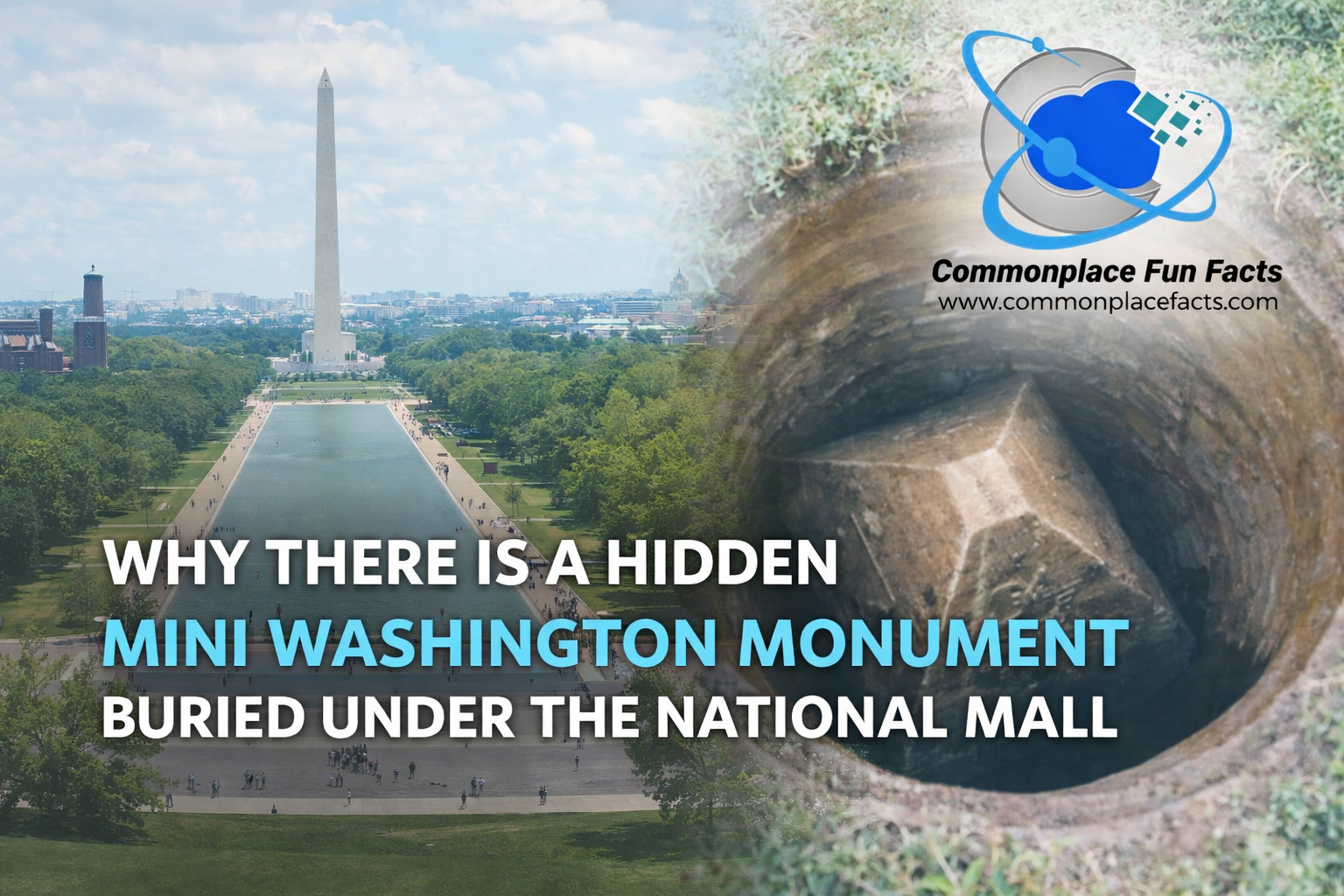

Everyone knows the Washington Monument—named, of course, for the man whose decisions, restraint, and deeply inconvenient refusal to be king still hover over the Mall as much as the obelisk itself. It is the giant marble obelisk that dominates the National Mall, looms in the background of approximately every documentary ever made about American history, and has served as a directional aid for lost tourists since the 19th century. You look at it, you nod respectfully, you take a photo, and you move on with your day.
What almost no one realizes—despite walking directly over it—is that the Washington Monument also has a smaller, lesser-known sibling buried underground nearby. A quiet twin. A minimalist version. A Washington Monument that very clearly did not ask for fame.
This is the story of the hidden Mini Washington Monument—never meant to be admired, photographed, or merchandised, but built to do something far more important than look impressive.
Contents
The Surprise Obelisk Under Your Feet

If someone told you there was a small stone replica of the Washington Monument hidden beneath a manhole cover on the National Mall, your first instinct would be to assume this was one of those “you won’t believe number seven” internet clickbait stories that collapses under even mild scrutiny.
But this one holds up.
There really is a tiny obelisk-shaped structure buried underground near the base of the real Washington Monument. It stands several feet tall, is neatly constructed, and sits inside a brick-lined chamber like a shrine devoted to extremely precise measurements. It is not visible to the public. It is not marked. It does not appear on souvenir maps. It is watched over by exactly zero souvenir vendors.
It exists entirely for the benefit of surveyors.
Not a Monument, Technically
Before we go any further, it is important to establish what this thing is not.
It is not a memorial. It is not a time capsule. It is not part of a forgotten subway station. It does not contain secret documents, alien technology, or a second, better Declaration of Independence with a surprise plot twist.

What it is, officially, is a geodetic benchmark.
That phrase alone guarantees obscurity.
A geodetic benchmark is a fixed physical point used to anchor surveying measurements. It is how surveyors know, with astonishing precision, how high something is, how far apart things are, and whether the ground beneath your feet has subtly shifted over time. These benchmarks are the quiet backbone of maps, infrastructure, GPS calibration, and the general human assumption that distances continue to behave themselves.
Most benchmarks are boring metal disks, rods driven deep into the ground, or plain concrete pillars. They are all around us. (Locate the ones in your area through the National Geodetic Survey’s interactive map.) This one, however, had ambition.
Why Make It Look Like the Washington Monument?
The Mini Washington Monument—often referred to as “Benchmark A” by the people who care deeply about such things—was established in the late 19th century during a nationwide effort to create a consistent elevation system for the United States.

At the time, the National Mall did not look anything like the carefully manicured space we know today. Large parts of it were muddy, uneven, and aggressively unconcerned with aesthetics. Surveyors were laying down foundational reference points that future measurements would depend on for decades.
Benchmark A sat near the Washington Monument, which made it symbolically useful. Unlike the actual monument, the mini version does not have a cap of aluminum, however. Otherwise, it is a tiny copy of the 555-foot original. The decision to give it a tiny obelisk shape appears to have been partly practical and partly irresistible. If you’re anchoring measurements next to one of the most recognizable structures in the country, why not lean into the theme?
There was also something unintentionally appropriate about borrowing Washington’s name and form for a structure whose entire job was to establish limits, define boundaries, and then hold fast to them. Washington was never especially interested in monuments, but as a surveyor and statesman, he cared deeply about fixed reference points—precedent, restraint, and the idea that power worked best when it knew exactly where it stopped.
It Used to Be Above Ground
Originally, the Mini Washington Monument was not hidden at all. It stood in the open, marking its importance clearly. Over time, however, two problems emerged.
First, the Mall was being redesigned, landscaped, and cleaned up into something that resembled an actual national park instead of a soggy worksite.
Second, tourists.
Anything left standing in Washington for long enough will eventually be leaned on, climbed, vandalized, or used as a lunch table. For something whose entire purpose was remaining perfectly fixed and undisturbed, this was suboptimal.
So the solution was elegant and permanent: build a protective chamber around it and bury it.
Today, the Mini Washington Monument lives below a metal cover set flush with the ground. You can walk across it without ever realizing you are stepping over one of the most quietly important points in the country.
Who Actually Uses This Thing?
The Mini Washington Monument is not ceremonial. It is actively boring.

Surveyors use it as a known, fixed reference point to calibrate measurements across the region. Elevations are checked against it. Shifts in the earth are measured by comparing new data to its established position. When earthquakes rattle Washington, this benchmark helps scientists detect whether the ground has moved by millimeters.
Millimeters matter, apparently.
Washington himself would likely have approved. Much of his influence came not from dramatic gestures, but from insisting on clear definitions—where authority began, where it ended, and when it was time to hand it off and walk away. The system worked not because it was flashy, but because it stayed anchored.
In a world dominated by satellites and GPS, it is comforting—and faintly unsettling—to know that all that high-tech wizardry still depends on old-fashioned points in the dirt that stubbornly refuse to move. When those physical anchors are replaced with purely digital shortcuts, things can go sideways very quickly—as one Kansas farm learned after an algorithm quietly decided it was the epicenter of hundreds of crimes. Read “The IP Address Mapping Error that Made a Kansas Farmhouse a Major Criminal Hangout” for more details about that.
Yes, It Has Been Opened Before
On rare occasions, officials have lifted the cover and allowed people to look inside the chamber. What they find is not disappointment.
Inside sits a small, handsome obelisk made of stone, neatly proportioned, standing patiently in a brick-lined pit like it’s guarding something extremely valuable. Which, in its way, it is.
Then the cover goes back on, and the Mini Washington Monument returns to its chosen life of solitude.
The Philosophical Part (You Knew This Was Coming)

There is something deeply satisfying about the idea that the Washington Monument—the soaring symbol of national identity, aspiration, and carefully aligned marble blocks—has a smaller counterpart below the surface whose entire purpose is keeping things grounded.
One monument points upward, visible for miles. The other points upward too, technically, but does so quietly, underground, without gift shops.
One is about vision. The other is about calibration.
Together, they form a metaphor so clean it almost feels intentional, which history assures us it probably was not.
A Final Thought for the Next Time You Visit
The Washington Monument announces itself loudly and continuously. It reminds us—visually and unavoidably—of the Father of the Country, the man whose name sits on the city, the state, the currency, and an impressive amount of elementary school gymnasiums. It is history rendered in marble, towering, symmetrical, and very certain of its own importance.
The miniature monument buried beneath the Mall points to something quieter, but arguably more enduring. Washington’s influence was not limited to the fact that he had a name grand enough to engrave into stone. It was his restraint, his choices, and his insistence on limits—on power, ambition, and permanence—that helped establish the invisible frameworks the country still operates within. The hidden monument reflects that legacy more closely than the one above it: steady, unmoving, and concerned less with admiration than with keeping everything properly aligned.
One monument reminds us who George Washington was. The other reminds us how he governed—by setting reference points and then refusing to budge them. In that sense, the most Washingtonian structure on the National Mall may not be the one that reaches skyward, but the one underground, quietly doing its job, content to let everything else find its bearings around it.
You may also enjoy…

When Aluminum Was Worth More Than Gold: From Napoleon’s Fancy Forks to the Washington Monument
Discover how aluminum went from a metal more valuable than gold—gracing royal tables and the Washington Monument—to a common material in soda cans. Explore its glittering past and industrial transformation.

The IP Address Mapping Error that Made a Kansas Farmhouse a Major Criminal Hangout
Discover how a Kansas farmhouse became the target of FBI raids, angry calls, and scammers, all due to an IP address mapping error. Learn about one family’s geolocation digital nightmare.

The Staten Island Ferry Disaster Memorial: the Monument to the Giant Octopus Attack — That Never Happened
Discover the surprising story of the Staten Island Ferry Disaster and the attack by a giant octopus — that never happened.






Leave a Reply to cat9984Cancel reply