
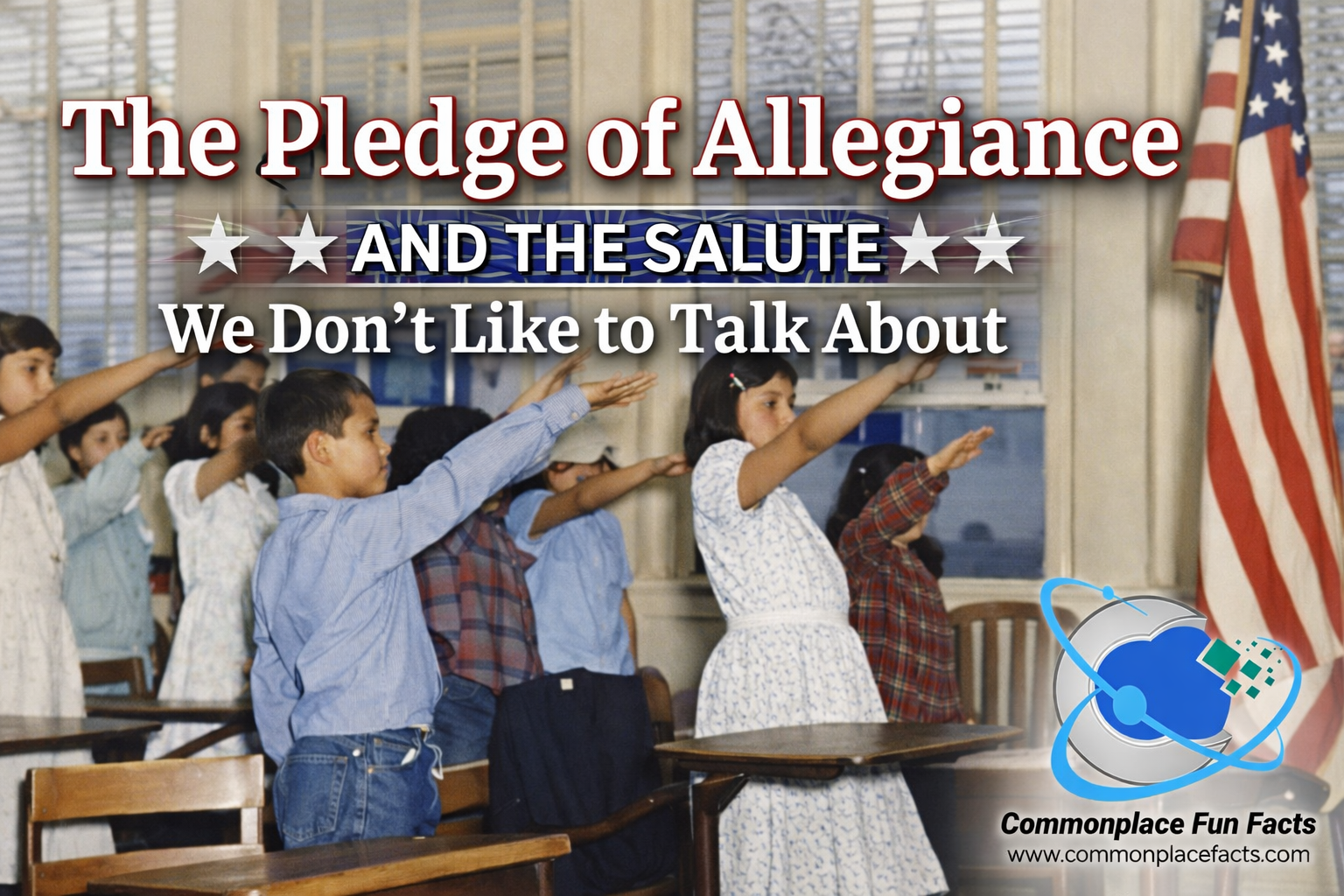

Most Americans can recite the Pledge of Allegiance on autopilot. Say the first three words and a surprising number of adults will feel an uncontrollable urge to stand up straighter, locate the nearest flag, and assume what they hope is the correct posture. This makes sense. The Pledge is not just a sentence. It is a ritual. And rituals, once learned, tend to burrow deep into the subconscious and refuse to leave.
What most people do not realize is that the Pledge once came with a choreographed arm movement that modern Americans would very much prefer to pretend never existed.
For several decades, American schoolchildren recited the Pledge while extending their right arms straight out in front of them, palms downward.
Yes. That kind of salute.
If this is the first time you are hearing about it, your reaction is probably a bit uncomfortable. If this is the fifth time, you are probably still a bit squeamish. History rarely checks in with us before changing the meaning of things.
Contents
America Decides Children Need a Patriotic Script
The idea of asking schoolchildren to swear loyalty to the nation did not come out of nowhere. By the late nineteenth century, the United States was wrestling with rapid immigration, industrialization, and the lingering aftershocks of the Civil War. There was a growing sense that “being American” needed a little more structure, preferably something short enough to be memorized before recess.
An early attempt came from George Thatcher Balch, a Civil War veteran who wrote a flag salute in 1885 that leaned heavily on military loyalty and obedience, including such language as: “We give our heads and our hearts to God and our country; one country, one language, one flag!” It circulated in some schools, but it never quite caught on. It sounded stern, and it felt like something issued rather than embraced.

The version that stuck was written in 1892 by Francis Bellamy, a Baptist minister and Christian Socialist working for The Youth’s Companion magazine. Bellamy was helping organize a nationwide school celebration marking the 400th anniversary of Columbus’s arrival, and he was tasked with producing a pledge that could be recited by millions of children at once. His goal was clarity, unity, and memorability, not theology.
Bellamy’s original text read: “I pledge allegiance to my Flag and to the Republic for which it stands; one Nation indivisible, with Liberty and Justice for all.”
Every word was chosen carefully. “My Flag” was intentionally generic, allowing immigrant children to speak the words without feeling as though they were renouncing their origins. “Indivisible” reflected the still-recent trauma of the Civil War. God was not mentioned at all.
That wording did not remain fixed for long. As the United States became more concerned about national identity and loyalty, the language tightened. In 1923, “my Flag” was replaced with “the flag of the United States,” a change prompted largely by fears that children might be mentally picturing the wrong flag while reciting it. The following year, “of America” was added for extra clarity, as if someone worried the message still wasn’t landing.
By the mid-1920s, the Pledge read: “I pledge allegiance to the flag of the United States of America, and to the Republic for which it stands; one Nation indivisible, with Liberty and Justice for all.”
This version would remain unchanged for decades. Then, in 1954, at the height of the Cold War, Congress added two words that reshaped the Pledge permanently. “Under God” was inserted after “one Nation,” transforming a civic statement into one that also signaled ideological opposition to officially atheistic communism.
The modern version became: “I pledge allegiance to the flag of the United States of America, and to the Republic for which it stands, one Nation under God, indivisible, with liberty and justice for all.”
By then, the Pledge had accumulated layers of meaning Bellamy never anticipated. What began as a unifying exercise for schoolchildren evolved into a living artifact, revised to reflect the anxieties, conflicts, and priorities of the nation that kept asking it to speak.
We Have a Pledge, So Now We Need a Salute
Bellamy’s words were memorable, but they weren’t the only missing piece in this new civic ritual. There was something else every school administrator quietly assumed: if you’re going to ask children to pledge loyalty, there ought to be a physical component to go with it. Saying a line while lounging in your chair seemed out of the question, and anything resembling elaborate calisthenics was both impractical and, frankly, a little ridiculous.
The solution, to 1890s eyes, seemed obvious: borrow a salute. Not from the military, not from a ceremonial drill team, but from a gesture already circulating in American culture that looked solemn, orderly, and suited to repetition.

This was the moment the so-called “Bellamy salute” came into being. The idea was simple. Children would begin with their right hands at their sides; as they spoke the words “I pledge allegiance to the flag,” they would extend their right arm outward and slightly upward toward the flag, palm down, holding it there until the end of the Pledge. The motion was intended to look respectful and unified — a visual punctuation mark attached to the text.
In practice, it was a graceful, uncomplicated gesture that didn’t require drill practice or marching orders. It presented a way for classrooms across the country to synchronize body and voice in a single act of collective loyalty. For a generation that was just getting used to the idea of public schooling and mass civic rituals, it felt natural and earnest. No one at the time foresaw that changes in world politics would make that very gesture look anything but.
Over the next several decades the salute became as familiar in classrooms as chalkboards and spelling tests. It carried with it an assumption of unity, a visual shorthand for “we are together in this.” But history has a funny way of reshaping meanings. Within a few decades, the same gesture would be adopted by political movements in Europe and take on an entirely different set of associations. What began as a practical classroom routine would eventually become a national embarrassment, forcing another quiet revision to how Americans physically express their pledge.
An Ancient Gesture That Wasn’t Ancient at All
Any discussion about how this style of salute was adopted inevitably includes a confident assertion: it was Ancient Rome that gave it to us. This claim is repeated constantly and confidently. It sounds plausible. There’s just one problem: it’s probably not true.

There are no Roman statues or art from that era showing it. No relief carving. No coin. No contemporary written description. Romans did swear oaths using their right hands, but there is no evidence they lined up and performed synchronized arm extensions like a Bronze Age drill team.
The “Roman salute” is not Roman. It is artistic.
The earliest identifiable appearance of the gesture comes not from antiquity, but from a painting: The Oath of the Horatii, completed in 1784 by Jacques-Louis David. It depicts three brothers dramatically extending their arms toward their father as they swear to defend Rome. The scene is heroic, theatrical, and carefully staged. It is also fictional.
This is not unusual. Neoclassical artists were not documenting history so much as inventing emotionally satisfying versions of it. The painting resonated deeply with Revolutionary France, which promptly decided this was what civic virtue probably looked like and behaved accordingly.
Over time, the gesture accumulated meaning by repetition rather than evidence. It felt ancient. It looked solemn. That turned out to be enough.
When we needed a salute for the newly-minted Pledge of Allegiance, why not borrow this one?
It worked. It looked dignified. It felt serious. And no one involved foresaw how badly this was going to age.
Decades of Extremely Awkward Photographs
From the 1890s into the early twentieth century, American classrooms dutifully performed the Bellamy salute. Photographs from the period exist. They are unsettling for reasons that had nothing to do with the intentions of the people in them.

The children are earnest. Focused. Proud. They are also frozen in a posture that later decades would associate with authoritarianism, mass rallies, and some of the worst crimes in human history.
Context matters. Unfortunately, photographs are terrible at providing it.
At the time, no one saw anything sinister in the gesture. It was simply a salute. A formalized way of signaling loyalty to a flag that itself had been given deep symbolic weight. The problem came later, when some troublemakers in Europe decided to borrow the gesture and attach considerably darker meanings to it.
Europe Enters the Picture and Everything Gets Ruined
In the 1920s, Italian Fascists adopted the outstretched-arm salute to visually link themselves to the grandeur of ancient Rome. The historical accuracy was irrelevant. The implication was what mattered.

The Nazis followed suit, claiming the salute was actually an ancient Germanic greeting. This, too, was invented on the spot. Authoritarian movements are extremely comfortable with creating fictional histories to justify present behavior.
By the time World War II arrived, the gesture had acquired a meaning so specific and so horrifying that it swallowed all previous associations. The salute was no longer ambiguous. It belonged to the Nazis now, regardless of where it had started.
America discovered, somewhat belatedly, that it had a public-relations problem.
When Plausible Deniability Becomes National Policy
The overlap between the Bellamy salute and the Nazi salute created uncomfortable situations. Americans with fascist sympathies were occasionally photographed giving what they claimed was a patriotic American salute. Technically, they were not wrong. Optically, they were absolutely not right.
This was not a problem that could be solved with footnotes.
The solution was swift and mercifully quiet. In 1942, the salute was officially changed. Instead of extending the arm, Americans were instructed to place their right hands over their hearts while reciting the Pledge.
No dramatic announcement. No national reckoning. Just a subtle pivot away from a gesture that had become irrevocably compromised.
Sometimes history does not offer clean breaks. It offers quiet rewrites.
The Hand Over the Heart Becomes the Law
The updated posture was eventually written into the U.S. Flag Code. Citizens were expected to stand, remove their hats, and place their hands over their hearts during the Pledge and the national anthem. This was framed as respect, not enforcement—though for much of the twentieth century, the distinction was blurry in practice.
The ritual now looked harmless. Natural, even. Which is how rituals function best: by erasing the evidence of their own construction.
Children learned it early. Adults complied out of habit. Few people asked why this posture, specifically, mattered.
When Respect Became Optional
The final twist in the story arrived through a series of U.S. Supreme Court cases involving the Pledge and the practice of burning the flag. The Court’s decisions protected the rights of individuals to refuse to salute, stand, or recite the Pledge, and established that symbolic acts—even those many people find deeply offensive—are protected forms of speech under the First Amendment.
The implications went well beyond salutes or flags set on fire in parking lots.
Once symbolic expression was protected, symbolic compliance could no longer be compelled. Standing for the anthem. Removing a hat. Placing a hand over the heart. These acts retained cultural power but lost legal force.
The Flag Code, adopted decades earlier with very serious intentions, became advisory. The law could recommend respect. It could not require it.
The Pledge, once tightly choreographed, now existed in a legal space where participation was encouraged, expected, but ultimately voluntary.
What the Pledge Really Tells Us
The history of the Pledge of Allegiance is not a story about sinister ties to nefarious ideology. It is a story about symbols drifting away from their creators and acquiring meanings no one anticipated.

A gesture invented by an artist. Adopted by revolutionaries. Repurposed by schoolteachers. Claimed by fascists. Quietly abandoned by a president. All without changing the intent behind the words being spoken.
The Pledge survived not simply because it adapted, but because the principles of the nation it represents were always built to endure. Yes, it shed a gesture that history made unusable and kept the part that still functioned. More importantly, the nation represented by that flag was designed to do the same thing—adjust, recalibrate, and persist without surrendering its core ideals.
Today, Americans argue passionately about whether to stand, kneel, salute, or refuse entirely. That argument is not a breakdown of the ritual. It is the ritual, evolved.
The Pledge began as something you were told to do with your body. It ended up as something you are allowed to decide for yourself.
Which, given the alternatives history has offered, is probably the healthiest outcome available.
You may also enjoy…

How a High Schooler’s B- Project Became the Official 50-Star American Flag
Learn how a high school student designed the 50-star American flag — and earned a B- for his efforts.

Whoops! What Happens When a Country Misplaces its Declaration of Independence?
Fiji achieved independence from the United Kingdom in 1970, but don’t ask the government to prove it. The actual legal document proclaiming their independence seems to have been misplaced. The historic document was presented to the Fiji government by the Prince of Wales on October 10, 1970. It formalized the British government’s relinquishment of any…

Strange Flags: A Tour of the World’s Most Unusual Flags
Take a tour of some of the world’s strange flags.




Leave a Reply to ScottCancel reply