

Ask the average person about the official residence of the British monarch, and you’ll likely get answers about Buckingham Palace. It’s the place everyone knows about. Big gates. Balcony. Guards who stare stoically into the middle distance while tourists attempt increasingly unwise selfies.
This answer is understandable. It is also, in a quietly bureaucratic sense, wrong.
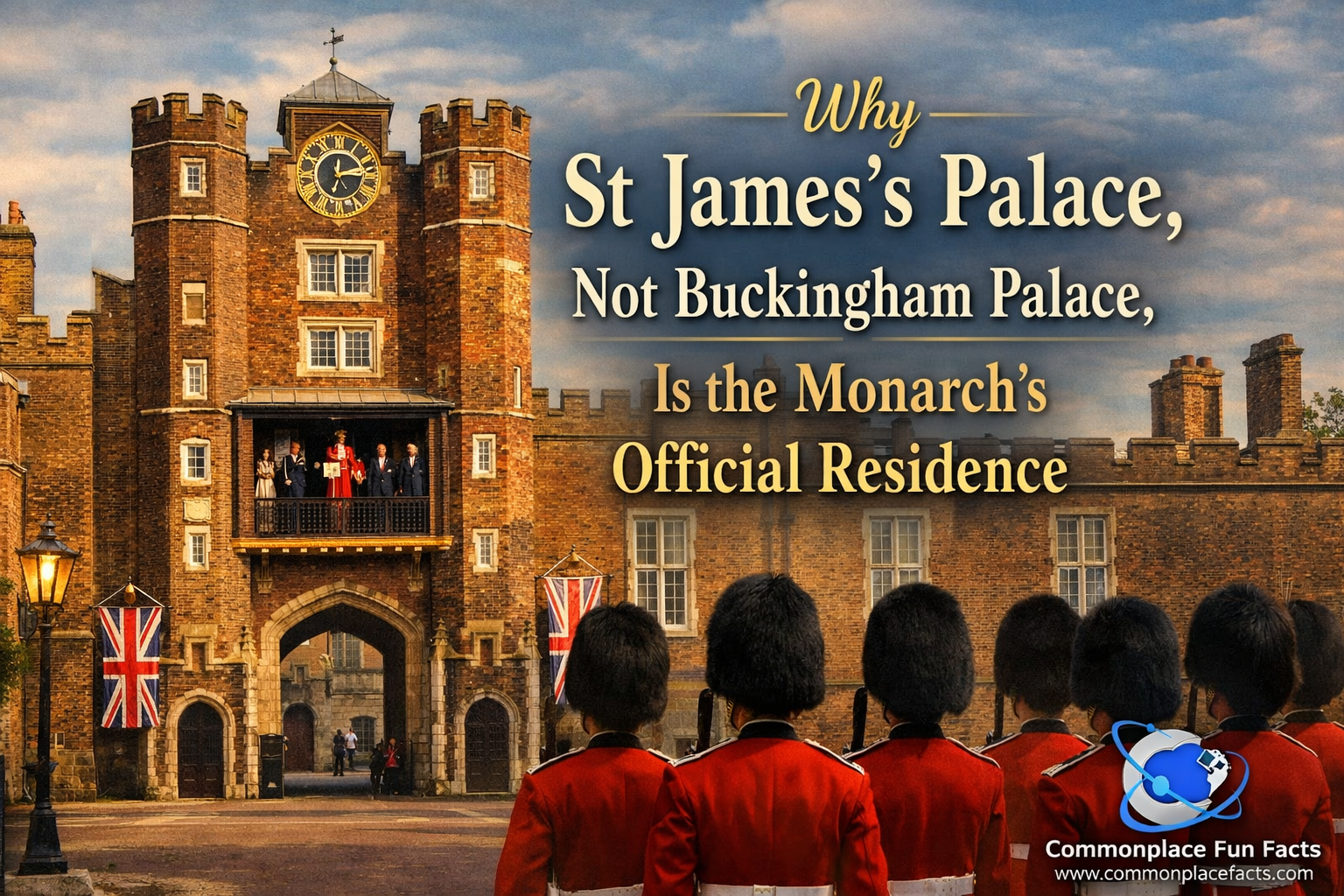
The king may be most closely associated with Buckingham Palace, but his official London residence is a few doors down the street, behind a set of unassuming gates, in a red-brick Tudor palace most people couldn’t identify if you pointed it out and offered three guesses. That building is St. James’s Palace—senior royal palace of the United Kingdom, constitutional ground zero of the monarchy, and living proof that history never updates its address book.
Contents
The Palace Everyone Knows, and the One That Actually Matters

Buckingham Palace is the monarchy’s public face. It’s where state banquets happen, where foreign leaders are photographed smiling politely, and where the sovereign waves at enormous crowds while the nation briefly agrees not to argue with itself.
St. James’s Palace, by contrast, is where things quietly happen.
This is not a matter of symbolism or vibes. On paper—the kind of paper monarchies care deeply about—the official royal residence of the monarch in London is St. James’s Palace. It is the palace to which ambassadors are accredited. It is where the Accession Council meets. It is where a new monarch is formally proclaimed. It is, in short, the monarchy’s legal mailing address.
Buckingham Palace is the show home. St. James’s is the registered office.
Henry VIII Built It, Which Explains a Lot

St. James’s Palace began life in the 1530s, commissioned by Henry VIII. This alone tells you several important things, the first being that any building associated with Henry VIII is going to have a complicated emotional backstory.
The palace was built on the site of a former leper hospital, dedicated to St. James the Less. That’s not the sort of origin story you expect for a senior royal residence, but monarchy has never been particularly concerned with real estate optics. Henry wanted a smaller, more private palace away from Whitehall. He got one. England got a constitutional artifact that refuses to retire.
It was never meant to outshine the great palaces. It was meant to be useful. History has respected that job description with grim efficiency.
A Tudor Crash Pad with an Unsettling Guest Book
St. James’s Palace has hosted an impressive number of historically awkward moments.
Anne Boleyn stayed there the night after her coronation. That fact sits in history like an unfinished sentence everyone would rather not complete.
Mary Tudor signed away Calais at St. James’s, formally ending England’s last continental foothold. Losing your final possession in France feels like the sort of thing you want to do in a room with heavy curtains and no witnesses.
Charles II and James II were both born and baptized there, giving the palace strong “royal maternity ward” credentials. If buildings could speak, St. James’s would politely decline to comment.
The Palace Where World History Wanders In
In 1941, representatives of Allied governments met at St. James’s Palace and signed the Declaration of St. James’s Palace, a document that would eventually lead to the creation of the United Nations.
This is a recurring theme in the palace’s history. Something enormously consequential happens. The building absorbs it without comment. Later generations assume it must have taken place somewhere more obvious.
St. James’s specializes in moments that do not photograph well but change everything anyway.
Senior Palace, Junior Publicity
Officially speaking, St. James’s is the senior royal palace in the United Kingdom. This does not mean it is the largest or most impressive. (Read about Buckingham Palace and its 775 rooms in this article.) It means it has seniority, which is a very different and much more dangerous concept in British institutional life.
When a monarch dies, the Accession Council meets at St. James’s Palace. The new sovereign is proclaimed from the Proclamation Gallery overlooking the courtyard. The words that bind an entire constitutional system together are spoken there, not at Buckingham Palace.
This is how monarchies work. The important moments happen indoors, in rooms with excellent carpentry, while everyone else waits outside.
Why Ambassadors Still Report to St. James’s
All ambassadors to the United Kingdom are accredited to the Court of St. James’s. This confuses journalists, diplomats, and at least one intern per decade, because they understandably assume the court should be wherever the monarch happens to be standing that week.
Instead, it is fixed in place, like a legal anchor dropped in the sixteenth century and never retrieved. Buckingham Palace may host receptions, but St. James’s Palace holds the diplomatic fiction together.
If monarchy were software, this would be a legacy system no one dares uninstall.
A Quietly Inhabited Royal Apartment Building
St. James’s Palace is not empty. It is home to several senior royals, including the Princess Royal and other extended members of the family. Over time, it has become something like a dignified residential complex for royals who prefer not to live inside a tourist attraction.
This is perhaps the palace’s most impressive trick. It manages to be both constitutionally vital and almost entirely ignored by the public at the same time.
Why Everyone Still Thinks It’s Buckingham Palace
The myth persists for understandable reasons. Buckingham Palace has balconies. It has symmetry. It has guards with hats that look like a practical joke taken too far.
St. James’s Palace has protocol.
Public imagination gravitates toward spectacle. Constitutional reality stays where it was left.
The Address History Refuses to Change
St. James’s Palace remains the official royal residence not because anyone sat down and decided it should be, but because no one ever saw a compelling reason to move it. Tradition, once established, tends to linger long past the point where explanation feels necessary.
The king may wave from Buckingham Palace. The monarchy, officially speaking, still answers its mail at St. James’s.
History, as it turns out, is very bad at updating forwarding addresses.
To learn more about the palace or to find out how to visit in person, go to the Royal Collection Trust’s website.
You may also enjoy…

Buckingham Palace: Where Even the 78 Bathrooms Probably Have Crown Molding
Take a royal tour of Buckingham Palace—775 rooms, a swimming pool, its own post office, and enough drama to rival any Netflix series. Get the full story behind the monarch’s London home in this witty deep-dive.

Istana Nurul Iman: Inside the World’s Largest Residential Palace (Brunei’s 1,788-Room Mega-Mansion)
Discover Istana Nurul Iman, the Sultan of Brunei’s 1,788-room mega-palace. Explore its staggering size, golden opulence, and how it compares to Buckingham Palace, Versailles, and other royal residences.

History’s Strangest Royal Nicknames: From the Short to the Slobberer
Discover history’s strangest royal nicknames, from Pepin the Short to Alfonso the Slobberer. Learn the bizarre stories behind these unusual monarch titles and how they became legendary.




Leave a Reply to ScottCancel reply