
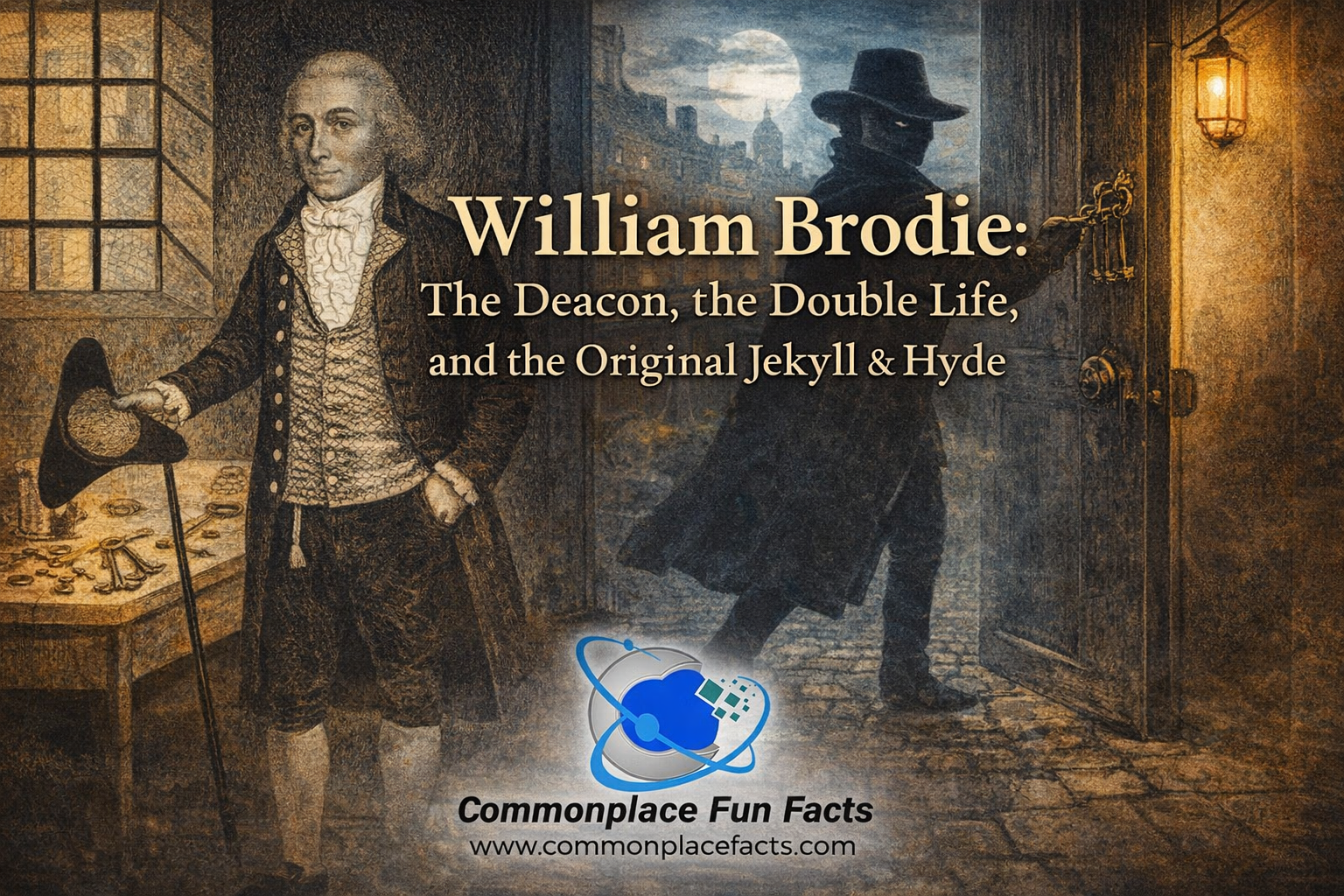

Every city has that one respectable fellow. The pillar of the community. The man who nods gravely at civic meetings, shakes hands with solemn dignity, and probably owns more waistcoats than any human strictly needs.
In late 18th-century Edinburgh, that man was William Brodie.
He was a successful cabinetmaker. A respected locksmith. A Deacon of his trade guild. A member of the town council. The sort of person you would trust with your front door, your valuables, and possibly your daughter’s hand in marriage.
And by night?
He led a dastardly double life that was so extraordinary that it served as the real life inspiration for Dr. Jekyll and Mr. Hyde.
This is the story of a man who chaired committees by day and chaired burglary operations by night. A craftsman who built elegant furniture for Edinburgh’s elite while quietly copying their keys on the side. A civic leader so polished that no one thought to check whether the shine was coming from virtue or from recently pocketed silver.
It is the story of Deacon William Brodie: master of locks, servant of respectability, patron saint of compartmentalization.
He lived two lives in the same coat. One was a pillar of the community. The other was the embodiment of everything the community despised.
Contents
From Wood Shavings to Respectability

William Brodie was born in 1741 in Edinburgh, the son of a successful wright (a craftsman who worked with wood). His father was not just competent—he was prominent. The family workshop sat along the Lawnmarket, an area busy with trade, influence, and people who liked to talk about philosophy over supper.
This was the Scottish Enlightenment, after all. Men debated reason and human progress while wearing wigs that didn’t even try to offer appropriate ventilation.
Brodie grew up in this atmosphere of polish and prestige. He inherited the family business. He became a skilled cabinetmaker and locksmith. He rose to become Deacon (head) of the Incorporation of Wrights and Masons, which sounds vaguely medieval and absolutely official.
To modern ears, “Deacon Brodie” sounds like either a trustworthy church elder or a minor Batman villain. In fairness, he managed to be both.
A Locksmith’s Temptation
Thus far, Brodie’s life reads like the résumé of a man destined to be played by the most honorable-looking actor in the cast. Guild leader. Craftsman. Council member. Owner of several waistcoats that suggest steady income and decent laundering practices.
On the surface, this is not the stuff of scandal. This is the stuff of respectable footnotes.
That assessment holds — right up until you ask what he was doing after dark, when the candles were low, the streets were quiet, and the very locks he installed began to prove remarkably cooperative.
As a cabinetmaker and locksmith, Brodie routinely installed locks and safes in the homes and offices of wealthy clients. He had access. He had trust. He had keys.
He also had wax and an imagination that should not have been left unsupervised.
Brodie began taking impressions of keys while working in the homes of his well-to-do clients. With these impressions, he was able to make duplicates of the keys. Then, under cover of darkness, he returned to those same properties and helped himself to the contents.
This was not the behavior of a desperate man stealing bread. This was a civic leader running what amounted to a side hustle in burglary.
Why?
Because William Brodie had expensive tastes and questionable hobbies.
Double Lives, Gambling, and Other Hobbies
The most expensive and questionable of Brodie’s extracurricular pursuits were his mistresses. Not content with a single complicated domestic arrangement, he opted for two — Jean Watt and Anne Grant — each blissfully unaware that they were sharing a Deacon. Between them, he accumulated five illegitimate children, which is impressive if you are building a secret parallel civilization and less impressive if you are trying to balance a checkbook.
Add to this a growing appetite for gambling, good wine, and the general thrill of living just a little too close to the edge, and the financial math began to wobble.
Even as a successful cabinetmaker and highly respected locksmith, Brodie simply could not earn enough honest money to support two households and a hobby involving games of chance he was not particularly good at winning.
Naturally, he attempted to gamble his way back into solvency.
Unsurprisingly, this did not go well.
By 1768, what had begun as an adventurous indulgence had matured into a very real, very pressing debt problem — the sort that tends to push otherwise respectable men toward creative moral accounting.

As he realized that his income from his day job was insufficient to support his lifestyle, he faced a decision that confronts most people: change his lifestyle or increase his income.
He enjoyed his double life far too much to consider giving that up. That left him with the obligation to boost his revenue. Unfortunately, rather than commit to putting in extra hours in the cabinet shop or taking a second job delivering pizzas, he opted for a more nefarious method for padding the pocketbook.
By day, he built cabinets, attended council meetings, and managed guild affairs. By night, he worked with an assembled gang of accomplices and went burgling across Edinburgh.
This is the point where the phrase “He really compartmentalized his life” stops being metaphorical.
He was so effective at his respectable image that at one point he even served on a jury — judging the crimes of others — while actively committing felonies himself.
If irony were taxable, Edinburgh could have funded several new bridges.
The Gang, the Opera, and the Beginning of the End
Every criminal career eventually reaches the point where confidence mutates into recklessness. For Brodie, that point arrived on March 5, 1788, at the Excise Office in Chessels Court along Edinburgh’s Canongate.
The plan was elegant. On a previous visit, Brodie had taken an impression of the entry key using putty. Once a duplicate was made, entering the Excise Office required no smashed windows, no dramatic prying—just the calm turn of a perfectly crafted key.
He assembled his team: George Smith, Ainslie, and Brown. All dressed in black. Brodie and Brown each carried flintlock pistols. They set out around 8 p.m., a time carefully chosen because the office was closed and the night watchman did not arrive until 10. Ainslie took position outside as lookout.

Brodie, in what can only be described as an enthusiastic mood, reportedly sang selections from The Beggar’s Opera as they began. Nothing says “low-profile crime” quite like musical accompaniment.
Unfortunately, the Excise Office had other plans.
At approximately 8:30 p.m., James Bonar unexpectedly returned to the office. The robbery, previously operating with smug precision, collapsed into urgency. The gang fled with a grand total of £16.
Sixteen pounds.
For this, Brodie had risked pistols, exposure, and his carefully curated reputation as a civic leader.
He hurried home, changed into respectable clothing, and then presented himself at the home of his mistress Jean Watt on Libertons Wynd, seeking an alibi. When in doubt, establish plausible normalcy while conveniently ignoring the fact that “normalcy” includes carefully choosing which secret family to return to.
But the real crack came from within the gang.
That same night, Brown approached the authorities to claim a King’s Pardon that had been offered after a previous robbery. In exchange for mercy, he gave up the names of Smith and Ainslie—carefully omitting Brodie’s own involvement at first. As proof of good faith, he revealed a cache of duplicate keys hidden beneath a stone at the base of Salisbury Crags.
The symbolism was almost cruelly appropriate.
Smith and Ainslie were arrested. The next day, Brodie attempted to visit them in prison, presumably to check on morale and perhaps assess what they planned to confess. He was refused entry.
At this point, the respectable Deacon performed what any prudent civic leader might do when his criminal enterprise begins to unravel: he fled.
On March 9, Brodie left Edinburgh. By March 12, he had reached London. He was pursued by George Williamson, a King’s Messenger who assumed Brodie would make for Dover to sail to the Continent. Williamson lost the trail.
Meanwhile, Brodie was staying with a female acquaintance in London. Because of course he was. On March 23, he boarded the Leith-bound ship Endeavour, disguised as an elderly man in poor health under the name John Dixon.
This is the sort of detail that transforms crime into theatre.
The ship departed the following morning—but Brodie had arranged to disembark instead at Flushing in the Netherlands. From there, he made his way to Ostend, intending eventually to flee to the United States.
Alas, even in flight, he could not resist complexity. During the voyage, Brodie handed several letters to a Mr. Geddes to be delivered to one of his mistresses in Edinburgh. Geddes, apparently unimpressed by the performance, found the situation suspicious and turned the letters over to authorities.
Williamson resumed his pursuit and finally located Brodie in Amsterdam, where the Deacon was preparing to launch a new career somewhere across the Atlantic—preferably where no one inspected locks too closely.
He was arrested, returned to Edinburgh, and delivered—this time without disguise—to face trial.
Not until the infamous Burke and Hare murders 40 years later would Edinburgh have something so nefarious to talk about. For the time being, the extradited deacon who lived a double life would give them more than enough to keep the gossipers occupied.
Trial, Theater, and a Final Attempt at Outsmarting the Rope
Brodie’s arrest set Edinburgh buzzing. The spectacle of a respected Deacon—craftsman, councilman, jury member—standing trial for orchestrating a string of burglaries was irresistible. Polite society, which had once nodded approvingly at his public virtue, now leaned forward with sharpened curiosity.
The evidence was substantial. Duplicate keys. Testimony from accomplices. The unraveling of alibis that had once seemed clever.
He was convicted and sentenced to death.
On October 1, 1788, William Brodie was led to the gallows before a crowd reportedly numbering in the tens of thousands. Executions were public entertainment at the time, and few performances promised more narrative satisfaction than the fall of a double-dealing civic leader.

But Brodie, being Brodie, allegedly had one last plan.
According to persistent rumor, he wore a concealed device around his neck—variously described as a metal collar or piece of protective padding—designed to prevent the rope from tightening properly. The idea was straightforward: if the noose could not constrict the neck, perhaps the hanging could be survived. Given that hangings in the 18th century were not the precise drop calculations of later eras but rather prolonged strangulations, the theory was not entirely absurd.
This was the locksmith’s final engineering project. Not a cabinet. Not a key. A countermeasure against the gallows.
Legend adds that friends in the crowd were prepared to cut him down once he appeared lifeless, assuming he might revive once the pressure was relieved. Whether this was carefully coordinated planning or optimistic folklore layered onto the event afterward is difficult to say.
What is clear is this: if he attempted to outwit the rope, it did not work.
Brodie was left hanging long enough to remove any doubt that the hangman had done his job properly. He was cut down and declared dead. Any hidden device he may have worn failed to deliver one last improbable escape.
And so the man who had once copied keys in secret, engineered duplicate entrances, and slipped through locked doors could not unlock the one mechanism that mattered most.
In the end, the gallows proved harder to pick.
Enter Robert Louis Stevenson
Brodie’s story did not end at the scaffold.
Edinburgh is a city that does not throw away a good scandal. It preserves it. It polishes it. It tells it on walking tours with dramatic pauses.

By the time Robert Louis Stevenson was born in 1850 (and long before he gave away his birthday to a little girl), Deacon Brodie’s double life had already matured from criminal record into legend. Stevenson grew up hearing the story of the respectable cabinetmaker who moonlighted as a burglar. According to family lore, furniture crafted by Brodie himself once stood in Stevenson’s childhood home — which means young Robert may have been doing his homework at a desk built by a man who once stole other people’s ledgers.
The contrast captivated him. Edinburgh, after all, is practically built on duality. It has an elegant New Town perched neatly above the darker, narrower closes of the Old Town. It has polite drawing rooms and shadowed wynds only a short walk apart. Brodie embodied that split in human form: deacon by daylight, delinquent by moonlight.
Stevenson leaned into the theme early. In the 1870s, he collaborated on a play titled “Deacon Brodie, or the Double Life.” It did not exactly set the theatrical world ablaze. The public, it turns out, preferred its hypocrisy either less literal or more melodramatic.
But the idea lingered.
In 1886, Stevenson published The Strange Case of Dr. Jekyll and Mr. Hyde, a novella that distilled the anxiety of divided identity into one of the most enduring stories in English literature. Respectable Dr. Jekyll creates a darker alter ego, Mr. Hyde — a physical embodiment of impulses he keeps carefully concealed from polite society.
Stevenson never claimed he was writing a biography of Brodie. The story is psychological, not procedural. There are no wax key impressions in Jekyll’s laboratory. No town council minutes tucked into the narrative.
Yet the parallels are difficult to ignore. Both men enjoyed public esteem. Both cultivated reputations for integrity. Both maintained a second life that was not merely mischievous but criminal. Both were undone when the boundary between their identities collapsed.
If Jekyll and Hyde is about the terrifying possibility that goodness and corruption can inhabit the same person, then Brodie was the proof of concept. He did not drink a potion and transform into a snarling monster. He simply put on a different coat, stepped into the night, and used a duplicate key.
In other words, this was not a tale of supernatural metamorphosis. It was a story about a very human one.
Why We Still Care
William Brodie’s story survives because it speaks to something universal.

We like our villains obvious. We prefer moral categories neatly labeled. We are less comfortable when the criminal is also the respectable neighbor everyone trusts.
Brodie forces us to confront an uncomfortable truth: humans are experts at selective self-presentation.
He was not a cartoon villain twirling a mustache. He was a craftsman. A father. A civic leader. And also a burglar who financed a secret life through duplicity and careful key impressions.
Edinburgh still remembers him. There is a pub named Deacon Brodie’s Tavern on the Royal Mile. Tour guides invoke his name with theatrical pauses. His legacy lingers as both cautionary tale and tourist attraction.
Because nothing sells quite like hypocrisy with good tailoring.
The Final Door
William Brodie spent years opening doors that did not belong to him.
In the end, he opened one he could not close.
His story reminds us that reputation is easier to build than to maintain, and that sometimes the most dangerous tool in the room is not a crowbar but a copy of the key.
History has produced many rogues. Few were as meticulously organized.
And fewer still chaired the meeting beforehand.
You may also enjoy…

The Burke and Hare Murders: The Shocking Cadaver Scheme That Transformed 19th Century Medicine
Explore the Burke and Hare murders, the shocking 1828 Edinburgh crimes in which two men killed to supply cadavers to medical schools—sparking outrage and helping lead to the Anatomy Act of 1832.

The Haunting Legend of Sawney Bean: Scotland’s Scary Cannibal Clan
Discover the chilling legend of Sawney Bean, the Scottish cannibal who may—or may not—have eaten over 1,000 people. Truth, myth, and dark folklore collide.

Robert Burns: Scotland’s National Poet Was Far Less Polite Than You Remember
Robert Burns wasn’t just a gentle folk poet. Explore his radical ideas, bawdy verse, class critiques, and the carefully curated myth we remember today.






Leave a Reply to Commonplace Fun FactsCancel reply