
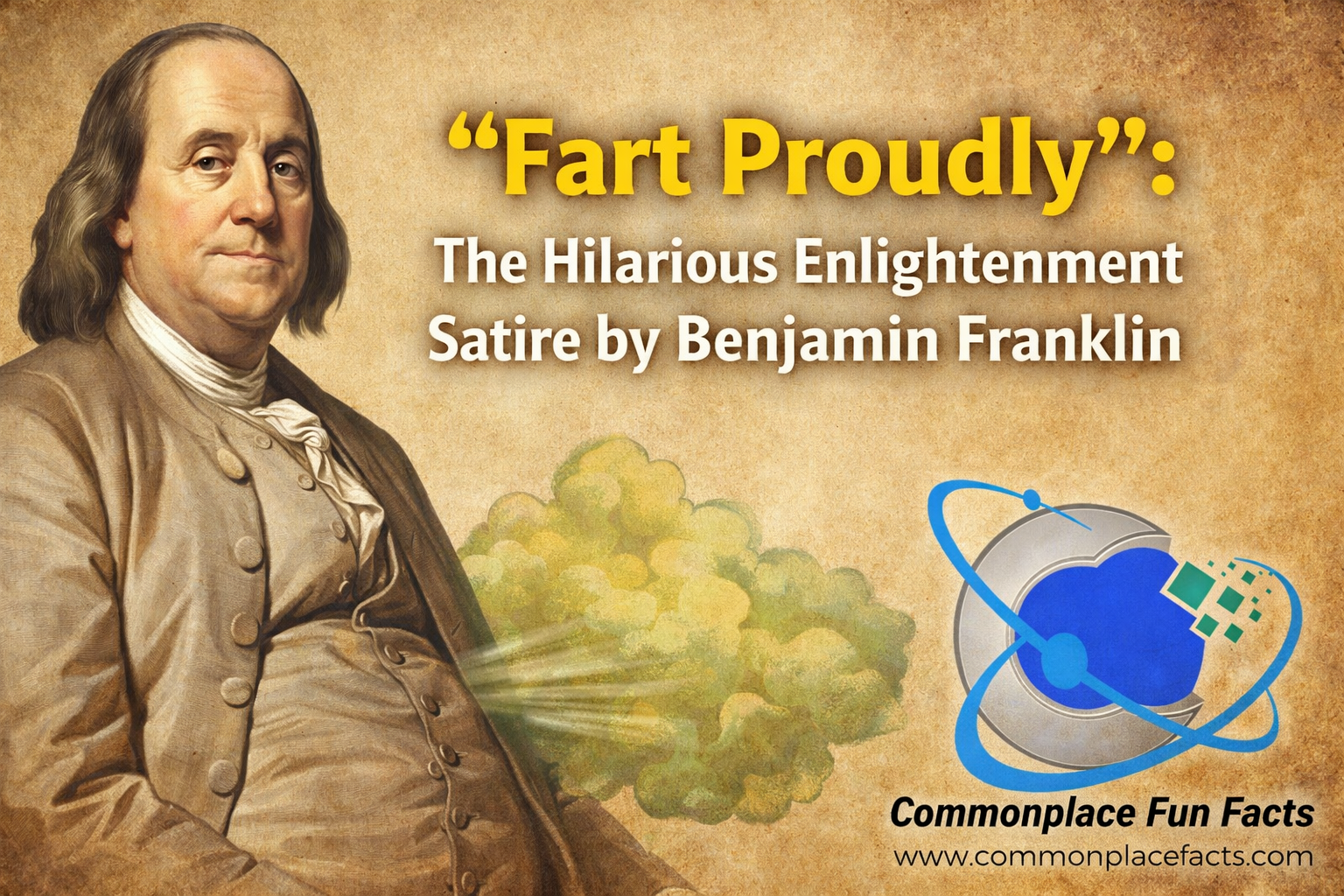

There are many things we ask of our Founding Fathers.
We ask them to be wise. Visionary. Principled. Calm under pressure. Good with quills. Ideally handsome in a way that suggests they were born already posing for currency.
We do not generally ask them to weigh in on flatulence.
And yet: Benjamin Franklin, the patron saint of practical thinking and deeply inconvenient truth, always seems to deliver far beyond anyone’s expectations. We refer, of course, to his essay politely suggesting that the scientific community should dedicate itself to a noble, civilization-saving goal: Make farts smell better.
This work is often referred to today as “Fart Proudly”—a title Franklin didn’t actually give it, but which later editors clearly could not resist, because historians are human too, and humans are weak. Franklin’s original title was far more buttoned-up: “A Letter to a Royal Academy.”
It was written in 1781, while Franklin was in France doing actual grown-up diplomacy during the American Revolution. The context is important, because it means this was not the product of a bored teenager doodling in the margins of a notebook. This was the product of the mature mind of one of the most brilliant men who ever lived—a world-class political operator who looked at the Enlightenment’s scientific establishment and said, in effect: “You people have microscopes and leisure time. Why are we still living like animals?”
Contents
The Enlightenment: When Smart People Became Brave Enough to Say Weird Things Out Loud
To appreciate Franklin’s “Letter,” you have to remember what the Enlightenment looked like. This was an era when intellectuals gathered in salons and academies, argued about reason and progress, and generally acted like civilization was a machine that could be improved if you just tightened the correct bolts.
And frankly, they weren’t wrong. This was the period that gave Europe and America an explosion of scientific inquiry, political theory, and technical innovation. It also gave us powdered wigs, which we can only assume was a side effect of breathing too much candle smoke.
Scientific academies were the TED Talks of their day. They offered prizes. They proposed “important questions.” They encouraged learned men to submit papers that advanced human understanding.

Franklin loved science. He adored practical invention. He was the sort of man who would look at lightning and think, “We should really be doing something with that.” So he was completely at home in this world.
But Franklin also had a long history of noticing when smart people were getting a little too impressed with themselves.
If you’ve read his satirical suggestion about daylight saving time—where he essentially proposed that Parisians could save money on candles by getting up earlier, and then went on to suggest hilariously aggressive methods for forcing early rising—then you already know he enjoyed the sport of pretending to be earnest while quietly holding a “you can’t be serious” sign behind his back. Read “Daylight Saving Time: The Unbelievable Sarcastic Joke of Benjamin Franklin” for more about that.
Now take that same Franklin—sarcastic, practical, allergic to pretension—and aim him at the scientific elite of Europe.
You can probably see where this is going.
The Problem: The Human Body Insists on Being a Human Body
“Fart Proudly” begins like a proper scientific note. He is respectful. He is measured. He is, for a moment, exactly the sort of man you’d want addressing a Royal Academy.
And then he calmly introduces the topic that polite society prefers to pretend doesn’t exist.
He writes:
“It is universally well known, That in digesting our common Food, there is created or produced in the Bowels of human Creatures, a great Quantity of Wind…”
This is a masterclass in tone. “Universally well known.” “Common food.” “Bowels of human creatures.”
Franklin is not giggling. He is not winking. He is presenting flatulence the way Isaac Newton might present gravity: farting is aplain fact of nature that must be dealt with.
He continues:
“…which being press’d by the other Bowels, is thence forc’d out by the Anus…”
There are two kinds of readers at this point:
(1) Those who just laughed out loud at the phrase “forc’d out by the Anus,” because it’s hard not to, and we are all basically twelve years old at heart.
(2) Those who did not laugh, but only because they are the sort of people who would attend a Royal Academy meeting in a powdered wig and insist they are above laughter and the peculiar form of “wind” being described. Franklin wrote this for them too.
Franklin then identifies the real issue: not the farts, but the social consequences.
“That the permitting this Air to escape and mix with the Atmosphere, is usually offensive to the Company, from the fetid Smell that accompanies it.”
Notice what he’s doing. He’s describing an everyday embarrassment with the gravity of a diplomatic incident.
“Offensive to the Company.” “Mix with the Atmosphere.”
He’s writing about something that has ruined dinner parties since the invention of dinner parties, and he’s doing it as if he’s reporting on a treaty violation.
A Letter to the Royal Academy: Science Should Serve the People (Even the People Who Ate Beans)
Franklin’s letter is satire, but it’s satire with a point. He is gently mocking the tendency of intellectual institutions to prioritize subjects that sound grand over subjects that affect actual living humans.

So he proposes a new line of research. And he proposes it with the seriousness of a man petitioning for funding.
He suggests that learned chemists and physicians should discover a method for improving the smell of flatulence—specifically by identifying foods or additives that could transform the odor into something more pleasant.
Franklin writes:
“How small a Quantity of any of these odorous Substances, thrown into the Air, is sufficient to perfume a Room…”
We have entered the “farts as interior design problem” portion of the essay.
Franklin then pivots toward his real ask:
“…and what an immense Difference it would make in the Commerce of Life…”
Franklin knew exactly what he was doing. He is escalating the stakes on purpose. He is dressing the subject in the language of economics and social stability. If you want to force a room full of lofty academics to confront something they consider beneath them, the best tactic is to treat it as if it’s a national crisis.
Franklin argues that if scientists can improve perfumes, and if perfumes can improve the air, then surely scientists can improve the air that humans naturally produce.
It is both ridiculous and, in its own bizarre way, logically consistent.
Is This Just a Joke?
Yes.
But also no.
The obvious reading is that Franklin is doing bathroom humor in a tuxedo. He is writing about something crude with a formal voice, and the contrast is funny. The essay is meant to amuse. It was circulated privately. It was not published during Franklin’s lifetime. In other words, Franklin understood that there are limits, even for a man who once suggested using cannons to wake people up earlier.

But Franklin also uses satire the way a good lawyer uses a hypothetical: to expose the absurdities of the system. He’s essentially asking why we treat some human problems as worthy of study and others as too embarrassing to mention.
Flatulence is universal. Everyone produces it, whether they’re willing to admit it or not. It affects everyone. It can ruin social situations. It can, in certain cases, change the entire emotional weather system of a room. There was one fart that killed 10,000 people, and another that triggered a revolution.
And yet it’s considered vulgar to talk about seriously.
Franklin’s point is not that the Royal Academy should literally devote its best minds to turning gas into perfume (although we would support federal funding for such a project). His point is that intellectual prestige can warp priorities.
He’s poking at the idea that science should be conducted mainly for honor and applause, instead of for practical benefits to real people.
Franklin’s Sarcasm: A Longstanding Public Service
Franklin’s flatulence letter makes a lot more sense when you remember that he had a habit of weaponizing politeness.
His daylight-saving satire is a classic example. He didn’t just propose earlier rising; he proposed forcing it with the kind of cheerful authoritarianism that only works if everyone understands you’re joking. The problem, of course, is if everyone doesn’t understand you’re joking, congratulations: you’ve just invented a practice of changing the clocks twice a year—a system that no one likes but can’t seem to get rid of.
Franklin’s style is deceptively calm. He writes like a man presenting reasonable solutions. Meanwhile, the solutions are increasingly unhinged in a way that highlights how silly the underlying assumptions are.
That’s what he’s doing here too.
He’s saying, “Since science is about improving life, why not improve this part of life?” And the very fact that it feels ridiculous to say that is the point.
Franklin and the Enlightenment’s Biggest Problem: Pretending Humans Aren’t Animals
The Enlightenment celebrated reason, refinement, and progress. It also produced an enormous amount of etiquette. This is the era where people worked very hard to act as if their bodies were merely elegant vehicles for their minds.
Franklin is reminding everyone that the human body is not an elegant vehicle.
The human body is a loud, leaky contraption that makes smells and noises at the worst possible times and then expects you to keep smiling politely while it happens. This is precisely why NASA employs a “Chief Sniffer” — a person whose job is to inhale experimental materials before they ever reach orbit — all in an effort to spare astronauts from olfactory betrayal in the confined quarters of space.
Franklin understood something that is still true today:
We can build constitutions, invent stoves, and map the heavens, but we still can’t prevent someone from betraying themselves at a dinner party after a bowl of soup. That’s not a failure of reason. That’s biology.
Franklin is applying Enlightenment rationality to the thing Enlightenment society most wanted to ignore. And he’s doing it with just enough straight-faced seriousness to force the reader to confront the absurdity of their own squeamishness.
What Makes the Letter So Funny (and So Clever)
Franklin’s comedy here doesn’t come from cheap punchlines. It comes from the mismatch between form and content.

He treats flatulence like a problem worthy of a Royal Academy. He uses formal language. He uses reasoned argument. He frames the issue as a matter of social harmony and public benefit.
And because he refuses to treat the subject as shameful, he makes it funnier.
Most bathroom humor works by pointing and laughing. Franklin’s works by calmly clearing his throat and saying, “Gentlemen, we must address the wind.”
It’s the Enlightenment predecessor to today’s Ig Nobel Prize, which encourages dignified scientists to show up at a black-tie dinner and deliver a scholarly presentation on why wombat poop is cube-shaped.
Franklin’s Closing Argument: Fart Proudly
The genius of “A Letter to a Royal Academy” is that it quietly insists that civilization isn’t only built from grand ideas.
It’s built from the small, daily frictions that shape human life: discomfort, embarrassment, awkwardness, and the eternal problem of being stuck in a body with other people who are also stuck in bodies.
“Fart Proudly” suggests that maybe we should stop pretending that “serious” topics are the only ones worth studying. Sometimes the things that matter most to everyday happiness are the things everyone experiences but no one wants to mention.
And sometimes the best way to make that point is to write a formal scientific proposal about why the air in a room after dinner should smell less like a crime scene.
Franklin didn’t just give us political wisdom and electrical experiments. He gave us permission to admit that humans are ridiculous creatures who strive for dignity while their intestines actively work against them.
Which is, honestly, one of the more honest gifts a Founding Father could offer.
Because history may be written by the victors… but dinner parties are ruined by the beans.
Read Franklin’s essay in full here: “A Letter to the Royal Academy (Fart Proudly)”
You may also enjoy…

Daylight Saving Time: The Unbelievable Sarcastic Joke of Benjamin Franklin
Benjamin Franklin, known for his inventions and role as a Founding Father, humorously proposed a time management idea in 1784 to save on candle costs, suggesting a morning wake-up call with church bells. His jest inadvertently inspired Daylight Saving Time, which was formally implemented much later, despite its mixed reception and historical fluctuations.

Why Were 15 Bodies Buried in Benjamin Franklin’s Basement?
Benjamin Franklin was one of the best-known and well-loved of America’s Founding Fathers. Franklin’s brilliance and wit caused him to excel in almost every area of human understanding. He left his mark as a philosopher, scientist, inventor, statesman, and humorist. Was he also a mass murderer? For nearly twenty years prior to American independence, Franklin…

Benjamin Franklin, the Fishy Vegetarian: When Principles Meet a Frying Pan
Benjamin Franklin often claimed to be a vegetarian, but just how firm was he in his convictions? Discover how he made up his mind that eating fish is just fine.







Leave a Reply