
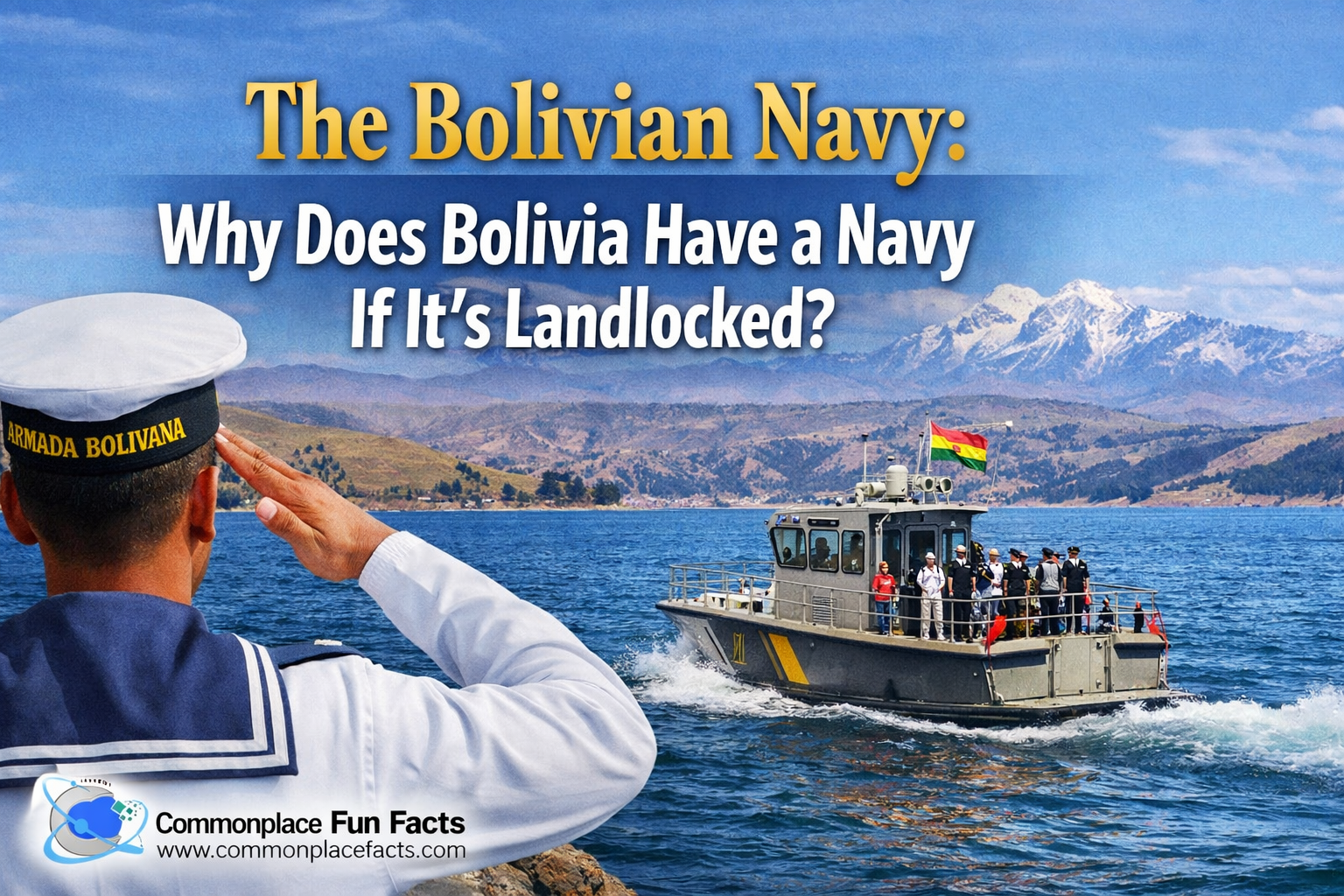

Every now and then, geography pulls a prank.
You glance at a map. You nod confidently. You believe you understand how the world is arranged. Oceans are wet. Mountains are tall. Switzerland avoids drama. All seems orderly.
Then someone casually mentions that Bolivia has a navy.
This is the point where your internal map briefly returns a 404 error.
Bolivia is landlocked. No coastline. No surf. No naval battles involving dramatic fog and someone shouting while peering through a brass telescope. And yet Bolivia maintains a fully functioning naval force—with bases, vessels, officers, and national ceremonies that lean unapologetically into maritime tradition.
At first glance, this feels like one of those trivia facts designed to ambush people at dinner parties. It is not. The Bolivian Navy (Spanish: Armada Boliviana) exists for reasons that are practical, political, historical, and surprisingly moving. What looks like a geographical contradiction turns out to be a story about rivers, national memory, stubborn resolve, and the long shadow of 19th-century war.
In other words, this isn’t a punchline. It’s a case study in how a country responds when history rearranges the map—and refuses to let the story end there.
Contents
How Bolivia Misplaced an Entire Coastline
To understand why Bolivia has a navy without a sea, you have to rewind to the late 1800s, when South America was having one of those decades where everyone looked around at a map, then at some mineral deposits, and decided maps were overrated.

Bolivia used to have a Pacific coastline. It wasn’t a tiny decorative strip either. It was a meaningful, economically important piece of territory along the Atacama region—an area that, despite being aggressively unwelcoming to human life, happens to sit on very valuable natural resources.
Then came the War of the Pacific (1879–1883), which involved Chile fighting Bolivia and Peru. The basic outline—leaving out a great deal of tragedy, politics, and the entire genre of “history is complicated”—is that Chile won, Bolivia lost its coastal territory, and the geopolitical shape of Bolivia changed permanently.
In 1904, a treaty made Bolivia’s landlocked status official. Bolivia got guarantees related to trade access and transit. Chile kept the coastline. Bolivia kept the grievance, which—unlike most things—has proved remarkably resistant to time.
And this is where the story gets weird in the most human way possible: Bolivia did not simply shrug, update the country brochure, and quietly accept the sea as a former hobby. Bolivia built a national identity around remembering that it once had an ocean. If you’ve ever held onto a petty argument for three days, you have a tiny glimpse of the energy here. Bolivia has held onto it for more than a century, but with far better branding.
Día del Mar: The Annual Ceremony of Strategic Grudge Maintenance
Every year on March 23, Bolivia observes Día del Mar—the Day of the Sea. It’s not a beach party. It’s a commemoration. A national reminder that Bolivia once had a coastline and still regards the loss of it as an open wound, a historical injustice, and a problem that should not be filed away in the “well, that happened” drawer.
There are speeches. There are ceremonies. There are references to national heroes. There is patriotism thick enough to spread on marraqueta. And there is also a fascinating cultural fact: Bolivia keeps the concept of “the sea” alive not as nostalgia, but as identity.
If you ever wonder how nations maintain collective memory across generations, this is how. You build rituals. You build institutions. You build uniforms. And, when given the opportunity, you build a navy.
So When Did the Navy Start, Exactly?
The modern Bolivian Navy, in recognizable form, dates to the 1960s, when Bolivia created a force dedicated to rivers and lakes. Over time, it developed into a full-fledged branch with a broad set of responsibilities, a large personnel footprint, and the official title that makes people blink twice when they see it on paper: “Navy.”
At first glance, it’s tempting to assume the navy exists purely for symbolic reasons—like an elaborate national reminder to the world that Bolivia still wants a sovereign path to the ocean. That symbolic layer is absolutely part of it.
But it is not the whole story.
Yes, Bolivia is landlocked. Such trivialities haven’t stopped other governments from forming a navy, however. See “The Great Navy of Nebraska: Why The Only Triple-Landlocked State Has a Navy” for one such example. Being landlocked doesn’t mean Bolivia lacks water. It has major rivers. It has Lake Titicaca, one of the most famous lakes on the planet, perched at high altitude like a geological flex. It has waterways that connect communities, support commerce, and complicate borders. If you want to protect a country like Bolivia, ignoring its waterways would be like trying to run airport security while ignoring the runways and terminal because “planes mostly fly in the sky anyway.”
What a Landlocked Navy Actually Does All Day
Let’s strip away the novelty for a moment and talk about what the Bolivian Navy does. Because this is where the story shifts from “quirky trivia” to “actually important.”
River and Lake Patrol: The Brown-Water Reality
Most people picture navies in deep blue water, with ships that look like floating office buildings and the kind of radar equipment that can detect your bad decisions from orbit.

But navies can also operate on rivers and lakes. These are sometimes called “brown-water” forces. They do patrol work. They monitor borders. They provide a state presence in remote areas. They help control movement on waterways that can otherwise become highways for smuggling, trafficking, and general mischief.
In a country with large, hard-to-access regions, rivers are not cute. They’re infrastructure. They’re borders. They’re lifelines. And they’re also perfect corridors for illegal trade if you leave them unattended.
That means the Bolivian Navy patrols. It enforces. It monitors. It does the watery version of “we are here, we are watching, and please stop trying to move contraband like it’s a weekend hobby.”
Humanitarian Missions: Boats as Lifelines
Then there is the part that makes the whole organization quietly admirable.
The Bolivian Navy also plays a real humanitarian role. Bolivia has communities that are difficult to reach by road—especially in lowland regions where rivers are the main arteries. In these places, a boat is not a luxury; it’s the difference between isolation and connection.
The navy has used hospital ships and medical missions to deliver care and supplies to remote communities. It can also move aid quickly during floods and emergencies—situations where roads become useless and helicopters are expensive.
This is the twist: the “funny landlocked navy” story turns into “practical institution doing serious work,” and now everyone feels slightly guilty for laughing. We apologize for setting you up.
Training, Presence, and a National Water Network
The navy also trains personnel to operate in Bolivia’s aquatic environments, and it maintains bases and operational districts across river regions. That presence matters for sovereignty. It matters for disaster response. It matters for national cohesion, because in a big country with challenging terrain, the state is not automatically present everywhere just because it exists on paper.
In other words: sometimes a navy is how a government shows up.
Where They Sail: Bolivia’s “Naval Theater” (Ocean Not Included)
Bolivia’s naval operations are not theoretical. They happen on real bodies of water, and the geography is part of what makes this story so distinctive.
Lake Titicaca: The High-Altitude Naval Experience

Lake Titicaca is one of the most iconic lakes in the world. It’s large. It’s historically significant. It’s shared with Peru. It’s also extremely high in elevation, meaning you can have a navy operating in an environment where your lungs think air is an endangered species.
The idea of naval patrols on a mountain lake is inherently funny in the way that reality sometimes is. But it’s also completely logical. Lake Titicaca is a major resource and a shared waterway. It supports communities and commerce. It requires monitoring and enforcement. And if you want to maintain a presence there, you use boats.
Rivers of the Amazon Basin: The Wild Workaday Core
Bolivia has extensive river systems that feed into the Amazon basin. These waterways are critical for transport, for local economies, and for connecting remote regions. They are also exactly the kind of place where illegal traffic thrives if state presence is thin.
So the navy operates in those rivers. It does patrols. It supports enforcement. It provides an institutional footprint in places that might otherwise feel like the edge of the map.
A Path Outward: The Paraguay–Paraná Waterway System
Here’s a fun logistics footnote that also matters geopolitically: even though Bolivia is landlocked, it can access international trade routes through river systems connecting to the broader Paraguay–Paraná network. That doesn’t mean Bolivia has a coastline again. But it does mean the country has real interests in navigable waterways and shipping corridors.
In a world where economics is often just geography doing accounting, waterways matter. A lot.
The Navy as Symbol: A Floating National Argument
Now we return to the symbolic layer, because it’s impossible to talk about the Bolivian Navy without acknowledging it.
The navy functions as an institutional memory of the sea. It is a national reminder, worn and marched and saluted, that Bolivia was once coastal and still regards that loss as unfinished business.

This is not just a government talking point. It’s woven into national culture: speeches, holidays, education, and political identity. The navy becomes a living symbol that says, “We are still here. We still remember. We still consider this unresolved.”
At various points, Bolivia has pursued the issue through diplomacy and international law. Outcomes have not produced a sovereign coastline. But the effort itself reinforces the idea that the claim is part of the national story, not a footnote.
And that is the key: the navy is both functional and symbolic. It is a real operating force that also represents a national narrative that refuses to quietly die.
Fun Facts That Won’t Sink
Because this is still our beloved corner of the internet, we should pause for a few practical “you can’t make this up” moments.
- Bolivia’s navy is not tiny. It has thousands of personnel, nearly 200 vessels, and a meaningful footprint across waterways.
- It is not merely ceremonial. It performs patrol, enforcement, logistics, and humanitarian roles.
- Bolivia has a national Day of the Sea (March 23). Most countries celebrate independence; Bolivia celebrates a coastline it doesn’t currently possess, which is either tragic, inspiring, or the most disciplined long-term commitment to a grudge in modern history.
- Lake Titicaca hosts naval operations. This is objectively one of the most unusual settings for a navy, and it’s also completely sensible once you stop trying to force every navy to be an ocean navy.
Why This Matters (Beyond the Irony)
The temptation is to treat the Bolivian Navy as a delightful oddity: a punchline with a uniform. But if you stay with the story for more than thirty seconds, it becomes something else entirely.
It becomes a case study in how nations process loss.
It becomes a reminder that geography isn’t just landforms and bodies of water—it’s identity, economics, and history.
It becomes an example of how symbols can be made tangible, institutional, and persistent. A flag is a symbol. A navy is a symbol that requires maintenance, budgets, training, and fuel.
And it becomes a practical lesson: landlocked doesn’t mean disconnected. It doesn’t mean you don’t need water security. It doesn’t mean you don’t have maritime-style interests—especially when rivers and lakes are the highways of daily life in major regions.
A Navy Without a Sea, and Yet… Completely Understandable
Bolivia’s navy is the kind of fact that makes people smile—right up until they realize it’s not a novelty but a layered, meaningful institution shaped by history and geography.
It exists because Bolivia has water that matters: lakes that support communities, rivers that define borders, waterways that connect remote places, and trade corridors that link Bolivia to the wider world.
It also exists because Bolivia lost something and chose not to forget it. The navy becomes a statement: not necessarily that an ocean is imminent, but that the memory of one remains part of what Bolivia is.
In the end, the strangest part is not that Bolivia has a navy. The strangest part is how quickly it stops being strange once you understand what it’s doing.
You may also enjoy…

The Great Navy of Nebraska: Why The Only Triple-Landlocked State Has a Navy
Nebraska is the only triple-landlocked state in America—so why does it have a navy? Discover the quirky story of the Great Navy of the State of Nebraska and its surprising admirals.

The Chaco War: The Forgotten Conflict That Was Triggered By a Postage Stamp
A deeper look at the real causes of the Chaco War (1932–1935) between Bolivia and Paraguay — and whether a postage stamp was the spark.

The Football War of 1969: When Honduras and El Salvador Took Rivalry Too Far
Discover the true story behind the 1969 Football War, when World Cup tensions between Honduras and El Salvador erupted into a real shooting war. Explore the causes, battles, and lasting impact of this extraordinary 100-hour conflict.







Leave a Reply to Jim BordenCancel reply