
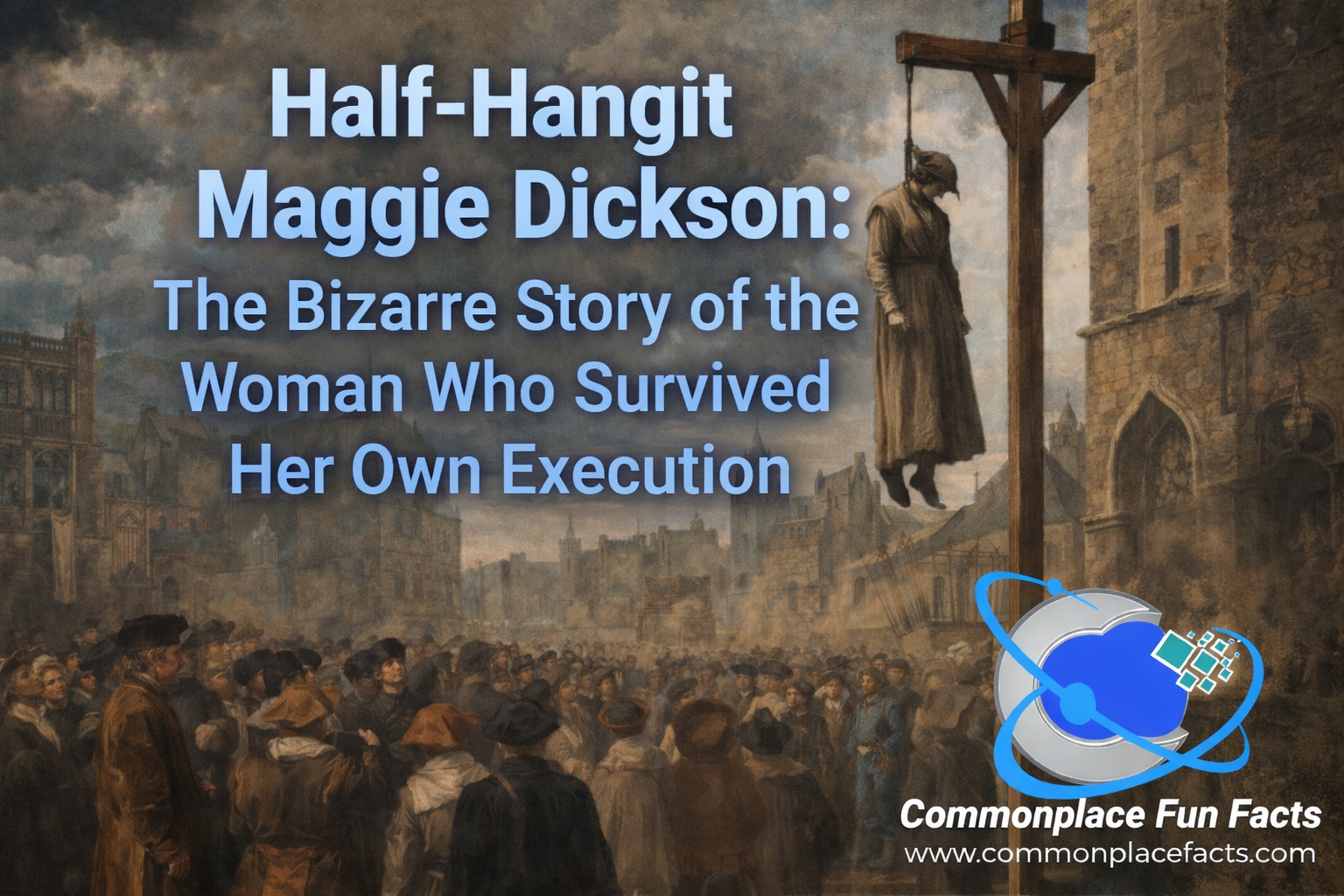

“Half-Hangit Maggie” Dickson did not set out to become a legend.
She was not a queen, a rebel leader, or the sort of person whose portrait hangs above a fireplace with a brass plaque underneath. She was a working woman in early 18th-century Scotland—born around 1702, married young, and living in the narrow margin between survival and disaster that defined life for much of the population.
History is usually written about people who seized power. Maggie’s story begins with someone who had almost none.
By her early twenties, her husband was gone—possibly lost to the sea or pressed into naval service—and Maggie was left to make her own way. She found work. She made mistakes. She became pregnant at a time when an unmarried pregnancy could cost a woman her reputation, her employment, and sometimes her life. In a society that treated shame as a public utility, secrecy could feel like the only available refuge.
What followed was not fame, but accusation. Not notoriety, but a trial. And not legend—at least not yet—but a sentence of death.
On September 2, 1724, Margaret “Maggie” Dickson was hanged for the alleged murder of her newborn child under a law that assumed concealment meant guilt. She was declared dead. She was placed in a coffin. She was carted away for burial.
And then she knocked from inside the box.
The woman who had just been executed was suddenly very much alive. In that instant, Margaret Dickson stopped being a condemned criminal in a small, bleak legal drama and became something far stranger: a living contradiction. The state had done its part. The rope had done its part. The crowd had gone home.
Maggie had other plans.
What turned her into “Half-Hangit Maggie” wasn’t just that she survived. It was that her survival forced everyone around her—judges, townspeople, clergy, and future storytellers—to decide what it meant when justice, death, and public certainty all failed to seal the lid.
This is the story of a woman who woke up in her own coffin—and what that moment says about law, shame, punishment, and the thin line between tragedy and legend.
Contents
Meet Maggie: A Working Woman in a World That Did Not Do “Grace”
Maggie Dickson was born in or near Musselburgh in the early 1700s—close enough to Edinburgh to feel the city’s gravity, far enough away to be considered “from out of town” when convenient. She married a fisherman named Patrick (according to many retellings), and for a while her life probably looked like the standard early 18th-century menu: work, scarcity, church, and the occasional existential crisis served without garnish.
Then her husband was gone. Some accounts say he deserted; others suggest he may have been press-ganged into naval service, which was a real hazard for working-class coastal families. Either way, the takeaway is the same: Maggie was left with limited options in a society that loved moral rules and hated paying for social safety nets.
So Maggie went looking for work and ended up in the Scottish Borders, around Kelso. If you’re keeping track, yes: this is the part of the story where the map quietly becomes a character. Musselburgh to Edinburgh. Edinburgh to Kelso. Kelso to the River Tweed. And eventually, a cart rolling back toward Musselburgh with a coffin on it and a future pub name inside.
The Pregnancy Problem (a Problem Society Invented and Then Punished)

While working in Kelso, Maggie became pregnant—traditionally said to be after an affair with the innkeeper’s son or someone connected with the household where she worked. This is where the story stops being merely sad and becomes a case study in how law and social shame can form a tag-team wrestling duo.
In early modern Scotland, an unmarried pregnancy wasn’t just scandalous; it could be economically catastrophic. Jobs vanished. Housing vanished. Support vanished. And the community often behaved as if a woman’s pregnancy was a personal insult delivered to the entire parish.
So Maggie concealed the pregnancy. Whether she hoped to keep her job, avoid disgrace, or simply survive without being publicly shredded is not hard to guess. That concealment—rather than any proven violence—was the legal and cultural spark that would light the fuse under her life.
A Baby, a Riverbank, and a Law Built to Assume the Worst
At some point the baby was born, and the baby was dead—either stillborn or dying shortly after birth. The historical record is thin and the story is thick, which is always the situation where later generations confidently fill gaps with whatever makes the best ballad.
What seems consistent across versions is that the baby’s body ended up near the River Tweed, near Kelso, and was discovered. Maggie was identified and arrested. From there, she was taken to Edinburgh for trial.
Now, here’s the important part: Scotland had a brutal legal framework around concealed pregnancies and dead infants, rooted in the idea that concealment itself was evidence of guilt. Under a notorious Scottish law from the late 1600s, a woman who concealed her pregnancy and did not call for assistance at the birth could be presumed to have murdered the child if the infant was found dead or missing—even if there were no signs of injury. It’s the kind of legal logic that says, “We can’t prove what happened, so we’ll assume the worst until you can convince us otherwise.”
As a philosophy of life, that worldview will rarely disappoint you. As a legal principle, however, it’s on the other side of the neighborhood from “innocent until proven guilty.”
In other words: this wasn’t a system designed for justice. It was a system designed for fear.
The Grassmarket: Edinburgh’s Outdoor Theater of Justice
On September 2, 1724, Maggie was hanged at the Grassmarket, the city’s longstanding execution site. The Grassmarket wasn’t just a location; it was civic programming. People came out in enormous numbers for executions in those days, because entertainment options were limited and because public punishment was the era’s favorite moral lesson delivered with maximum spectacle.

We should pause here and say the obvious: hanging is not supposed to come with a sequel.
But the mechanics of execution in the early 1700s could be inconsistent. The “long drop” method—designed to break the neck quickly—was a later refinement. Earlier hangings often involved slower strangulation, and survival (while rare) was not impossible if the drop was short, the knot placement was imperfect, the body was cut down quickly, or sheer physiology decided to get weird. Add cold weather, shock, and the general chaos of a public execution scene, and you have a recipe for a grim miracle.
Maggie was pronounced dead. Her friends and family claimed her body. She was placed in a coffin and loaded onto a cart to be taken back toward Musselburgh for burial.
So far, tragic. But normal-tragic, in the historical sense.
The Coffin Scene (Because History Occasionally Becomes a Horror Movie)
On the route between Edinburgh and Musselburgh, the cart stopped—often said to be around Duddingston, with some versions placing the pause at a local inn famously associated with the story. People went inside for refreshment, because nothing says “closure” like a quick pint while your loved one’s coffin waits outside.

And then: knocking.
Not metaphorical knocking. Not “the knocking of fate.” Actual, physical, “someone is inside this box and is having opinions about it” knocking.
The coffin lid was opened. Maggie was alive.
There are details that vary: some say she sat up; some say she groaned; some say she was in surprisingly decent shape given the circumstances, which is an extremely Scottish kind of understatement. But the core fact—the thing that made Maggie famous—was that she revived after being hanged and declared dead, while sealed in a coffin on the way home.
If you’re looking for the exact moment when this story stops being merely tragic history and becomes legend: it’s right there. The coffin lid lifts, someone screams, and the universe quietly files paperwork under “absurd.”
So… Do You Hang Her Again?
This is where the legal system had to do something it does not enjoy: improvise.
Scottish law may have worked against Maggie during the trial, but following her execution, it was a different story.

The authorities faced an awkward question. Maggie had been sentenced to death by hanging. The sentence had been carried out. She had, in fact, been hanged. She simply refused to cooperate with the expectation of staying dead.
Under the logic of the time, punishing her again raised serious problems. You can’t lawfully execute someone twice for the same conviction. The punishment had been imposed. The state had done its part. Maggie, apparently, had not read the memo.
A similar question was raised in 1947 when teenager Willie Francis went to the electric chair for murder. The chair wasn’t in a cooperative mood that day, and his lawyers argued that the sentence had been carried out and he should be released. Read “Willie Francis: The Teenager Who Was Executed Twice” to see how well that legal theory played out.
Fortunately for Maggie, Scottish justice was a bit more matter-of-fact. She had been sentenced to the gallows, and to the gallows she went. Sending her back a second time seemed a bit of an overreach. It is unclear whether the authorities feared public backlash or whether the whole event felt like divine intervention and nobody wanted to tell the Almighty that He needed to reconsider. Regardless, Maggie Dickson was spared a sequel to the worst day of her life.
Later tradition claims that this case helped cement a change in how death sentences were phrased: “hanged until dead.” Which is the legal equivalent of adding “no, seriously” to the end of a contract clause.
Read the poetic execution order handed down against Jose Manuel Miguel Xavier Gonzales for an example of a judge who left no doubt about the finality of the sentence.
The Myth Layer: Anatomy Students, Body Snatchers, and Other Add-Ons
As with any story that becomes famous, Maggie’s tale acquired accessories.
One popular flourish says there was a scuffle after her execution because medical students wanted her body for dissection and her friends fought them off. It’s a vivid image, and Edinburgh absolutely had a later reputation for body-snatching and anatomical controversy. The problem is timing: the most infamous era of Edinburgh body procurement scandals is later, and some historians note that the institutional landscape for medical anatomy in Edinburgh in 1724 doesn’t neatly support the idea of a student mob battling for Maggie’s corpse in the way the legend suggests.
So you can include the anatomy-student brawl in your story if you want—just present it honestly as a later embellishment that latched onto Maggie because Edinburgh already had a good “dark medical history” shelf for it to sit on.
Other versions get even more creative. Some claim Maggie bribed or seduced someone involved with the rope to ensure it would fail. Some frame her as a manipulator. Others frame her as a victim of a cruel law and a crueler social order. The truth is probably less theatrical and more depressing: Maggie was a working-class woman caught in a legal system that treated concealed pregnancy as presumptive murder and treated shame as a community sport.
Afterlife, the Non-Supernatural Kind
Maggie lived on—long enough to become a local celebrity and a cautionary tale and a legend that people could endlessly reshape depending on what moral they wanted to extract. Some accounts say she lived for decades afterward, had more children, and died many years later. The exact details are fuzzy, but the broad shape is consistent: she survived, she returned to ordinary life as much as one can after becoming the woman who crawled out of her own coffin, and she became “Half-Hangit Maggie” in the city’s memory.

And because Edinburgh knows branding, her name eventually ended up attached to a pub in the Grassmarket. It’s hard to outdo that as a historical legacy. Most people get a headstone. Maggie got a drinking establishment.
What Maggie’s Story Is Really About (Besides the Coffin, Which We Admit Is Doing a Lot of Work)
It’s tempting to treat Half-Hangit Maggie Dickson as a novelty—“the woman who survived hanging”—because that’s the headline-friendly hook. But the deeper story is about how societies police women’s bodies and then act surprised when tragedy follows.
Maggie’s case sits at the intersection of poverty, gender, law, and community enforcement. It’s a reminder that “justice” has often meant “whatever our fear tells us is probably true.” The legal framework around concealed pregnancy was built on suspicion, not proof. It punished secrecy as if secrecy were violence. And it made the mere fact of being an unmarried mother in trouble a kind of pre-crime.
Then, when the system did what it was designed to do—convict and kill—Maggie’s survival forced people to confront the machinery they had set in motion. Was she guilty? Was she innocent? Was it God’s will? Was it a botched execution? The story doesn’t hand us easy answers, and that’s partly why it stuck. A legend survives when it can be retold with different emphases: miracle, injustice, comedy, horror, cautionary tale.
But the most unsettling part of Maggie’s story isn’t that she woke up in a coffin. It’s that her legal peril likely began the moment she felt she couldn’t safely tell anyone she was pregnant.
History is full of grand narratives—wars, kings, treaties, revolutions. Maggie’s story is smaller in scale and bigger in implication: it shows how an ordinary person can be crushed by ordinary rules and ordinary cruelty, and how a single bizarre twist can turn that crushing into folklore.
Half-Hangit Maggie, Fully Remembered
If you ever find yourself walking through the Grassmarket, try to picture it as it was in 1724: crowded, loud, hungry for spectacle, convinced it was watching morality play out in real time. In that world, Maggie Dickson’s life was not treated as a complicated human life. It was treated as a lesson.
Then she survived.
And suddenly the lesson changed—because the audience had to decide what it meant when a condemned woman refused to stay neatly inside the ending they’d written for her.
That’s why Maggie lasts. Not just because she “didn’t die,” but because her survival yanked the curtain back on a system that wanted certainty without evidence and punishment without mercy. The gallows did its job. The law did its job. The crowd got its show.
Maggie got back up anyway.
In the end, that’s probably the most Scottish thing anyone has ever done.
You may also enjoy…

The Burke and Hare Murders: The Shocking Cadaver Scheme That Transformed 19th Century Medicine
Explore the Burke and Hare murders, the shocking 1828 Edinburgh crimes in which two men killed to supply cadavers to medical schools—sparking outrage and helping lead to the Anatomy Act of 1832.

Willie Francis: The Teenager Who Was Executed Twice
The shocking case of Willie Francis—the only person executed twice. Discover the failed electric chair attempt, Supreme Court battle, and the story behind Gruesome Gertie.

William Brodie: The Deacon, the Double Life, and the Original Jekyll & Hyde
Discover the true story of William Brodie, Edinburgh’s respectable Deacon who secretly led a life of burglary — and inspired Robert Louis Stevenson’s Dr. Jekyll and Mr. Hyde. A tale of double identities, scandal, and poetic justice.







Leave a Reply to Commonplace Fun FactsCancel reply