
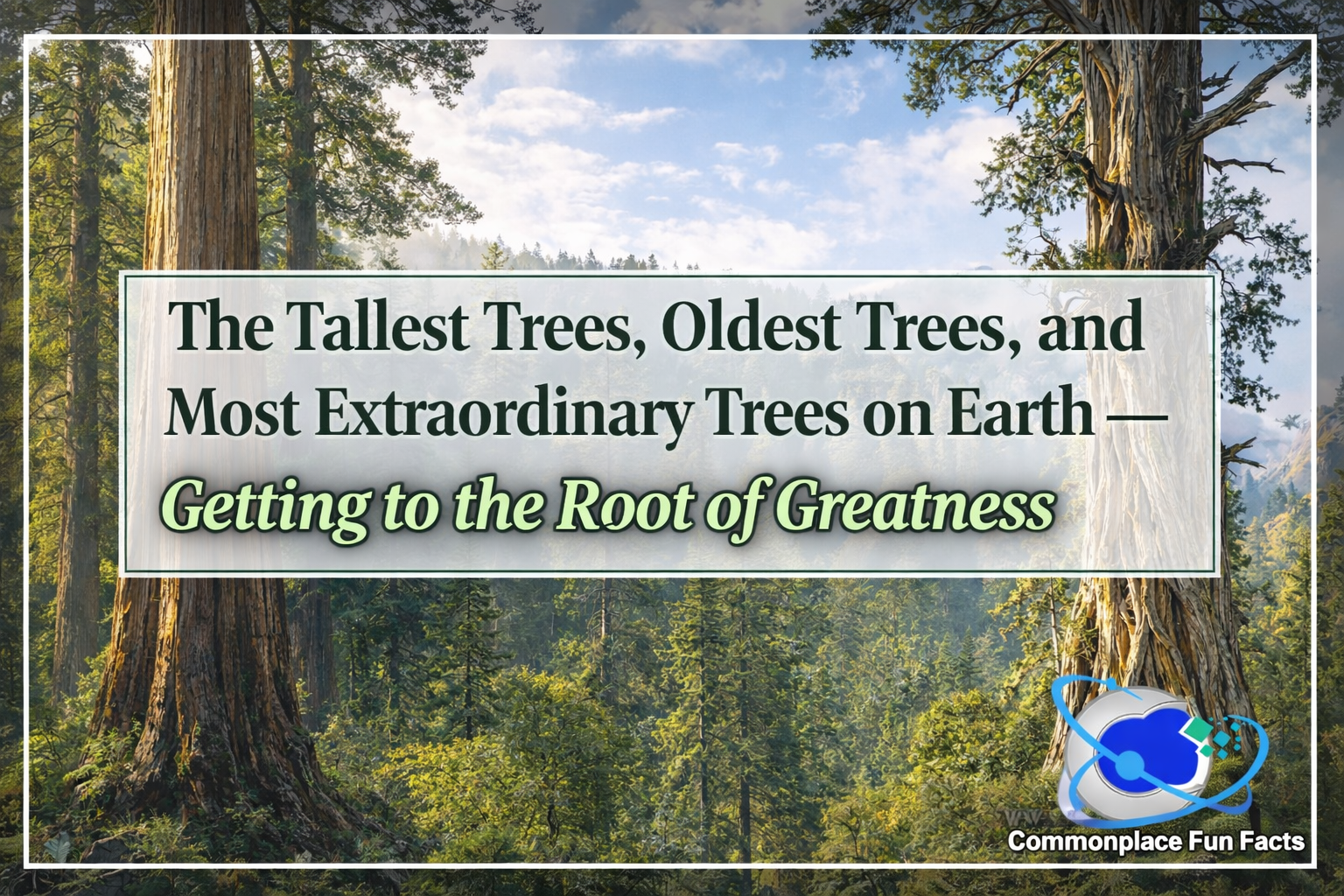

The World’s Tallest Trees, Oldest Trees, and Most Ridiculously Overqualified Trees
Trees have a public relations problem.
They stand around quietly, minding their own business, looking like background scenery for family photos, and then—if you start asking questions—you discover they are essentially running Earth’s entire operation while we bicker about when the neighbors should take down their Christmas decorations. Trees are older than our religions, taller than our buildings, heavier than our largest animals, and (in at least one case) capable of quietly absorbing gold like a leafy, photosynthesizing pirate.
Also, there are a lot of them. We have previously discussed the unsettling arithmetic of tree abundance in “There are More Trees on Earth Than Stars in the Milky Way”, in which the staff of Commonplace Fun Facts had to sit down for a moment and stare into the middle distance after realizing the planet is basically a giant, rotating stick collection. If you have not read that piece, it is a quick trip into the numbers that make humans feel small, which is a theme we are committed to exploring until morale improves.
Today’s mission is slightly different. Instead of counting trees, we are going to meet the trees that decided counting wasn’t enough. These are the record-holders. The freaks of nature. The botanical overachievers. The trees that make other trees quietly wonder if they should have tried harder in school.
Contents
The Tallest Tree Ever Measured Was Not a Redwood (Because Life Is Unfair)
When people talk about giant trees, the human brain immediately runs to California and starts humming a nature documentary soundtrack. That is understandable. Coastal redwoods and giant sequoias have been doing the “ancient cathedral of wood” thing for a long time, and they do it very well.

Still, the tallest tree ever measured was not a redwood or a sequoia. The all-time height record belongs to an Australian eucalyptus—specifically a mountain ash (Eucalyptus regnans), measured in the 1870s after it had already fallen. Reports place it at roughly 435 feet long when measured on the ground.
That number matters because 435 feet is not “tall for a tree.” That is “tall for a building.” That is “why are we allowing it to be outdoors” tall. It is taller than the Statue of Liberty (even with the pedestal) and taller than Big Ben. The only acceptable reaction is to blink a few times and then mutter something like, “Sure, Australia. Of course you did.”
Imagine the terrifying number of deadly Drop Bears that could live on that behemoth.
Many of the truly mythical-height eucalyptus giants are gone now, which is its own commentary on how humans treat anything impressive that happens to be made of wood. It does mean, however, that the modern title belt is held elsewhere.
Hyperion: The Tallest Living Tree, and Also the Most Guarded Celebrity in the Forest
The tallest known living tree on Earth is Hyperion, a coastal redwood (Sequoia sempervirens) in Redwood National Park in California. Hyperion is about 379.7 feet tall, which is the sort of number that makes a person reconsider how confident they feel about ladders.

Hyperion is also famously difficult to visit, and not because it is shy. Park officials do not publicly disclose its precise location, and in recent years they have gone further: the area around it has been officially closed due to habitat damage caused by visitors trampling the surrounding ecosystem. People, when told something is precious and delicate, have a well-documented tendency to respond by walking directly on it.
This is not a gentle “please stay on the trail” situation. Public reports about the closure mention potential penalties for entering the closed area, including fines and even jail time. In other words, Hyperion has achieved what few living things can: it has become a tourist attraction that may also function as a criminal justice elective.
For that reason, the tallest living organism on Earth remains unphotographed — at least in any way we can responsibly show you here. Instead, picture a massive coastal redwood that looks like it has been secretly training in a gym for the past few centuries. This is a tree so tall it could look down its nose — or its trunk, if we want to remain botanically accurate — at the Statue of Liberty, would top off at six or seven stories below.
There is a larger point here, hidden beneath the jokes. Hyperion is not just tall. It represents an entire ecosystem that supports that kind of height: the climate, the moisture, the soil, the slow patience of centuries. A tree that tall is not a “thing.” It is a process.
General Sherman: The Biggest Tree, the Heaviest Flex, and the Reason Tape Measures Feel Inadequate
Now let’s talk about size. Not height. Volume.
The world’s largest tree by volume is the General Sherman tree, a giant sequoia (Sequoiadendron giganteum) in Sequoia National Park. General Sherman is about 275 feet tall—impressive, yes, but not even closest to being the tallest. Its real claim to fame is that it is basically a wooden mountain wearing a suit of bark.

Its trunk volume is commonly listed around 52,500 cubic feet. That is a number that does not help the average reader until you translate it into something more relatable, like “enough wood to build a small neighborhood,” or “what happens when a tree commits to leg day for 2,500 years.” Estimates of its age often fall in the neighborhood of 2,200 to 2,700 years old, which means it was already an established elder when the Roman Republic was still doing its thing.
Weight is notoriously tricky to pin down for living trees because living trees do not like being placed on scales. Still, widely cited estimates put General Sherman around 2,000 tons. That is about as much as several blue whales. It is hard not to admire a life form that can be both majestic and somehow vaguely threatening just by existing.
General Sherman also makes a useful point: “largest” depends on what you mean. Tallest is one thing. Biggest trunk by volume is another. Widest canopy is another. Nature does not do simple awards categories. Nature is the Oscars, but with more chlorophyll.
Methuselah: The Tree That Was Old When Your Entire Civilization Was Just a Draft
If we are handing out superlatives, we should talk about age, because nothing makes a human feel like a temporary clerical error quite like an organism that has been alive since before writing was common.

The oldest known living non-clonal tree is Methuselah, a Great Basin bristlecone pine (Pinus longaeva) growing high in California’s White Mountains. Its age is estimated at more than 4,800 years, making it older than Stonehenge and even the Great Pyramid of Giza. Methuselah was already rooted and growing when much of human history still consisted of oral tradition and campfire storytelling.
Its exact location is kept secret, largely because humans have demonstrated a troubling tendency to treat ancient wonders like collectible souvenirs. Look no further than the Tree of Ténéré, which stood proudly for more than 350 years before being destroyed by a drunk driver. Methuselah is protected partly because it has survived thousands of years of harsh mountain conditions — and partly because it still needs protection from us.
Bristlecone pines achieve these remarkable lifespans by growing in brutal environments that slow everything down, including decay. Their dense wood, minimal growth rate, and pest-resistant habitat make longevity less about thriving and more about simply refusing to give up. Bristlecones are not living their best life. They are living their longest life, which is a different kind of victory.
Some trees have been even older. The famous Prometheus tree, for example, was about 4,900 years old before it was cut down in 1964. Clonal organisms like Sweden’s Old Tjikko and Utah’s Pando have root systems that are far older still, though their visible trunks are much younger.
So while Methuselah is not the oldest tree ever recorded, it remains the oldest known living individual tree on Earth — still standing, still growing, and still quietly outlasting nearly everything else.
Old Tjikko: The Tree That “Cheats” Death Through Cloning (Respectfully)
Then there are trees that make the “oldest” conversation even weirder, because they do not always play the game the way humans expect.

Old Tjikko, a Norway spruce in Sweden, is famous for having a root system dated to roughly 9,550 years old. The visible trunk is younger, because the plant survives through a form of vegetative regeneration—new trunks can sprout from the same ancient root system over millennia.
Old Tjikko gets its name from the dog of the scientist who studied it, which feels like the exact level of emotional grounding humanity needs when staring into a 9,500-year timeline. “Here is an organism that began its journey when the last Ice Age was still a fresh memory, and we named it after a good boy.” That is the kind of energy we can get behind.
Clonal longevity has a particular philosophical effect. It complicates the idea of what counts as “one tree.” It also suggests that trees have been quietly solving the problem of aging with a strategy that can be summarized as: “What if I just… continued?”
Pando: The Forest That Is One Tree, and the Tree That Is a Forest
If Old Tjikko makes you question identity, Pando makes you question everything else.
Pando is a clonal colony of quaking aspen in Utah’s Fishlake National Forest. It looks like a forest. It behaves like a forest. It has tens of thousands of stems (often cited around 47,000) that appear to be individual trees. Underneath, it is one organism—one genetic individual connected by a single root system.

Pando covers roughly 106 acres and has been estimated to weigh thousands of tons. Depending on which metric you use, it is sometimes described as the largest living organism on Earth. This is one of those facts that sounds like it belongs in a fantasy novel, but instead it lives quietly in Utah, being a botanical collective and waiting for humans to understand what they are looking at.
It is also a reminder that “largest” is not always a single trunk reaching into the sky. Sometimes “largest” is a sprawling underground system that keeps sending up new stems like it is running a long-term investment portfolio.
Gold in the Leaves: Eucalyptus Trees as Extremely Slow Metal Detectors
Now let’s return to the eucalyptus, because apparently it was not satisfied with being the tallest thing ever measured. Eucalyptus trees can also help locate gold deposits.
Researchers have found that certain eucalyptus trees can transport microscopic gold particles from underground deposits up into their leaves and branches. The idea is not that trees are “made of gold” in any practical sense. The amounts are tiny—so tiny that you might need hundreds of trees to get enough gold to make a ring. This is not a get-rich-quick scheme. This is a get-rich-in-the-next-geological-era scheme.
Still, the concept is incredible. The tree’s roots can reach deep, tap into water that contains trace gold from buried deposits, and bring that gold upward. The gold shows up as minuscule particles—far more “science lab” than “pirate treasure.”
From a human point of view, the value is not in harvesting the gold. The value is in using trees as biological clues. If your eucalyptus is quietly carrying trace gold in its tissues, that might tell you something about what lies beneath the surface. This is plant-assisted prospecting, which is either the future of mining or the opening scene of a movie where the forest finally gets tired of us.
The “Wood Wide Web”: Trees, Fungi, and the Underground Networking Event Nobody Invited Us To
Trees also have social lives. Not in the sense that they are texting each other memes, but in the sense that forests are connected below ground by networks of fungi called mycorrhizae. These fungal threads connect to tree roots and can help trees exchange nutrients and water.
This concept became popularly known as the “Wood Wide Web,” which is a clever phrase that makes forests sound like they have a router, a password, and a customer support number that never picks up. The underlying science is real: mycorrhizal networks exist and they can facilitate movement of resources between plants.
Some claims about trees “communicating” can get exaggerated in popular retellings, mostly because humans love turning biology into a personality quiz. Still, even the cautious version is remarkable. Trees are not isolated poles stuck in the dirt. They exist in relationships—roots, fungi, soil microbes, water flow, chemical gradients. A forest is less like a collection of individuals and more like a community that happens to be made of wood.
Fog, Water, and the Secret Ingredient Behind Redwood Superpowers
We should not talk about giant trees without talking about water, because “giant” is not a lifestyle choice. It is an engineering project.
Giant sequoias have been estimated to use hundreds of gallons of water a day, with some figures reaching 500 to 800 gallons during hot summer periods. That’s basically a municipal utility in bark form.
Coastal redwoods, meanwhile, live in a climate that helps them do their skyscraper routine. The northern California coast is famous for marine fog, and redwoods can capture fog moisture on their needles and bark. Some sources describe fog providing a significant portion of their water intake in dry seasons. Fog is not just atmospheric mood lighting. It is part of the plumbing.
It is hard not to admire the elegance of it. A redwood forest does not merely endure its environment. It uses it. Fog drifts in off the Pacific like a slow, silent supply drop, and the trees collect it the way humans collect packages from a porch.
So What Are Trees, Exactly?
On paper (a rather redundant phrase, actually, since paper is made from trees), trees are plants with woody stems. In practice, trees are time machines, climate regulators, water towers, ecosystems, record-breakers, and occasionally accidental mineral surveys.
Trees are also easy to underestimate because they do not move fast enough for our attention span. A redwood takes centuries to become itself. A bristlecone takes millennia to become a legend. Pando might be older than recorded history and still be quietly sending up new stems as if it is just getting started.
Humans tend to measure importance by urgency. Trees measure importance by longevity. If the universe ever holds a contest for “most patient life form,” trees are not just winning. They are letting everyone else finish first and then outliving the trophy.
In the end, the most unsettling thing about the world’s greatest trees is how little they care about our categories. Tallest. Oldest. Biggest. Heaviest. Most gold-adjacent. Trees are not trying to win awards. They are trying to keep doing what they do: turning light into life, quietly changing and protecting the planet, and making the rest of us look like a brief experiment in noise.
Which, admittedly, we are.
You may also enjoy…

Get Two Trees for the Price of One with the Double Tree of Casorzo
Poet Joyce Kilmer famously opined that he would never see a poem as lovely as a tree. If one tree struck his fancy, one wonders what he would have said if he gazed at the Double Tree of Casorzo — a spectacle that is two trees in one. The phenomenon is known as an epiphytic…

Why This May Be the Most Important Tree in History
At first glance, it appears to be an ordinary tree. Appearances can be deceiving, however. There is much about this tree that is far from ordinary. For one thing, it is an exceedingly rare type of apple tree. The Flower of Kent apples are green with a red flush. Once quite popular, it is all…

There are More Trees on Earth Than Stars in the Milky Way
Did you know there are more trees on earth than there are stars in the galaxy? Learn the facts in this eye-opening article.




Leave a Reply to ScottCancel reply