
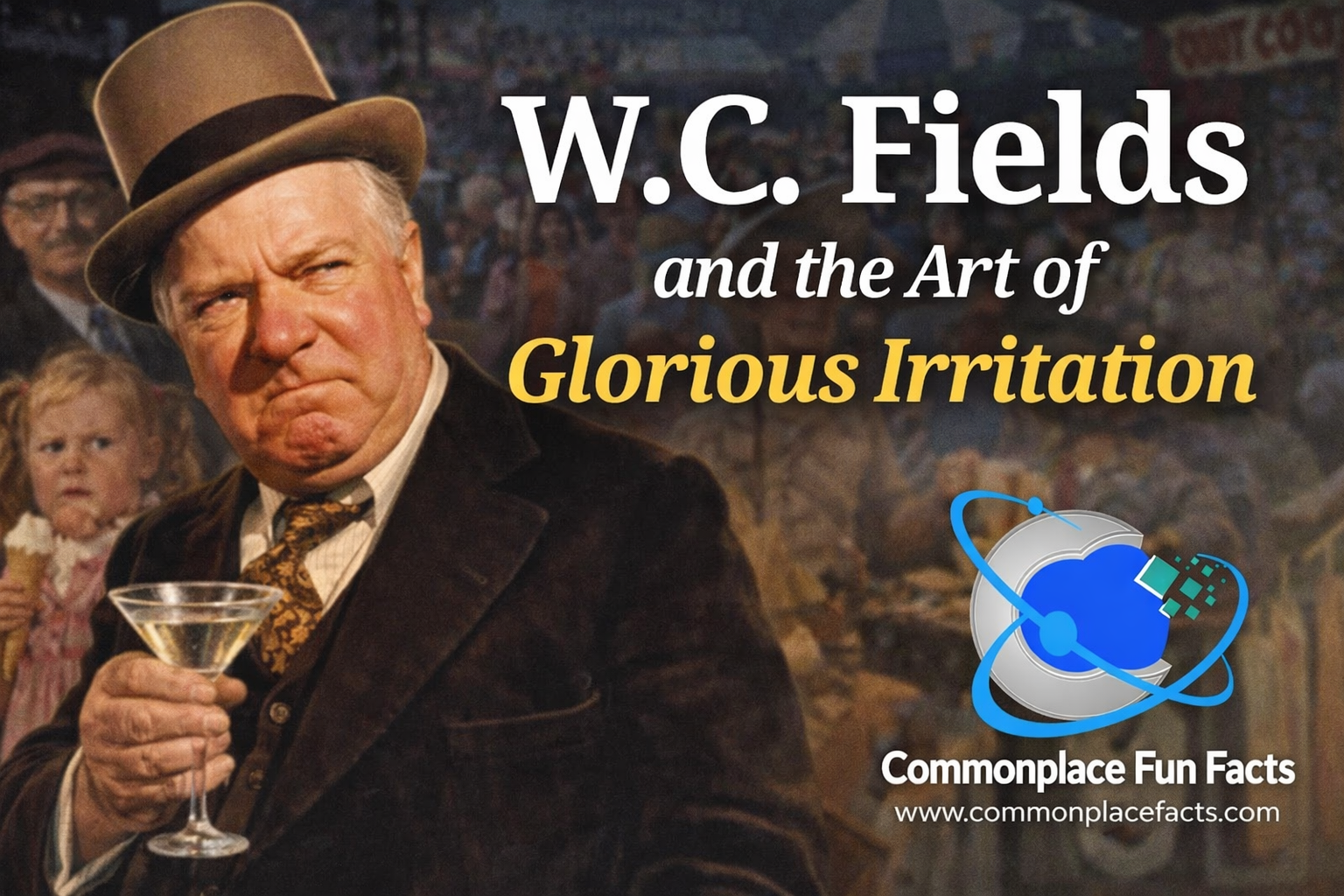

There are comedians who want you to love them.
There are comedians who want to be your friend.
And then there was W.C. Fields, who seemed perpetually annoyed that you had shown up at all.
William Claude Dukenfield—better remembered as W.C. Fields—built one of the most durable comedy personas in American history by perfecting a character who disliked children, distrusted authority, resented inconvenience, and regarded the universe as a rigged carnival booth. And yet… audiences adored him.
It is one of the great mysteries of entertainment history: how did a man whose on-screen personality suggested he would happily push you into a canal somehow become beloved?
The short answer is timing, talent, and an almost balletic mastery of indignation.
Contents
The Juggler Before the Grump
W.C. Fields was born on January 29, 1880, in Darby, Pennsylvania.
His childhood was difficult. Fields grew up under an abusive alcoholic father whom he later referred to as “The Old Patriarch.” Life in the Dukenfield household was unstable and frequently violent. He would later claim that he endured repeated abuse—including being struck in the head with a shovel. According to the version he preferred to tell, when he was eleven years old, he smashed a crate over his father’s head and fled into the night.

It is a dramatic origin story. It is also probably exaggerated.
In reality, “Whitey”—as he was known because of his blond hair—quarreled constantly with his father but appears to have remained in and around the Dukenfield household until he was about eighteen. As with much of Fields’ life, the legend is cleaner than the truth, and considerably more theatrical. Fields never met a good story he couldn’t improve.
What is certain is that young Dukenfield discovered juggling and clung to it like a flotation device. He began practicing with fruit from his father’s produce supply and graduated to balls, hats, cigar boxes, and a cane. He spent time in pool halls, where he picked up billiards tricks that would later become part of his stage routines. Already, he understood something critical: skill alone was not enough. The trick was presentation.
He began adding comedy to his juggling—“accidentally” dropping objects and recovering them at the last second, bouncing props off bewildered assistants, and turning precision into apparent chaos. The act looked reckless. It was anything but. Fields was developing astonishing control disguised as calamity.
In January 1898, he began performing at local Masonic halls under the name “Wm. C. Felton.” That alias did not last long. Dressed in ragged clothes and a fake beard, he soon reemerged as “W.C. Fields, Tramp Juggler.” The character—a slightly disreputable wanderer with improbable dexterity—fit him better. By August of that year, he secured a job at Plymouth Park, an amusement park in Norristown, Pennsylvania. The proprietor, J. Fortescue, quickly moved the popular young juggler to his Atlantic City venue, Fortescue’s Pavilion.
Yes, this is where the Atlantic City drowning stories tend to appear. According to later accounts, when crowds thinned, the young performer staged dramatic fake drownings followed by heroic rescues to stir up business. Whether entirely factual or partially embellished, the tale feels perfectly aligned with the Fields worldview: if commerce requires spectacle, provide spectacle.
As his skills sharpened (in juggling, not necessarily in simulated aquatic distress), Fields found steady work in vaudeville. He developed a precision act built around cigar boxes, hats, balls, and trick props that required extraordinary coordination. Early in his career, he spoke very little onstage. Whether by design or because he struggled with a stutter, Fields discovered something invaluable: silence could be funnier than speech. Timing was everything.
That lesson never left him. Even at the height of his verbal brilliance decades later, his comedy remained deeply physical. The slow turn of his head. The calculating pause. The careful balancing of a prop as though Western Civilization depended upon its stability.
Fields did not merely cross a stage. He invited gravity to join him as the co-star.
Vaudeville was a merciless proving ground. If an act faltered, the audience expressed its displeasure through boos, heckling, and occasionally rotting produce at dangerous speeds. Fields not only survived that arena—he mastered it. Vaudeville allowed him to become battle-tested in the comedy trenches, sharpened by audiences who did not believe in participation trophies.
From Vaudeville to Broadway Royalty
By the early 1900s, Fields had become one of vaudeville’s top attractions. He landed in the Ziegfeld Follies, sharing stages with some of the biggest names in American entertainment. His juggling grew more elaborate, but slowly, something else began to emerge.
A persona.
Instead of the generic entertainer smiling politely at the audience, Fields began developing the irritated, suspicious, slightly pompous character we now recognize instantly. He added dialogue. He sharpened his diction. He cultivated a vocabulary that sounded as though it had been marinated in a dictionary overnight.
His comedy wasn’t merely about dropping things. It was about reacting to the indignities of existence with theatrical exasperation.
He was not clumsy.
The universe was clumsy around him.
Cholmonley Frampton-Blythe Goes to the Bank
With vaudeville now firmly under his feet, Fields did what ambitious performers of the era tended to do: he kept moving. Success in 1900 did not mean security in 1901. A packed house tonight could become an empty train platform tomorrow.
Fields understood this. Perhaps because of his unstable childhood. Perhaps because vaudeville itself was a financial roller coaster powered by ticket stubs and rumor. In any case, he developed an unusual coping mechanism.
He began opening bank accounts across the country under elaborate pseudonyms. Not one or two. Hundreds.
Using such names as Cholmonley Frampton-Blythe, Aristotle Hoop, Ludovic Fishpond, Figley E. Whitesides, and Sneed Hearn, he is said to have maintained more than 700 such accounts scattered across the United States. Only forty-eight were identified at the time of his death.
This was not performance art. It was paranoia with paperwork. If the universe intended to cheat him, it would have to work harder.
Burlesque, Marriage, and the Rise of the Tramp Juggler
A stint with a traveling burlesque show ended in peak theatrical fashion when the manager abandoned the entire troupe in Kent, Ohio, around 1900. Stranded performers, unpaid bills, no management — show business has always been glamorous.
But it was during this period that Fields fell for a chorus girl named Hattie Hughes. He married her and made her his stage assistant, folding matrimony neatly into the act. For the next several years he toured burlesque circuits throughout the East and Midwest, climbing steadily toward top billing. The Tramp Juggler was no longer a novelty; he was becoming a headliner.

In 1901 he made his first tour of Europe, where his largely silent act played brilliantly. Precision transcends language. Dropped objects and near misses need no translation. By 1903, Fields added the routine that would define his early career: the trick pool table act. Critics soon hailed him as the greatest comedy juggler of his generation — not merely amusing, but astonishingly skillful.
Around this time, another transformation began quietly. Fields started educating himself. He filled a steamer trunk with books — Dickens, Twain, Hardy, Milton, Shakespeare, Dumas — and devoured them between performances. The boy who had struggled to survive domestic chaos was now constructing his own interior library. The ornate diction that would later define his screen persona did not appear from nowhere. It was assembled, page by page, on trains and in boarding houses.
Domestic life, however, proved less orderly than the juggling act.
When Hattie became pregnant, Fields sent her back to Philadelphia. She never returned to the stage. It seemed she preferred a more stable and “respectable” life. Fields continued touring and, for the next three decades, mailed her a weekly check — although, by most accounts, never one large enough to inspire gratitude. Hattie converted to Catholicism and raised their son, Claude, in the faith. Fields regarded organized religion as a confidence game for the gullible, which did not improve marital harmony. Their relationship hardened into long-distance warfare, a dynamic that would echo unmistakably in his later portrayals of the beleaguered husband.
Meanwhile, Fields’ professional ascent continued unabated. He toured internationally until 1915, when he settled in New York and joined Flo Ziegfeld’s Follies. There he shared stages with Al Jolson, Ed Wynn, Bert Williams, Fanny Brice, Will Rogers, and other giants of the era. Though he still juggled occasionally, he began concentrating on structured comedy routines — sketches like A Game of Golf, The Back Porch, The Picnic, and The Stolen Bonds — material that would later migrate almost intact to the screen.
He also appeared in rival revues such as George White’s Scandals and Earl Carroll’s Vanities, because rivalry sells tickets and Fields rarely objected to ticket sales.
In 1923, he starred on Broadway in Poppy as Professor Eustace McGargle, F.A.S.N., a genial fraud who blended carnival barker, medicine-show operator, and con man with just a hint of Dickens’ Mr. Micawber. This role crystallized one of the two archetypes Fields would inhabit for the rest of his career: the charming swindler and the exasperated pater familias. Everything afterward was refinement.
It was also during this period that Fields began dabbling in silent film, starting with Pool Sharks (1915). With the exception of Sally of the Sawdust (D.W. Griffith’s 1925 adaptation of Poppy), these early films struggled both critically and commercially. The camera had not yet discovered how to frame him.
His personal life was, if anything, even less tidy. Fields effectively abandoned his marriage and began a string of relationships with chorus girls. One of those relationships resulted in a son, William Rexford Fields Morris, born in 1917 to Follies dancer Bessie Poole. Poole gave the child up for adoption and died ten years later in a bar fight. Though Fields had insisted she sign a statement disclaiming his responsibility, he quietly supported the boy into adulthood. Years later, when Morris tracked Fields down in Hollywood and asked to see his father, the reunion was — by report — chilly. Fields instructed his butler to tell him to do something that was anatomically unlikely. Any fatherly tenderness he might have possessed remained well concealed.
Hollywood Discovers the Irritated Genius
Fields transitioned into silent films in the 1910s and 1920s, but it was the arrival of sound that truly unleashed him.
Many silent stars struggled when talkies arrived.
Fields thrived.
His voice was a weapon. Gravelly. Precise. Musical in its disdain. He spoke in elaborate, ornamental phrases that felt both inflated and deadly accurate. He could insult you in twelve syllables and leave you grateful for the opportunity.
By the 1930s, he was starring in films that essentially codified his screen identity: the irritable schemer, the beleaguered husband, the man with a questionable relationship to responsibility and an enthusiastic relationship to liquid refreshment.
The astonishing thing is that Fields almost always “won.”
While other comedies of the era punished selfish behavior with moral lessons, Fields frequently stumbled into accidental success. His characters failed upward. They dodged consequences. They thrived in spite of themselves.
In a nation navigating the Great Depression, this was not merely funny.
It was therapeutic.
It’s a Gift: Weaponizing Everyday Frustration
If you have ever stood in line behind someone writing a check in the year 2026, you understand Fields’ energy.
It’s a Gift (1934) remains one of his defining films. He plays Harold Bissonette, a mild-mannered store clerk harassed by customers, tormented by neighbors, and slowly disintegrating under the weight of banal irritation.
There is a porch scene—now legendary—where Fields simply attempts to sleep while the world conspires against him. A blind man crashes into objects. Salesmen hover. Dogs bark. Civilized society unravels.
Nothing explodes.
No one is chased by a pie.
It is simply a man versus minor inconvenience.
And it is glorious.
Fields understood that comedy lives in the accumulation of small annoyances. Modern sitcoms owe him a royalty check.
A Man of Many Names (Most of Them Hilarious)
Most performers adopt a stage name and call it a day. W.C. Fields treated identity as a revolving door. Throughout his life, he accumulated pseudonyms the way other men accumulated bad habits.
Among the more notable aliases that had wandered off the census roll:
- Cholmonley Frampton-Blythe
- Aristotle Hoop
- Ludovic Fishpond
- Figley E. Whitesides
- Sneed Hearn
- Cuthbert J. Twillie
- Otis Criblecoblis
- Mahatma Kane Jeeves
- Egbert Sousé
- Professor Eustace McGargle
- Larson E. Whipsnade
- Ambrose Wolfinger
Fields seemed constitutionally incapable of naming a character “Bob.”
The Bank Dick and Mahatma Kane Jeeves
Then came The Bank Dick (1940), where Fields plays Egbert Sousé, a man whose credentials are nonexistent but whose confidence is unshakeable.

Egbert stumbles his way into becoming a bank detective—“bank dick”—without any meaningful qualifications. He sabotages. He schemes. He drinks. And somehow, he becomes a hero.
If that sounds improbably modern, that’s because Fields helped invent this model.
Even better: Fields helped write the screenplay under one of the greatest pseudonyms in Hollywood history—“Mahatma Kane Jeeves.”
Which, when spoken aloud, sounds suspiciously like “My hat, my cane, Jeeves.”
If that pun alone does not justify his career, we don’t know what will.
The Bank Dick would later be preserved in the National Film Registry. Which means that, formally and officially, America agrees that Fields’ brand of dignified chaos is part of our cultural DNA.
My Little Chickadee (1940) paired W.C. Fields with Mae West, which sounds like a recipe for something that should create a measurable atmospheric disturbance. West wrote most of the screenplay, Fields contributed material (quietly and strategically), and the result is less a traditional narrative than a duel conducted in full sentences. West glides through the film with knowing innuendo and velvet self-assurance; Fields lumbers in as Cuthbert J. Twillie, a faux-gentleman cardsharp with a suspicious past and a talent for appearing respectable while behaving otherwise. The story concerns frontier scandal and mistaken virtue, but the real entertainment lies in watching two titans refuse to yield an inch of comedic territory. It is not so much a collaboration as a negotiated truce, delivered with impeccable timing and enough double entendre to require ventilation. In a career defined by verbal fencing, this may be Fields’ most evenly matched bout.
Radio, Rivalry, and the War Against a Wooden Child
By the late 1930s, W.C. Fields had conquered vaudeville and screen, which meant there was only one frontier left: the American living room.
Radio, at the time, was not background noise. It was the center of household gravity. Variety programs commanded audiences in the tens of millions. A performer didn’t simply appear on radio; he entered the bloodstream of the country.
Fields became a recurring guest on major programs, most notably the wildly popular Chase and Sanborn Hour, headlined by ventriloquist Edgar Bergen and his top-billed partner—who happened to be made of wood—Charlie McCarthy.
It was a perfect comic setup. Fields, who had built a career out of distrusting children, authority, and basic human interaction, now found himself in weekly combat with a wisecracking dummy. McCarthy was smug, flirtatious, and persistently impertinent. Fields was prickly, theatrical, and constitutionally unable to suffer fools—especially lacquered ones.
The feud was staged, of course. But it crackled. McCarthy needled Fields mercilessly. Fields fired back with ornate insults delivered in that gravel-and-silk voice. The strange genius of it all was that radio listeners were laughing at a ventriloquist act. They could not see the dummy. They were, in effect, enjoying a fight between two voices and an implied monocle.
Fields often played the lecherous antagonist, mock-outraged at McCarthy’s remarks or scheming to outwit him, usually unsuccessfully. The audience adored it. At the height of the program’s popularity, millions tuned in specifically for the exchanges between the human curmudgeon and the wooden provocateur.
McCarthy threw barbs such as, “I’ll stick a wick in your mouth and use you for an alcohol lamp.”
Fields had his own arsenal of wit: “Is it true your father was a gateleg table?” Prompting McCarthy’s response: “If it is, your father was under it.”
The rivalry was so successful that it spilled beyond radio into public perception. The idea that Fields despised children became one of his most durable myths, fueled in no small part by his on-air war with Charlie McCarthy. That McCarthy was technically lumber only enhanced the absurdity.
Behind the scenes, the dynamic was more professional than personal. Fields respected Bergen’s craft. He understood timing. He recognized good material when it struck him verbally in the face. But on the air, he treated McCarthy as though the future of civilization depended upon silencing him.
Radio gave W.C. Fields something film could not: pure voice. No props. No cane. No juggling. Just language and timing. It proved that his greatest weapon had never been the cigar box or the pool table. It had been syntax.
Never Give a Sucker an Even Break

Fields’ philosophy could be summarized in one semi-official maxim: never give a sucker an even break.
The phrase is widely associated with him, and whether he originated it or perfected it is almost beside the point. It perfectly encapsulates his worldview and became the title of his final featured screen role.
Never Give a Sucker an Even Break (1941) is his most unapologetically idiosyncratic film. Fields not only headlines — he wrote the original story under the pseudonym “Otis Criblecoblis” — and plays an exaggerated version of himself, a beleaguered screenwriter pitching an outrageously surreal script to a befuddled studio executive. The film teeters between plot and pure Fields improv, leaping from gag to sight joke to sketch so gleefully random that Universal once worried it wouldn’t even fit on a theater marquee. Alongside singing sensation Gloria Jean, comic foil Leon Errol, and Margaret Dumont as the imperious Mrs. Hemogloben, Fields delivers a blend of meta-Hollywood satire, bizarre set pieces, and classic one-liners that pay off decades of persona buildup. Though controversial with censors and never quite embraced as a mainstream comedy in its time, it remains a fascinating farewell — a last hurrah from a comic who spent his career refusing to give the audience or the studio an even break.
The Alcohol Question
We should address it directly.
Was W.C. Fields really the perpetually pickled misanthrope he portrayed on screen — or was the bottle merely a well-used prop?
The answer is inconveniently both.

Alcohol became central to the Fields persona. His characters clutched it, protected it, philosophized around it, and treated it as a loyal friend in a hostile universe. The audience learned to expect it. The glass was practically a co-star.
But the man himself was not simply play-acting. Fields drank heavily and did so for years. He inherited the alcoholism that he detested in his father. By the 1930s and 1940s, his health reflected it. He suffered from significant medical issues, including gastrointestinal bleeding and other complications consistent with long-term alcohol abuse. Doctors warned him repeatedly. He did not always listen.
And yet, this was not a man drifting drunkenly through his career. He was disciplined about scripts. Meticulous about rewrites. Strategic in negotiations. He maintained complex financial structures, toured relentlessly, and fought studios over creative control. Even when physically declining, he could deliver line readings with needlepoint precision.
In other words, the drinking was real. So was the control.
Fields weaponized a vice he already possessed, amplifying it into character. On screen, drink became philosophy. Off screen, it was habit, indulgence, sometimes liability. He blurred the line so completely that separating myth from metabolism becomes impossible.
The glass was not just a prop. It was an accessory. But it was also branding.
Like nearly everything else in his act, he turned reality into exaggeration and then exaggerated it again until it became legend.
Fields the Writer: Ornamental Insults and Verbal Gymnastics
Fields’ language deserves its own exhibit in the Smithsonian.
He favored elaborate constructions when a simple insult would have sufficed. He inflated minor complaints into symphonic grievances. He chose archaic phrasing just to add weight.
He was the kind of comedian who would call someone “a prognosticating worm of malodorous disposition” instead of just “a jerk.”
His dialogue had rhythm. It had architecture. It had the careful balance of a man who once juggled cigar boxes for a living.
Comedy is timing.
Fields measured timing in syllables.
The Quotable W.C. Fields
- “I never drink anything stronger than gin before breakfast.”
- When asked, “How do you like children?” Fields responded, “Par-broiled.”
- To Mae West, as he bent to kiss her outstretched hand in My Little Chickadee, “Ah, what symmetrical digits, my beautiful little brood-mare!”
- Only W.C. Fields could combine his uncanny ability to start a sentence with the word likely with style of speech that stretched the word shoulder into five syllables. Upon seeing Sabu, the actor known for his work as an elephant driver, Fields exclaimed, “Likely the little mahout will mistake my nose for a proboscis and climb up on my shoulder!”
- “It was a woman who drove me to drink, and I never had the courtesy to thank her for it.”
- “There comes a time in the affairs of man when he must take the bull by the tail and face the situation.“
- In Poppy (1936), he tells his daughter “If we should ever separate, my little plum, I want to give you just one bit of fatherly advice: Never give a sucker an even break!”
The Epitaph That Wasn’t (But Should Have Been)
W.C. Fields died on December 25, 1946. Yes, Christmas Day. A man who once built a career out of snarling at small indignities exited the world on the holiday most associated with goodwill toward men. One suspects he would have appreciated the irony.

By then his health had been in decline for years. Heavy drinking had taken its toll, and he suffered from complications that left him frail but not entirely subdued. Even near the end, he retained flashes of the old precision and the old bite. Friends and colleagues visited. Hollywood took note. The curmudgeon, the juggler, the verbal architect of irritation had reached the one inconvenience he could not argue with. And as with everything else in his life, it would soon acquire a punchline.
One of the most famous lines associated with Fields is, “On the whole, I’d rather be in Philadelphia.”
It is widely attributed as his preferred epitaph.
The fact that the sentence does not appear over his remains is less important than the fact that it fits so perfectly that history adopted it anyway.
It is both affectionate and dismissive. It is wistful but undercutting. It is the kind of joke that works best when delivered half-seriously.
Even death, in the Fields universe, required a punchline.
The Legal Afterlife
Although Fields left the stage of life, he did not leave the courtroom.
His funeral was held on January 2, 1947, in Glendale, California. According to his will, he was to be cremated. That simple instruction promptly became complicated. Hattie and their son Claude objected on religious grounds, and the cremation was delayed. For more than two years, Fields’ remains lingered in legal limbo while lawyers debated theology.
Ultimately, on June 2, 1949—over two years after his death—Fields was finally cremated, and his ashes were interred at Forest Lawn Memorial Park in Glendale. Even in death, he required timing adjustments.
But the real fireworks concerned the will itself.
Fields had included a clause directing that part of his estate be used to establish a “W. C. Fields College for Orphan White Boys and Girls, where no religion of any sort is to be preached.” The specificity was unmistakable. This did not sit well with his estranged wife or with the courts. In December 1949, a judge disallowed the bequest.
Fields’ fiercely loyal secretary and executor, Magda Michael, was not inclined to surrender. Determined to honor her employer’s intentions, she continued the fight. In December 1950, a compromise emerged: instead of founding a fully independent institution, $25,000 would be donated to a Los Angeles County college for the benefit of orphans. It was not quite the irreligious academy Fields had envisioned, but it was close enough to irritate somebody.
The estate litigation dragged on. Hattie Fields ultimately received the bulk of the inheritance. Payments were made to Carlotta Monti, to Fields’ siblings Walter and Adele, and to his son by Bessie Poole. Assets dwindled as legal fees accumulated. Magda Michael eventually resigned as trustee in 1956, by which time the residue of the estate was nearly exhausted.
The estate of W.C. Fields was not formally closed until January 16, 1963—sixteen years after his death.
It is tempting to imagine Fields observing the proceedings from some celestial balcony, muttering about inefficiency while lawyers devoured the proceeds. In life, he had opened hundreds of bank accounts in an effort to avoid being stranded without funds. In death, his fortune became the very sort of bureaucratic tangle he had spent a career mocking.
The last gag, it seems, required attorneys as the co-stars.
Fields and the Antihero Template
Long before modern television gave us morally dubious protagonists, Fields demonstrated that audiences are perfectly capable of loving a flawed main character.
His characters were selfish.
They lied.
They cut corners.
They occasionally behaved as though civic responsibility were optional.
And yet, because the world around them was chaotic and absurd, they felt strangely justified.
Fields positioned his protagonists not against virtuous adversaries, but against petty bureaucracy, hypocritical elites, nagging relatives, and cosmic inconvenience. He invited the audience to root for the underdog—even if that underdog was technically insufferable.
In doing so, he quietly laid groundwork for generations of comedic antiheroes.
The Strange Alchemy of Likability
The final question remains: how did he get away with it?
How does someone build a career around being irritated, suspicious, self-serving, and mildly antisocial—and remain beloved?
The answer lies in precision.
Fields never punched down gratuitously. He targeted pomposity. He exaggerated himself so thoroughly that the audience was in on the joke. He performed selfishness as theater, not confession.
And beneath the irritation, there was vulnerability. His characters were not conquerors. They were strivers, scrambling for dignity in a world that kept knocking their hats off.
Literally knocking their hats off.
The Legacy of a Man with a Cane
W.C. Fields began as a boy juggling fruit into the air so it would not fall.
He ended as a man juggling language, insults, syllables, and expectations with the same improbable control.

What looked like chaos was choreography. What sounded like complaint was composition. The irritation was real enough, but the artistry was deliberate. He did not merely grumble at the universe. He engineered its inconvenience for maximum comic yield.
Fields understood something fundamental: perfection is dull. Friction is funny. A hat that stays on is not nearly as interesting as one that refuses to cooperate. A polite world produces no stories. A world populated by fools, frauds, bureaucrats, and minor catastrophes produces a legend.
He left behind no college in his name, no marble monument carved with his most famous line, no neat moral lesson.
He left timing.
He left the antihero template.
He left a cane, a raised eyebrow, and the enduring suspicion that the universe is slightly ridiculous and best confronted with vocabulary.
There are comedians who chase affection.
Fields chased equilibrium in a lopsided world and made imbalance entertaining.
The fruit is still in the air.
You may also enjoy…

The Jack Benny Program: How Silence, Timing, and Character Transformed American Comedy
The Jack Benny Program transformed American comedy using silence, timing, and unforgettable characters—proving that the loudest joke on radio could be saying nothing at all.

Mae West Went to Jail in Silk Underwear—and Came Out a Star
Discover how Mae West turned scandal into stardom—writing risqué plays, defying censors, and becoming the highest-paid woman in Hollywood. From jail time to radio bans, her legacy is anything but quiet.

The War of the Worlds Broadcast: The 1938 Hoax That Became History
Discover the true story behind the 1938 *War of the Worlds* radio broadcast that fooled America. Explore how Orson Welles’ realistic performance, bad timing, and a few poor programming choices sparked nationwide panic—and made media history.






Leave a Reply to cat9984Cancel reply