
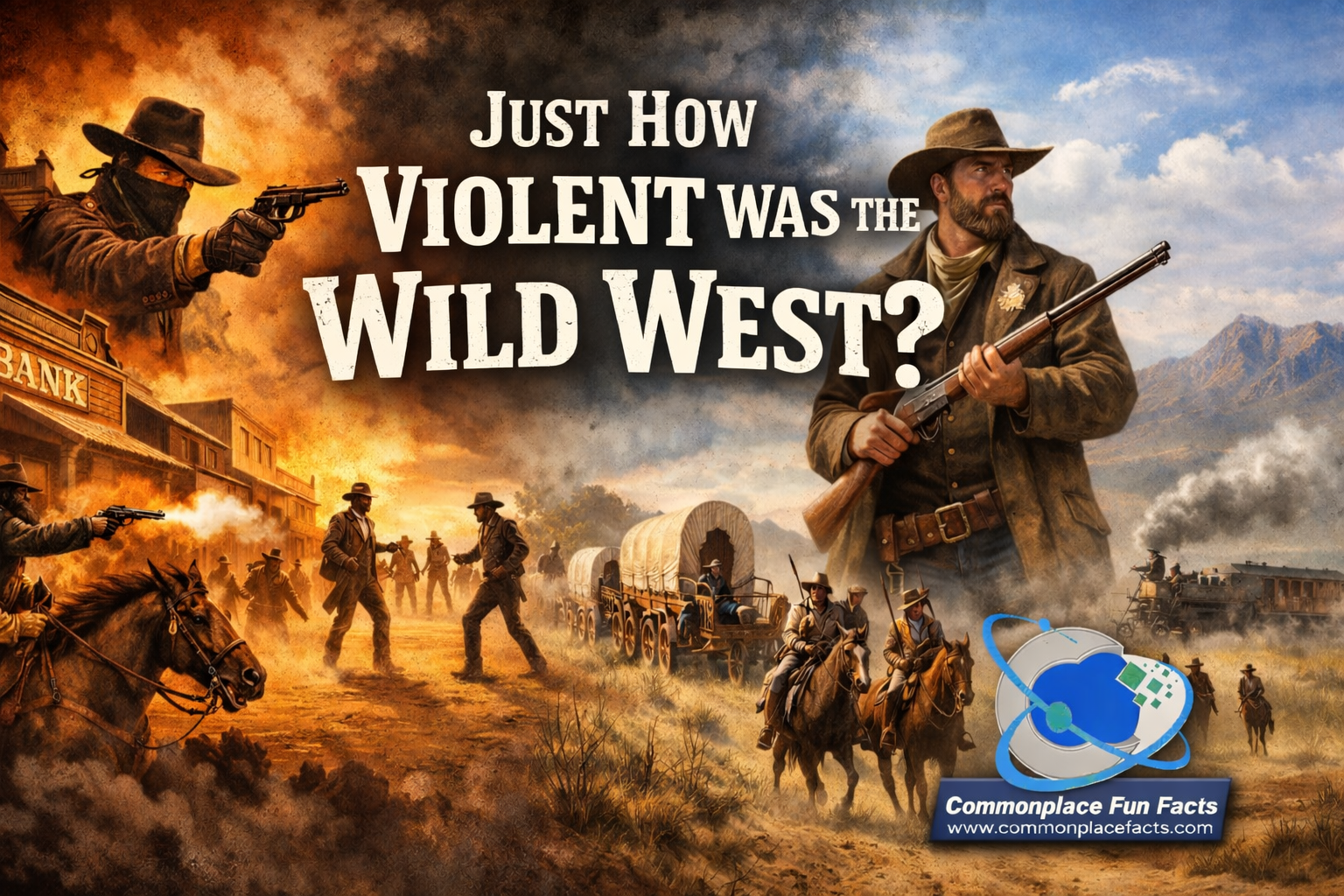

Just How Violent Was the Wild West?
Ask Hollywood, and the Wild West was a place where every third man wore a hat, every second man had a revolver, and every first man was about to settle something in the street at high noon.
According to the movies, a normal Tuesday in Dodge City involved three bank robberies, two stagecoach chases, and a dramatic showdown that paused politely until the piano player finished his tune.
But how violent was the Wild West really? Historians studying crime in the Old West have found that frontier towns were often far less deadly than movies suggest.
Admittedly, it wasn’t exactly a peaceful land of book clubs and neighborhood watch meetings. There were murders, robberies, vigilantes, range wars, and enough reckless young men with alcohol and firearms to make poor decisions into a regional specialty (even without a hotsauce-fueled study to prove it.) But the historical record suggests that the Old West was not one endless gunfight. In many of the towns we imagine as lawless, the number of killings in a given year was small enough that it wouldn’t even have triggered a PG-13 rating.
The truth is more interesting than the myth: the Wild West was not constant chaos. It was a place where a few spectacular crimes happened often enough to earn permanent legendary status.
Contents
The Wild West Was Surprisingly Short
One of the first surprises is how short the “Wild West” era actually was. In popular imagination it feels like a century of lawlessness stretching endlessly across the frontier. In reality, historians usually place the core period between roughly the late 1850s and about 1900. Even being generous with the timeline, the classic era lasted only a few decades.
That relatively brief window produced an enormous number of stories, dime novels, films, and television series. When you compress mythology into thirty years, it starts to look a lot busier than it really was.
In other words, the entire era we call the Wild West lasted about as long as the television run of Gunsmoke. Hollywood somehow turned three decades of frontier history into roughly five thousand shootouts.
Shoot-Outs: Dramatic but Rare
The classic image of the West is the showdown: two men facing each other in the street, hands hovering above holsters while the wind politely rearranges nearby tumbleweeds.

The historical record suggests that this almost never happened.
The formal quick-draw duel that dominates Western movies appears to have been largely fictional—or at least extremely rare. Gunfights certainly occurred, but they were usually messy affairs fueled by alcohol, personal grudges, or sudden arguments. A typical frontier shooting looked less like a choreographed duel and more like what happens when several armed men simultaneously reach the upper limit of their alcohol tolerance and the lower limit of their chill-o-meters.
The famous Gunfight at the O.K. Corral, perhaps the best-known shoot-out in Western history, lasted only about thirty seconds. That is still dramatic, but it is not the prolonged cinematic ballet that later storytelling turned it into.
Murder in the Cattle Towns
Places such as Dodge City, Abilene, Ellsworth, Wichita, and Caldwell have become legendary for violence. These towns were major railroad stops where cattle drives ended, and during peak seasons they were crowded with young cowboys, gambling halls, and saloons.
That combination could certainly produce trouble.
Yet historians examining the actual records discovered something surprising: violence in these towns was sporadic rather than constant. In many cases the number of killings in a given year was quite small—often only a few, and sometimes none at all.
One of the most influential studies of frontier crime was conducted by historian Robert R. Dykstra in his book The Cattle Towns. Dykstra examined court records, newspapers, and other historical documents from five of the most famous Kansas cattle towns—Abilene, Ellsworth, Wichita, Dodge City, and Caldwell. Covering roughly the years from 1870 to 1885, he found a total of about forty-five homicides across all five towns combined.
That sounds dramatic until you do the math. Spread across fifteen years and five towns, that works out to roughly one or two killings per town per year.
That is still tragic, of course—but it is not quite the nonstop gunfire suggested by movies in which the average cowboy seems to have the life expectancy of a mayfly.
Even allowing for gaps in historical records, the figures are far lower than the image created by Western films in which gunfights erupt whenever someone orders the wrong drink.
This does not mean the cattle towns were peaceful villages. During the height of the cattle-drive season they were crowded with young men carrying pay from months on the trail, which was an environment capable of producing spectacular bar fights and the occasional deadly encounter. But the evidence suggests that the famous frontier towns were not the nonstop shooting galleries that later mythology imagined.
Even notorious frontier figures were less lethal than legend suggests. Billy the Kid, one of the most famous outlaws of the period, is believed to have killed somewhere between four and eight people. Each death was tragic, but that total is far smaller than the body counts often attributed to him in popular culture.
Ironically, some of the most famous frontier towns later helped promote the myth of their own lawlessness. After the cattle-drive era ended, Dodge City leaned into its reputation as a dangerous frontier settlement to attract tourists. The town that once tried hard to control violence eventually discovered that stories about violence were excellent for business.
Bank Robberies: Much Rarer Than You Think
If Western movies have taught us anything, it is that banks existed primarily to be robbed by men wearing bandanas.
Reality again refuses to cooperate with the myth.
Historians studying crime in the frontier period have found remarkably few confirmed bank robberies. Across roughly forty years and fifteen Western states, researchers have identified a few dozen definite cases. In fact, bank robberies were so uncommon that modern cities often experience more of them in a single year than many frontier regions saw in a decade.
The Old West produced many famous outlaws—but apparently very few of them felt strongly about personal banking.
There were outlaws, certainly. Jesse James, Butch Cassidy, and others built reputations on train robberies and stagecoach hold-ups. But the iconic image of masked riders galloping into town to empty the local bank vault appears to be more dime novel than daily reality.
The West Even Had Gun Control
Another surprising detail is that many frontier towns had strict rules about firearms.
Dodge City, Tombstone, and other towns often required visitors to surrender their weapons upon entering town limits. Signs banning the carrying of firearms were common, and local lawmen spent considerable time enforcing these rules.
This does not fit comfortably with the popular image of the frontier as a place where everyone walked around permanently armed. Apparently local officials understood something that Hollywood screenwriters often forget: large numbers of intoxicated young men and loaded revolvers are a poor combination.
Even more surprising, some frontier lawmen did not carry firearms at all. Contemporary accounts mention sheriffs who believed that visibly carrying a gun increased the likelihood of violence rather than preventing it. The fastest way to avoid a shootout, it turns out, was sometimes to avoid bringing a gun to one.
Frontier Justice Was Often Private
Another detail that rarely appears in Western movies is how often frontier communities created their own systems of law enforcement long before official government institutions arrived.
In many parts of the American West, there simply was no functioning government at first. There might be a distant territorial authority or a military outpost hundreds of miles away, but for the most part the people living on the frontier had to figure things out themselves.
So they did.
In other words, the frontier occasionally solved problems with town meetings rather than gunfights—a development that has been tragically underrepresented in Western cinema.
During the California gold rush beginning in 1848, miners quickly realized that if they did not establish some basic rules, chaos would follow. Mining camps developed their own agreements governing claims, property rights, and dispute resolution. These rules were often written down, voted on by the miners, and enforced by elected arbitrators or justices of the peace. When conflicts arose, the community handled them collectively rather than waiting for distant authorities to intervene.
Similar arrangements appeared elsewhere across the frontier. Wagon trains traveling west commonly adopted written codes of conduct and elected leaders responsible for maintaining order during the journey. Ranchers formed cattlemen’s associations to combat rustling, sometimes hiring private investigators or organizing posses to track stolen livestock. In effect, these groups created their own locally organized enforcement systems.
These arrangements were not perfect, and they could certainly produce injustices. But they reveal something important about frontier life. The people settling the West were usually trying to build stable communities, not live in a permanent state of gunfire and lawlessness. When formal governments were absent, they often created their own systems of rules and enforcement to fill the gap.
That reality is far less cinematic than the image of the lone sheriff facing down a gang of outlaws in the street. But historically speaking, it is much closer to the truth.
The Dark Source of Violence of the Old West
When historians examine the genuine large-scale violence of the Old West, it often has less to do with outlaws and more to do with government policy.
Railroad expansion and westward settlement brought the United States into conflict with Native American tribes across the plains. Military campaigns and government policies aimed at clearing land for railroads and settlement resulted in devastating violence against Indigenous populations.
Some of the most violent episodes of the frontier era were not saloon gunfights but organized military actions. In 1864, for example, Colorado militia attacked a village of Cheyenne and Arapaho at Sand Creek. The camp had been told it would be under U.S. protection, yet soldiers killed more than a hundred people, many of them women and children. The event shocked many contemporaries and later became one of the most infamous massacres of the period.
Another example occurred in 1890 at Wounded Knee in South Dakota. U.S. troops attempting to disarm a group of Lakota Sioux opened fire after a confrontation escalated. The fighting quickly turned into a massacre, leaving hundreds of Lakota dead. The tragedy effectively marked the end of the Indian Wars on the Great Plains.
Throughout the latter half of the nineteenth century, similar conflicts erupted as federal policy pushed Native American tribes onto reservations while settlers, railroads, and mining operations expanded across the continent. Campaigns led by officers such as Generals William T. Sherman and Philip Sheridan targeted tribes across the Plains in an effort to secure territory for settlement and transportation routes.
This conflict—driven by expansion, military policy, and the struggle over land—produced far more sustained violence than the famous outlaw stories that dominate Western mythology. While dime novels and Hollywood films focused on bank robbers and quick-draw gunfighters, the most significant bloodshed of the frontier era often occurred in wars between the United States and the Native peoples who already lived there.
The Real Cowboys

Even the iconic cowboy owes much to earlier traditions.
Many of the practices associated with cowboys originated with Mexican cattlemen known as vaqueros. Long before Hollywood invented the rugged American cowboy, vaqueros were herding cattle, holding rodeos, and developing the techniques that later ranchers adopted.
Several words associated with cowboy culture—including “bronco,” “lariat,” and “stampede”—come directly from Spanish. Even the word “buckaroo” likely evolved from “vaquero.”
Like many parts of Western mythology, the cowboy legend turns out to have deeper and more complicated roots.
The daily life of a working cowboy was far less glamorous than Hollywood suggests. Much of the job involved long days riding slowly behind cattle, fixing broken gear, and trying to keep several thousand animals from wandering off in different directions. If Western movies portrayed cattle drives accurately, half the scenes would consist of cowboys staring at cows and wondering when dinner would happen.
So, Just How Wild Was It?
The Wild West was dangerous enough to earn its reputation, but not dangerous in the way movies usually portray.
Violence existed. Outlaws operated. Some towns had serious crime problems. But the frontier was not a nonstop carnival of gunfights and bank robberies. Many communities were surprisingly orderly, and much of the violence that did occur happened in bursts rather than as daily routine.
In other words, the West was not a lawless wasteland filled with constant shoot-outs. It was a region in transition—full of ambition, conflict, cooperation, and the occasional spectacular disaster that later storytellers turned into legend.
Most days did not end in a dramatic showdown in the street. Many ended with paperwork, property disputes, and people arguing about livestock.
The myth of the Wild West may be louder than the truth. But the truth turns out to be far more interesting.
You may also enjoy…

Wyatt Earp’s Strange Life: Lawman, Gambler, Boxing Referee, and Hollywood Advisor
Discover the strange real life of Wyatt Earp—lawman, gambler, boxing referee, and Hollywood advisor. Explore the surprising stories behind the Old West legend.

Lipitor: A Shady Lesson in How to Lie With Statistics
The post discusses the manipulation of statistics, exemplified by Lipitor’s advertising that highlights a 36% heart attack risk reduction while obscuring the minimal actual benefit of 1.1%. It also critiques government budget reporting, where proposed cuts often misrepresent increases, leading to public misunderstandings about funding reductions versus actual spending increases.

The Invisible Bank Robber: Meet the Man Who Paid a Wizard to Make Him Invisible
A Tanzanian man paid a wizard $500 to turn him into an invisible bank robber. Shockingly, the plan failed. Here’s the bizarre story.

Leave a Reply