

At the moment, the United States is gearing up for its 250th birthday in July, which means we are entering that familiar national phase in which Americans become temporarily sentimental, vaguely historical, and deeply committed to commemorative merchandise. There will be speeches. There will be patriotic graphics. There will almost certainly be people earnestly throwing “semiquincentennial” into ordinary conversation as if it is a word they use all the time.
That raises an obvious question: how did Americans celebrate the first really big birthday milestone?
To answer that, we have to go back to 1876, when the nation turned 100 and decided that the proper way to mark the occasion was with the enormous 1876 Centennial Exposition in Philadelphia. This was not a modest little civic pageant with bunting and brass bands. This was America announcing to the world that it had survived revolution, civil war, political chaos, economic panic, the invention of a great many terrible beards, and was now ready to show off its machines.
The Centennial Exposition was part world’s fair, part industrial flex, part national therapy session, and part giant public experiment in seeing how many people could be packed into one place before a second Civil War was triggered. It introduced visitors to astonishing new technologies, strange foods, mechanical marvels, and enough examples of progress to make the future seem as if it had arrived early and was charging admission.
And because this is America, it also got weird.
Contents
A Birthday Party the Size of a Small Civilization
The official name was the International Exhibition of Arts, Manufactures, and Products of the Soil and Mine, which sounds less like a celebration and more like a show-and-tell day for liberal arts professors. Everyone sensibly called it the Centennial Exposition.
Held in Philadelphia from May to November of 1876, it was the first official world’s fair in the United States. More than 10 million people visited. That number becomes even more impressive when you remember that the country was much smaller then (about 45 million people), transportation was slower, and nobody could tap an app to complain about parking. People came anyway. They came by train, carriage, trolley, and probably sheer patriotic stubbornness.

The grounds covered hundreds of acres and included more than 200 buildings. The Main Exhibition Building alone was so enormous that it briefly held the title of the largest building in the world by area. America, having reached age 100, responded in the mature and measured fashion of a newly rich uncle who buys the biggest possible hat.
The fair was meant to celebrate the nation’s first century, but it was also designed to tell a bigger story. The Civil War had ended only a decade earlier. Reconstruction was still underway. The country was trying very hard to present itself as healed, modern, unified, and ready for the future. In other words, the Exposition was a birthday party with a public relations department.
When the Future Started Talking Back
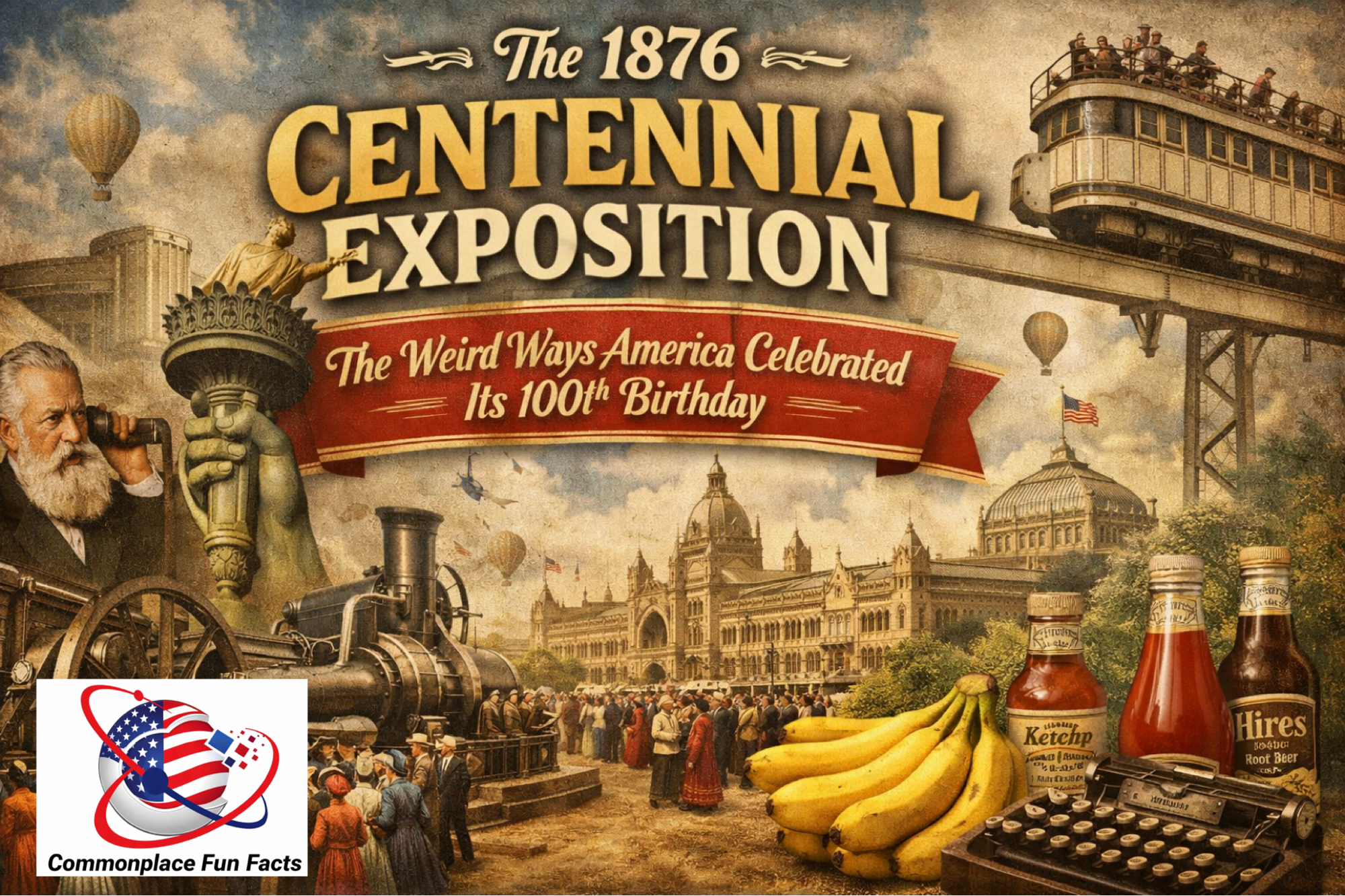
The single most famous debut at the fair was Alexander Graham Bell’s telephone.
That sentence sounds routine to us because we live in a world where people use phones to summon groceries, ruin Thanksgiving dinner with political opinions, and accidentally photograph the inside of their own nostrils. In 1876, however, the idea that a human voice could travel over a wire and emerge elsewhere was not a convenience. It was wizardry with a patent application.
Bell’s invention might easily have been overlooked. As the story goes, the judges were tired and ready to move on when Dom Pedro II, the Emperor of Brazil, recognized Bell. Dom Pedro had previously met him while Bell was working with deaf students in Boston. The emperor took an interest, followed Bell to the exhibit, and drew the others along with him because emperors tend to have that effect on a crowd.
Then came the famous moment. Dom Pedro listened and reportedly exclaimed, “My God, it talks!”
That remains one of the great reviews in the history of consumer technology.
Imagine being Bell. You bring a device that could permanently alter civilization, and your first major endorsement is essentially a crowned head of state yelling that your invention appears to be haunted. Honestly, no marketing team could improve on it.
The endorsement did the trick, and the telephone began its inevitable intrusion into the lives of everyday people. The next year, 1877, would bring the first telephone to the White House, along with the easy-to-remember phone number: 1.
The Giant Engine That Stole the Show by Existing Loudly
If the telephone was the delicate miracle of the fair, the Corliss steam engine was its great iron thunder god.

Visitors flocked to see this colossal machine in Machinery Hall. It stood nearly 50 feet tall and powered the exhibition’s machinery displays. Descriptions of its size varied, as descriptions of giant Victorian machinery often do, but the point was clear: this thing was enormous, impressive, and not at all subtle.
People did not just look at the Corliss Engine. They admired it. They wrote about it. They treated it as a symbol of national industrial might. Today, if you want to impress people, you unveil a thinner phone or a smarter watch. In 1876, you rolled out a machine the size of a small courthouse and let it roar.
The message was unmistakable. America had spent a century becoming not just a republic, but a factory with ambition.
The Statue of Liberty Showed Up One Limb at a Time

One of the strangest attractions at the Centennial Exposition was not a completed monument, but a body part.
The right arm and torch of the Statue of Liberty were displayed at the fair years before the full statue was assembled in New York Harbor. Visitors could pay fifty cents to climb up into the torch balcony, with proceeds helping fund the pedestal.
This means that, long before Lady Liberty became a towering national icon, Americans were paying to climb her detached arm in Philadelphia.
There is something wonderfully nineteenth-century about this. The age believed deeply in progress, engineering, and symbolism, but it was also perfectly comfortable saying, “The whole monument is not ready yet, but would you like to inspect this large patriotic forearm?”
And people did. Happily.
The Monorail That Arrived About Eighty Years Too Early
The Centennial also featured what is often described as the world’s first steam-driven monorail.
That alone feels unfairly futuristic for 1876. A monorail belongs in a retro-future cartoon, not a fairground full of waistcoats. Yet there it was: an elevated single-rail passenger system carrying riders through the exposition.
Americans who visited the fair could sample a transportation concept that would spend the next century and a half periodically reappearing whenever civilization wanted to signal that it was serious about tomorrow.
Like many futuristic ideas, it was dazzling, memorable, and not quite the everyday revolution people imagined. The monorail at the Centennial was less the birth of normal commuting than a reminder that history is full of inventions that arrive early, wave cheerfully, and then wander off before society quite knows what to do with them.
The Refrigerator That Promised to Break Up with Ice
Among the many marvels on display at the Centennial Exposition were quieter exhibits that did not immediately inspire emperors to shout but would eventually change daily life in ways far more practical.
One of those was Hyde Fisher’s refrigerator.

At the time, refrigeration meant one thing: ice. Lots of it. If you wanted to keep food from spoiling, you relied on an icebox, which was essentially a well-insulated cabinet that required regular deliveries of large, slowly melting blocks of frozen water. That ice had to be harvested from lakes during the winter, stored in icehouses, and shipped wherever it was needed. It worked, but it was not exactly a triumph of convenience. It also meant that your dinner plans were, to some extent, dependent on the weather in January.
Fisher’s exhibit pointed toward a different future—one in which cold could be manufactured rather than harvested.
His system used early mechanical refrigeration principles, involving the compression and expansion of gases to produce cooling. The idea was revolutionary, even if the execution was not yet ready for widespread domestic use. These machines were large, complex, and expensive. You were not going to tuck one neatly into the corner of your kitchen next to the flour bin. If anything, it looked more like something you would install if you ran a brewery, a meat-packing operation, or simply enjoyed the idea of owning a machine that sounded like it might launch into orbit.
Still, the significance was unmistakable. Fisher’s refrigerator represented a shift in thinking. Cold no longer had to be something you collected and stored. It could be something you created, controlled, and summoned on demand. That was a subtle idea with enormous consequences.
Visitors at the fair may not have fully appreciated what they were seeing. It did not have the theatrical flair of the telephone or the overwhelming presence of the Corliss engine. It did not speak, roar, or tower over crowds. It simply suggested, rather calmly, that one day you might not need a block of ice to keep your food from spoiling.
Which, in hindsight, is a fairly astonishing promise.
Like many inventions at the Centennial, Fisher’s refrigerator was less about immediate transformation and more about direction. It pointed toward a future where food could be stored safely for longer periods, where transportation of perishable goods would become more reliable, and where the modern kitchen—complete with a humming appliance that quietly keeps everything cold—would eventually become an ordinary part of life.
In other words, while much of the fair was busy announcing the future with spectacle and noise, Hyde Fisher was quietly introducing one of the inventions that would make everyday life in that future possible.
America Met Bananas and Other Suspiciously Modern Delights
The Centennial Exposition was not only a parade of machines. It was also a buffet of novelties.

For many visitors, this was their first introduction to foods that would later become familiar. Bananas were one of the sensations of the fair. So were popcorn, Hires root beer, and Heinz ketchup. The exposition gave Americans a chance to sample new tastes while wandering through a giant national showroom for the future.
That is a wonderfully American combination. We did not merely celebrate our founding ideals. We also encountered snack foods.
Imagine seeing the telephone for the first time, then strolling past a massive steam engine, then trying a banana, then perhaps examining ketchup in glass packaging, and finally going home to explain all of this to relatives who would immediately assume you were exaggerating.
The banana in particular must have felt like a suspiciously convenient fruit. It came in its own wrapper. It required no slicing. It looked exotic. What else could it be other than an indication that the future was here?
The Typewriter Made Its Debut and Was Not Yet Cool
The typewriter also appeared at the Centennial, which is notable both because it would eventually transform offices and writing, and because many early observers were not exactly swept off their feet.
This was not yet the sleek instrument of fast, professional prose. It was an awkward early machine that looked to many people like a sewing machine having an identity crisis. Some early models typed only in capital letters, which meant they reproduced the general emotional tone of a person shouting through paperwork.
Like so many important inventions, the typewriter arrived in public before the public was fully prepared to admire it. That is often how progress works. People later speak reverently of the turning point. At the time, half the crowd thinks it is marvelous, and the other half suspects it will never replace a decent pen.
History is full of revolutionary devices that initially made onlookers say, “Well, that seems impractical” or “That’s dangerous and will ruin the next generation!”
The Women’s Pavilion Quietly Did Something Radical
One of the most important features of the Exposition was also one of the easiest to underestimate: the Women’s Pavilion.

This was the first structure at an international exposition devoted specifically to women’s work, and it did more than put decorative accomplishments on display. It showcased inventions by women, including practical devices such as improvements in ironing, sewing, and household work. In other words, women were not merely being invited to admire progress. They were demonstrating that they had been inventing it all along.
That mattered.
The Centennial liked to present itself as a grand celebration of national achievement, but the Women’s Pavilion also revealed how much of American advancement had been hidden, minimized, or politely shoved aside by men with official titles. The pavilion was both a showcase and an argument. It said that women belonged in the story of innovation, industry, and modern life, whether the rest of the fair was entirely ready to admit it or not.
Even in a fair full of gigantic engines and electrical marvels, that may have been one of the boldest statements on the grounds.
Not Everyone Was Equally Celebrated
Like many grand commemorations, the Centennial was very good at celebrating a certain version of the nation.
The fair stressed unity, reconciliation, and progress. It featured participation from states across the country and from dozens of foreign nations. It symbolized a United States that had emerged from war and was now stepping confidently onto the world stage.
That was the polished version.
The less polished version was that African Americans were badly underrepresented, despite the recent abolition of slavery and despite the central reality that the nation’s first century had included both enslavement and civil war. The exposition projected harmony, but it did so by editing out a good deal of the struggle. Humanity has always had a gift for commemorative optimism, especially when optimism is more photogenic than honesty.
This does not make the Centennial unimportant. It makes it recognizable.
A Fair Where People Lost Their Teeth
No enormous public gathering is complete without a layer of human absurdity, and the Centennial did not disappoint.
The fair had its own police force and lost-and-found operation. Among the items reportedly recovered were hairpieces and false teeth. Which feels exactly right. Give millions of people a gigantic fairground, a swarm of attractions, summer heat, strange foods, and endless walking, and eventually someone is going to misplace both dignity and dental equipment.
There is something comforting in that detail. For all the lofty rhetoric about national progress and industrial destiny, the Centennial was still full of ordinary people doing ordinary things: getting tired, getting confused, dropping objects, and probably arguing about directions.
History is always more useful when it remembers that even the grandest events were populated by people who had to stop for lunch.
What the Centennial Was Really Celebrating
On the surface, the Exposition celebrated 100 years of independence. Beneath that, it celebrated something else: arrival.

In 1776, the United States had declared itself. By 1876, it wanted to prove itself.
The Centennial Exposition was the country’s way of saying that it had grown up. It could manufacture, invent, build, and compete. It could host an international event of enormous scale. It could present itself not as an experiment barely hanging together, but as a modern industrial nation with momentum.
That helps explain the peculiar blend of reverence and showmanship that defined the fair. The Centennial looked backward just enough to invoke the Revolution, then immediately turned around and pointed to engines, telephones, typewriters, packaged foods, and technological spectacle. It honored the founders, certainly, but it also seemed eager to reassure everyone that the age of powdered wigs had given way to the age of machinery.
America was not merely celebrating its birth. It was unveiling its upgrade.
So What Can the 250th Learn from the 100th?
As the nation prepares to mark 250 years this July, the Centennial offers a useful reminder that Americans have never been content to celebrate quietly. We prefer our anniversaries with symbolism, scale, gadgetry, and just enough weirdness to make future generations stare at the record and say, “They did what?”
In 1876, that meant a world’s fair where people encountered talking wires, towering engines, unfamiliar foods, a detachable Statue of Liberty, and a transportation system from the future. It was patriotic, theatrical, technological, commercial, hopeful, selective, earnest, and bizarre. Which, when you think about it, is not a bad summary of the country itself.
Perhaps that is the real lesson of the Centennial. National celebrations do not merely tell us what a country remembers. They tell us what it wants to believe about itself.
In 1876, America wanted to believe that its first turbulent century had led, inevitably, to greatness. It wanted to believe the future was bright, mechanical, and available for viewing in Philadelphia for a modest admission fee.
And for a few months, with steam hissing, crowds milling, bananas baffling people, and telephones apparently speaking by magic, that vision seemed entirely possible.
Which is really the most American birthday party imaginable.
To learn more, see the digital exhibits of the Free Library of Philadelphia.
You may also enjoy…

Relive the Wonder of the 1893 Chicago World’s Fair
In 1893, Chicago threw a big party in honor of the 400th anniversary of Christopher Columbus’ voyage to the New World. It was a spectacular affair. For five months, people from all over the world flocked to Chicago to take in the sights, which included such things as the first Ferris Wheel, cultural exhibitions, lectures,…

Celebrating Independence Day … a Little Too Early
John Adams envisioned the day being celebrated with fireworks, parades, and massive celebrations, as Americans commemorated the day that brought them independence from Great Britain. As it turns out, Adams was right, but he got the date wrong. The date Adams had in mind was July 2, 1776. It was on that day that the…

Caesar Rodney: The Midnight Ride That Secured American Independence
Caesar Rodney’s daring 80-mile ride through a storm changed history by breaking Delaware’s tie for independence. Discover the heroic story of America’s forgotten midnight rider.

Leave a Reply