

There are many ways to try to build a media empire.
You can patiently develop talent. You can cultivate affiliates. You can create innovative programming. You can inspire loyalty, reward creativity, and think long-term.
Or, if you are William S. Paley in the late 1940s, you can stroll up to your rival’s most valuable stars with a checkbook, a tax strategy, and the emotional energy of a man shopping for crown jewels at a clearance sale.
That, in essence, was the CBS Talent Raid.
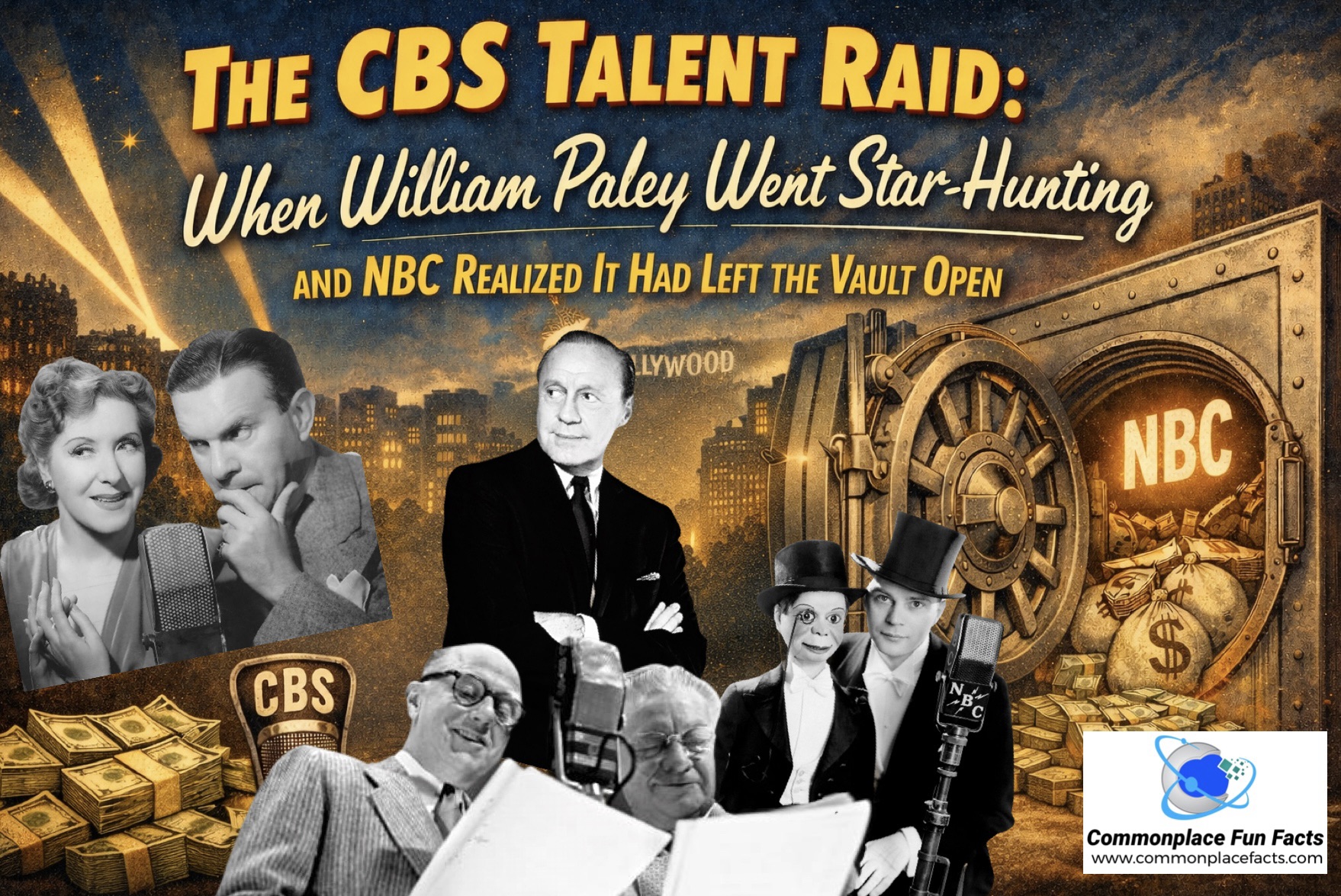
The phrase refers to the period in the late 1940s when CBS, under Paley’s leadership, lured some of the biggest names in American radio away from NBC. It was not called the CBS Talent Raid because anyone was trying to be subtle. It was called that because “organized, carefully financed talent extraction with devastating strategic consequences for the competition” is a little clunky for a headline.
This was the moment when network radio stopped being merely competitive and became openly predatory. It was also one of the clearest signs that broadcasting had become a serious corporate battlefield, complete with egos, brinkmanship, and enough money to make the word “entertainment” sound less like show business and more like a military-industrial complex with punch lines.
Contents
NBC Was the Big Dog, and CBS Was Tired of Pretending Otherwise
To understand why the raid mattered, it helps to remember the broadcasting landscape of the era. NBC had long been the heavyweight champion of radio. It had prestige, reach, and a stable full of stars that made everyone else look as though they were trying to entertain America with no greater talent arsenal than your crazy uncle who suddenly discovers a passion for flamenco after his third drink at Thanksgiving.

CBS, meanwhile, had grown dramatically under William S. Paley, who had taken a struggling network and turned it into a serious competitor. He had already proven that he understood something essential about broadcasting: audiences do not fall in love with corporate infrastructure. They fall in love with voices, personalities, characters, and habits. They tune in for people.
This sounds obvious now, because modern media has spent the last several decades beating us over the head with the concept of celebrity until it became one of the dominant forces in Western civilization. In the 1940s, however, Paley grasped this with unusual clarity. If NBC had the stars, NBC had the advantage. Therefore, if CBS wanted to win, CBS needed the stars.
Not eventually. Not theoretically. Immediately.
William Paley Was Not a Man Burdened by Excessive Timidity
Paley was one of those executives who seemed to have been assembled in a laboratory from equal parts charm, ambition, and polished steel. He was elegant, socially adept, and extremely good at making people feel important, which is a very useful skill when your business model involves persuading famous performers to abandon their current employers.
He also had a gift for understanding that talent was not just talent. It was leverage. It was prestige. It was ratings. It was advertising revenue. It was the difference between being the network everyone listened to and the network everyone said nice things about while tuning somewhere else.
So Paley went hunting.
The earlier phase of the campaign had already shown what he was willing to do. He went after Amos ’n’ Andy, one of NBC’s biggest properties, and reportedly made an offer so blunt it deserves to be displayed in a museum case under the label Executive Subtlety, 20th Century, Rarely Seen in the Wild. The principle was simple: whatever NBC was paying, CBS would do better.
That would have been unsettling enough. Paley then kept going.
The Genius, or Audacity, of the Deal Structure
This is the part of the story where things stop looking like ordinary contract negotiations and start resembling a master class in turning the Internal Revenue Code into a competitive weapon.
At the time, top marginal income tax rates in the United States were extraordinarily high—hovering somewhere in the neighborhood of “why am I even working this hard?” For the biggest stars, as much as 77% of their salary could vanish into taxes before it ever had the chance to become something useful, like a house, a car, or a very expensive hobby involving boats.

Capital gains, however, were taxed at the significantly lower rate of 25%. If you could somehow transform income into something that looked less like “salary” and more like “proceeds from the sale of property,” you could keep far more of it.
This is where Paley and CBS stopped playing checkers and quietly set up a chessboard.
Instead of simply paying performers a weekly fee, CBS structured deals in which the star would, in effect, sell valuable rights associated with their show—such as their name, format, or ownership interest—to the network. That transaction could be treated as the sale of a capital asset. The result was that a substantial portion of the money the performer received was taxed at the lower capital gains rate rather than as ordinary income.
In practical terms, this meant that two contracts offering the same headline dollar amount were not remotely equal. A traditional NBC-style salary might look impressive on paper but shrink considerably after taxes. A CBS deal, by contrast, could leave the performer with dramatically more money in hand, even if the gross figures appeared similar.
It was the financial equivalent of being offered two identical-looking suitcases, only to discover that one is filled with cash and the other is filled with cash and an ambitious IRS collector.
The arrangement also encouraged performers to think of themselves not merely as hired talent but as owners of something tangible and valuable. Their show was no longer just a weekly obligation. It was an asset—something that could be sold, leveraged, and structured in ways that would make an accountant smile in a deeply professional and slightly unsettling manner.
NBC, for its part, was not eager to embrace this kind of arrangement. Whether out of caution, corporate philosophy, or a general reluctance to redesign its entire compensation model on the fly, it largely stuck to more traditional salary-based contracts. This left CBS with a powerful advantage: it was not just offering more money. It was offering smarter money.
And in a world where the government was taking a very large interest in everyone’s paycheck, smarter money had a way of winning arguments that charm alone could not.
Then Came Jack Benny
If you were making a list of radio stars whose defection would cause maximum psychological damage, Jack Benny would be near the top.
Benny was not just famous. He was institution-famous. He was Sunday-evening famous. He was “millions of Americans know exactly how long to pause before the punch line” famous. By the 1940s, his radio persona was one of the most polished and beloved creations in the medium: vain, cheap, perpetually thirty-nine, easily flustered, and somehow both ridiculous and dignified at the same time.
That is not an easy balance to strike. Most people attempting it end up merely weird.
Benny had been a pillar of NBC for years. His presence on that network felt natural, almost permanent. Which is precisely why his move mattered so much. When he jumped to CBS for the beginning of 1949 (listen to that first broadcast here), it was not just another booking announcement. It was an unmistakable sign that Paley’s raid had become a full-scale strategic success.
Stealing Jack Benny from NBC was like taking the cathedral bell off someone else’s church and hanging it in your own steeple. It made noise. Everyone noticed.
If there was any lingering doubt that CBS intended to make the most of its newly acquired star power, Benny removed it before his first broadcast even ended. As the program wrapped up, he and Mary Livingstone launched into a cheerful bit of musical self-promotion, set to the tune of “Slow Boat to China.”
The lyrics were less a subtle plug and more a full-blown victory lap, name-checking CBS’s formidable Sunday night lineup with the enthusiasm of a network that had just raided its rival’s pantry and was now inviting the neighbors over for dinner:
“We’d like to get you to tune in on Sundays and listen to CBS.
(It’ll be so fun for you and me and everyone.)
Get you and tell you how much you’ll laugh at Spike.
Next comes Ol’ Blue Eyes.
Amos, he will surely delight (with Andy).
Then wait until you get Sam Spade to thrill you and guess when the villain will confess.
(I’m not gonna say; you’ll have to listen in today.)
Next comes Luigi.
You’ll hear him on CB…
Tune in on CBS (That’s now our network!)
Tune in on CBS!”
This was not just a catchy sign-off. It was a statement. In the span of a few playful verses, CBS effectively rolled out a lineup that could keep an audience planted in front of the radio for an entire evening. It was the programming equivalent of saying, “You could change the dial—but why would you?”
For NBC, this was something far more ominous than a single defection. It was the sound of momentum shifting.

He Was Not Alone
Benny’s move tends to get a lot of the attention, and understandably so, but the raid was not a one-man operation. CBS brought over a remarkable collection of major names, including Edgar Bergen and Charlie McCarthy, Red Skelton, George Burns and Gracie Allen, and others who helped reshape the balance of power in network radio.
The cumulative effect was brutal. This was not CBS picking off a few underused performers from the margins of NBC’s schedule. This was CBS reaching into the center of NBC’s identity and walking out with key pieces of it under one arm.
Imagine a rival restaurant stealing not only your head chef, but also your maître d’, your pastry specialist, your best waiter, and somehow the piano player the customers keep requesting by name. At a certain point, it stops feeling like competition and starts feeling personal.
For NBC, it was deeply personal.
The Stars Who Switched Sides
Strictly speaking, the “CBS Talent Raid” usually refers to the concentrated wave of high-profile defections in 1948–1949—particularly the headline names like Jack Benny and Red Skelton. However, performers such as Fred Allen, Fanny Brice, and The Aldrich Family were part of the same broader migration that strengthened CBS’s lineup. In other words, even when it wasn’t technically the raid, it still looked suspiciously like CBS was helping itself to NBC’s pantry.
Over the course of the Talent Raid, Paley enticed some of the biggest names in radio to jump ship and become part of the CBS lineup. The biggest names included:
- Jack Benny (The Jack Benny Program)
- Amos ’n’ Andy
- Edgar Bergen and Charlie McCarthy
- Red Skelton
- George Burns and Gracie Allen (The Burns and Allen Show)
- Frank Sinatra
- Fred Allen (moved in 1948, just ahead of the main wave)
- Fanny Brice (The Baby Snooks Show)
- The Aldrich Family

Why the Raid Worked
Money was part of it, obviously. It is difficult to overstate the persuasive power of being offered a lot more money. Humanity has historically found this compelling.
Paley’s personal style also mattered. He was famous for lavishing attention on talent. Stars were not treated like interchangeable programming units. They were courted, flattered, reassured, and made to feel that CBS understood their value in a way NBC either did not or no longer expressed convincingly.
That can matter as much as the contract. Entertainment has always had a strong emotional component, and not just on the air. Performers want money, yes, but they also want respect, freedom, leverage, and occasionally the pleasant sensation of watching someone powerful panic because they might leave.
Celebrities are also famously vain. That much hasn’t changed a bit since history’s first theatrical performance.
Paley knew this. Sarnoff knew a lot of things, but on this front he looked like a man who believed the stars should be grateful to orbit his sun. Paley behaved like a man willing to hand them their own solar systems.
NBC’s Problem Was Bigger Than Hurt Feelings
It is tempting to tell this story as a feud between Paley and Sarnoff, and there was certainly enough rivalry there to power several respectable biographies. Still, the larger problem for NBC was structural. For years, it had benefited from being the dominant network. Dominance can be useful. It can also make institutions a little complacent, a little rigid, and a little too convinced that yesterday’s arrangements will remain tomorrow’s arrangements because that would be convenient.
Then an opponent appears who is less interested in preserving custom than in winning.
Once the defections began piling up, NBC did not merely lose names. It lost momentum, prestige, and the comfortable assumption that its top talent would naturally remain where it was. The raid revealed something that had not previously seemed obvious: stars were portable. Audiences, inconveniently, might follow them.
That was bad enough for radio. It was even more ominous because everyone could see television looming ahead like weather.
The Raid Was Really About the Future
This is one of the most important things about the CBS Raid, and also one of the easiest to miss if you focus only on the drama of the defections.

Paley was not simply raiding NBC to improve radio ratings for a season or two. He was positioning CBS for the next era of entertainment. Television was coming into its own, and nobody in broadcasting could afford to ignore that fact. If radio stars could be moved to CBS now, they could become CBS television stars later.
That was the long game.
Radio still mattered enormously in the late 1940s, but the shape of the future was becoming visible. A network that controlled major personalities would have a better chance of controlling the transition. Paley was not just collecting trophies. He was building inventory for the next medium.
In that sense, the raid was less a robbery than a pre-invasion troop movement.
How Big Was the Impact?

Big enough that CBS overtook NBC in the ratings and big enough that the balance of network power was permanently altered. By around 1949 and into 1950, CBS had turned the raid into measurable success. It was no longer just the network that had signed some major stars. It had become the network that had proved NBC could be beaten.
That matters because institutions often survive single losses. What they struggle to survive is the destruction of inevitability. NBC had seemed inevitable. The raid cracked that illusion.
From there, the broader story of American broadcasting continued its restless march into television, sponsorship changes, shifting formats, and the slow twilight of radio’s golden age. Yet the CBS Raid remained one of the defining episodes in that transformation, because it showed that talent itself had become the key strategic asset of the industry.
The Modern Echoes Are Hard to Miss
If this all sounds strangely familiar, that is because the CBS Talent Raid has had many descendants.
Any time a media company lures a high-profile host, commentator, actor, or producer away from a rival with a dazzling contract and promises of creative freedom, it is reenacting the same basic logic. Streaming wars do it. Sports networks do it. Podcast companies do it. Cable news does it with the enthusiasm of a caffeinated raccoon in the kitchen pantry.
The forms change. The principle does not. Talent draws audiences. Audiences attract advertisers or subscribers. Therefore, talent is worth fighting over.
Paley understood that earlier, more clearly, and more ruthlessly than many of his contemporaries.
The Lasting Fun of the Story
Part of what makes the CBS Talent Raid such a satisfying topic is that it combines several excellent ingredients: huge personalities, boardroom warfare, tax maneuvering, bruised executive egos, and the faintly absurd spectacle of America’s biggest comedians becoming strategic assets in a corporate cold war.
It also reminds us that the golden age of radio, for all its nostalgic glow, was never just a gallery of beloved voices in front of microphones. It was a business. A fierce one. Behind every genial announcer and every perfectly timed laugh was a network trying to beat another network senseless with contracts, affiliates, sponsors, and ratings reports.
Under William Paley, CBS decided not to settle for second place. It decided to go shopping in NBC’s living room.
The age of passive competition was over. The age of talent warfare had arrived.
You may also enjoy…

The Rise and Breakup of NBC’s Radio Empire
Discover how NBC built a color-coded radio empire with Red and Blue networks—and how government regulators forced a breakup that helped create ABC and reshape broadcasting.

Amos ‘n’ Andy: The Comedy Hit That Changed Broadcasting—and Sparked Debate
Discover the legacy of Amos ‘n’ Andy, the groundbreaking radio and television show that captivated millions. Explore its origins, impact, cast, controversy, and lasting influence on American media.

The Jack Benny Program: How Silence, Timing, and Character Transformed American Comedy
The Jack Benny Program transformed American comedy using silence, timing, and unforgettable characters—proving that the loudest joke on radio could be saying nothing at all.






Leave a Reply