

If your understanding of the Pilgrims comes primarily from elementary school pageants, decorative napkins, and that one relative who insists on narrating Thanksgiving dinner like it’s a Charlie Brown Thanksgiving pageant, there is a very good chance you’ve been given a version of events that is… how shall we put this… aggressively simplified.
The real story of the Pilgrims—the passengers of the Mayflower who established Plymouth Colony in 1620—is far more interesting, considerably messier, and occasionally much funnier than the version we tend to repeat between bites of turkey and pie.
Let us take a moment to revisit the Pilgrims, separate fact from fiction, and, along the way, address one of the more colorful phrases ever allegedly associated with them: “psalm-singing puke stockings.”
Contents
The “Psalm-Singing Puke Stockings” Problem
Before we get too far, let us deal with the phrase that sounds like it was invented by someone who lost a bet at a Renaissance fair.

Occasionally the internet lights up with the delightful claim that the Pilgrims were mockingly referred to as “psalm-singing puke stockings.” The usual explanation adds a cinematic touch: the professional sailors aboard the Mayflower supposedly concluded that their passengers spent the voyage engaged in two primary activities—singing psalms and surrendering their breakfasts onto their feet with admirable consistency. It is the sort of detail that feels too specific not to be true, like a line overheard on a talk show and preserved for posterity.
The trouble is that history refuses to back it up.
The phrase appears to be a mash-up of two entirely real but unrelated elements. On one hand, Puritans—of whom the Pilgrims were a subset—were indeed mocked for their religious seriousness and fondness for singing psalms. During the English Civil War, their allies were derisively called “psalm-singing Roundheads,” a nickname that combined commentary on both their behavior and their haircut.
On the other hand, “puke stockings” was a legitimate term, but not nearly as dramatic as it sounds. In the 17th century, “puke” referred to a dull brownish color. “Puke stockings” were, quite simply, brown stockings. No nausea was involved.
Combine those two ideas, and you get a phrase that feels historically plausible but, as far as evidence goes, never actually existed. It is the historical equivalent of deciding that because it’s called a stovepipe hat, Abraham Lincoln must have fashioned it out of spare chimney parts.
They Didn’t Call It Thanksgiving
The famous 1621 feast is widely known as “the First Thanksgiving,” which is a bit like calling your first barbecue “The Founding of All Cookouts.”
The Pilgrims themselves would not have recognized the term. To them, a “thanksgiving” was a solemn religious observance—something closer to a day of fasting and prayer than a three-day outdoor buffet.
What they actually held was a harvest celebration, which involved food, socializing, and, one assumes, a general sense of relief that they had managed not to perish.
It Wasn’t the First of Anything
Even if we generously allow the name “Thanksgiving,” the 1621 feast was not the first of its kind.
Harvest celebrations had been a long-standing tradition in Europe, and similar events had already taken place in the Americas, including earlier Spanish settlements.
The Pilgrims did not invent the idea of gathering people together to eat after a successful harvest. They simply participated in a very old human tradition: celebrating survival with carbohydrates.
The Menu Would Disappoint You
If you are picturing a table laden with turkey, mashed potatoes, cranberry sauce, and pumpkin pie, you may want to take a moment to adjust your expectations downward to something closer to “whatever we managed to catch, shoot, or dig up.”
The 1621 feast was not a carefully curated holiday spread. It was a celebration assembled from what was available, which meant the menu leaned heavily toward practicality and away from anything that required a recipe card.

There was meat, and quite a bit of it. The Wampanoag contributed five deer, which strongly suggests that venison, not turkey, was the centerpiece of the meal. The colonists also went “fowling,” which is a polite way of saying they hunted whatever birds were within range. Duck and goose were likely present. Turkey may have made an appearance, but if it did, it was sharing the stage rather than headlining.
Living near the coast had its advantages, and the Pilgrims took full advantage of them. Seafood was almost certainly part of the feast, including fish, shellfish, and possibly eel—because nothing says celebration quite like a menu item that looks mildly judgmental when you pick it up.
The side dishes were equally grounded in reality. Corn appeared, though not in the form of buttery ears passed around the table, but as cornmeal used for porridge or bread. Beans, squash, onions, and other local vegetables rounded things out in a way that was nutritious, sensible, and unlikely to inspire anyone to request the recipe.
What was missing is where the illusion really falls apart. There were no mashed potatoes, because potatoes had not yet become a New England staple. There was no cranberry sauce, largely because sugar was scarce and nobody had yet decided that cranberries needed to be sweetened into submission. Pumpkin existed, but pumpkin pie—as we understand it—did not. At best, one might have encountered something involving a hollowed-out gourd and a sense of cautious optimism.
If you would like a more detailed reconstruction of what actually appeared on the table, including the historical detective work required to piece it together, we have covered it in full here: What Was Really on the First Thanksgiving Menu.
In short, the first Thanksgiving was not a triumph of culinary tradition. It was a triumph of survival. It involved substantial amounts of protein, a respectable showing of vegetables, and absolutely no marshmallows, which may be the most unsettling detail of all.
The Plymouth Rock Photo Opportunity
At some point, someone decided that the Pilgrims needed a dramatic landing scene and thoughtfully provided them with Plymouth Rock.
The problem is that none of the primary sources from the time—particularly the writings of William Bradford—mention anything about stepping onto a conveniently placed boulder.
The story appears to have been added later, giving us a neat, symbolic moment that looks excellent in paintings and considerably less convincing under scrutiny.
History, it turns out, has a tendency to add cinematic details long after the credits have rolled.
They Didn’t Dress Like That

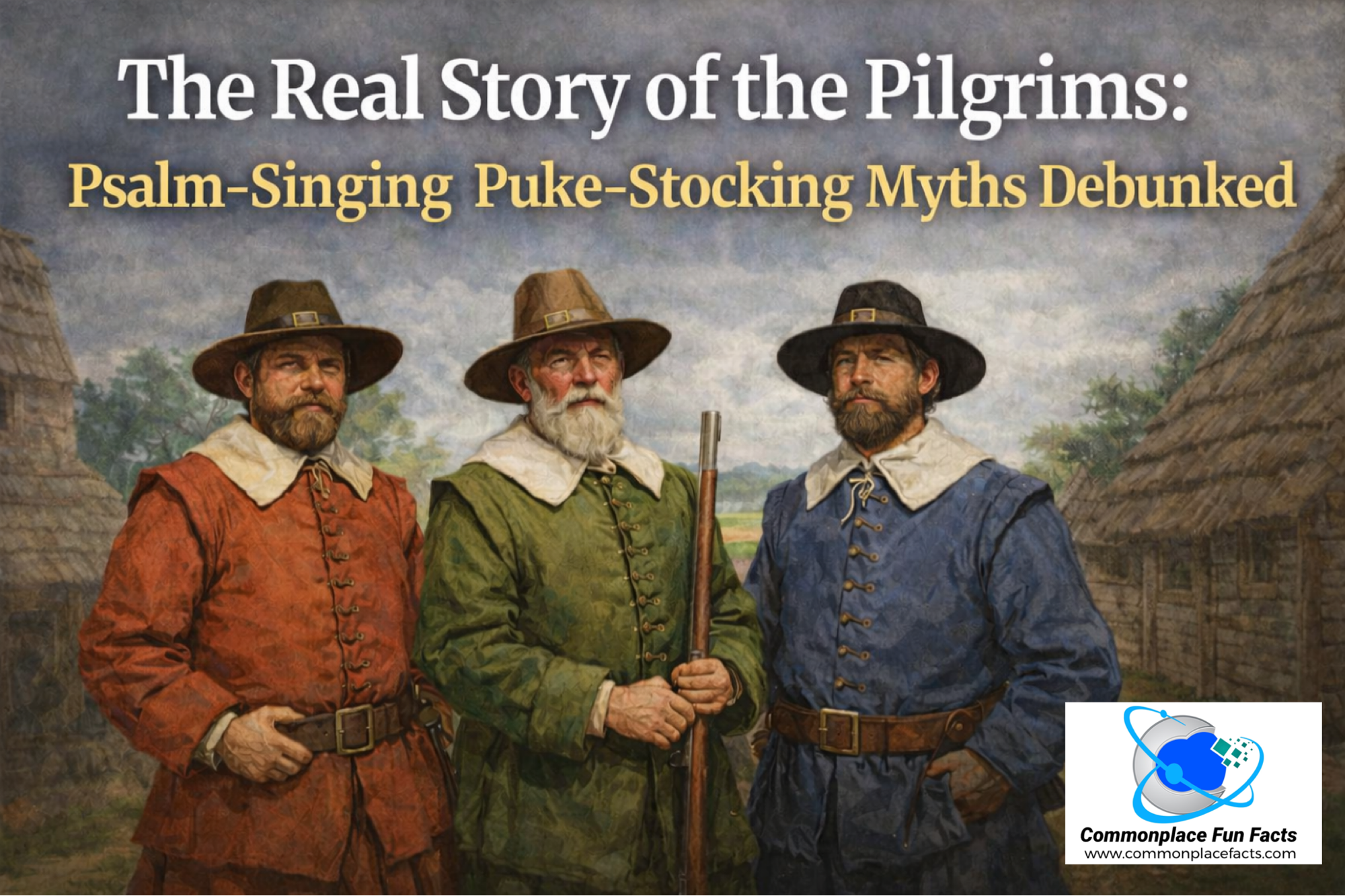
The traditional image of the Pilgrims involves black clothing, large hats, and an alarming number of buckles, as though they had all agreed to dress as very serious furniture.
In reality, they wore a range of colors, including reds, greens, and blues. Buckles existed but were not the dominant fashion statement we have come to associate with them.
The all-black wardrobe is largely a later invention, possibly created by artists who believed that religious seriousness should be expressed through an enthusiastic rejection of color.
Religious Freedom… With Conditions
The Pilgrims are often presented as champions of religious freedom, which is true in a very specific and carefully defined sense.
They sought the freedom to practice their own beliefs without interference. They were considerably less enthusiastic about extending that same courtesy to others.
Like many groups throughout history, they were deeply committed to liberty, provided it was their version of it.
The “Friendly Feast” Was Strategic
The relationship between the Pilgrims and the Wampanoag is often depicted as a warm and uncomplicated friendship.
In reality, it was a strategic alliance.
Both groups had strong incentives to cooperate. The Pilgrims needed assistance to survive in an unfamiliar environment, and the Wampanoag saw potential advantages in forming an alliance with the newcomers.
This was diplomacy, not a spontaneous group hug.
They Accidentally Invited 90 Armed Guests
The story of the 1621 feast often suggests that the Wampanoag were politely invited to join the celebration.
What seems more likely is that the Pilgrims were firing guns—possibly in celebration—and the Wampanoag, hearing the commotion, arrived to investigate what may have sounded like a developing military situation.
They then stayed for the meal, which is either a testament to diplomacy or an early example of turning an awkward misunderstanding into a social event.
Half of Them Didn’t Make It
The Pilgrims’ first winter was not a quaint prelude to a holiday tradition. It was brutal.
Roughly half of the settlers died from disease, exposure, and inadequate supplies. Those causes are familiar, but they were made worse by a system that, in practice, guaranteed inefficiency at the worst possible moment.

In the colony’s early days, land and labor were organized communally. Each person worked for the collective storehouse rather than for individual households. On paper, this sounded like a noble arrangement. In reality, it produced a predictable problem: some worked diligently, others less so, and everyone received the same share regardless of effort. As one might expect, this bred resentment, reduced productivity, and—most importantly—left the colony dangerously short of food.
The result was not merely inconvenience. It was deadly. When combined with a harsh New England winter, disease, and limited supplies, the inefficiencies of the communal system contributed to widespread starvation and suffering. The colony was not just struggling against nature; it was also struggling against its own economic structure.
Facing collapse, the leadership made a critical adjustment. The communal system was abandoned, and families were assigned their own plots of land to cultivate for themselves. Suddenly, effort and reward were connected. People planted more, worked harder, and took greater care in producing food because the results directly affected their survival.
The change was immediate and dramatic. Crop yields improved, morale rose, and the colony stabilized. What had been an experiment in shared labor gave way to a system that recognized a simple truth: people tend to work harder when they—and their families—benefit directly from the results.
The survival of the colony was still far from guaranteed, which adds a certain gravity to the later celebration. It was not just a feast—it was a marker that they had, against the odds, endured—and learned a few hard lessons along the way.
Not Everyone on the Mayflower Was a Pilgrim
One of the more overlooked details is that not everyone aboard the Mayflower was a religious separatist.
A significant portion of the passengers were there for practical or economic reasons. The Pilgrims themselves referred to these individuals as “Strangers,” which sounds less like a demographic category and more like the title of a suspense novel.
Even at the very beginning, the colony was a mix of motivations, personalities, and expectations.
How the Story Got… Polished
Much of what we think we know about the Pilgrims comes from later retellings, particularly in the 19th century, when there was a strong interest in creating a tidy, inspiring national origin story.
Details were simplified, complexities were smoothed over, and the result was a version of events that fit neatly into textbooks and holiday traditions.
It is a reminder that history is not just about what happened, but also about how later generations choose to remember it.
Conclusion: Less Buckles, More Reality

The real Pilgrims were not the monochrome, buckle-adorned figures of popular imagination. They were complex, determined, occasionally contradictory people navigating a difficult and uncertain situation.
They did not coin catchy insults like “psalm-singing puke stockings,” they did not dine on pumpkin pie in 1621, and they did not step obligingly onto a conveniently labeled rock.
What they did do was survive, adapt, and leave behind a story that, even after centuries of embellishment, remains compelling.
And if nothing else, they gave us a holiday that involves food, gratitude, and the annual opportunity to discover that someone, somewhere, is still absolutely certain that they wore nothing but black.
You may also enjoy…

The First Thanksgiving Menu: What the Pilgrims Really Ate (No Popcorn Included)
What was on the first Thanksgiving menu in 1621? Not what you might have expected!

Sarah Josepha Hale: She Gave Us Thanksgiving and Mary Had a Little Lamb
Discover the remarkable life of Sarah Josepha Hale—author, editor, and the woman who made Thanksgiving a national holiday. From “Mary Had a Little Lamb” to women’s rights, her legacy is anything but ordinary.

Debunking the Life Expectancy Myth: 2 Reasons Your Ancestors Lived Longer Than You Think
In the past, infant mortality heavily skewed average life expectancy, making it seem like our ancestors had short lives. However, if they made it past infancy, they could live to 70 or 80. Modern advancements have nearly doubled life expectancy and reduced infant deaths, challenging the myth of our ancestors’ short lives.




Leave a Reply