

The birth of the United States involved certain indispensable people, most of whom wore powdered wigs, delivered dramatic speeches, fought in heroic battles, and did it all in an atmosphere thick with destiny.
Somewhere in the background there was probably an eagle, with arrows clutched in its talons.
Less theatrical—and considerably more carpentry-adjacent—was something else that proved indispensable: Thomas Jefferson’s writing desk.
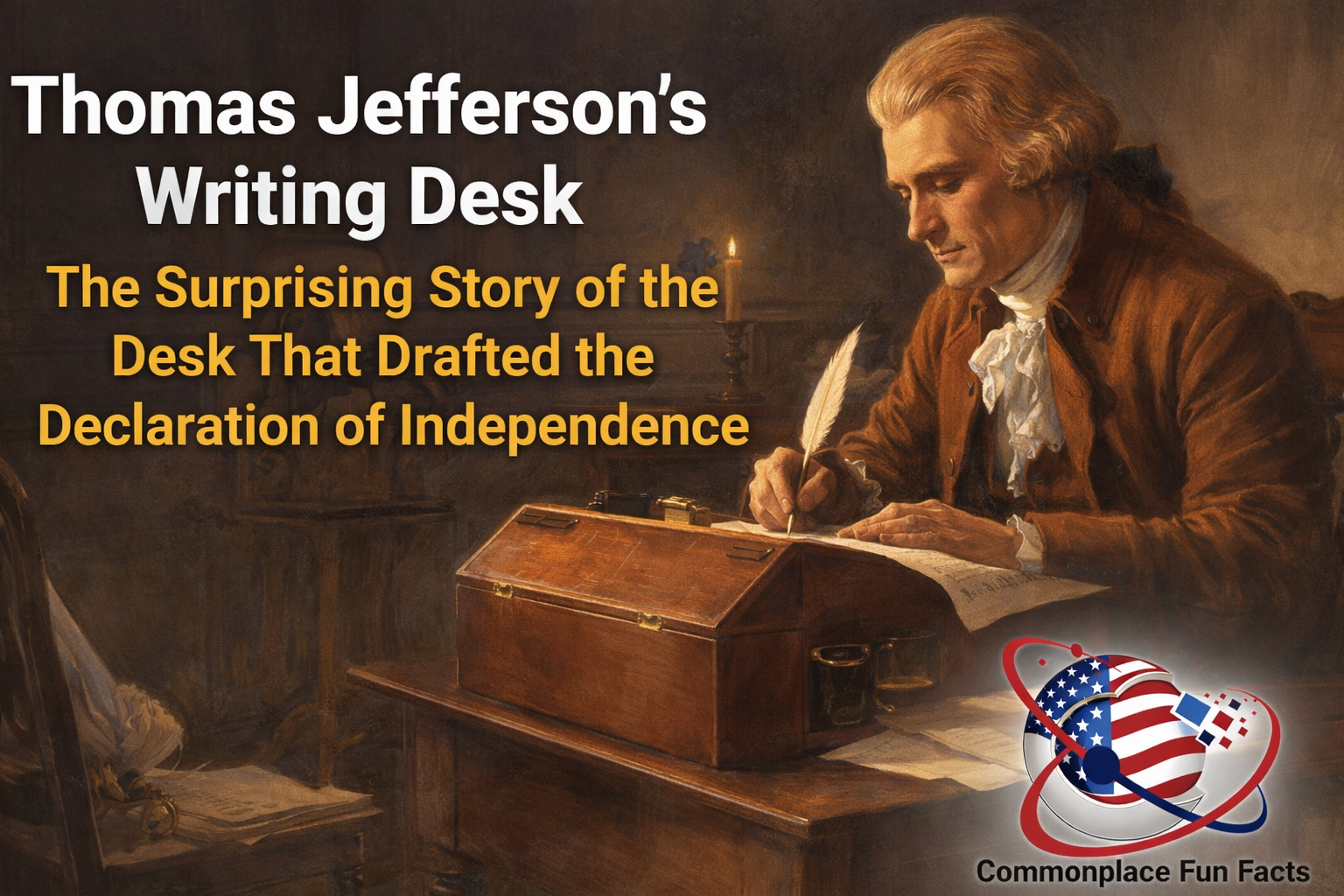
The Declaration of Independence—the document that politely informed King George III that the colonies would no longer be taking his calls—was largely drafted by Thomas Jefferson sitting alone in a rented room in Philadelphia, hunched over what can only be described as a very nice wooden box.
This box, officially known as Jefferson’s portable lap desk, may be one of the most important pieces of office furniture in history. It is also a reminder that revolutions are not always born in grand halls. Sometimes they are written on something that looks suspiciously like it could double as a place to organize your receipts.
Contents
The 18th-Century Laptop
Thomas Jefferson had the desk made in 1776, just before he got to work drafting the Declaration. It was constructed by a Philadelphia cabinetmaker—most likely Benjamin Randolph—and designed with portability in mind. Jefferson wanted something he could use anywhere, which makes sense when your job description includes “overthrow empire” and “write the document that makes it official.”

The desk was made of mahogany and featured a hinged writing surface that sloped upward for comfort. Inside were compartments for paper, ink, and writing tools. It folded up neatly and could be carried under one arm.
In other words, it was the colonial equivalent of a laptop—minus the screen, the keyboard, and the existential dread of software updates.
It also had two critical features modern devices lack: it never ran out of battery and never ceased to be useful when the Wi-Fi went down at a pivotal moment in history.
Drafting a Revolution, One Sentence at a Time
Jefferson didn’t write the Declaration in Independence Hall surrounded by cheering colleagues. He did it in relative solitude, in his lodgings, working through drafts with the kind of quiet focus that usually produces grocery lists rather than geopolitical earthquakes.
Of course, Jefferson was not working entirely alone in spirit. He consulted with fellow committee members, including John Adams and Benjamin Franklin, both of whom contributed edits. Franklin, in particular, made one of the most famous revisions, changing Jefferson’s “We hold these truths to be sacred and undeniable” to the far more Enlightenment-friendly “self-evident.”
This is the historical equivalent of a friend looking over your shoulder and saying, “Not bad, but have you considered making this sentence immortal?”
Still, the physical act of drafting—the ink, the quill, the crossed-out phrases—happened at that desk. It sat there quietly while Jefferson composed grievances, philosophical arguments, and one of the most quoted sentences in the English language.
Jefferson’s Writing Desk and the Surprisingly Good Exit Strategy
Many historical artifacts spend centuries being fought over, stolen, misplaced, or quietly gathering dust in attics. Jefferson’s writing desk, by contrast, had a remarkably civilized journey through history.
In 1825, nearly fifty years after writing the Declaration, Jefferson gave the desk as a gift to Joseph Coolidge, the young son of a friend. He described it modestly as “a small portable writing desk… on which I wrote the Declaration of Independence.”
This is a level of understatement that suggests Jefferson may have had a future in passive-aggressive emails.
The desk remained in the Coolidge family for generations before eventually being donated to the Smithsonian Institution. Today, it resides in the National Museum of American History, where it sits quietly, no longer drafting revolutions but still carrying the unmistakable aura of having once done so.
Fun Fact: The Declaration Was Edited Like a Group Project
If you imagine the Declaration of Independence as a pristine, perfectly conceived document, history would like to gently correct you.
Jefferson’s original draft went through multiple rounds of editing—not just by Adams and Franklin, but by the Continental Congress itself. Entire sections were removed, including a lengthy passage condemning the slave trade. Congress trimmed, revised, and adjusted the wording before approving the final version on July 4, 1776.

In other words, the Declaration of Independence was not handed down fully formed. It survived a committee.
Anyone who has ever worked on a group project can appreciate the miracle that it still reads as well as it does.
As it turns out, Thomas Jefferson did not particularly enjoy watching his carefully crafted document tweaked and edited.
This will not come as a shock to anyone who has ever poured their soul into a draft only to have it returned looking like it lost a knife fight with a red pen.
Jefferson was, in a word, annoyed.
Enter Benjamin Franklin, who had seen enough of life—and enough edited drafts—to recognize the symptoms. Rather than launching into a lecture about collaboration or reminding Jefferson that revolutions are, by nature, group projects, Franklin chose a different approach. He told a story.
According to Jefferson, Franklin recounted the tale of a man who decided to open a hat shop. Wanting to attract customers, the man designed a sign with a picture of a hat and the words:
“John Thompson, Hatter, makes and sells hats for ready money.”
Proud of his work, he showed the sign to his friends and asked for feedback.
One suggested that “Hatter” was unnecessary—after all, the image of a hat on the sign made that obvious.
Another pointed out that “makes” could be removed, since customers would assume the hats didn’t simply materialize out of thin air.
A third thought “for ready money” was implied—no one expected to walk away with a hat on a handshake and a promise.
Yet another suggested that “John Thompson” might not be needed if the sign was hanging directly outside his shop.
One by one, the words were eliminated until the sign was reduced to a simple picture of a hat.
Franklin’s point was not subtle.
Jefferson, like the hatter, had started with something carefully constructed and personally meaningful. Then came the helpful suggestions. Then came the edits. Then came the slow realization that what remained, while still functional, was no longer entirely his.
It was Franklin’s gentle way of saying: this is how things go.
To Jefferson’s credit, he accepted the changes—though not without privately noting his frustrations. And history, of course, suggests that the final version turned out reasonably well. At the very least, it hasn’t been misplaced like Fiji’s Declaration of Independence.
Still, somewhere in Philadelphia, a portable desk quietly witnessed a founding father learning that even immortal prose is not safe from committee review.
Fun Fact: Portable Desks Were Surprisingly Trendy
Jefferson’s lap desk may feel unique, but portable writing desks were actually quite fashionable among educated individuals in the 18th century. They allowed scholars, politicians, and travelers to write wherever they happened to be.
Think of them as the productivity tools of their day—except instead of managing email inboxes, they were used to compose letters, essays, and occasionally documents that would fundamentally alter human governance.
Jefferson himself was something of a gadget enthusiast. He owned multiple writing devices and was constantly looking for ways to improve efficiency. This included a polygraph machine (not the lie detector designed in part by the creator of Wonder Woman, but a device that copied letters as he wrote them), because even in the 18th century, people were already trying to streamline paperwork.
History, One Object at a Time

There is something oddly comforting about the fact that one of the most important documents in history was drafted on a portable desk. It reminds us that history is not just shaped by grand ideas, but by the ordinary objects that make those ideas possible.
The American Revolution was not only fought on battlefields. It was written—on desks, in letters, in pamphlets passed from hand to hand. It was argued over, revised, and refined before it was ever declared.
Jefferson’s desk is a quiet witness to that process. It didn’t create the ideas, but it gave them a place to exist.
Which raises a mildly unsettling thought: somewhere, right now, someone is sitting at a desk that looks entirely unremarkable and is writing something that future generations will treat with great reverence.
Maybe it’s you. If so, please take good care of that future historic relic.
You may also enjoy…

Shakespeare’s Chair: How Adams and Jefferson Went on a Souvenir Hunt
Discover how John Adams and Thomas Jefferson found a souvenir from William Shakespeare’s chair. A story of diplomacy, history, and a bit of mischief!

How Much Do You Know About the Declaration of Independence?
The United States of America celebrates its birthday on July 4. That day marks the anniversary of the Declaration of Independence and the formal separation of the colonies from Great Britain. But should July 4 really be the nation’s birthday? See how much you know about this founding document of the USA? Independence Day Is…

Mary Katharine Goddard: The Woman Whose Name is on the Declaration of Independence
Who was Mary Katharine Goddard, and how did her name appear on the Declaration of Independence?





Leave a Reply