

The BBC and the Spaghetti Tree Hoax
On April 1, 1957, the British Broadcasting Corporation (BBC) pulled off one of the greatest April Fools’ Day hoaxes of all time. With the utmost British dignity and deadpan seriousness, the BBC convinced an unsuspecting public that spaghetti grew on trees. And not just any trees — they grew in the picturesque fields of southern Switzerland, where the year’s mild weather and the elimination of the spaghetti weevil led to a bumper crop.
For those of us who spend our days doomscrolling and fact-checking celebrity rumors, it’s easy to forget that 1957 was a simpler time. There was no internet, no social media, and no “Wikipedia rabbit holes” to fall down in search of instant verification. People trusted what they saw on TV, and in Britain, if the BBC said spaghetti grew on trees — well, who were they to question it?
Contents
A Dish Best Served Cold (and Twirled)
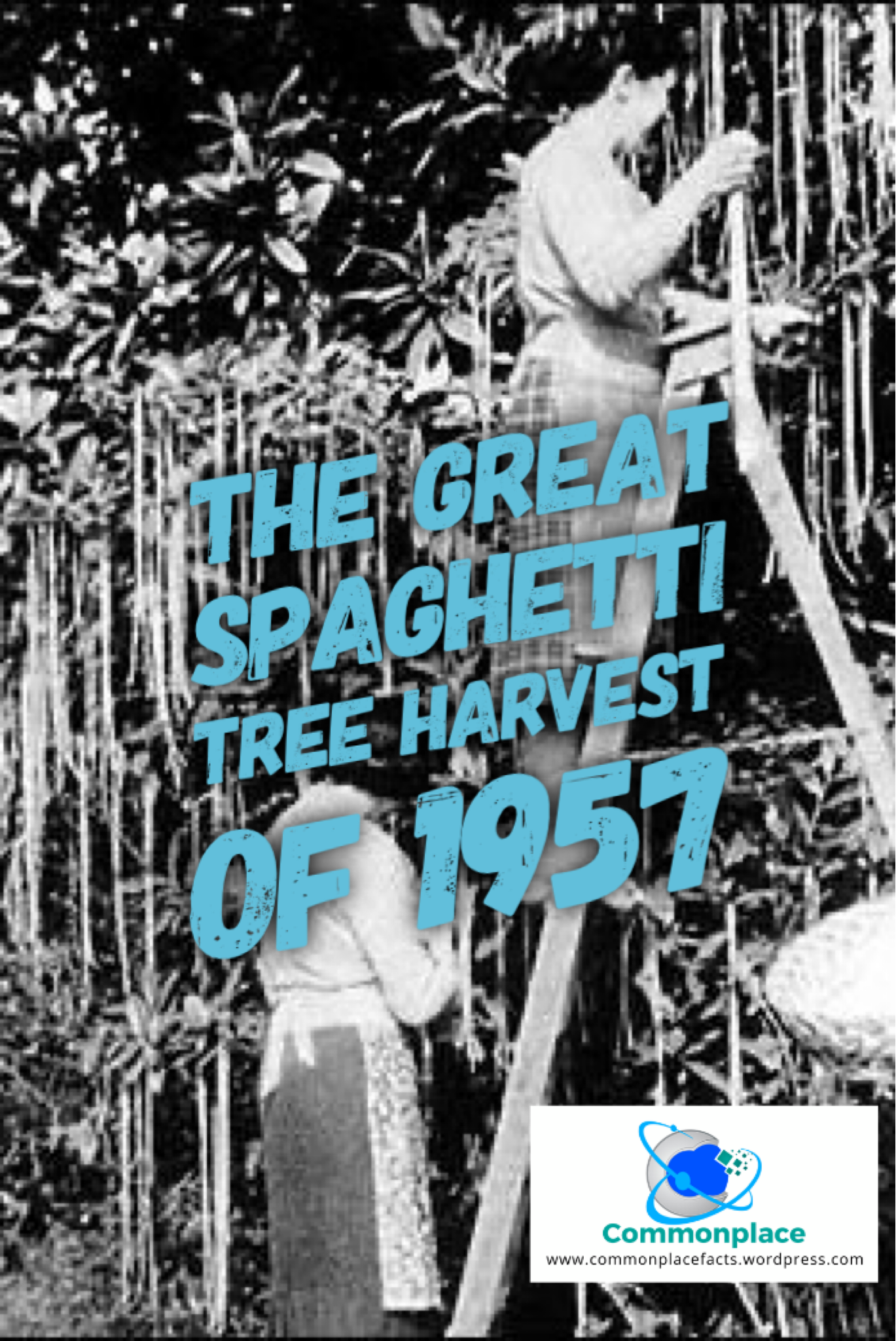
The infamous hoax aired on the BBC’s Panorama program, a respected current affairs show known for its hard-hitting journalism. Imagine tuning in for your usual dose of international news and instead being treated to a three-minute segment narrated by the ever-credible Richard Dimbleby, describing the Swiss spaghetti harvest with all the gravitas of a United Nations report.
Dimbleby’s voice, as smooth as a perfectly-cooked al dente noodle, guided viewers through serene images of Swiss villagers plucking long strands of spaghetti from trees and carefully laying them out to dry in the sun. Viewers watched as smiling women gathered the delicate strands into baskets, ready to be transformed into that night’s pasta dinner. The footage was accompanied by Dimbleby’s detailed commentary, which explained how a mild winter and the defeat of the dreaded spaghetti weevil led to an exceptionally bountiful harvest.
The Hook: How They Reeled In Viewers
The beauty of the hoax lay in its subtlety. There were no winks, no nods, no sly hints that something was amiss. The segment was presented with the same earnestness as any other Panorama feature, making it all the more believable. At the time, spaghetti was still an exotic delicacy in Britain, usually served in tins and doused in tomato sauce. For many viewers, the idea that spaghetti grew on trees wasn’t all that far-fetched.
To add an extra dash of authenticity, Dimbleby explained that the uniform length of spaghetti strands was the result of meticulous cultivation — a claim that undoubtedly seemed plausible to anyone who had never seen a spaghetti noodle in its natural habitat (hint: it’s a factory, not a forest).
When Pasta Meets Panic
After the segment aired, the BBC’s phone lines lit up like a Christmas tree. Viewers called in, eager to know where they could get their very own spaghetti tree. Housewives, aspiring gardeners, and pasta enthusiasts alike flooded the switchboard with inquiries about planting their own spaghetti groves. The BBC’s operators, no doubt stifling laughter, reportedly advised callers to “place a sprig of spaghetti in a tin of tomato sauce and hope for the best.”
Learn about the world’s only federally-maintained Bigfoot trap
Some viewers caught on quickly, realizing they’d been had. Others? Not so much. One particularly enthusiastic caller wanted to know how to cultivate their spaghetti tree to ensure a bumper crop, while another asked whether it was better to plant spaghetti in the shade or full sunlight.
The Sauce Behind the Hoax
The mastermind behind the hoax was Charles de Jaeger, a BBC cameraman with a mischievous streak. Inspired by a comment from one of his schoolteachers who had once quipped, “Boys, you’re so stupid, you’d believe me if I told you spaghetti grows on trees,” de Jaeger brought his whimsical vision to life.
The segment was filmed at a hotel in the Swiss town of Castiglione, near Lake Lugano. To create the illusion of spaghetti-laden branches, the production team carefully draped cooked spaghetti over tree limbs and filmed local women “harvesting” the noodles with practiced hands.
When April Fools’ Went Viral (Before Viral Was a Thing)
The response to the hoax was overwhelmingly positive, and the story quickly gained traction around the world. Newspapers covered the prank with a mixture of amusement and bewilderment. Even today, the spaghetti tree hoax remains a textbook example of how to execute the perfect April Fools’ Day prank — equal parts clever, convincing, and absurd.
Over the years, the hoax has been referenced countless times in pop culture, inspiring other media outlets to attempt similar pranks (though few have managed to replicate its success). In 2009, The Museum of Hoaxes declared it the “greatest hoax that any reputable news establishment ever pulled.”
Lessons in Noodle-ology
The spaghetti tree hoax wasn’t just a brilliant joke — it was a reflection of a time when media could play with public perception in ways that seem almost impossible today. Modern audiences, armed with smartphones and Google at their fingertips, are far less likely to be taken in by such an audacious prank. But in 1957, the BBC proved that sometimes, all it takes is a little imagination and a plate of pasta to get people to believe in the impossible.
So, the next time you tuck into a bowl of spaghetti, give a little nod to Charles de Jaeger and the BBC team who reminded us that, sometimes, truth is stranger than fiction — especially when it’s served with a side of April Fools’ mischief. And if you’re still curious about growing your own spaghetti tree, well… just remember to keep it well-watered and free of spaghetti weevils.
You may also enjoy…

The Volcano Eruption That Was an April Fools’ Day Joke
It had been 400 years since Alaska’s Mount Edgecumbe last erupted. The long-dormant volcano towers at the southern end of Kruzof Island. The 8,000-plus residents of Sitka delight in the mountain’s majestic snow peak, while simultaneously taking for granted that there is no imminent danger from the volcano that is a mere 15 miles (24…

The Great Banana Peel Smoking Hoax: Just One More Reason The 1960s Were So Weird
Say what you will about the 1960s, you have to admit it was a decade of weirdness. It was a time when rebellion, revolution, and poorly thought-through hairstyles were the norm. Musical tastes ranged from folk songs to atonal psychedelic screeches. Society was gripped with anti-war protests, race riots, political assassinations, and drugs. Return with…

The Epic Prank that Became History’s Greatest Practical Joke
Filippo Brunelleschi (1377-1446) was an accomplished architect, designer, sculptor, and mathematician. He is considered to be one of the founding fathers of Renaissance architecture and holds the distinction of being the first person to receive a patent in the Western world. He achieved immortality in the history books by designing the dome of the Florence…




Leave a Reply