
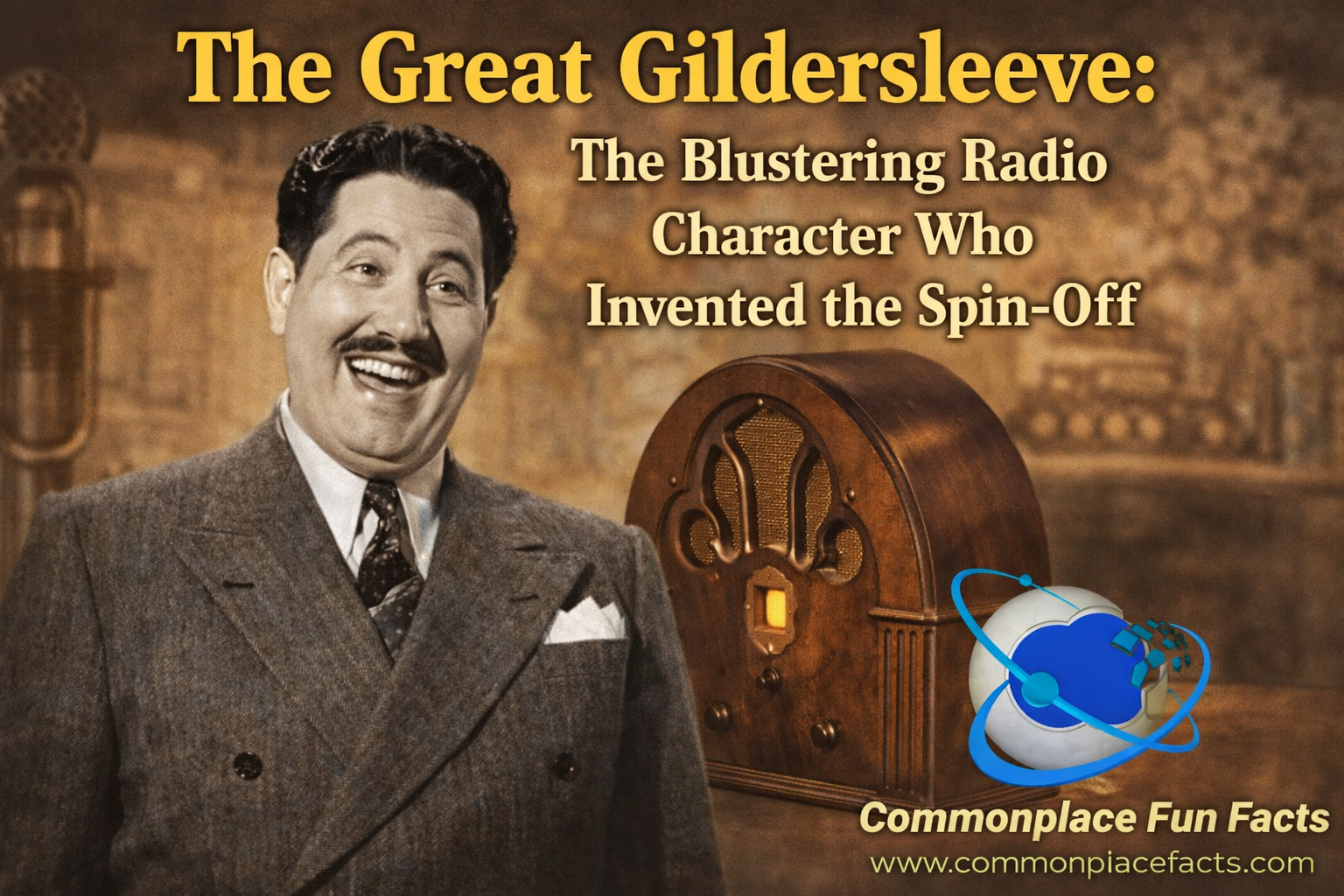

Modern entertainment loves a spin-off. If a side character gets enough laughs, enough applause, or enough people posting online that they are “the real reason I watch the show,” somebody in a conference room eventually decides that this person now deserves an empire. This is how we get television series, movie franchises, origin stories, prequels, sequels, and occasional programming decisions that feel like they were made by a dartboard in a panic.
As with everything, there has to be a “first.” In the case of the very first spin-off, it did not begin with streaming, despite streaming’s best efforts to behave as if history started in 2017. It didn’t even start with television. The spin-off was already alive and thriving during the golden age of radio. The character widely credited for starring in broadcasting’s first true spin-off was a loud, pompous, gloriously overconfident fellow named Throckmorton P. Gildersleeve.
That is right. Before Star Trek: The Next Generation, Frasier, or The Jeffersons—and before every franchise on earth discovered that a sufficiently popular supporting character could be spun off into a separate series like a laboratory experiment with strong ratings potential—there was The Great Gildersleeve. And because history has a sense of humor, the man who helped invent this formula was not a square-jawed hero or a brilliant detective. He was a blustering radio nuisance with a distinctive laugh and the emotional steadiness of a shopping cart with one bad wheel.
Contents
Before He Was Great, He Was Somebody Else’s Problem
Gildersleeve did not begin at the center of his own universe. He started out on Fibber McGee and Molly, one of radio’s biggest hits. That program was already a giant in American broadcasting, and like many long-running comedies, such as Amos ‘n’ Andy, and The Jack Benny Program, it built a whole ecosystem of recurring characters around its stars. Listeners got attached to these supporting figures because radio, perhaps even more than television, encouraged that cozy sense of familiarity. You invited these voices into your home week after week, and before long they felt like neighbors, relatives, or mildly alarming local personalities who kept wandering into your kitchen unannounced.

Into that world came Throckmorton P. Gildersleeve, played by Harold Peary. He made his debut as a recurring character and quickly became one of those scene-stealing irritants audiences cannot get enough of. He was pompous. He was self-important. He argued. He fumed. He had a way of carrying himself like a man who had been appointed emperor of the municipal complaint department. Naturally, people loved him.
That was one of radio’s little miracles. A supporting character could show up, grab the audience by the lapels, and become too entertaining to keep on the sidelines. Gildersleeve was one of those figures. He had a booming personality, a recognizable voice, a comic rhythm all his own, and that unforgettable laugh that sounded like a man congratulating himself before anyone else had the chance.
Harold Peary deserves a large share of the credit here. A character like Gildersleeve only works if the performer understands exactly how much vanity, irritation, bluster, and hidden humanity to mix together. Too much arrogance and the character becomes unbearable. Too much softness and the joke evaporates. Peary landed in the sweet spot. His Gildersleeve was ridiculous, but never so ridiculous that you wanted him to disappear. Quite the opposite. You wanted more.
And Then Radio Stumbled Into a New Idea
So the networks and sponsors noticed something obvious: if audiences enjoyed Gildersleeve this much as a supporting player, perhaps they would follow him into a show of his own. This now sounds painfully normal. Entertainment executives have been milking that logic ever since. But in the early 1940s, this was still a new move. Characters crossed over. Recurring performers turned up elsewhere. But building an entirely new series around a side character from another hit program was a fresher idea than it later became.
That is what makes The Great Gildersleeve historically important. When it premiered in 1941, it took a familiar character from Fibber McGee and Molly and transplanted him into his own setting, with his own supporting cast, his own storylines, and his own identity as the star. That is not merely an offshoot. That is the spin-off formula in full working order.
So yes, when we say The Great Gildersleeve was the first spin-off, we are not merely tossing around a cute bit of trivia. We are pointing to a genuine milestone in broadcast history. Radio got there first. Television later took the idea, dressed it in better lighting, and behaved as if it had invented civilization.
Listen to episodes of The Great Gildersleeve radio program here.
Moving to Summerfield
The new show had to do more than just give Gildersleeve extra airtime. It needed to reshape him. On Fibber McGee and Molly, he worked beautifully as an adversarial foil and recurring nuisance. But a starring role required more room. A character built only to bluster at the leads can be hilarious for ten minutes and exhausting for thirty. The writers wisely solved this by softening him just enough and surrounding him with a new domestic world.

In The Great Gildersleeve, he moved to the town of Summerfield and became guardian to his niece Marjorie and nephew Leroy. Suddenly the loudmouthed fussbudget had responsibilities. He was no longer simply there to inflate himself and irritate other people. He had to run a household, make decisions, manage children, handle civic duties, and navigate a community full of people who were, in one way or another, prepared to puncture his ego on a regular basis.
This was a smart shift. It let the show keep the comic bluster that made Gildersleeve memorable while giving him something radio audiences reliably adored: family warmth. He could thunder and preen and make a spectacle of himself, but at the center of the series there was now a domestic heart. That made him more than a comic device. It made him a character viewers could settle in with over the long haul.
The Small-Town Machinery of Comedy
Summerfield turned out to be exactly the sort of fictional town old-time radio loved to build. It was full of recurring faces, minor civic battles, friendly rivalries, romantic complications, and just enough everyday nonsense to keep the machinery of comedy running smoothly. Gildersleeve himself served as Water Commissioner, which is one of those wonderfully specific little details that makes old-time radio feel delightfully grounded. Not mayor. Not senator. Not industrial titan. Water Commissioner.
There is something almost poetic about that. A man with the personal calm of a teakettle was put in charge of local infrastructure. What could possibly go wrong?
The supporting cast helped make the series hum. Leroy and Marjorie gave Gildersleeve family responsibilities and constant opportunities for exasperation. Birdie, the household cook and housekeeper, became one of the show’s most important presences, often serving as the person least impressed by Gildersleeve’s grandeur and therefore one of the most useful. Judge Hooker provided friendship, rivalry, and the kind of bantering male companionship that radio sitcoms could mine forever. Then there was Mr. Peavey, the druggist, whose dry, unhurried way of speaking made him a perfect counterweight to Gildersleeve’s gusty theatricality.
That was part of the show’s charm. It did not depend on one joke repeated endlessly. It built an entire social world around its star. Gildersleeve could court women, feud with acquaintances, meddle in civic matters, fret about family, and deliver righteous pronouncements that collapsed under the slightest pressure. In other words, he could do what all great sitcom leads do: generate trouble simply by being himself.
The Voices of Summerfield: The Cast Behind the Characters
One of the reasons The Great Gildersleeve lasted as long as it did is that it was not a one-man show. Throckmorton P. Gildersleeve may have been the loudest personality in Summerfield, but he was surrounded by a talented ensemble that helped turn the fictional town into a living, breathing radio community.
At the center of it all was Harold “Hal” Peary, the original voice of Gildersleeve. Peary’s performance defined the character: pompous, booming, self-assured, and perpetually teetering between dignity and comic disaster. His distinctive laugh—half chuckle, half self-congratulation—became one of the most recognizable sounds in radio comedy.
After Peary left the program in 1950 following a dispute with NBC, the role was taken over by Willard Waterman. Replacing a beloved star is usually a dangerous move in entertainment, but Waterman managed the difficult task of keeping the show running while maintaining the character’s essential personality. The transition was unusual but successful enough that the series continued for several more years.
Two of the most important voices on the show belonged to the children in Gildersleeve’s care. Lurene Tuttle initially voiced Marjorie Forrester, the responsible niece who often acted as the household’s voice of reason. Later performers would take over the role as the series evolved. Her younger brother Leroy, however, became one of the program’s most memorable characters thanks to the unique voice of Walter Tetley.

Tetley got his start as the voice of Felix in Felix the Cat (1935), when he was 20 years old. He was already an adult when he began playing Leroy, yet he possessed the natural voice of a young boy. For most actors, playing children on radio came with a built-in expiration date: puberty arrives, the voice drops, and suddenly the kid who was supposed to be twelve sounds like he should be applying for a mortgage. Tetley had the opposite situation—or advantage, depending on how you look at it. Throughout his adult life he retained the voice and appearance of a preteen, which allowed him to specialize in playing young boys across radio, film, and television. Decades later, many listeners would recognize that same unmistakable voice as Sherman on The Rocky and Bullwinkle Show. The precise reason for Tetley’s permanently youthful voice was never definitively determined, though some biographers have suggested a hormonal condition such as Kallmann syndrome. Whatever the medical explanation, the result was a performer who could convincingly play a boy long after most actors had moved on to roles involving car payments and lower back pain.
The rest of Summerfield’s population was equally important to the show’s charm. Earle Ross played Judge Horace Hooker, Gildersleeve’s friend and occasional partner in mischief. Richard LeGrand voiced Mr. Peavey, the famously mild-mannered druggist whose calm, unhurried speech made him the perfect counterbalance to Gildersleeve’s bluster. Meanwhile, Lillian Randolph played Birdie, the family’s cook and housekeeper, whose practical wisdom and dry humor frequently cut through Gildersleeve’s grand pronouncements.
Put together, this cast created the small-town world that made The Great Gildersleeve work. Gildersleeve himself might have been the center of attention, but the surrounding voices gave the show its rhythm. Each character served as either a foil, a friend, or a gentle reminder that Summerfield’s most self-important citizen was rarely quite as impressive as he believed himself to be.
Why Audiences Took to It
The series became a substantial hit, especially in the 1940s. That makes sense. It arrived at a time when radio was still the dominant home entertainment medium, and listeners loved characters who felt instantly familiar. Gildersleeve had enough comic exaggeration to be funny and enough emotional sincerity to keep the show from drifting into caricature.
He was pompous, yes, but also vulnerable. He wanted romance, dignity, affection, and respect, usually all at once and usually in quantities the universe was not eager to supply. There is an eternal comic engine in that. Give an audience a man whose opinion of himself is consistently larger than reality can support, and you have material for years.
That is exactly what happened. The Great Gildersleeve became one of radio’s longest-running comedy programs, running from 1941 to 1957. It survived because it was more than a novelty. The “supporting character gets his own show” angle may have opened the door, but it would not have kept people tuning in. The show lasted because it developed an identity of its own. The spin-off became a world.
From Radio to Movies, Because Of Course It Did

Once a character becomes popular enough, Hollywood eventually tries to put him in a movie. This is one of our oldest cultural reflexes. Gildersleeve made that leap as well. Harold Peary brought the character to a series of feature films in the 1940s, which is about as clear a sign of success as you can get in that era. The blustering fellow who began as a recurring voice on someone else’s program had now become a cross-media property.
There is something wonderfully charming about that phrase in this context. “Cross-media property” sounds like the sort of thing a consultant says while charging by the hour. In practice, it meant that a radio character with a funny laugh was now large enough to stride onto movie screens. Show business has always been both glamorous and faintly ridiculous.
When the Star Walked Away
No history of The Great Gildersleeve would be complete without mentioning one of its stranger twists. The man who made Gildersleeve famous—Harold Peary—eventually left the show in 1950 after a dispute with NBC involving contracts and sponsorship arrangements. Peary assumed that if he walked away, he could simply take the character with him to another network.
Broadcasting law had other ideas.
NBC owned the character of Throckmorton P. Gildersleeve. Peary had created the voice, the laugh, and the personality that audiences loved, but the legal paperwork placed the character firmly in the network’s possession. As a result, NBC did something that feels slightly surreal when viewed from the modern perspective: they kept the show and replaced the actor.
Enter Willard Waterman, who stepped into the role of Gildersleeve and continued the series for several more years. Recasting a beloved character is always risky, but it has happened more often than people realize. Television audiences experienced a similar moment of confusion in the 1960s when the character of Darrin Stephens on Bewitched suddenly changed faces—Dick York quietly giving way to Dick Sargent with little explanation beyond a polite expectation that viewers would simply roll with it.
In the case of The Great Gildersleeve, audiences largely did just that. Waterman’s interpretation was slightly different, but the character’s bluster, civic pride, and talent for self-inflicted trouble remained intact. The show continued successfully into the 1950s, proving that while Harold Peary had created Gildersleeve, the character himself had grown larger than any single performer.
A Survivor in a Changing Industry
That may be one of the most impressive things about the series. It was born during radio’s golden age, thrived through the 1940s, and continued on while television was busy eating radio’s lunch, radio’s dinner, and eventually most of radio’s furniture. Many old-time programs vanished as tastes changed and the medium lost its central place in family life. The Great Gildersleeve proved remarkably durable.
The television version of The Great Gildersleeve premiered in 1954, producing 39 episodes during its single season on the air while the radio program continued for several more years. The show that gave birth to it, Fibber McGee and Molly, lasted even longer, remaining on the air until 1959. In other words, the spin-off proved strong enough to stand on its own, even if the parent show ultimately outlived it—rather like a grown child who moves out, starts a respectable career, and still shows up at the family table every Sunday.
Part of that durability came from flexibility. The format changed over time. The supporting cast shifted. The show itself adapted to a new entertainment environment. By the end of its long run, it had gone through multiple phases and had become a kind of living fossil of radio comedy, still chugging along after the world that produced it had begun to fade.
That, in its own way, makes the program even more important. It was not just an early spin-off. It was a successful spin-off. It demonstrated that audiences would follow a strong supporting character into a new setting and stay there for years if the new show offered enough charm, structure, and comic momentum.
The Legacy of the Loud Man
Today, spin-offs are so common that nobody blinks at them. A side character can get a new show before the closing credits have cooled. Franchises now operate like extended family reunions where every cousin is being considered for separate representation. But The Great Gildersleeve helped prove the concept in the first place.
That is the real legacy here. Gildersleeve was not merely a successful radio comedian. He was the blueprint. He showed broadcasters that a secondary character could break free from the gravitational pull of the parent series and generate an entire narrative orbit of his own. He showed that audiences enjoyed continuity, familiarity, and expansion of a fictional world. In other words, he helped invent one of the most durable habits in entertainment history.
That’s a fairly impressive achievement for a man best remembered for being pompous, excitable, and forever slightly too pleased with himself.
The next time you see television’s latest spin-off, spare a thought for Throckmorton P. Gildersleeve. He was doing this before television even thought of taking off its training wheels. He came out of radio, marched into his own show, became a hit, reached the movies, outlasted enormous industry changes, and quietly established a storytelling tradition that the rest of entertainment would spend decades copying.
In other words, the entire modern spin-off phenomenon—television empires, cinematic universes, and the endless parade of secondary characters getting their own shows—owes a quiet debt to a loud man from Summerfield. Long before the phrase “expanded universe” existed, Throckmorton P. Gildersleeve expanded one all by himself. And somewhere in the distance you can almost hear the sound of that famous laugh, echoing through broadcasting history.
You may also enjoy…

You Bet Your Life: How Groucho Marx Hijacked a Quiz Show and Invented Modern TV Hosting
Groucho Marx turned You Bet Your Life into a revolutionary quiz show by ignoring the quiz. Discover how improvisation, editing, and authenticity made the show a radio, TV, and syndication classic.

The Jack Benny Program: How Silence, Timing, and Character Transformed American Comedy
The Jack Benny Program transformed American comedy using silence, timing, and unforgettable characters—proving that the loudest joke on radio could be saying nothing at all.

Amos ‘n’ Andy: The Comedy Hit That Changed Broadcasting—and Sparked Debate
Discover the legacy of Amos ‘n’ Andy, the groundbreaking radio and television show that captivated millions. Explore its origins, impact, cast, controversy, and lasting influence on American media.


Leave a Reply