
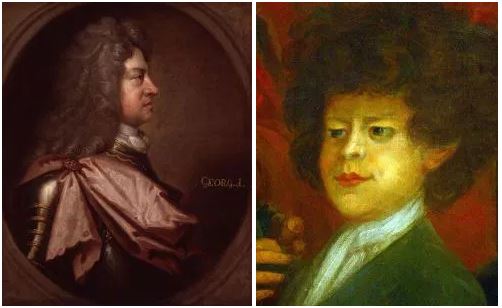

Britain’s King George I was on a hunting party in the Hertswold Forest of northern Germany in 1725 when he came across an extraordinary discovery: a wild boy.
The child lived alone, without human companionship, and survived off of the local plant life. He walked on all four limbs like an animal and was unable to speak. No one could ascertain where he came from or from whose family he came.

The King named the boy Peter and brought him back to England. He lived at Kensington Palace in London, where he became known as “The King’s Human Pet.” The best efforts to teach him to read, write, or even speak were in vain, and he continued to get around on all fours, rather than walking upright on his legs. After he temporarily went missing following a fire, his caretakers had him fitted with a leather collar bearing Peter’s name and address, in case he wandered off again.
Peter lived to an estimated age of 70 years, passing away in 1765. He ultimately was able to say “Peter” and “King George” but aside from being able to hum a few songs, that was the extent of his verbal communication. Scottish philosopher and judge James Burnett, Lord Monboddo reported that Peter appeared to understand what was said to him.
In 1978 — more than 200 years after Peter’s death — scientists identified a genetic condition known as Pitt-Hopkins. This condition produces severe neurological effects, including severe learning disabilities, developmental difficulties, and the inability to develop speech. Geneticists now suspect that Pitt-Hopkins might explain Peter’s condition.
Read “Raised by Wolves? The True, Tragic, and Occasionally Fraudulent History of Feral Children” for more stories of children like Peter.
You may also enjoy…

Victor of Aveyron: The Feral Child Who Turned Philosophy Into a Reality Show
Discover the true story of Victor of Aveyron, the 18th-century “wild child” who walked out of the French woods and straight into Enlightenment philosophy. Part science experiment, part social spectacle — all very human.

The Green Children of Woolpit: Medieval X-Files, But With Beans
Discover the strange tale of the Green Children of Woolpit—mysterious green-skinned siblings who appeared in medieval England speaking an unknown language and eating only beans. History, folklore, and extraterrestrial theories collide in this bizarre true story.

How Royal Inbreeding Broke an Empire: The Tragic, Bizarre Lives of Charles II of Spain and Ferdinand I of Austria
Discover how centuries of Habsburg inbreeding shaped the tragic and bizarre lives of Charles II of Spain and Ferdinand I of Austria, revealing the genetic and political consequences of royal inbreeding that helped fracture an empire




Leave a Reply