
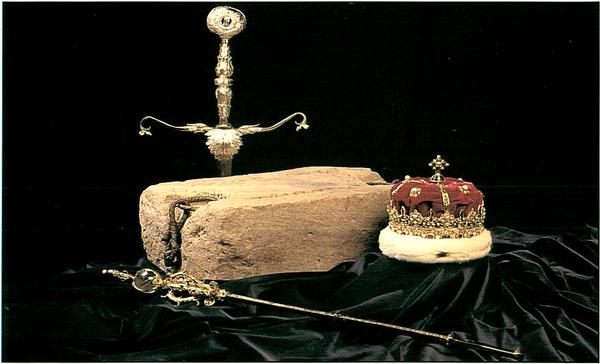

The Honours of Scotland is the name given to the crown, sceptre, and sword of the Scottish monarchy. They are the oldest set of crown jewels in the British Isles, dating back to the coronation of Mary I in 1543.
The Crown of Scotland

The crown is the ancient symbol of supreme authority. Scotland’s crown is encrusted with 22 gemstones and 20 precious stones taken from the former crown. It is also adorned with freshwater pearls from Scotland’s rivers. It weighs 3 lb., 10 oz., (1644 g). Its four golden arches are decorated with red and gold oak leaves. At the point of the crown is an orb of gold, enameled in blue and ornamented with gilt stars. On top of the orb is a gold and black cross with a rectangular amethyst. Velvet and ermine are used for the bonnet.
The Sceptre of Scotland

The silver-gilt sceptre is a symbol of authority, largely in religious matters. The Sceptre of Scotland of was a gift in 1494 from Pope Alexander VI to James IV, as a mark of papal support for Scotland as a “special daughter” of the Holy See. It is also possible that the preceding Pope, Innocent VIII, presented it earlier in 1491. Remodeled and lengthened in 1536, the sceptre’s finial features small figures of the Virgin Mary and Baby Jesus, St. James and St. Andrew within Gothic canopies, flanked by stylized dolphins (symbolic of Christ’s Church). The sceptre is topped by a polished globe of rock crystal, held in place by three silver strips. A small golden globe surmounted by a pearl sits upon this.
The Sword of State of Scotland

The Sword of State is traditionally held by a monarch to represent the military might of the throne. The Sword of State of Scotland, like the Sceptre, was a papal gift. Given to James IV in 1507 by Pope Julius II, the sword is 4.5 feet (99 cm) in length. The blade is etched in silver with images of St. Peter on one side and St. Paul on the other. In 1652 the sword was broken in half in order to conceal it from agents of Oliver Cromwell.
The Honours were placed in a chest in the Crown Room of Edinburgh Castle in 1707 upon the dissolution of Scotland’s parliament, following the unification of the kingdoms of Scotland and England. Soon, they were forgotten, and remained, untouched, for over a century. Even the keys to the chest had been lost. In 1818, following a renewed interest in the heritage of Scotland, the Castle was searched, the chest broken open, and the Honours saw the light of day for the first time in 111 years.
Today they are on public display at Edinburgh Castle. On July 1, 1999, the Crown was paraded at the opening of the newly devolved Scottish Parliament and is now part of the opening session of each Parliament. The sword and sceptre are considered too fragile to be used at this time.

The Royal Prerogative: Wearing the Crown Brings Some Unusual Rights
Historically, royalty carries with it inherent aspects of sovereignty, power, and might. To wear the crown is to have the ability to yell, “Off with their heads!” and have the command carried out. For the most part, the sheer power of royalty has given way to more of a celebrity status in modern government. While…


A King So Nice They Crowned Him Twice
Robert the Bruce (1274 – 1329) was crowned King of Scots on March 25, 1306, by Bishop William de Lamberton at Scone, near Perth, Scotland. By tradition, the Earl of Fife had the role of placing the monarch on the Stone of Destiny, the ancient stone upon which the Scottish kings have been crowned. Duncan,…
Royal Roominess
Buckingham Palace’s 775 rooms include 78 bathrooms, 92 offices, 52 royal and guest bedrooms and 188 staff bedrooms. source



Leave a Reply