

White House Water Contamination: A Strange Chapter in the History of Presidential Deaths
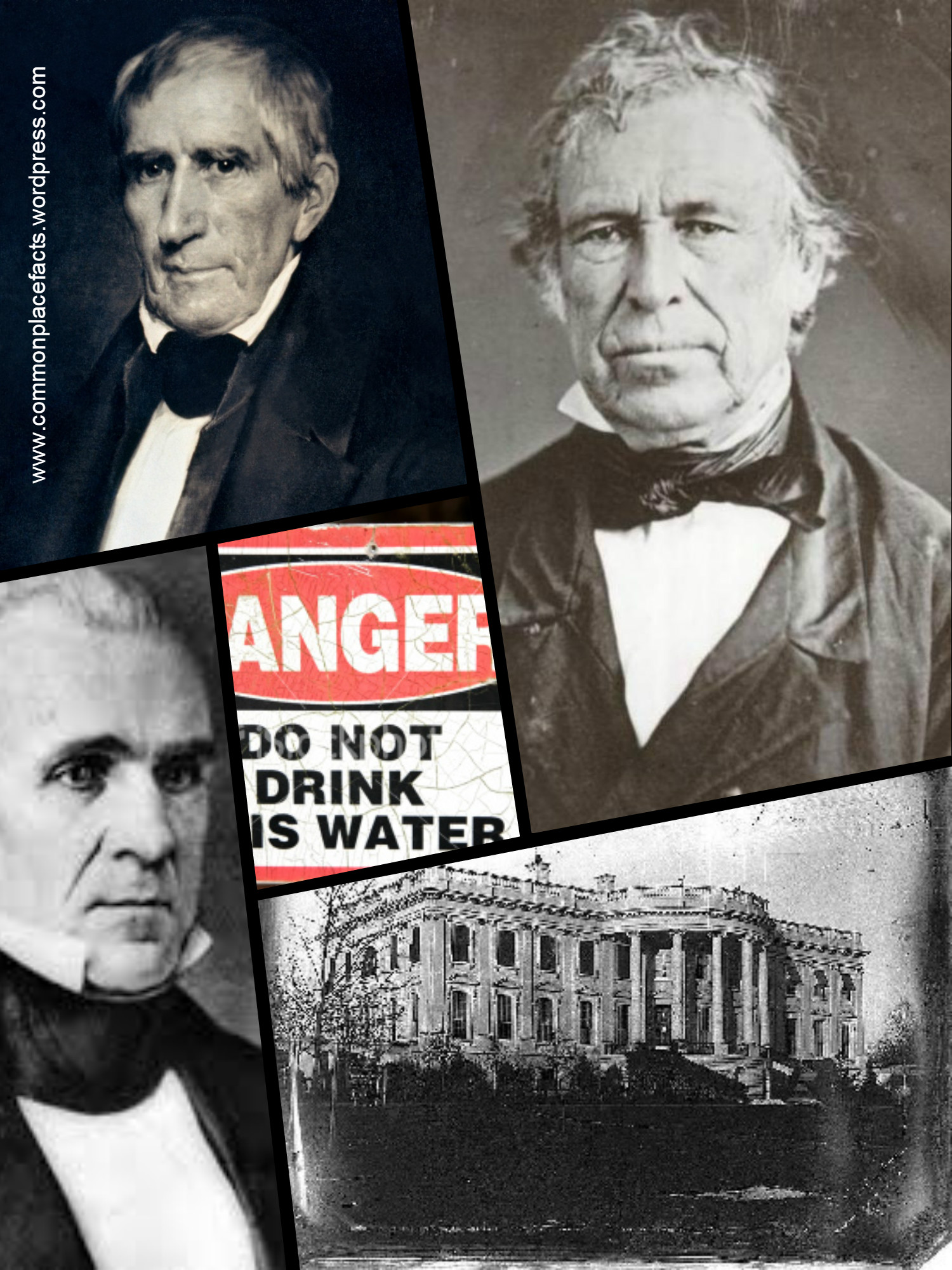
Three Presidents who died in the years between 1840 and 1850 have inspired the well-known tales regarding the cause of their deaths. We all know that William Henry Harrison’s one-hour-and-forty-five-minute inaugural address, delivered without a hat or coat during a snowstorm, resulted in the President catching pneumonia and dying just thirty days into his administration. Historians have long declared that Zachary Taylor’s consumption of cherries and iced milk in the hot days of Washington, DC summer led to his death from cholera shortly thereafter. It has long been accepted that James K. Polk worked himself so hard during his administration that he died just three months after leaving office.
As it turns out, none of these long-held facts may be true. There could have been a common killer for all three chief executives: the White House itself.
A New Study in White House Deaths
In “Death in the White House”, a study by Jane McHugh and Philip A. Mackowiak in the October 1, 2014 volume of Clinical Infectious Diseases, the researchers looked at these four presidents and debunked the conventional wisdom surrounding their deaths.

It has been long accepted that William Henry Harrison brought his death upon himself by speaking for one hour and forty-five minutes in freezing weather without hat, coat, or gloves. His personal physician, Dr. Thomas Miller, chalked the death up to pneumonia, and the matter seemed laid to rest.
A few problems with this diagnosis stand out. For one thing, Harrison first consulted with his physician on March 26 — three weeks after the inauguration. Any upper respiratory infection that might have been triggered during that ill-advised, long-winded speech, would surely have shown up much sooner. Additionally, the chief complaint of the president was of abdominal discomfort and severe constipation.
Learn about the contagious insanity surrounding the Lincoln assassination
Despite — or perhaps because of — the doctor’s best treatments (which included mercury and opium), President Harrison died on April 4 — just 30 days, 12 hours, and 30 minutes after taking the oath of office.
In reviewing Harrison’s medical file, researchers questioned whether pneumonia was truly the culprit. In fact, Harrison’s own doctor was not entirely comfortable with his diagnosis of pneumonia, and he noted that he felt the intense pressure of a public that wanted an immediate answer to what caused the first presidential death in office. McHugh and Mackowiak instead concluded that Harrison’s symptoms were much more in line with typhoid fever — an affliction often caused by drinking water contaminated by human sewage.
According to the study,
There is ample reason to conclude that Harrison’s move into the White House placed him at particular risk of contracting enteric fever. In 1841 the nation’s capital had no sewer system (nor, for that matter, did any other American city). Until 1850 sewage from nearby buildings simply flowed onto public grounds a short distance from the White House, where it stagnated and formed a marsh. The White House water supply, which came from springs in the square bounded by 13th, 14th, I, and K streets NW, was situated just 7 blocks below a depository for night soil that was hauled there each day from the city at government expense.

This theory would also explain the sudden deaths of two other presidents of that decade.
Was Typhoid The Reason for Presidential Deaths?
James K. Polk took office four years after the death of William Henry Harrison. He served only one term before retiring to his home in Tennessee. His death 103 days later shocked the nation, which concluded that Polk had worked so tirelessly during his term as President that he had, in effect, worked himself to death.

Researchers questioned that conclusion and noted that Polk suffered from severe gastroenteritis while in the White House and recovered, only to develop it again shortly after leaving office. The symptoms each time were consistent with drinking contaminated water — the same water that had taken the life of the tenth President.
Before the Washington, DC water situation would be corrected, it would be responsible for the life of one more President.
Zachary Taylor followed James Polk to the White House. A comparatively rugged man, Taylor seemed to be the picture of health. That’s why his sudden death on July 9, 1850 was such a shock to the nation.

His illness came upon him after presiding over Independence Day festivities at the Washington Monument. Observers remembered it as being a torrid day, and the President drank copious amounts of iced milk to wash down the raw fruit on which he snacked.
Doctors diagnosed the President with “cholera morbus” — a contemporary ailment that included just about anything related to digestional problems. Conspiracy theorists suggested that the President had been poisoned with arsenic, leading to the exhumation of his body in 1991 for testing. The tests showed no presence of arsenic in the President’s remains.
Researchers now speculate that while the President was poisoned, it was not intentional, nor was it arsenic. Instead, they believe he was poisoned with the the same pathogen that killed the 10th and 12th Presidents — the typhus bacteria. Drawing on Taylor’s symptoms, as well as the fact that several of the members of Taylor’s Cabinet got sick at the same time, McHugh and Mackowiak again point to the sewage-contaminated water of the White House being the most likely culprit.
Since 1850 Washington, DC’s water supply has become much cleaner, and no further Presidential deaths have been linked to typhoid fever. Just the same, if you are ever invited to a State Dinner, you might consider asking for bottled water as your beverage of choice.
You may also enjoy…

That Day Elvis Showed Up at the White House
Not just anyone can walk up to the gates of the White House, ask to see the President and be taken seriously. Of course, the man who did that on December 21, 1970, was no ordinary man. He was a king. More precisely, he was the king. His royal title did not give him access…

Peter Benchley: The White House Speechwriter Who Refused to be Fired
Discover how Peter Benchley, the author of ‘Jaws,’ navigated a tumultuous stint as a White House speechwriter under LBJ and turned his experiences into inspiration for his iconic novel.

The First Siamese Cat in the USA Lived in the White House
Fancy Address for USA’s First Siamese Cat The first Siamese cat in the United States was named Siam and came from — drumroll, please — Siam. OK, that’s not all that fascinating. It isn’t where the cat originated that makes its story interesting. It is the destination. The country’s first such feline resided in the…




Leave a Reply to stephaneCancel reply