
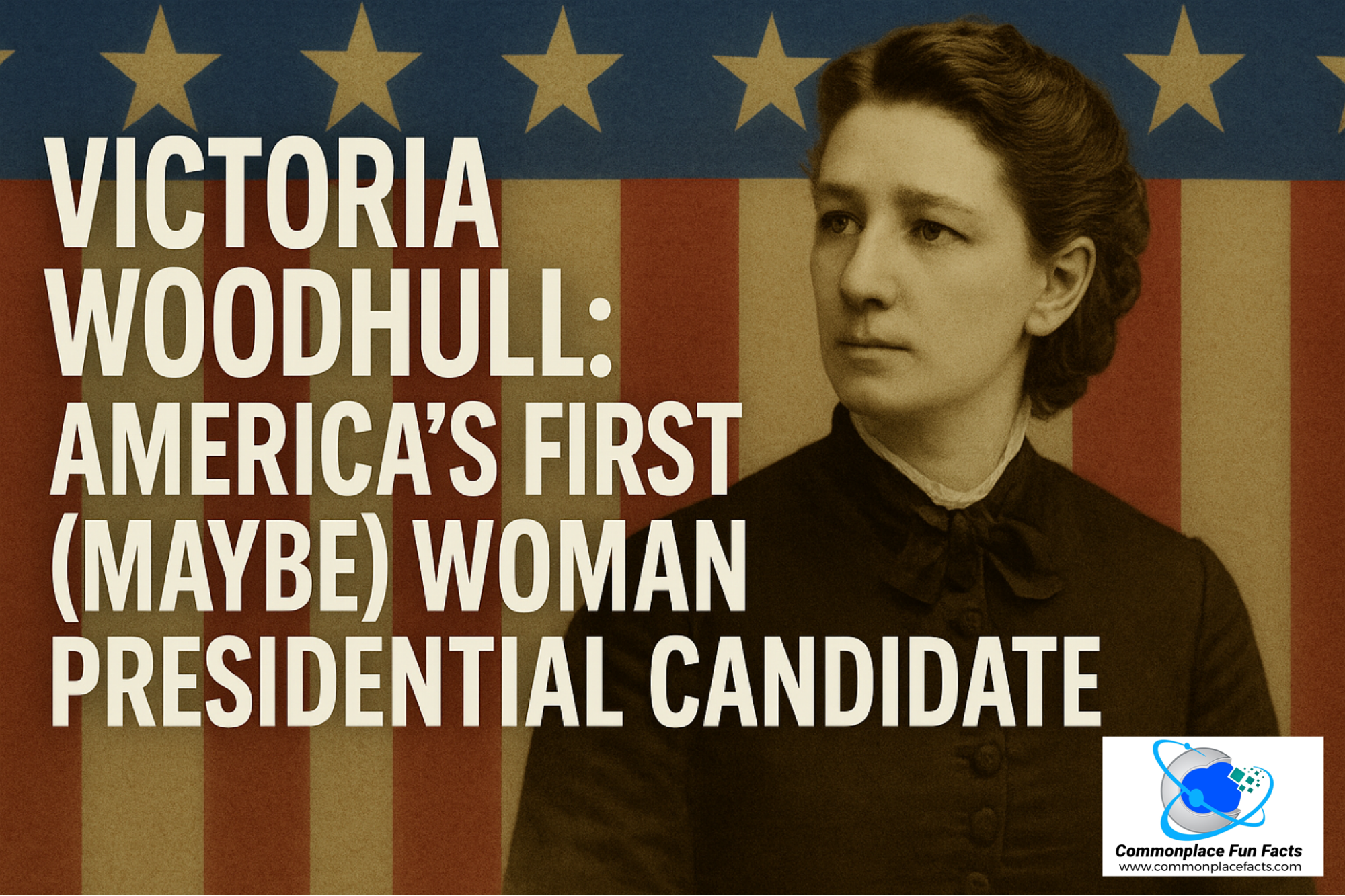

On May 9, 1872, history was made when the National Woman’s Suffrage Association (and its allies) nominated Victoria Woodhull as their candidate for President of the United States. Even the most casual observer would have to admit—she faced an uphill battle to the White House.
Contents
Early Life & Upbringing

Born September 23, 1838, in Homer, Ohio, Victoria California Claflin was the seventh child in a household that barely kept its balance. Her mother, illiterate and steeped in spiritual-healing and mesmerism, and her father, an itinerant con man and swallow-your-snake-oil salesman, gave her a childhood unlike most. She had only a few years of formal schooling before dropping out to help her family survive.
Reinvention: Broker, Publisher & Spiritualist
Fast forward into adulthood and you’ll find Woodhull doing things no woman (publicly) had done before: with her sister Tennessee (Tennie) Claflin she opened one of the first women-run brokerage firms on Wall Street, founded the radical newspaper Woodhull & Claflin’s Weekly in 1870, and campaigned for labour rights, women’s suffrage and so-called “free love” (yes, you read that right).
The 1872 Presidential Run
In 1872 she accepted the presidential nomination of the Equal Rights Party, with Frederick Douglass listed (nominally) as her running mate. She was about 32 at the time—two years younger than the constitutional minimum—couldn’t vote, and nine times out of ten was treated like a circus act by the press. On election day she landed in jail on an obscenity charge stemming from her newspaper’s publication of a scandal involving a prominent preacher.
What had to be even more discouraging for her was that she received absolutely no votes in the Electoral College. The reason this was so remarkable was that her running mate was named as an elector to the Electoral College and cast his vote for Ulysses S. Grant, instead.
In his defense, Frederick Douglass did not seek the nomination as Woodhull’s running mate. He did not attend the convention, and he did not acknowledge the nomination. It is questionable whether he even gave Woodhull a thought as he joined with his fellow New York electors to cast all of the state’s votes for President Grant.
It would be another fifteen years before America would elect a woman to a notable office, and that happened as the unintended consequences of a practical joke. You can read more about that story here.
Obstacles That Would Frustrate Anyone
- Women could not vote until the 19th Amendment in 1920.
- She was constitutionally too young to hold the presidency.
- Her name appeared on ballots in a few states but the tally of popular votes is uncertain and minimal.
- Her former allies in the women’s rights movement sometimes distanced themselves from her because of her radical style and free-love rhetoric.
Aftermath & Later Life
Woodhull didn’t fade into obscurity. She remarried, emigrated to England, continued to lecture and publish, and died June 9, 1927, in Bredon’s Norton, Worcestershire, England. Her life was messy, bold, and beyond the bounds of many Victorian-era critics—but in retrospect, that messiness is precisely the point.
Why Victoria Woodhull Matters Today
Her candidacy reminds us that change often comes before rules catch up. She smashed windows when the doors were locked. She showed that the “woman candidate” label existed long before women held large numbers of elected offices. Her story intersects women’s suffrage, labour reform, sexual freedom and publishing—threads that still pixelate our contemporary debates.
Further Reading
You may also enjoy…

The Practical Joke that Resulted in the First Woman Mayor
When Susana Salter’s name appeared on the ballot on April 4, 1887, it was all supposed to be a late April Fools Day gag. As it turned out, the joke was on those who pulled the prank when she won the election and became the first woman elected as mayor in the United States. The…

A Crazy, Messed Up, Fraudulent, Stolen Election — (Not the One You’re Thinking Of): The Story of the 1876 Election
The 1876 election between Rutherford B. Hayes and Samuel J. Tilden was marked by controversy, allegations of fraud, and a disputed Electoral College outcome despite Tilden winning the popular vote. The resulting Electoral Commission ultimately awarded the presidency to Hayes, ending Reconstruction and initiating systemic racism, echoing divisions seen in modern elections.

The Strange Case of Mrs. Prodgers — The Terror of London Cabmen
Caroline Giacometti Prodgers, an infamous figure in 1890s London, gained notoriety as the Terror of London Cabbies for her relentless legal battles against cab drivers, filing over 50 lawsuits. Known for her dramatic courtroom antics, she became a symbol of consumer advocacy and garnered both fear and ridicule from cabbies. Her death in 1890 was…



Leave a Reply