
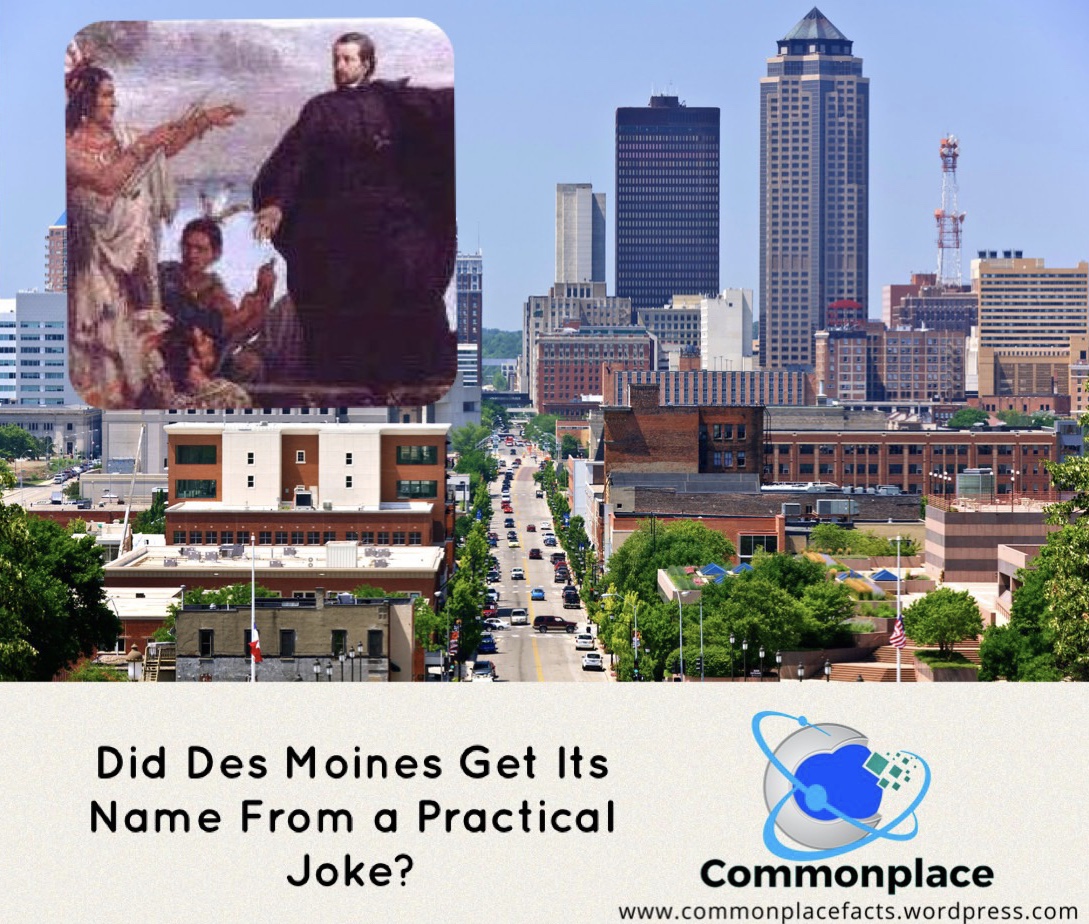

Des Moines — Could It Be a Joke?
The city of Des Moines is a jewel in the middle of Iowa. With skyscrapers breaking up the monotony of the prairie horizon and the gold-domed Iowa State Capitol building reflecting the sun’s rays, the city of over 200,000 has a lot to be proud of.
As it turns out, its name is not one of those bragging points; it is actually the result of a practical joke from over 300 years ago.
In 1673 Father Jacques Marquette encountered members of the Peoria Indian tribe near the mouth of what we now know as the Des Moines River. Marquette made inquires about the area. He also asked for information about another tribe that lived further up the river. They told him their neighbors were the Moingoana. When it came time to name the river, Marquette used the name of that tribe and dubbed the river “Des Moines,” signifying its identity with the Moingoana.
For over 300 years, that has been the commonly-held notion. Recent research casts new light on the origin of the word, however, and the result may leave historians — not to mention the residents of the city — a little red-faced with embarrassment.
Researcher Michael McCafferty of Indiana University, while studying the now extinct Miami-Illinois language, came up with the conclusion that the Peoria spokesman was pulling a fast one on Father Marquette. In an article in A Journal of Onomastics, McCafferty agrees that the “Moines” in Des Moines is a French derivation of Moingoana. What he discovered, however, was that it wasn’t the actual name of the neighboring tribe; it was an insulting nickname they hurled at their rivals.
McCafferty concluded that the word originates from mooyiinkweena. That translates, in polite terms, as “the excrement-faces.”
No one remembers the name of the Peoria representative who conveyed this name to Father Marquette, and one can only speculate about his intentions in playing this practical joke. It is highly unlikely that he ever imagined his ribald term would become the official name of a river and a city and would endure for hundreds of years.
“It’s the knowledge of this language that has grown in the past 25 years that has allowed us the ability to understand what past scholars couldn’t understand,” said McCafferty. “So, yes, this particular place name is definitely nailed down. Think the city fathers will a) give me the key to the city, or b) call for my execution?”
Des Moines isn’t the only place to have its grand notions about its name challenged. There was the curious case of Colorado, which was nearly named “Idaho” because of a big hoax about the meaning of that name. There’s also the city of Chicago, which has long held to the story that its name means “strong” or “great.” Linguists generally accept, however, that it really means “skunk” or a foul-smelling “wild leek.”
You may also enjoy…

Why We Could Be Eating a Portsmouth: Unveiling the True Story Behind the Sandwich
There is a good chance you have eaten a sandwich within the past few days. Meat, cheese, peanut butter, or any variety of foods held between two pieces of has been a key part of menus for about as long as bread has existed. Many people mistakenly believe the sandwich was the invention of John…

Harald Bluetooth: The Intriguing Story of How a 10th-Century Viking King Is Responsible for Technology You Use Today
Bluetooth technology originated from efforts in the late 1980s by Nils Rydbeck and his team at Ericsson to develop wireless headsets. Named after 10th-century Viking king Harald Bluetooth Gormsson, it symbolizes the unification of devices. The name stuck due to its popularity, leaving a lasting legacy of innovation in connectivity.

A Silly Candidate With a Silly Name for Silly Times
Most candidates for political office have lofty goals for the betterment of society. They put themselves through the ordeal of a campaign with aspirations of influencing policy and making a difference. John Desmond Lewis had somewhat different goals. When he stood as a candidate for the British Parliament, he changed his name to Tarquin Fintimlinbinwhinbimlim…



Leave a Reply to Mike WhyeCancel reply