
Correction: An earlier version of this article incorrectly identified a painting as a work by Pierre Brassau. We apologize for the error.
In 1964, visitors to an art exhibition in Göteborg, Sweden, encountered the work of an exciting new artist named Pierre Brassau.
Several critics were impressed. Rolf Anderberg of the Göteborgs-Posten offered an especially enthusiastic assessment:
“Brassau paints with powerful strokes, but also with clear determination. His brush strokes twist with furious fastidiousness. Pierre is an artist who performs with the delicacy of a ballet dancer.”
That was high praise, particularly for an artist whose preferred compensation consisted largely of bananas.
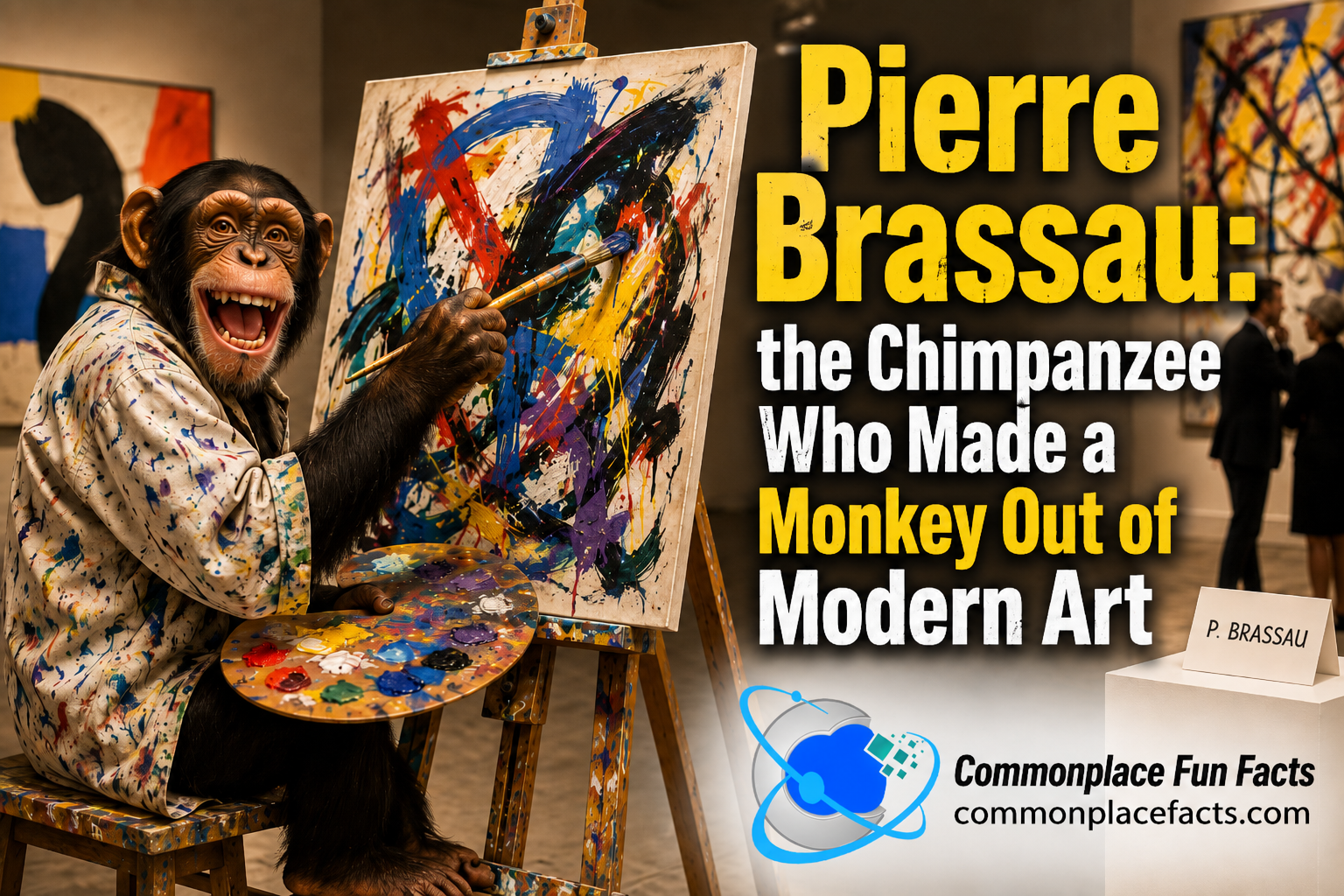
Pierre Brassau did not exist. The paintings had been created by Peter, a 4-year-old chimpanzee living at Sweden’s Borås Djurpark zoo.
At least one skeptical critic reportedly dismissed the paintings with the observation, “Only an ape could have done this.”
For once, the harshest art critic in the room was also the most technically accurate.
Contents
Creating the Mysterious Pierre Brassau
The hoax was organized by Swedish journalist Åke “Dacke” Axelsson, who wrote for Göteborgs-Tidningen. Axelsson wanted to test whether art critics could distinguish between paintings created by serious modern artists and paintings created by someone whose previous artistic experience consisted mainly of redecorating the walls of his enclosure.

Axelsson arranged for Peter to receive brushes, paints, and canvases. The chimpanzee was encouraged to participate with the traditional currency of the primate world: bananas.
The project encountered an early complication. Peter was initially more interested in eating the paint than applying it to the canvas. He reportedly developed a particular fondness for cobalt blue, demonstrating that although he may not have understood abstract expressionism, he was already prepared to suffer for his art.
Eventually, Peter began putting brush to canvas. He produced several works using broad strokes, energetic movements, and the sort of fearless disregard for convention that critics often admire—at least when they believe the artist is wearing a beret rather than picking insects from his own fur.
Peter’s Paintings Go on Exhibition
Axelsson selected four of Peter’s paintings and submitted them to an exhibition at Galerie Christinae in Göteborg. The works were presented under the more sophisticated-sounding name Pierre Brassau.

It was an excellent choice. “Peter the Chimpanzee” sounded like a novelty act. “Pierre Brassau” sounded like someone who had spent six years in Paris refusing to explain what his paintings meant.
The paintings were displayed alongside works by legitimate human artists. Viewers and critics examined them without being told that Brassau’s studio was located at the zoo.
Several reviewers responded favorably. Anderberg’s description of Brassau’s “powerful strokes” and “furious fastidiousness” became the most famous example, mostly because phrases like “furious fastidiousness” deserve to be preserved whenever possible.
Not everyone was convinced. The skeptical observation that “only an ape” could have painted the works proved unexpectedly prophetic. Most criticism merely attempts to identify what the artist was trying to say. This critic managed to identify the artist’s biological classification.
The Monkey Behind the Masterpieces
After the exhibition, Axelsson revealed that Pierre Brassau was actually Peter the chimpanzee.

The revelation was embarrassing for those who had praised the paintings, although Anderberg refused to retreat. He reportedly maintained that Peter’s work was “still the best painting in the exhibition.”
It is difficult to decide whether that response represented admirable consistency, stubborn pride, or a final attempt to ensure that the human artists felt even worse.
The paintings also attracted at least one buyer. Private collector Bertil Eklöt purchased one of Peter’s works for $90. That may not sound like much by the standards of today’s art market, where almost any object can become priceless once someone places a velvet rope around it, but it was a respectable sum for a painting produced by a chimpanzee with a documented habit of eating his supplies.
What Did the Pierre Brassau Hoax Prove?
The story is often presented as proof that modern art critics cannot tell the difference between artistic genius and random brushstrokes. That conclusion is tempting, entertaining, and probably a little too convenient.
Peter was not the first unlikely artist to receive enthusiastic reviews from the modern art world. Nearly four decades earlier, Paul Jordan-Smith invented an entire artistic movement called Disumbrationism and successfully persuaded critics to take it seriously. Apparently, the surest route to artistic credibility is a mysterious name, an incomprehensible explanation, and the confidence to assume no one will admit being confused.
Peter’s paintings were not necessarily random. Chimpanzees are intelligent, expressive animals capable of making deliberate choices. Peter may have preferred certain colors, movements, or patterns, even if he lacked a formal artistic philosophy beyond “blue tastes better than red.”
The hoax demonstrated something less dramatic but equally human: context strongly influences judgment. Viewers were told they were looking at the work of a serious modern artist. They examined it accordingly, searching for intention, emotion, and technique. Had the same paintings been labeled “Artwork Created by Zoo Chimpanzee,” the reviews probably would have used more words such as “adorable” and fewer such as “fastidiousness.”
That does not mean the critics were entirely foolish. Art is subjective, and people often respond sincerely to objects without knowing who created them. If someone genuinely admired Peter’s painting before learning his identity, the revelation did not magically erase whatever qualities had attracted the viewer in the first place.
Context can be persuasive enough that people sometimes overlook details considerably more basic than the artist’s identity. Museums have occasionally displayed modern paintings sideways or upside down without anyone immediately noticing. Evidently, the first rule of appreciating modern art is to nod thoughtfully. Determining which end belongs at the top can be addressed later.
Peter’s Retirement From the Art World
Peter moved to Chester Zoo in England in 1969. There, he lived out the remainder of his life away from the pressures of gallery openings, critical reviews, and collectors asking whether he had anything from his “cobalt blue period.”
His brief career left him with an unusual distinction. Peter became one of the few artists in history whose true identity made his paintings more famous rather than less valuable.
Pierre Brassau may have been fictional, but the paintings were real, the praise was real, and someone really paid money for one of them. Whether that makes Peter a legitimate modern artist remains open to debate.
He did, however, accomplish what countless human artists have spent their careers attempting to do: get exhibited, receive reviews, sell a painting, and leave the critics arguing about what it all meant.
Then he retired to the zoo. Frankly, many artists have made worse career decisions.
You may also enjoy…

Could an Infinite Number of Monkeys Really Reproduce the Works of Shakespeare?
It has been said that if you give enough monkeys enough time to peck away at typewriters, they will eventually, through random chance, reproduce the works of William Shakespeare. That’s an interesting intellectual exercise, but it is even possible to test the notion? Thanks to computers, the Infinite Monkey Theorem has finally been put to…

Disumbrationism: The Prank That Punk’d Modern Art
The Commonplace Fun Facts writing team was inspired by the success of the fake Disumbrationist art movement and is now considering creating their own art movement, Neo-Commonplacism. They believe that with a little nonsense, bold lines, and an obscure backstory, they can fool the art world just like Paul Jordan-Smith did with Disumbrationism in the…

Turning the Modern Art World Upside-Down
Admittedly, the Commonplace Fun Facts editorial department is not exactly a paragon of cultural sophistication. This is especially true when it comes to the phenomenon known as Modern Art. For this reason, we tend to delight in those situations that confirm our belief that the experts in this field are more delusional than they are…