


The Mystery of the Mouse Soup Machine
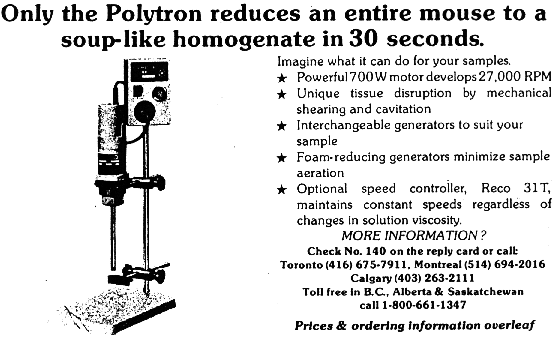
“Only the Polytron reduces an entire mouse to a soup-like homogenate in 30 seconds.”
That’s how the newspaper advertisement begins. If your reaction is typical, you went back and read the first sentence again. “Did it really say ‘mouse’? Did it really say ‘soup-like’?” Confirming the answers are “yes” and “yes,” you undoubtedly delved into the rest of the advertisement, hoping for some clarification.
The Search for the Elusive Polytron Homogenizer
The curious advertisement for a “Polytron” has been circulating on the internet for years. When posted, it typically generates many more questions than answers. The advertisement begs you to “imagine what it can do for your samples” before going on to highlight some key features:
- Powerful 700W motor develops 27,000 RPM
- Unique tissue disruption by mechanical shearing and cavitation
- Interchangeable generators to suit your sample
- Foam-reducing generators minimize sample aeration
- Optional speed controller, Reco 31T, maintains constant speeds regardless of changes in solution viscosity.
What on earth is this thing, and why would anyone want it? Is there a big demand for mouse soup that has thus far eluded us?
The ad ends with the invitation to call several phone numbers if you want more information. None of those numbers appear to still be connected with the curious contraption that apparently makes mouse soup in 30 seconds without an excess of foam. (We all know that nothing ruins a good mouse soup more than too much foam on the surface.)
The tireless interns at Commonplace’s secret underground research facility found the answers to the mysteries of the mouse homogenizer. It is, in actuality, a Brinkmann Polytron Reco 31T Homogenizer, and the advertisement originally appeared in a publication marketed at the scientific community.
The device was manufactured by Brinkmann Instruments, which does business under the name Metrohm. The company generates $75.73 million in annual sales of scientific instruments. Many of the products sold and described on its website look like they would be used in a quest for world domination if placed in the hands of a supervillain.
Homogenizers, such as the Polytron Teco 31T, are used for laboratory sample preparation by the scientific community. They operate essentially as very powerful food processors. They ensure that the thing being studied — whether it is a mouse or a mixture of inorganic chemicals — is completely uniform in terms of particle or globule size.
BEE International is the self-described manufacturer and distributor of “next-generation homogenizers.” The company’s website gives a more detailed explanation of the homogenizer:
What is a Polytron Homogenizer?
In the world of homogenizers, it’s a lot like Shakespeare’s Juliet said: “A rose by any other name would smell as sweet.” Depending on where you are and who you are, you might call a homogenizer a sonicator, a lysor, a bead mill, a high shear mixer, a disperser or a tissue tearor. You might even call a standard blender or whisk a homogenizer. Sometimes, people refer to all homogenizers by the brand name Polytron® (much like many call all tissues “Kleenex®”), and sometimes they specify the kind of homogenizer according to the type of force it supplies, like a mechanical, high-pressure or ultrasonic homogenizer. In the end, however, all these names refer to the same basic piece of equipment that is used by laboratories and in industrial processes to disrupt and blend the components of a product.
Morbid curiosity sent us on a quest to find a video of a mouse getting homogenized. Alas, we were sorely disappointed in that endeavor, but we did find one that makes short order of a mouse’s heart. We also found a video demonstrating a newer version of the Brinkmann Polytron Homogenizer.
Should you be sufficiently intrigued and wish to acquire your own homogenizer, be prepared to shell out a few dollars. A benchtop model costs about $2,100, while the handheld versions will set you back by about $4,000. Of course, if you are a true mouse soup connoisseur, you know that you just can’t skimp on liquefying your rodents.
You may also enjoy…

Stooky Bill: The Creepy Puppet Head That Helped Invent Television
Meet Stooky Bill, the creepy puppet head that helped John Logie Baird invent early television, survive blazing studio lights, and launch one of history’s strangest technological breakthroughs.

The Ford Nucleon: Inside the Atomic Car of 1958
The Ford Nucleon was a 1958 concept car powered by nuclear energy. Discover how it worked, why it failed, and whether atomic cars could exist today.

Barbed Wire Telephone: How Farmers Turned Fences Into Phone Lines
Discover how farmers in rural America turned fences into barbed wire telephone networks, connecting entire communities in the late 1800s with ingenuity, frugality, and a surprising bit of electrical know-how.






Leave a Reply to Jim BordenCancel reply