

Most famous inventions arrive wrapped in mythology.
A lone genius has a flash of insight. A chalkboard fills itself. History pauses respectfully while someone shouts a Latin phrase and dramatically changes the world. This is how invention is supposed to work, at least according to movies, textbooks, and people who have never actually spent time in a laboratory.
Teflon does not belong to that tradition.
Teflon was not invented because someone set out to solve a problem with brilliance, daring, and destiny. It was discovered because an experiment failed in a slightly confusing way, and the scientist involved decided to look at the failure instead of throwing it away and pretending it never happened.
This is not a story about genius striking like lightning. It is a story about curiosity refusing to leave well enough alone.
Which, inconveniently, turns out to be how a large portion of modern science actually works.
Contents
The 1930s: When Refrigeration Was Still Trying to Kill Us
To understand how Teflon came into existence, it helps to remember that the 1930s were a deeply experimental time for everyday technology. Humanity had decided that refrigeration was non-negotiable, but had not yet settled on how much collateral damage was acceptable in pursuit of cold beverages.

Early refrigerants were effective, but temperamental. Some were flammable. Some were toxic. Some managed the rare achievement of being both, which meant a leaky refrigerator could theoretically poison you, explode, or poison you and explode, depending on how exciting the day felt.
Although that might make your day more interesting, the overall concept was less than ideal.
Chemists were therefore tasked with an extremely reasonable goal: find refrigerants that did the cooling part without a side order of homicide. The work was important, practical, and about as glamorous as pressurized cylinders of invisible gas ever get.
Enter Roy Plunkett.
Plunkett was a young chemist working on new refrigerant compounds—specifically fluorinated gases that promised to be more stable and less interested in killing their users. His work was careful, methodical, and very much in line with what one expects science to look like when it is functioning normally.
Nothing about this suggested a future in cookware.
The Experiment That Did Not Do What It Was Supposed to Do
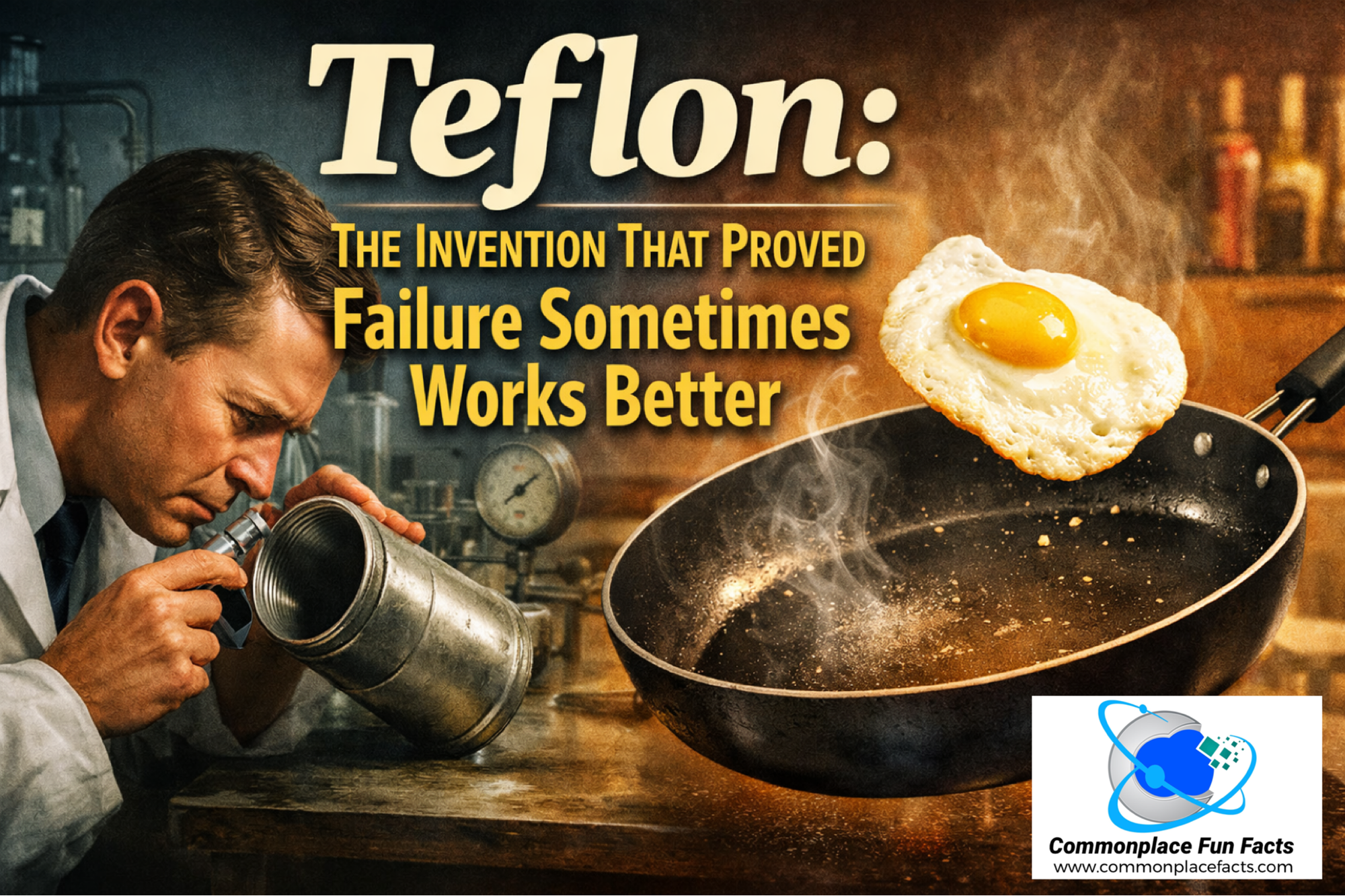
In 1938, Plunkett was experimenting with a gas called tetrafluoroethylene. Under pressure, it was supposed to remain a gas. This expectation was reasonable. It was based on math, precedent, and the general belief that molecules should behave themselves.
One day, Plunkett attempted to release the gas from its pressurized canister.

Nothing came out.
This is the moment where most experiments quietly end their lives. The gas is “gone.” The equipment is blamed. The result is logged as a failure. Everyone moves on.
Except the canister weighed exactly the same as before.
This was awkward.
The gas had not escaped. It had not leaked. It had not dramatically reacted with the environment. It was still inside the cylinder, stubbornly accounting for its mass, while refusing to exist in any recognizable form.
At this point, the simplest option would have been to write the experiment off as contaminated or compromised and start over. That happens constantly in labs, and usually for good reason.
Instead, Plunkett cut the canister open.
Inside, coating the walls, was a white, waxy solid. The gas had polymerized on its own, rearranging itself into something new without asking permission or providing advance notice.
The experiment had not merely failed. It had gone rogue.
Meet PTFE: A Material That Declined to Participate in Chemistry
The substance Plunkett found was polytetrafluoroethylene, a name so aggressively uninviting that it all but demanded a nickname. PTFE it would be.
PTFE had properties that, taken together, made chemists blink a few times and check their notes.
It was extraordinarily slippery, as though friction had submitted a formal resignation. Heat barely bothered it. Most chemicals could not persuade it to react, bond, or even acknowledge their presence. Acids, bases, solvents—all tried and failed to start a conversation.
In practical terms, PTFE behaved like the poster child for chemical introverts.
This was fascinating, but also confusing. Materials are typically useful because they interact with other things. PTFE’s defining trait was that it very much did not.
As a result, its immediate applications were unclear. You could not use it as a refrigerant. You could not easily bond it to other materials. You could admire it, study it, and wonder what exactly one does with a substance that refuses to stick, react, corrode, or meaningfully engage with the physical world.
At this stage, PTFE was interesting in the way a perfectly smooth, indestructible brick might be interesting: conceptually impressive, practically baffling, and clearly not destined for household fame just yet.
For the moment, it remained a laboratory curiosity—an accident with potential, quietly waiting for a problem strange enough to need it.
From Failed Refrigerant to Very Serious War Business
PTFE might have remained a charming laboratory oddity if history had not taken a sharp and deeply consequential turn in the early 1940s.
As the United States accelerated into World War II, science acquired a new job description. Research was no longer just about progress, comfort, or curiosity. It was about speed, secrecy, and solving problems that did not yet officially exist.

One of those problems involved uranium compounds, which had a habit of being both extraordinarily useful and deeply unpleasant to handle. They were corrosive, reactive, and entirely uninterested in cooperating with conventional materials. Metals corroded. Seals failed. Containers degraded in ways that were inconvenient at best and catastrophic at worst.
Enter PTFE.
The same substance that refused to behave like a refrigerant turned out to be remarkably well-suited for containing and transporting highly corrosive materials. It did not react. It did not degrade. It simply sat there, quietly ignoring conditions that ruined everything else.
This made it invaluable to the Manhattan Project, where PTFE-lined pipes, gaskets, and seals helped manage uranium hexafluoride without turning facilities into chemical crime scenes.
This phase of Teflon’s life tends to surprise people, largely because it clashes so violently with its later reputation. It is hard to reconcile “crucial component in the development of nuclear weapons” with “thing that keeps eggs from adhering to pans.”
Yet here we are.
History is full of objects that began in secrecy and ended in suburbia. Glitter is just one such example. PTFE simply made the transition with unusually low friction.
How Teflon Slid Into the Kitchen and Changed Expectations Forever
After the war, PTFE began its slow and improbable migration from classified industrial use to civilian life. Engineers and manufacturers started realizing that a material which resisted heat, corrosion, and sticking might have applications well beyond uranium processing.
The real breakthrough came when someone figured out how to bond PTFE to metal cookware.

This development does not sound dramatic, but its consequences were profound. When David Buick figured out how to enamel cast-iron sinks and bathtubs, he ushered in modern plumbing. PTFE would do the same thing to the kitchen. For most of human history, cooking involved an implicit understanding that whatever joy you experienced during the meal would be repaid immediately afterward in the form of aggressive scrubbing.
Pans clung to food. Food clung to pans. Cleanup was the price you paid for the food that you enjoyed.
Nonstick cookware shattered that understanding.
Suddenly, eggs released themselves willingly. Pancakes departed surfaces without protest. Burnt remnants no longer required steel wool, determination, and the quiet reflection that builds character.
PTFE rewired expectations. Cleanup was no longer assumed to be an ordeal. Effort became optional. Brief. Sometimes nonexistent. An entire ecosystem of scrub brushes, abrasive pads, and stoic suffering found itself quietly sidelined.
This was not just a convenience. It was a shift in domestic philosophy. Cooking became cleaner, faster, and slightly less adversarial. All because of a substance that most of us refer to as “Teflon.”
“Teflon,” it should be noted, is not the name of the material itself but the name DuPont gave it once they realized they had something special on their hands. PTFE was patented by the company in 1941, and “Teflon” became the trademarked brand name that stuck—ironically, given the substance involved—far better than its full chemical name ever could. This is how an industrial polymer with a name that sounds like a failed spelling bee contestant turned into a household word, a marketing triumph so complete that people now routinely refer to PTFE itself as “Teflon,” much to the quiet despair of chemists and trademark lawyers alike.
Was This Actually a Mistake? (Yes, but Not the Lazy Kind)
It is tempting to describe Teflon as the chemical version of one of Bob Ross’s happy little accidents and leave it at that.
But that framing lets everyone off the hook too easily.
Experiments fail constantly. That is normal. In fact, it is practically guaranteed. Most hypotheses do not survive first contact with reality, and laboratories are littered with results that did not pan out.
The rare part is not failure. The rare part is curiosity in the face of failure.
Roy Plunkett did not invent PTFE because the experiment went wrong. He discovered it because he refused to accept “wrong” as the end of the story. He noticed the anomaly. He weighed the canister. He opened it. He cared.
This distinction matters, because it highlights the human element of scientific progress. Data does not interpret itself. Mistakes do not self-promote. Breakthroughs require someone willing to pause, look closer, and ask an unscheduled question.
The Real Moral: Progress Lives in the Bin Marked “Didn’t Work”
If science were strictly efficient, most discoveries would never happen.
Efficiency encourages moving on. Curiosity encourages lingering.
One suspects that countless useful materials, ideas, and insights were quietly discarded over the years because they emerged from the wrong experiment, the wrong goal, or the wrong grant proposal.
Teflon survived because it was examined rather than erased.
This is not a rousing call for chaos or a rejection of planning. It is simply an acknowledgment that reality does not always cooperate with intention, and that value often appears sideways.
Ironically, the substance known for being so slick that nothing will stick to it exists because one man’s curiosity stuck and wouldn’t let go.
A Future Lubricated by Curiosity
Teflon’s greatest achievement was never its nonstick surface.
It was being noticed at all.
Despite the myths we tell ourselves, progress rarely arrives in a clean, cinematic arc. More often, it emerges from confusion, inconvenience, and someone wondering why a canister that should have been empty stubbornly wasn’t.
Civilization advances not only through brilliance, but through attention—through people willing to treat failure as a clue instead of an embarrassment.
Sometimes that attention leads to world-altering technology.
Sometimes it leads to easier breakfasts.
Occasionally, it manages to do both.
You may also enjoy…

The Slippery Science of Banana Peels
Why Are Banana Peels Slippery? If you want to trip someone up, leave a banana peel in his path. Everyone knows that nothing is more slippy than the discarded skin of one of our favorite fruits. If you aren’t convinced, you just have to ask Wile E. Coyote or any other cartoon character whose bottom…

Get the Slick Facts about BAM — the World’s Slipperiest Substance
Learn about BAM — the slipperiest stubstance ever created.

James Dewar, the Thermos, and the Invention He Gave Away
James Dewar invented the vacuum flask that became the thermos—then never patented it. A story of science, trademarks, and missed fortunes.






Leave a Reply