
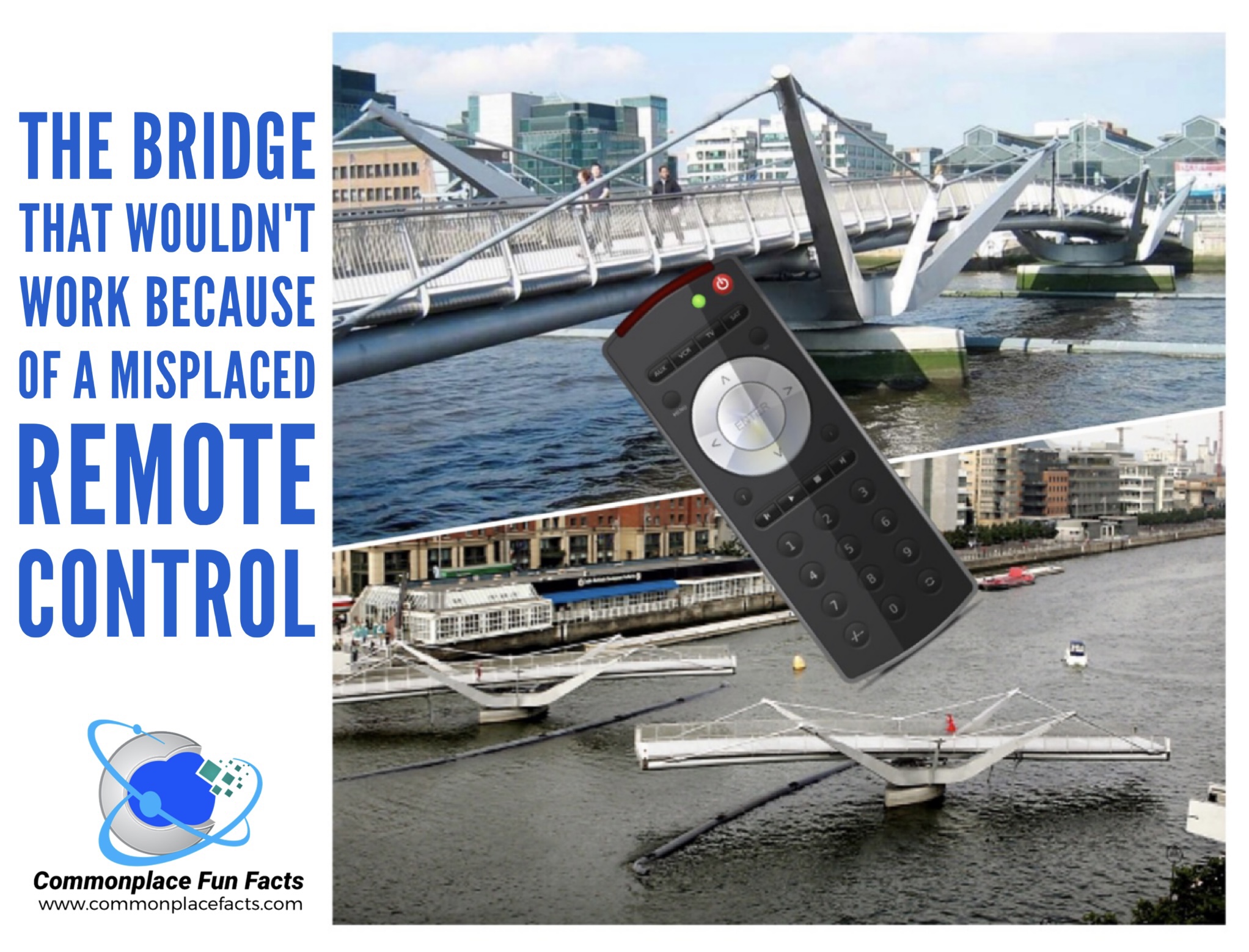

Seán O’Casey Bridge: A Dublin Bridge With a Remote Control
Admit it. We’re all guilty of setting the remote control somewhere and losing track of it. Even though the television is less than 10 feet away, we’ll hunt around for 15 minutes, looking for the misplaced remote, rather than manually changing the channel on the TV.
As televisions become increasingly complicated, finding the missing remote becomes even more important. Some things cannot be done without it. In those cases, the prospect of permanently misplacing the handheld device is catastrophic.
Now imagine that you have misplaced the remote control for something significantly more important than your television. There is a lot more at stake than the prospect of missing Strictly Come Dancing. If you can’t find this remote, river traffic will come to a standstill.

The Seán O’Casey Bridge opened in 2005. Located in Dublin, Ireland, the bridge spans the River Liffey. Named for the Irish playwright Seán O’Casey (1880-1964) who lived in the area, its beautiful modern design enhances Dublin’s reputation for iconic bridges.
The 320-foot (97.6-meter) bridge consists of two 144-foot (44-meter) sections that swing open to allow tall boats to pass. Its movements were designed to be controlled through the use of a simple handheld remote control unit.

That was the plan, anyway, and it worked fine for about five years. Sometime around 2010, however, someone reached for the remote control to open the bridge, and it wasn’t there.
The bridge was constructed under the auspices of the Dublin Docklands Development Authority. It moved its offices several times and had to admit, red-faced, that in one of the moves, the remote seems to have been misplaced.
Employees conducted a frantic search — much like the ones all of us have done. They looked under cushions, in drawers, on the shelves, and in unlikely places such as refrigerators and the laundry hamper. The missing device, described as being about the size of a 1990s-era mobile phone, was nowhere to be found.

Fortunately for pedestrians, the bridge was in its closed position, allowing easy foot and bicycle access between the International Financial Services Centre (IFSC) and the City Quay. Unfortunately for boats and their crew, the innovative swing design was useless, since there was no alternate way to open the bridge for tall river traffic.
The moveable bridge remained unmovable for about four years. The remote control, technically referred to as a “remote radio handheld pendant key,” needed to be replaced, but budgetary restrictions kept that from happening. One of the people involved in the bridge’s operations explained that the remote control was a bit more complex than “a Sky box remote control.” The bridge’s operating system required multiple layers of security to prevent unauthorized access.
In 2014, for about €1,800 (US $2,043), a new remote was programmed to replace the lost one. Once again, the Seán O’Casey Bridge can live up to its original design, facilitating both pedestrian and boat traffic.
We hope the budget for the new remote includes an additional €25 (US $29) for an Apple Air Tag. If that is too expensive, there is also the option of getting a simple remote control tether for less than €18 (US $20).
You may also enjoy…

How the Berlin Wall Fell Because Someone Misread His Notes
The fall of the Berlin Wall wasn’t planned—it was triggered by a mistake. Learn how a bungled press conference changed history on November 9, 1989.

The Sultana Disaster: America’s Deadliest Maritime Tragedy You’ve Never Heard Of
The Sultana disaster killed more Americans than the Titanic, yet remains largely forgotten. How a steamboat explosion on the Mississippi vanished from history.

The Bizarre Death of Samuel Wardell And The Alarm Clock That Killed Its Owner
A 19th-century lamplighter built an alarm clock that worked too well. Meet Samuel Wardell—and the bizarre true story of the alarm clock that killed him.





Leave a Reply