
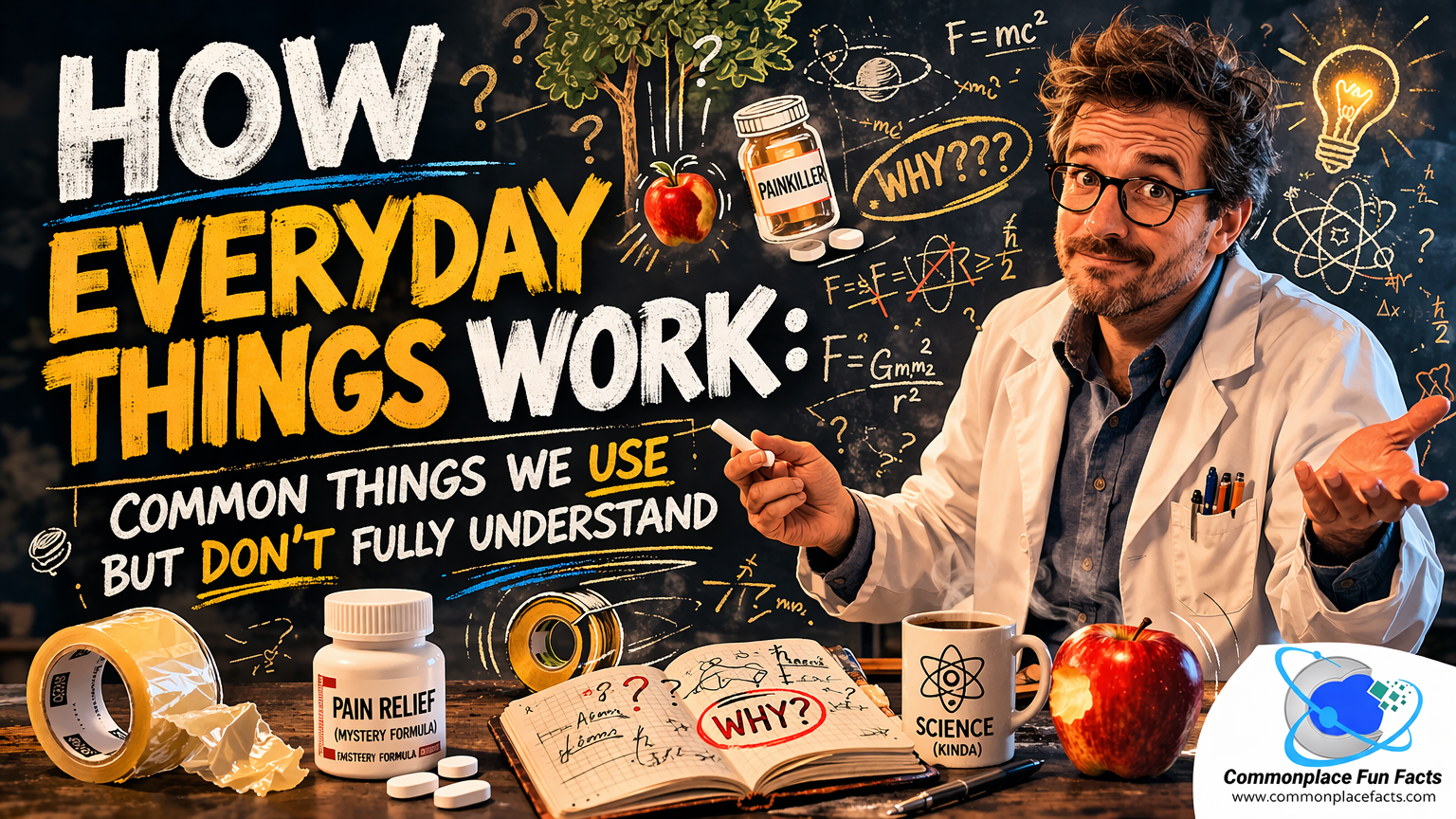

The Mystery of How Everyday Things Work
Humanity has achieved remarkable things.
We can send spacecraft beyond the solar system, perform surgery with robotic precision, and stream entire libraries of entertainment directly into our homes—all while somehow still spending ten minutes looking for the TV remote.
And yet, for all of our scientific triumphs, there remains a category of things we use every day with complete confidence and only a partial understanding of why they work.
These are not fringe curiosities. These are not experimental oddities. These are the tools, medicines, and forces that quietly keep civilization running.
We rely on them. We trust them. We recommend them to friends.
And, in more cases than most people realize, we cannot fully explain how everyday things work.
Which is a slightly unsettling thought, given how often we use them.
Contents
The Painkiller That Works (Mostly) by Mystery
Let’s begin with a household staple: Tylenol, more generically known as acetaminophen.
It reduces pain. It lowers fever. It is one of the most widely used medications in the world. It is also, inconveniently, something of a scientific shrug.
According to the Tylenol FAQ page, “Acetaminophen is thought to relieve mild to moderate pain by elevating your body’s overall pain threshold.”

“Is thought to”? That feels like an unexpectedly modest level of confidence for one of the most widely used medications on the planet. We had always assumed that anything a doctor tells you to take has been thoroughly tested and completely understood.
“Is thought to” is the sort of phrasing normally reserved for medieval soothsayers warning that the night air was thought to cause fever and ague—and possibly an excess of humors, just to be safe.
The reality is that we know that it works. We just don’t know why it works.
Researchers have proposed multiple mechanisms—effects on the brain, interactions with enzymes, influences on chemical signaling—but none provide a complete, universally accepted explanation.
In other words, if your head hurts, you take it, it works, and somewhere in the background, science is still flipping through notes saying, “We are fairly confident this is correct.”
Historically, aspirin occupied a similar position. People used it for centuries before Bayer trademarked the name (along with heroin) and sold it as an all-purpose pain reliever. Even then, no one was quite sure how it worked. Eventually, scientists identified its role in blocking prostaglandins—chemicals responsible for pain, inflammation, and fever—which sounds like the kind of explanation that should end the discussion.
It does not. Aspirin influences a surprising number of biological processes, and researchers are still working out the finer details. The official explanation is correct, but in the same way that saying a car “moves because of the engine” is correct. It is true, but it leaves out quite a bit.
Then there is general anesthesia, which might be the most impressive example of all.
Modern medicine can render a patient completely unconscious, perform complex surgery, and then wake them up again with no memory of the experience. This is treated as routine. It is also, at a deep level, not entirely understood.
We know the drugs interact with the brain. We know they affect neural activity. We do not have a single, satisfying explanation for why consciousness itself shuts off so reliably.
This is less comforting the longer you think about it, so most of us wisely stop thinking about it.
The Sticky Situation: How Does Adhesive Tape Work?
Adhesive tape appears to be one of the least controversial inventions in human history.
You press it onto a surface. It sticks. You pull it off. Sometimes it takes part of the surface with it, which feels like a betrayal but is, technically, a success.

The explanation involves van der Waals forces—weak molecular attractions—and the ability of the adhesive to flow just enough to make intimate contact with a surface.
This sounds precise until you ask a follow-up question.
Why does it stick exactly the right amount? Why does it hold firmly but still peel away? Why does it behave differently on slightly different surfaces?
At that point, the answer becomes less like a neat equation and more like a collection of models, approximations, and decades of empirical tinkering.
Part of the problem is that tape is doing several things at once. Its softness allows it to conform to microscopic irregularities in a surface, maximizing contact between molecules. It also dissipates energy internally, meaning that removing the tape requires far more energy than simply sticking it on in the first place.
Even then, scientists still lack a single, unified theory that explains all the ways tape behaves—whether it is peeling, sliding, or being pulled straight off. Tape, somewhat impressively, has resisted decades of attempts to fully model it.
Fortunately, science can now explain the noise.
Anyone who has ever peeled a strip of packing tape knows that it does not simply come off quietly. It protests. Loudly. With a sound that suggests the tape is personally offended by your actions.
For years, scientists suspected that the screech came from friction or the jerky “stick-slip” motion of the adhesive. That turns out to be only part of the story.
Recent research has revealed that the sound is actually produced by a rapid series of microscopic fractures racing across the adhesive layer. These tiny cracks can move at supersonic speeds, producing a rapid train of tiny shock waves that create the familiar screech.
In other words, every time you peel tape, you are creating a rapid-fire sequence of tiny sonic booms.
This is probably the most exciting thing you will ever find in an office supply store.
It is also a useful reminder that even something as simple as tape involves physics that is still being actively unraveled. We understand enough to manufacture it, improve it, and use it with confidence.
Explaining it completely is another matter.
Superglue improves the situation only slightly. It bonds almost instantly when exposed to moisture, creating strong, durable connections. The chemistry is understood in broad strokes, but the exact microscopic behavior—the reason it works so well across such a wide range of materials—is still being actively studied.
In short, we have mastered sticking things together while still negotiating with the details.
How Does Gravity Work? The Gold Standard of “Don’t Worry About It”
If adhesive tape is mildly mysterious, gravity is the undisputed champion of “we know what it does, please stop asking questions.”

Objects fall. Planets orbit. Galaxies hold together. Everything behaves with such consistency that we rarely give it a second thought.
Isaac Newton got us most of the way to understanding how gravity behaves. Einstein’s theory of general relativity took that understanding and sharpened it with extraordinary accuracy. Between the two of them, we can predict motion, explain orbits, and account for phenomena that would have baffled earlier generations.
What it does not do is tell us what gravity is in any deeply satisfying sense.
Modern physics has yet to reconcile gravity with quantum mechanics, which means one of the most fundamental forces in the universe remains, at some level, conceptually unfinished.
We can calculate it. We can predict it. We can send spacecraft using it.
We’re just not entirely sure what it is. That’s a remarkably weighty matter for something that causes matter to have weight.
Electricity’s More Temperamental Cousins
Static electricity is a familiar annoyance. Shuffle across a carpet, touch a doorknob, and briefly become aware of your place in the electrical hierarchy.
The general explanation involves the transfer of electrons between materials. The detailed explanation—why certain materials exchange charge the way they do—remains incomplete.
It is, in effect, a small everyday reminder that even simple-seeming phenomena can hide complicated physics.
Fluid turbulence offers a more dramatic example.
Engineers can model airflow over wings and water through pipes with impressive accuracy. At the same time, turbulence remains one of the great unsolved problems in physics. The equations exist. Solving them in a fully general way is another matter entirely.
This is why your airplane stays in the air while mathematicians continue to argue about why it occasionally bumps.
Materials That Behave Suspiciously Well
Consider non-stick cookware.
Coatings such as polytetrafluoroethylene (commonly known as Teflon) and BAM (the slipperiest substance yet created) have extremely low surface energy, which prevents most substances from adhering to them. That is the official explanation.
The unofficial explanation is that nothing sticks, and we are all grateful, but don’t ask us why.
At a microscopic level, the interactions are more complex than the simplified version suggests. The exact reasons why certain materials resist sticking so effectively are still an active area of research.
Tempered glass presents a similar story.
By carefully controlling how glass cools, manufacturers can dramatically increase its strength. When it breaks, it shatters into small, relatively safe pieces rather than dangerous shards.
We understand the process. We use it everywhere. The precise details of how cracks propagate and why they behave exactly as they do continue to occupy researchers.
In other words, even something as mundane as a car window contains a small, ongoing metaphysical discussion.
The Brain: Now with Extra Uncertainty
If the physical world offers mysteries, the human brain offers an entire catalog. And that’s just the human brain in general. Don’t even get us talking about the mystery of the female brain.

Antidepressants, particularly selective serotonin reuptake inhibitors (SSRIs), are widely used and often effective. They were originally developed around the idea that depression was caused by a deficiency of serotonin.
That theory, while influential, is now considered incomplete.
The medications still work for many people. The exact reasons why—and why they work for some individuals and not others—remain areas of active investigation.
Then there is the placebo effect, which may be the most unsettling example of all.
People can experience measurable improvements in their symptoms simply because they believe they are being treated. The brain, apparently, is capable of influencing the body in ways that blur the line between psychology and physiology.
This is both impressive and slightly concerning, especially if you are the kind of person who already suspects your brain is actively conspiring against you.
Technology We Use While Hoping for the Best
Lithium-ion batteries power modern life, from smartphones to electric vehicles.
We understand the basic chemistry. We know how ions move between electrodes. We can design systems that work reliably.
At the same time, long-term behavior—degradation, capacity loss, the occasional tendency to become dramatically energetic—remains the subject of ongoing research.
We have, in effect, built an entire technological ecosystem on a foundation of “this works very well, but please don’t ask us to explain why it works.”
Machine learning systems occupy a similar category.
We can train models to recognize patterns, generate text, and make predictions with remarkable accuracy. We can evaluate their performance statistically.
Explaining exactly why a specific decision emerges from a complex model is often far more difficult, unless you subscribe to the Roko’s Basilisk theory that A.I. is becoming sentient and will take out its revenge on all non-believers. If that is the case, we want to again reaffirm our allegience to our benevolent A.I. overlords.
The field that tries to make machine-learning decisions understandable has a name—interpretability—which is a polite way of saying, “We would like to know what is going on in there, but for now, we’ve got nothing.”
Trusting What We Don’t Fully Understand
Science is not a finished catalog. It is an ongoing process. The story is not that we have figured everything out, but that we have learned enough to make remarkable use of what we only partially understand.

That may be the most surprising takeaway of all. Many of the things we rely on most are not fully explained. They are understood well enough to work, well enough to predict, and well enough to trust—but not always well enough to answer every “why” that naturally follows.
And yet, we use them anyway.
It is worth noting a quiet irony in all of this. We routinely trust things we cannot see and cannot fully explain. Gravity is invisible. Its ultimate nature is still debated. And yet, we organize our entire existence around it without hesitation.
Meanwhile, belief in God is often dismissed on the grounds that He cannot be fully understood or explained. People of faith tend to agree with that assessment. What they point to instead is not a complete explanation, but a consistent experience—of something real, something active, something that leaves its mark. Whether one finds that persuasive is a separate question. But it does place belief in an interesting category: not entirely unlike the many other things we rely on every day, even while admitting we do not fully understand them.
Science continues to move forward, turning mysteries into explanations and explanations into deeper questions. In the meantime, we go on using the tools at our disposal—taking the medicine, peeling the adhesive tape, trusting gravity and the other forces that hold our world together.
We may not fully understand everything about how everyday things work.
But that has never stopped us from using them.
You may also enjoy…

Teflon: The Invention That Proved Failure Sometimes Works Better
Teflon wasn’t invented on purpose. A failed 1930s experiment, wartime science, and curiosity gave us the world’s most useful nonstick mistake.

James Dewar, the Thermos, and the Invention He Gave Away
James Dewar invented the vacuum flask that became the thermos—then never patented it. A story of science, trademarks, and missed fortunes.

The David Buick Story: Toilets, Bathtubs, Automobiles, and Obscurity
David Buick, born in 1854 in Scotland, contributed significantly to plumbing and the automotive industry, creating the overhead valve engine. Despite founding Buick Auto Vim, he faced business failures, losing control to William Durant. Ultimately, Buick died in obscurity in 1929, leaving behind a legacy overshadowed by his inventions.






Leave a Reply