
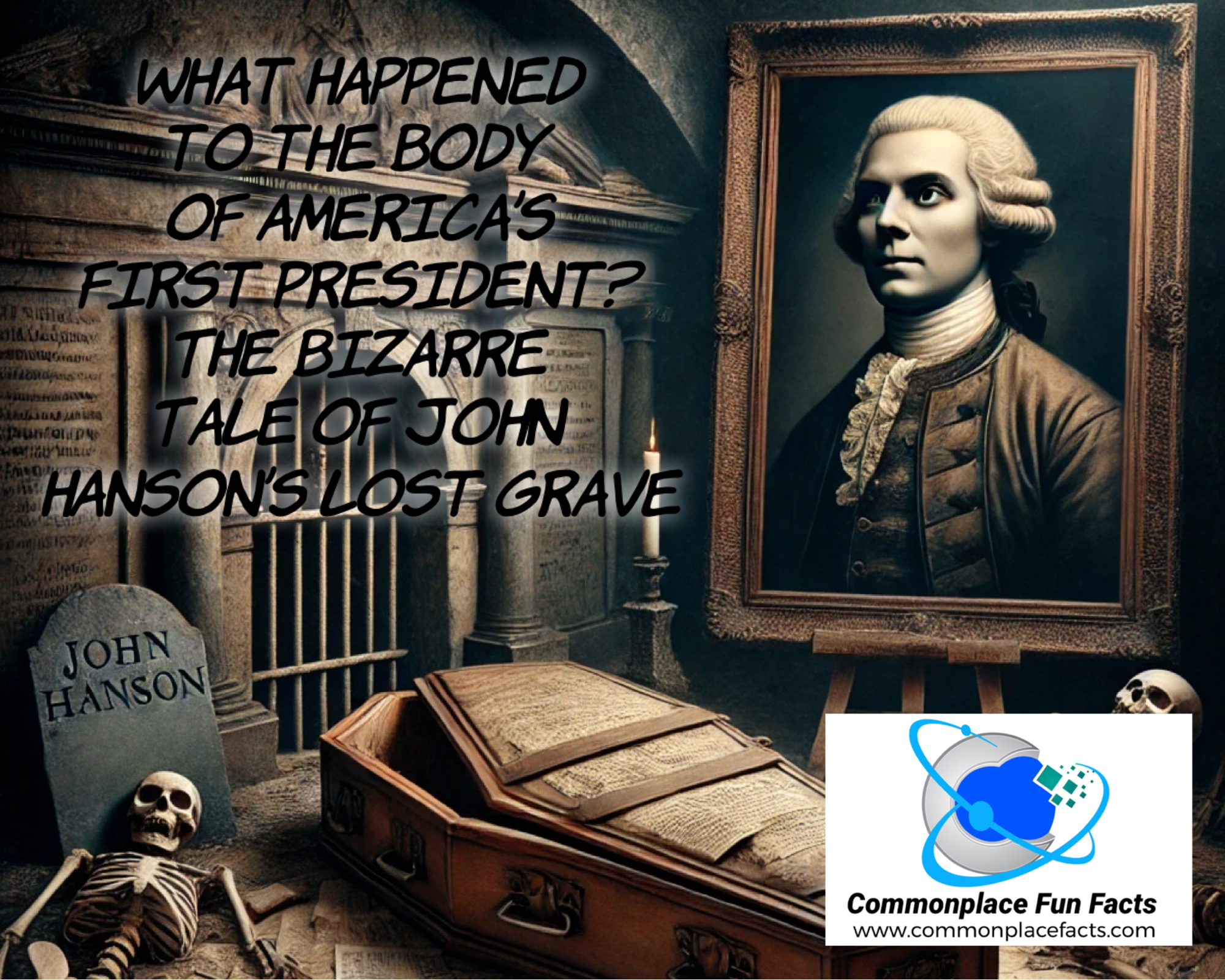

A Forgotten Founding Father and a Missing Grave
Who was John Hanson? Depending on who you ask and how you define certain terms, he may have been the United States’ first president. Yes, we do know about that chap by the name of George Washington, but as we explain in this article, there are several different definitions of “the United States’ first president.” Regardless of whether John Hanson properly has that distinction, he was undoubtedly an important Founding Father. Sadly, his role in American history has gotten a bit lost over the years. What’s even more perplexing is that the current location of his body is a complete mystery.
Contents
The First “President” Under the Articles of Confederation
John Hanson was the first official to serve a full term as the “president” of the Confederation Congress under the Articles of Confederation in 1781. However, his role as “president” was a far cry from what we now associate with the office of the President of the United States. Unlike the executive role enshrined in the Constitution six years later, Hanson’s job was more administrative—conducting votes, signing paperwork, and ensuring that the young nation’s government kept ticking along during its fledgling years.
Hanson’s presidency, while not as glamorous as George Washington’s, was crucial during the Revolutionary War. Washington went on to become the uncontested leader of a new nation, cementing his place in history as the first President under the Constitution. Meanwhile, Hanson’s legacy teetered on the edge of becoming a historical footnote.
The Man Behind the Title

Hanson, a Maryland planter and dedicated patriot, was a key figure in the Continental Congress. His election as president of the Confederation Congress in 1781 was part of a deal to secure Maryland’s approval of the Articles of Confederation earlier that year. Others had held the position before him, but Hanson was the first to serve a full one-year term.
Despite his contributions, Hanson’s role as “president” has sparked debates and myths over the years. Some claim he was the true first President of the United States, and there’s even a statue of him in the U.S. Capitol’s National Statuary Hall, courtesy of Maryland’s lobbying efforts. This statue, which survived a recent attempt to replace it with one of Harriet Tubman, serves as a reminder of Hanson’s somewhat ambiguous place in American history.
Read John Hanson’s biography at the Biographical Directory of the United States Congress
The ambiguity has not shielded him from some wild rumors and myths. Among them are the claims that Hanson was related to Swedish royalty or that he had African ancestry. While these tales add a dash of intrigue to Hanson’s story, they don’t change the fact that he remains a “lost” Founding Father—both in terms of recognition and, quite literally, in terms of his final resting place.
The Strange Case of the Missing Grave
This brings us to the strange and rather unfortunate saga of Hanson’s missing grave. After leaving office, Hanson passed away on November 22, 1783, while staying at his nephew’s plantation, Oxon Hill Manor, in Prince George’s County, Maryland. The original mansion burned down in 1895, and it seems that Hanson’s crypt, along with his body, vanished into thin air until the 1980s.
Enter Peter Michael, a relative of Hanson and the president of The John Hanson Memorial Association. Driven by a desire to find his ancestor’s grave, Michael embarked on a months-long quest, digging through archives and records to uncover the truth. What he found was both fascinating and infuriating.
Initially, Michael believed that Hanson was buried in a hillside crypt at Oxon Hill Manor, as indicated by historical documents, oral traditions, and Hanson’s own obituary. This crypt, built into a riverside cliff on the manor’s property, was listed as sealed and intact in a 1985 state survey. However, just two years later, an archaeological survey commissioned by a developer uncovered that the crypt had been opened and looted—Hanson’s body was gone. The reasons for the grave robbery remain unclear, adding another layer of mystery to the tale.
To make matters worse, the empty crypt was bulldozed and paved over as part of the construction of a waterfront resort at National Harbor. In other words, the final resting place of a man whom the United States once called “president” lies beneath a commercial parking lot.
A Shared Fate of Forgotten Graves
Hanson wasn’t the only one whose grave met an unfortunate fate. His wife, Jane, outlived him by nearly 30 years and was buried in Frederick, Maryland. However, in the early 20th century, her body, along with hundreds of others, was exhumed from All Saints’ Episcopal Church’s graveyard to make way for development. Jane’s remains ended up in a mass grave at Mount Olivet Cemetery, with no individual markers to distinguish her resting place.
Reflecting on these strange twists of fate, we have to scratch our heads at how two early American patriots, who contributed so much to the nation’s founding, ended up with no marked graves? If someone as significant as John Hanson can be lost under a parking lot, what other valuable knowledge from our history is at risk of getting paved over?
You may also enjoy…

What Is Missing From the Thomas Jefferson Tombstone and Why Isn’t It at His Grave?
Discover why the Thomas Jefferson tombstone, now located at the University of Missouri, highlights his chosen legacy while omitting his presidency. Learn the fascinating history behind his epitaph and the journey of this historic marker.

Skull-duggery at Mount Vernon: What Happened to George Washington’s Skull?
Few names are revered more than that of George Washington. As the father of his country and first president of the United States, he was, as Major General Henry Lee eulogized him, “First in war, first in peace, and first in the hearts of his countrymen.” That doesn’t mean everyone held him in complete respect.…

William Henry Harrison’s Terrifying Voice From the Grave
Why could a voice be heard crying out from the grave of William Henry Harrison?


Leave a Reply