
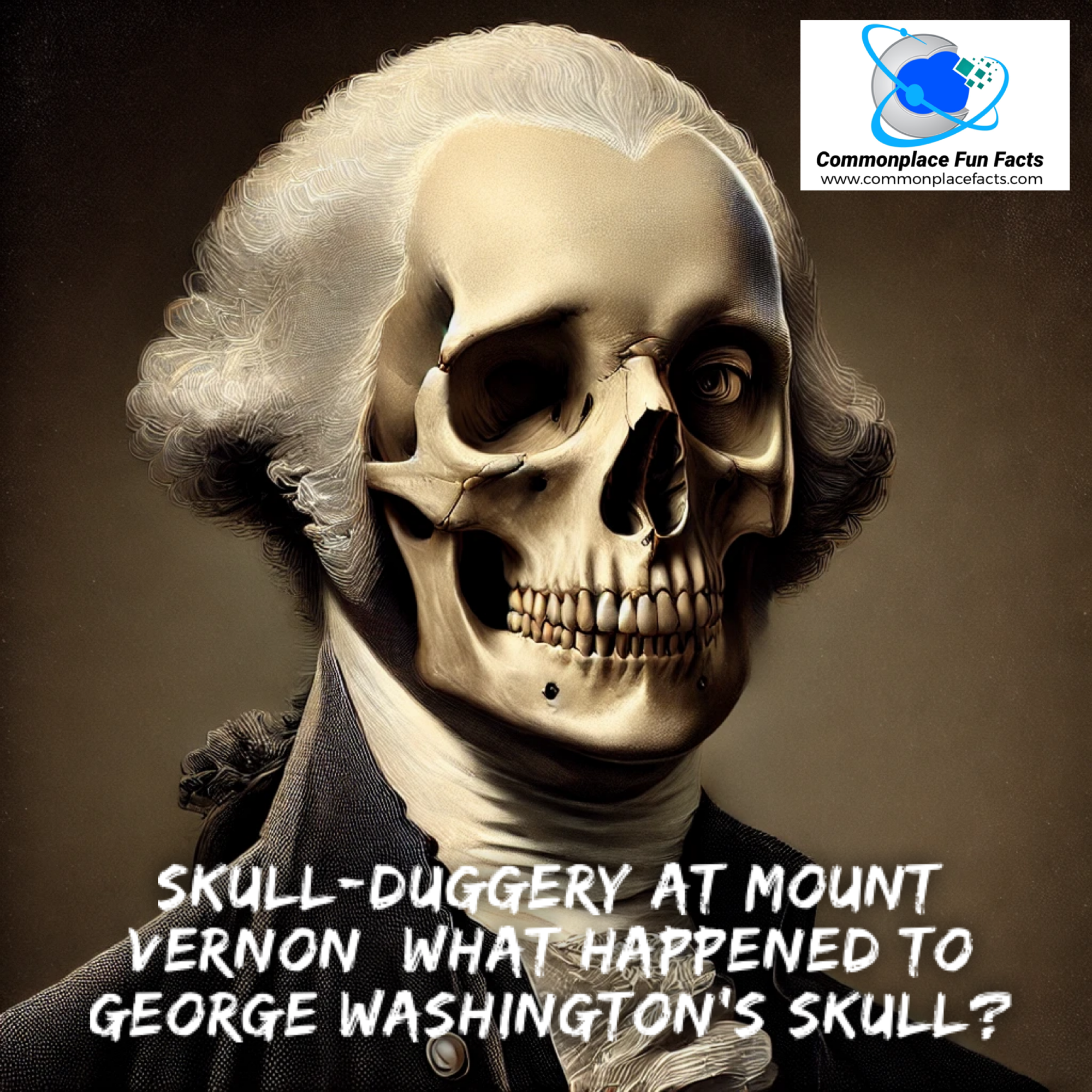

Few names are revered more than that of George Washington. As the father of his country and first president of the United States, he was, as Major General Henry Lee eulogized him, “First in war, first in peace, and first in the hearts of his countrymen.”
That doesn’t mean everyone held him in complete respect. Join us as we dive into the story of a disgruntled gardener who attempted the ultimate act of revenge: stealing George Washington’s skull.
A Crypt in Shambles
The story begins with the decrepit state of Washington’s crypt at Mount Vernon. Washington left detailed instructions in his will for his final resting place: “The family Vault at Mount Vernon needing repairs and being improperly situated, I desire that a new one of brick, on a larger scale, be built at the foot of the Vineyard Inclosure.” “Needing repairs” was a polite way to say, “the old tomb is a mess.” Its entrance was so shabby that an 1820 visitor likened it to a pigsty, fit for pigs to waltz right in. Flood-prone and decaying, it housed rotting coffins and spilled bones. Washington’s lead-lined coffin was situated above the water on a table. Everything else, however, was in rapid decline. Tree roots had even started creeping in, threatening to turn this revered site into a skeletal free-for-all.
Despite Washington’s explicit “build me a better resting place” orders, his remains languished in that crypt for thirty more years as it continued its slow descent into ruin. This left the crypt susceptible to throngs of souvenir hunters. One notable incident occurred when the ambassador from Russia snagged an entire branch from a tree that was growing next to the crypt. The branch was for Tsar Alexander I. A century after Washington’s death, Theodore Roosevelt bragged about wielding a big stick, but Tsar Alexander beat him to the punch with a big stick from America’s biggest legend.
A Boneyard Boondoggle
By 1830, Mount Vernon was under the care of John Augustine Washington II. He fired one of the estate’s gardeners. The gardener’s name and the reason for the firing are unknown. The anonymous gardener apparently felt that his dismissal was unwarranted. He decided to vent his disapproval toward horticultural hooligans. The crafty criminal broke into Washington’s crypt with the intent of nabbing Washington’s noggin.
This is where the crypt’s disrepair worked in the family’s favor. The tomb at Mount Vernon was in such a shambles that the gardener got confused. The mortal remains of approximately twenty members of the Washington family and extended family rested in the crypt. Over time, even their wooden coffins had decayed, leaving skeletons strewn about like a haunted house gone wrong. Fortunately, George and Martha Washington’s bodies had been encased in lead, sparing them the indignity of joining the skeletal jumble on the crypt floor. Amid the chaos of the crypt and the stress of his heist, our bumbling gardener mistakenly snatched the skull of a Blackburn family member, in-laws to George Washington’s nephew, Judge Bushrod Washington, instead of the intended prize. One would think that in a tomb filled with remains, a lead-lined coffin might stand out, but no. As a gardener, he may have had a green thumb, but as a thief, he was all thumbs. He left the crypt with a second-rate skull and a heap of regret.
Or did he?
Conspiracies, Consequences, and Critiques
The incident sparked an immediate outrage, as well as more than a few conspiracy theories. One of the biggest questions was how anyone could be sure Washington’s skull had not been snagged. Given the overall state of disrepair, isn’t it reasonable to assume that Washington’s coffin was likewise falling apart? Since it would take an exceptionally dull mind to miss the large lead-lined coffin in the center of the crypt, do we really believe this gardener settled for a random skull in the corner of the crypt?
It also rekindled a 30-year-old movement to have Washington’s body permanently entombed at the U.S. Capitol. In the original designs for the Capitol Building, William Thornton envisioned a majestic rotunda, with a sturdy crypt beneath it. Construction kicked off in 1793, with George Washington himself laying the cornerstone. Even in those early days, nothing associated with government planning moved quickly, so when Washington died in 1799, the project was nowhere near complete. The Capitol designers got Martha Washington’s blessing to move forward with the plans, but in the meantime, his remains were housed in the old crypt we have been discussing.
Delay followed delay. The War of 1812 threw a wrench into things, with the British setting the Capitol ablaze in 1814. It wasn’t until 1827 that Architect Charles Bulfinch finally finished the crypt section of the building. Even so, the plans to house Washington’s remains there fizzled. There was that pesky provision in Washington’s will about where he wanted to rest in peace. After the attempt to steal Washington’s skull came to light, Congress renewed its interest in reinterring the president to the city that was named after him.
Washington’s nephew, John Augustine Washington II, was calling the shots by this point, and he wasn’t having it. He insisted his uncle’s “perfect tranquility” mustn’t be disturbed. Instead, he commissioned a new, secure crypt at Mount Vernon. This 1831 makeover, however, received mixed reviews. The Earl of Carlisle, upon visiting, described the new tomb as a cross between a coach-house and a cage. Charming, really.
By 1837, the vault got another facelift with a Pennsylvania marble sarcophagus, ensuring Washington’s body finally rested in a dignified manner. It was during the process of moving the president to this final location that the family attempted to put an end to the speculation about the fate of Washington’s head. The coffin was unsealed, revealing that Washington’s body had remained surprisingly well-preserved. Spectators particularly noted the size of his head. This, hopefully, would allow the conspiracies to be put to bed, allowing the old general his final, peaceful rest.
Nearly fifty years later, the attempted theft of another body connected to the presidency would spark a new round of public and political outrage. As we have said, when it comes to government, things rarely get resolved quickly.
Hair Today, Gone Tomorrow
There is one more macabre piece to this already weird tale. There’s a claim that during the 1837 unsealing, some enterprising soul snipped locks of Washington’s hair. These relics have floated around, attempting to hit the auction block, though their authenticity remains in doubt. In 1835, Jules Germain Cloquet wrote about a touching moment during the Marquis de Lafayette’s 1824 visit to the U.S. One of George Washington’s step-grandchildren gifted Lafayette a ring containing hair from both George and Martha Washington. This sentimental token came with a wish for it to be passed down through the Marquis’ family for generations. It’s a small but poignant piece of history, connecting Lafayette to Washington in a personal and enduring way.
So there you have it: a story where Washington’s head nearly rolled, only to remain firmly attached through a combination of fate, family, and a touch of marble-induced grandeur. The moral? Even in death, George Washington was able to quit while he was a head.

Coffin Torpedoes: When 19th-Century Americans Booby-Trapped the Dead to Stop Grave Robbers
P.K. Clover’s 1878 coffin torpedo was designed to stop grave robbers with an explosive surprise buried alongside the deceased.

The Burke and Hare Murders: The Shocking Cadaver Scheme That Transformed 19th Century Medicine
Explore the Burke and Hare murders, the shocking 1828 Edinburgh crimes in which two men killed to supply cadavers to medical schools—sparking outrage and helping lead to the Anatomy Act of 1832.

Carl Tanzler and the Love that Creepily Continued After Death
Learn about Carl Tanzler, the creepy guy who preserved the object of his affection after she



Leave a Reply