

Since Orville and Wilbur Wright built the first airplane, there have been countless attempts to improve upon the design. Today’s sleek aircraft owe their graceful designs to all of the trials and errors between then and now. It must be acknowledged that not every design was a homerun. For every Sopwith Camel, there’s a SPAD SA, a plane that seemed designed with the express purpose of terrifying its gunners by putting them directly in front of the propeller. For every sleek Spitfire, there’s a Boulton Paul Defiant, a turret fighter that clung to World War I tactics like a man too stubborn to admit his favorite bell bottoms are out of style. And for every Boeing 747, there’s a Bristol Brabazon, a giant, bloated dirigible of a plane that was obsolete the moment it left the drawing board.

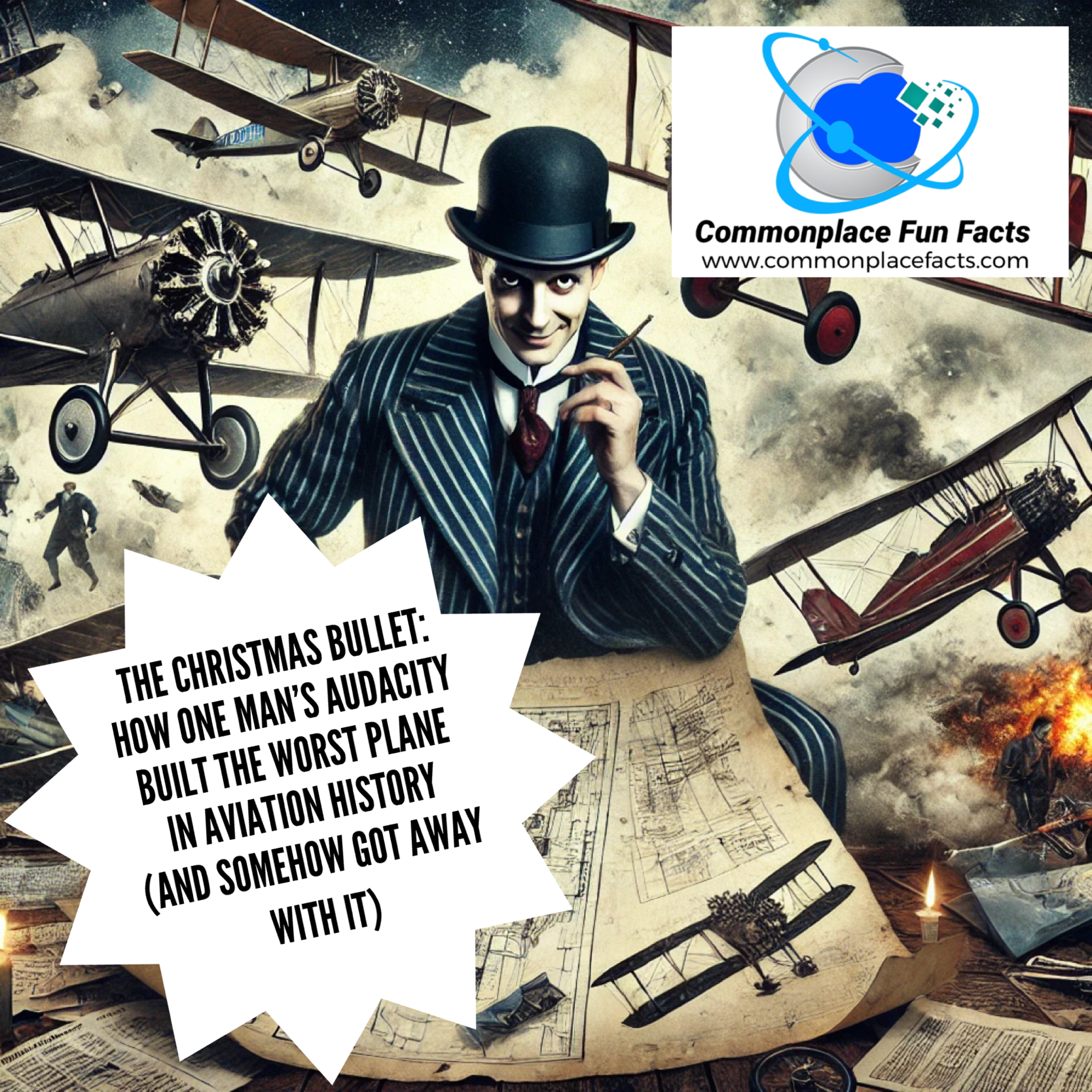
But in the glorious and ignominious history of aviation, one aircraft towers above the rest as the pinnacle of terrible design, catastrophic execution, and sheer, unmitigated gall. Now, ladies and gentlemen, please make sure your seat backs and tray tables are in their full upright position. Make sure your seat belt is securely fastened and all carry-on luggage is stowed underneath the seat in front of you or in the overhead bins. Prepare for a bumpy ride as we dive into the story of the Christmas Bullet—the aircraft that somehow managed to be so disastrously awful, that it could only have been birthed by one of the most audacious charlatans in American history.
Contents
Dr. William Whitney Christmas, A Man with No Scruples and Even Fewer Qualifications
Born on September 1, 1865, in Warrenton, North Carolina, William Whitney Christmas was a man of many talents, or so he would have you believe. He bounced from St. John’s Military Academy to the University of Virginia, and then to George Washington University, accumulating a Master of Arts degree along the way. He fancied himself a doctor, though the evidence supporting his medical credentials is about as solid as a paper airplane. Nonetheless, he eagerly adopted the title of “Doctor Christmas”—and who wouldn’t want a name like that?
Christmas’s brief flirtation with medicine was just that—brief. By the early 1900s, he had set his sights on the fledgling field of aviation. After all, why practice medicine when you can design flying death traps? In 1908, he claimed to have built and flown his first aircraft, but, like a magician with a penchant for drama, he claimed to have burned it to protect its top-secret design. Astonishingly, no one ever found a shred of evidence that this plane existed. But hey, it’s the thought that counts, right?
The Red Bird: Christmas’s First Foray into Fictional Aircraft
By 1909, Christmas was deep into his aviation ambitions, patenting a design for a plane he dubbed the “Red Bird.” Now, before you get too excited, let’s clarify: the Red Bird was a direct copy of Alexander Graham Bell’s “Red Wing,” an aircraft developed by Bell’s Aerial Experimentation Association. You remember him, don’t you? He’s the guy who invented the telephone? Apparently, originality was not Christmas’s strong suit. As you might expect, there’s no evidence that the Red Bird was ever built or flown—because, of course, it wasn’t
Undeterred by this minor setback (or, you know, reality), Christmas set out to find investors for his aviation endeavors. On October 26, 1909, he roped in a few brave souls—Creed M. Fulton, Lester C. McCloud, and Thomas W. Buckley—and together they formed the Christmas Aeroplane Company in Washington, D.C. Over the next eight years, the company was rebranded multiple times, likely in an attempt to outrun its own reputation, but no actual aircraft were ever produced. This might be a good time to point out that investors should never, under any circumstances, put their money in anything associated with an experienced aircraft designer who is incapable of showing you any plane that he designed.
The Bullet: A Disaster in the Making
Fast forward to December 5, 1915. Christmas, ever the showman, published an article in the New York Times claiming to have sold 11 battlecruisers to Britain and France. This was, of course, a lie. But Christmas’s charm was such that he managed to keep stringing along investors until 1917 when Fulton, McCloud, and Buckley finally had enough and bailed. You’d think this would spell the end of Christmas’s aviation dreams, but you’d be wrong. Enter the McCrory brothers, Henry and Alfred, two unfortunate souls who would soon regret their foray into the world of aircraft.
With new investors on board, Christmas pitched his designs to the struggling Continental Aircraft Company of Amityville, Long Island. His pièce de résistance? A single-seat scout plane with an audacious plan to fly into German territory and kidnap Kaiser Wilhelm II. Somehow, this was mistakenly interpreted as a completely rational and reasonable idea. The desperate folks at Continental, likely having lost all sense of reality, agreed to Christmas’s proposal. They assigned the design to Vincent Burnelli, who would later become a respected aircraft designer—though he probably wished he’d skipped this particular gig.
Wings of Death: The Making of the Christmas Bullet
To power his creation, Christmas secured an experimental Liberty 6 engine from the U.S. Army, thanks to the influence of New York Senator James Wadsworth. The engine was supposed to be used only for ground tests, with strict conditions that the Army would inspect the plane before any flight. Naturally, Christmas ignored these conditions. Why should such trivial things as safety rules get in the way?
Burnelli, tasked with making Christmas’s fever dream a reality, quickly realized the design was a disaster waiting to happen. The fuselage, a mix of steel and wood veneer, weighed an astonishing 2,100 pounds—nearly twice the weight of comparable planes of the era. The real kicker was the wings. Christmas insisted that the wings be allowed to flex freely, like a bird’s. Sounds poetic, right? Except, in this case, “flex freely” meant “tear off mid-flight,” a feature no sane pilot would appreciate.
The Tragic Maiden Flight of the Bullet
By the time the first Christmas Bullet was completed, the Great War had ended, mercifully sparing Kaiser Wilhelm from Christmas’s bizarre kidnapping plot. Now, Christmas faced a new challenge: finding a pilot willing to test-fly his monstrous creation. After several candidates took one look at the Bullet and decided they’d prefer to keep living, Christmas convinced airmail pilot Cuthbert Mills to take the controls.
The maiden flight took place in January 1919. At first, things seemed to be going well—the Bullet took off and climbed to 3,000 feet. And then, as if on cue, the wings tore off, sending Mills plummeting to his death. History does not record Mills’ final thoughts, but we suspect they had something to do with the empty promises he received from Christmas about the plane’s structural capability.
The Aftermath: Lies, More Lies, and Astonishing Audacity
You’d think this tragedy would mark the end of the Christmas Bullet. Anyone with “Christmas” in his name should be good for at least one miracle. Instead of admitting defeat, he covered up Mills’s death and ran a newspaper ad claiming the Bullet had achieved a speed of 197 miles per hour over Central Park, Long Island. He even claimed this feat had been witnessed by an Army Air Corps Colonel, a detail that no one seemed to bother verifying.
Emboldened by his ability to literally get away with murder, Christmas convinced the Army to lend him a propeller for a second Bullet prototype. Unsurprisingly, the second flight ended in disaster, killing pilot Lieutenant Allington Joyce Jolly. Despite this, Christmas continued to tout the Bullet as “the safest, easiest plane in the world.” At this point, it’s clear that Christmas had either completely lost touch with reality or was the most shameless conman to ever grace the aviation industry.
The (Not-So-)Grand Finale
Realizing that he couldn’t keep killing pilots without consequences, Christmas quietly abandoned the Bullet project before it could be formally evaluated by the Army. That didn’t mean he was done with his scheming. In 1923, Christmas appeared before the House Select Committee on Expenditures in the War Department, where he made all sorts of outlandish claims, including that his flexible wing design was being swamped with orders from Europe and that the U.S. government was conspiring against him.
In a final, jaw-dropping twist, Christmas billed the Army $100,000 for the use of his “revolutionary” wing design—and the Army, for reasons that defy logic, paid up, even though it was capable of killing more of the good guys that the disastrous Great Panjamdrum.
The Legacy of Dr. Christmas: A Cautionary Tale of Audacity and Disaster
William Christmas went on to a long succession of ventures, eventually becoming vice president of a real estate firm. He died in 1960 at the ripe old age of 95, having lived a life of audacious schemes, disastrous engineering, and unmitigated gall. The story of the Christmas Bullet is a testament to the dangers of unchecked ambition, a cautionary tale about the perils of charlatanism in a field where lives hang in the balance.
In the lawless landscape of early American aviation, Christmas managed to do the unthinkable: he swindled investors, built one of the worst aircraft in history, and was responsible for the deaths of two pilots—all while walking away with his reputation intact and his pockets full. The next time you board a plane, spare a thought for the pilots of the Christmas Bullet, who paid the ultimate price for one man’s audacity.

Anne Lindbergh: The Surprising Unknown Life of an Aviation Legend
Anne Lindbergh was more than Charles’ wife — she was an aviator, best-selling author, and pioneer whose legacy deserves a flight plan of its own.

Historic Aviation Achievement Accomplished Without Pants
In the COVID era, when so many people worked from home, some embarrassing situations led to widespread warnings. Among the most notable was the caution that when you are in a Zoom meeting, it is a good idea to wear pants. No one wants to offer a brilliant insight during a meeting, only to be…

Thomas Selfridge: The Aviation Legend Who Became the First Person to Die in a Plane Crash
Learn about Thomas Selfridge, the aviation legend who also became the first person to die in a plane crash.



Leave a Reply