
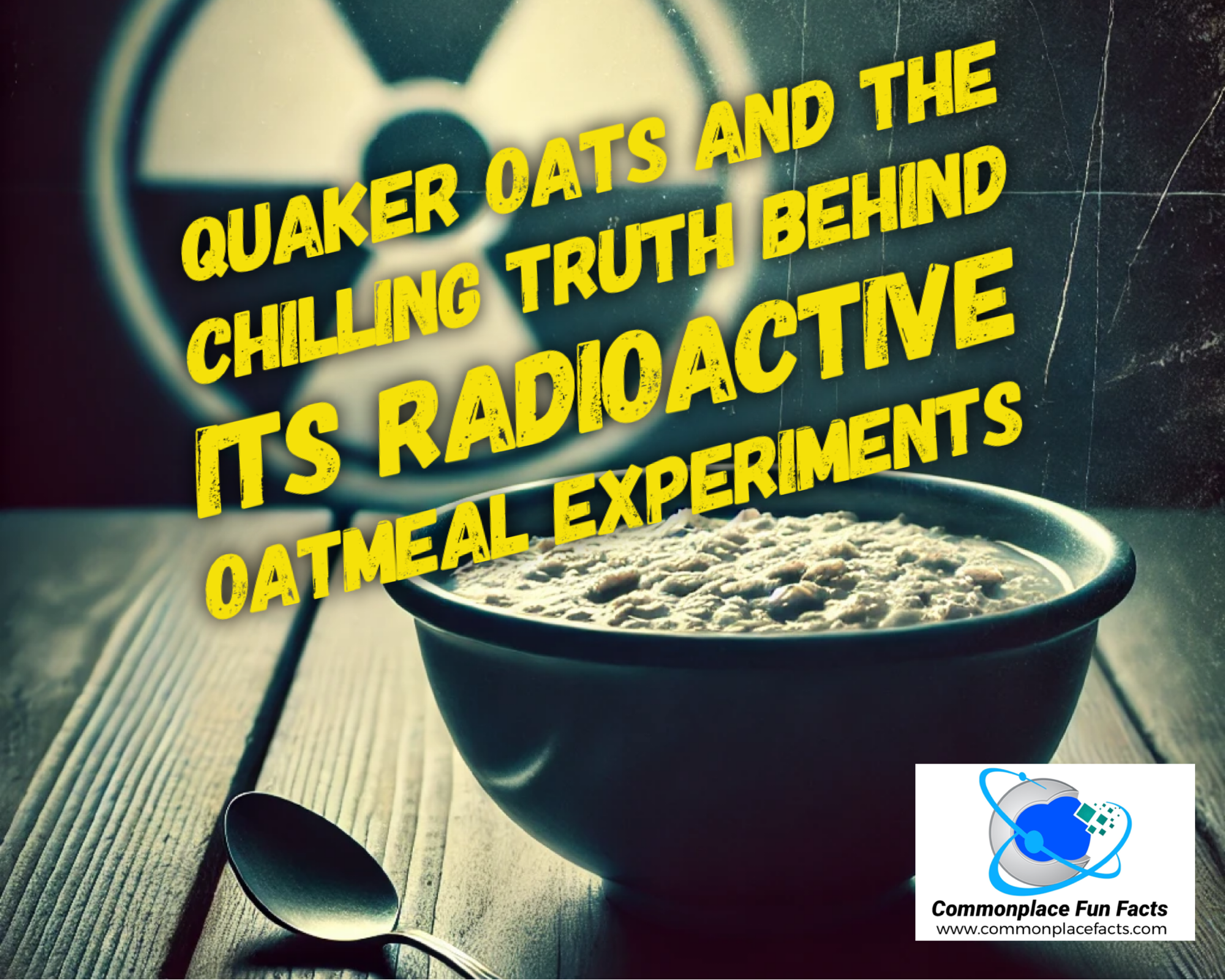

Oatmeal—the epitome of a hearty, nutritious breakfast. It’s the meal that fuels your day with fiber, vitamins, and a touch of warmth, often sweetened with a sprinkle of brown sugar for added delight. What if we told you that for a group of Massachusetts orphans in the 1950s and 60s, their “perfect” breakfast came with a sinister twist—a sizable serving of radioactive oatmeal?
Yes, you read that correctly. These children unknowingly participated in a covert study that sets the standard for unethical experiments. It was funded by Quaker Oats and MIT and became part of one of the most unethical chapters in American medical research. This dark tale unfolds at the Walter E. Fernald State School, a name that suggests an esteemed institution but conceals a disturbing history.
The Dark Reality of Fernald: More Than Just a School
Our story begins at the Walter E. Fernald State School in Waltham, Massachusetts, established in 1888. Originally named the Experimental School for Teaching and Training Idiotic Children (yes, the terminology was as harsh as it sounds, even though you immediately had someone come to mind who should immediately enroll in such an institution), the Fernald State School was born out of the American eugenics movement. This movement sought to “improve” the nation’s genetic pool by preventing those deemed “defective” from reproducing.
Fernald, like many institutions across the United States, was designed to house, isolate, and sometimes forcibly sterilize children labeled as feeble-minded. However, nearly half of the children sent to Fernald were not mentally disabled at all; they were simply impoverished, uneducated, and abandoned by parents who couldn’t care for them. The state, in its misguided wisdom, decided these children belonged in what can only be described as human warehouses.
Learn about the man who created the Quaker Oats logo and Santa Claus
Fred Boyce, a former resident who was admitted in 1949 at just eight years old, described the harrowing experience: “We thought for a long time that we belonged there, that we were not part of the species. We thought we were some kind of, you know, people that weren’t supposed to be born. The state government didn’t have to look for homes for you, so they could just dump you off in these human warehouses and just let you rot.”
Rot, they did. At its peak, Fernald housed up to 2,500 people, with children packed 30 to a room. To keep costs down, the residents performed most of the manual labor—growing their own food, sewing their shoes, and even manufacturing the brooms they used to clean the facility. Education was a farce; as Michael D’Antonio, author of The State Boys Rebellion, noted, “It was a school in name only.” Children would repeatedly go through the first year of school, endlessly reading the same Dick and Jane book, their progress stunted by design.
The “Science Club” with a Dark Secret

The most tragic chapter in this story is the creation of the so-called “science club.” In 1946, Fernald announced this club, offering its members extra oatmeal and milk for breakfast, Mickey Mouse watches, and even tickets to Boston Red Sox games. For the children, who lived bleak lives, this seemed like a dream come true.
What the children—and their guardians, if they had any—didn’t know was that this “science club” was a cover for a secret MIT nutrition study funded by Quaker Oats. The study aimed to prove that Quaker’s oatmeal was just as effective at promoting iron absorption as its competitor, Cream of Wheat. However, there was a disturbing catch—these breakfast meals were laced with radioactive tracers. Everyone knows a hot meal of radioactive oatmeal is the best way to start the day, right?
What about the parents and guardians? Shouldn’t they have been consulted and given the chance to decline the “honor” of having their children in the science club and its unethical experiments? Well, in Fernald’s defense, the administration did send a letter. This was it:
Dear Parents,
In previous years, we have done some examinations in connection with the Nutritional Department of the Massachusetts Institute of Technology, with the purpose of helping to improve the nutrition of our children and to help them in general become more efficient. For the checking up of the children, we occasionally need to take some blood samples, which are then analyzed. Blood samples are taken after one test meal, which consists of a special breakfast meal containing a certain amount of calcium. We’ve asked for volunteers to give a sample of blood once a month for three months, and your son has agreed to volunteer. Because the boys who belong to the science club have many additional privileges, they get a quart of milk daily during that time and are taken to a baseball game, to the beach, and to some outside dinners, and they enjoy it greatly. I hope you have no objection to your son voluntarily participating in this study. The first study will start on Monday, June 8th, and if you have not expressed any objections, we will assume that your son may participate.
Sincerely yours,
Clemens E. Bender, MD,
Clinical Director”
The letter conveniently neglected to mention that these special breakfast meals were laced with radioactive tracers or anything else that would give any rational person a moment’s pause before subjecting children to such things as Quaker Oats’ radioactive oatmeal.
Admittedly, this was an era when people lacked our knowledge about the harmful effects of radiation. That’s why Germans were able to purchase radioactive toothpaste laced with Thorium, theoretically to better whiten their teeth.
Despite the naivety about the dangers of radiation, what happened in the science club is horrifying. For a decade, from 1946 to 1956, over 100 residents were fed oatmeal and milk laced with radioactive iron-59 and calcium-47, with some even receiving intravenous calcium injections. These radioactive tracers allowed researchers to track the absorption of these nutrients in the body. Quaker Oats was thrilled with the results—oatmeal, it turned out, was just as good as Cream of Wheat. As far as that claim about milk building strong bones? You can thank non-consensual human experimentation for that little tidbit.
The Golden Age of Unethical Human Experimentation
The Fernald State School’s Quaker Oats experiment was not an isolated incident but part of a broader pattern of unethical experiments during the early Cold War period, all conducted in the name of national security and scientific advancement. Consider the Holmesburg Prison experiments, where hundreds of inmates were subjected to tests involving various toxins, creams, and detergents. What about the U.S. Public Health Service’s study in Guatemala? That’s the one where 700 people were deliberately infected with syphilis and gonorrhea. And who can forget the CIA’s infamous MK-Ultra experiments, which subjected thousands to electroshock therapy and hallucinogenic drugs in a failed attempt to develop mind control techniques?
Learn about the time Quaker Oats sold pieces of the Yukon — one square inch at a time
As John Lantos, a medical ethics expert, put it, the prevailing mindset was simple: “Technology was good. We were the leaders. We were the good guys. So anything we did could not be bad.” This attitude persisted despite the Nuremberg Code, drafted less than a decade earlier in response to Nazi human experiments, which stated that “the voluntary consent of the human subject is absolutely essential.” Yeah, yeah… Details, details.
A Long Road to Justice
For decades, the children at the Fernald State School had no idea they had been used as human guinea pigs. It wasn’t until 1993, when Secretary of Energy Hazel O’Leary declassified numerous Atomic Energy Commission documents, that the truth finally came to light. The Boston Globe broke the story on December 26, and soon after, other publications began urging victims to come forward.
Fred Boyce, a former resident, spearheaded a class-action lawsuit against MIT, Quaker Oats, and the U.S. government, bringing together 30 of his former Fernald classmates. Meanwhile, Senator Edward Kennedy chaired a hearing to investigate the Fernald experiments, questioning one of the study’s organizers about why they chose institutionalized orphans instead of, say, MIT students. The chilling response? It was all in the name of good science. After all, you can’t have a good experiment if you don’t control your subjects, ensuring they consume every last bite of that radioactive oatmeal.
In the end, both MIT and Quaker Oats settled out of court, agreeing to pay the plaintiffs $60,000 in compensation. While this was a small victory, it provided some measure of justice and closure to one of the darkest periods in American scientific history.
At the end of the day, if your mother told you that a nice bowl of oatmeal is a healthy way to start your day, she was telling the truth. If she failed to mention that you shouldn’t mix radioactive material with your breakfast, well, that’s why a well-balanced meal also includes an informative dose of Commonplace Fun Facts.
You may also enjoy…

Webster Edgerly: The Bizarre Guru Behind Ralston Purina
Discover Webster Edgerly, the eccentric founder of Ralstonism, whose odd health rules and utopian dreams shaped the cereal giant Ralston Purina.

Dr. Joseph Nash McDowell: The 19th-Century Doctor Who Turned Medicine Into a Cannon-Filled, Ghost-Haunted Adventure
Discover the eccentric life of Dr. Joseph Nash McDowell, a 19th-century physician known for body-snatching, building a cannon-armed medical school, and preserving his daughter in a haunted cave. Explore the fascinating mix of medical brilliance and bizarre oddities.

Martin Luther’s Feces Theses
The article discusses Martin Luther’s peculiar interest in fecal matter, revealing that he ingested a spoonful of his own excrement daily due to chronic constipation. Despite its gross nature, he believed in its curative properties, reflecting a historical context where such practices were not uncommon in medical belief.






Leave a Reply to Commonplace Fun FactsCancel reply