
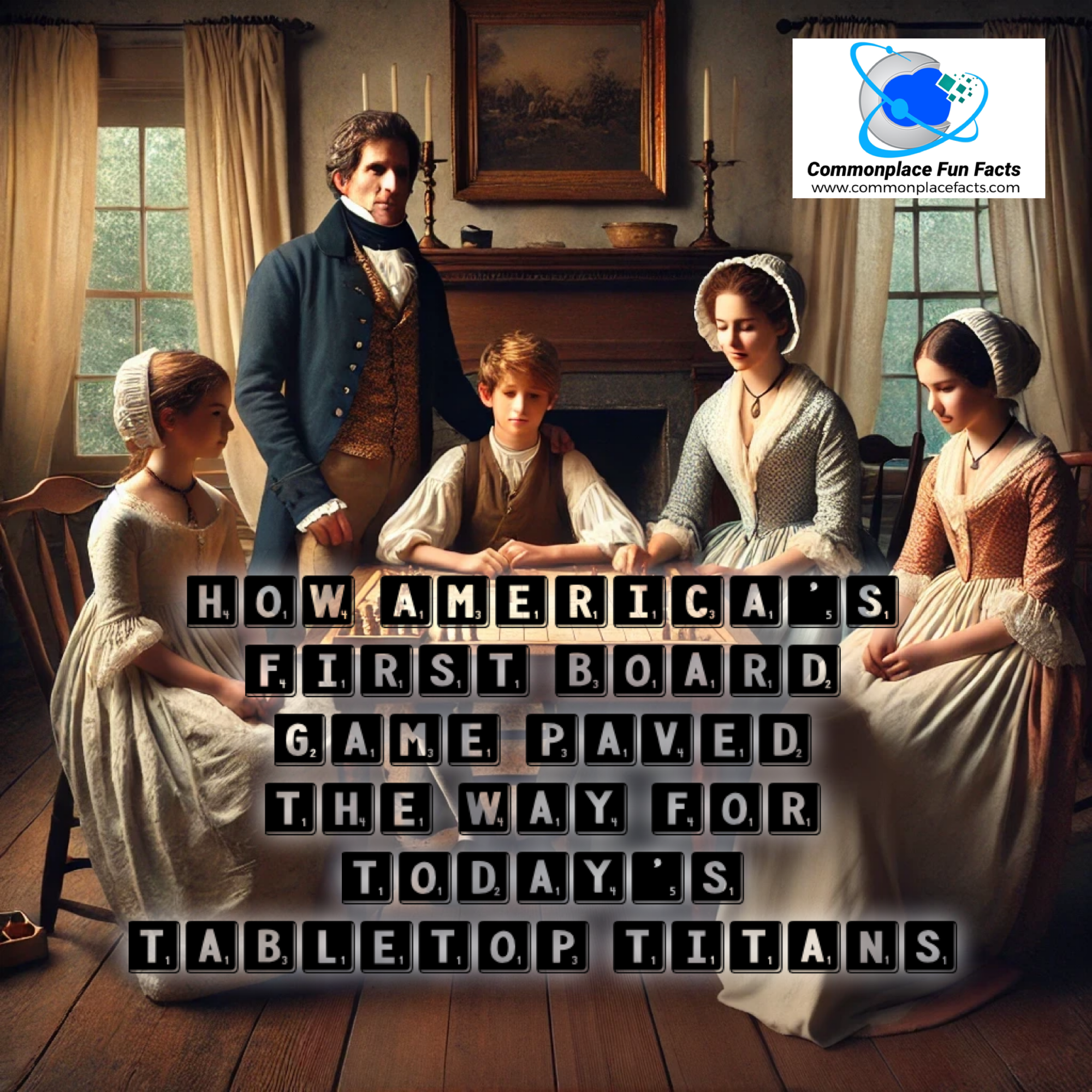

In 2023 alone, the board game industry raked in a staggering $16.8 billion. It’s on track to hit $40.1 billion by 2032. This isn’t just Monopoly money we’re talking about; it’s a global phenomenon. Classics like Scrabble are getting dusted off and being given the kind of makeovers that would make Hollywood jealous. Newcomers like Pandemic have fanbases more devoted than the average D&D group on a Friday night.
What started this craze? Finding the first American board game is a bit like looking for the Ark of the Covenant. Join us as we go on this epic quest to explore the roots of American gaming culture — minus the face-melting special effects.
Long before Candy Land, Trivial Pursuit, and Chutes and Ladders made their way under family Christmas trees, and way before the board game Mousetrap found its way into a study involving handguns and hot sauce, there was a game that tickled the fancy of early Americans. It’s hard to find a surviving copy, but if you do, you will have uncovered a rare treasure. We refer to the forgotten gem of early American playtime: a board game called The Travellers’ Tour Through the United States.

Produced by F. & R. Lockwood, a New York-based cartography firm, The Travellers’ Tour is a slice of America’s past. It was printed a year after Missouri joined the Union and long before the phrase “board game night” was a thing. Imagine a time when instead of Ticket to Ride or Catan, families gathered around the parlor table to play games designed to make you smarter (or at least pretend to be). The Travellers’ Tour was part of this tradition, mimicking European geography games where players raced across maps while spouting geographic trivia.
This game holds the distinction of being the earliest known board game printed in the United States, predating what we once thought was the first: The Mansion of Happiness. In 1894, Parker Brothers—a name now synonymous with classic games—declared The Mansion of Happiness (1843) as the first American board game. Little did they know, a humble little geography game had been sitting quietly in the archives, waiting for its moment in the sun. That moment came in 1991 when a game collector stumbled upon a copy of The Travellers’ Tour in the American Antiquarian Society’s vault, setting the record straight.
But let’s rewind to 1822. By this time, board games were already making a name for themselves among America’s middle- and upper-class families. Back then, New Year’s Day was the prime gift-giving occasion, not Christmas. Bookshops were stocked with holiday-themed goodies, including puzzles (then called “dissected maps”) and paper dolls. Among these offerings were games imported from England like The New Game of Human Life and The Royal And Entertaining Game of Goose—titles that practically scream “fun for the whole family.”
The Travellers’ Tour was a unique gift, though, as it was the first game to use a map of the United States as its board. It was a hand-colored map of the then-24 states, accompanied by a list of 139 towns and cities, each with its own description. The game’s rules were simple: spin a “Tetotum” (a top-like device used instead of dice, because dice were considered a gateway drug to gambling and moral decay), and move your token to the corresponding town. If you could recite the name and facts about the town, you advanced closer to New Orleans—the ultimate goal.
If you think modern games like Settlers of Catan are all about strategy, imagine trying to remember 139 towns and their descriptions. This wasn’t just a game; it was an educational workout. And what did you learn on your journey? For one, America’s early 19th-century self-image was pretty rosy. The game’s descriptions painted a picture of a nation brimming with agricultural bounty, commercial potential, and cultural sophistication. Philadelphia was lauded for its “literary and benevolent institutions,” while Boston’s citizens were “enterprising and liberal in the support of religious and literary institutions.” The game was like a guided tour of America’s finest features, with a heavy dose of national pride.
Alas, like many stories from this era, there were glaring omissions. For instance, while the game was keen to highlight the virtues of cities like Richmond and Charleston, it conveniently skipped over some less flattering aspects—namely, the institution of slavery and the ongoing displacement of Indigenous peoples. It’s as if the game was designed to be a G-rated version of America, where everything was splendid and progress was inevitable.
Despite its sanitized portrayal of the nation, The Travellers’ Tour represents a significant milestone in the history of American gaming. It laid the groundwork for what would become a thriving industry, even if it wasn’t a blockbuster hit in its own time. Today, only a handful of copies exist, scattered across museums, libraries, and private collections.
How Did Abraham Lincoln’s Beard Inspire One of the Most Popular Board Games?
Fast forward two centuries, and board games have evolved into something far more complex and varied. Titles like Freedom: The Underground Railroad and Votes for Women aren’t just about winning; they’re about engaging with history and social issues in ways that challenge players to think critically about the world around them. Pandemic puts you in the shoes of global crisis managers, while Wingspan lets you build your own bird sanctuary, complete with stunning artwork and intricate gameplay mechanics. These games are the descendants of The Travellers’ Tour, carrying forward the idea that play can be both fun and educational.
So, the next time you’re setting up a board game, whether it’s a quick round of Codenames or a marathon session of Twilight Imperium (seriously, clear your calendar for that one), remember that you’re participating in a tradition that’s been evolving for centuries. And who knows? Maybe in 200 years, someone will be uncovering your well-worn copy of Wingspan in an archive, marveling at the cardboard empire of the 21st century.

Fun Google Tricks To Ward Off Boredom
The Commonplace Fun Facts Department of Data, Analytics, Viewer Demographics, and User Engagement (otherwise known as DAVDAUE — yeah, we know. We’re working on a better name) tells us that a significant number of our regular readers spend their lunch breaks with us. We also know a fair number of you are sneaking visits to…

Handguns, Hot Sauce, Board Games, Testosterone and Aggression: Discover the Intriguing Link
Explore how handguns and hot sauce impact testosterone and aggression in men. A fascinating study on male behavior.

Check Out These Wacky Board Games
Admittedly, the Commonplace Fun Facts staff is not really big into board games or games in general. It probably has something to do with the “Does not play well with others” notation that kept showing up in our grade school report cards. Even so, we find ourselves wondering how some board games ever made it…



Leave a Reply