
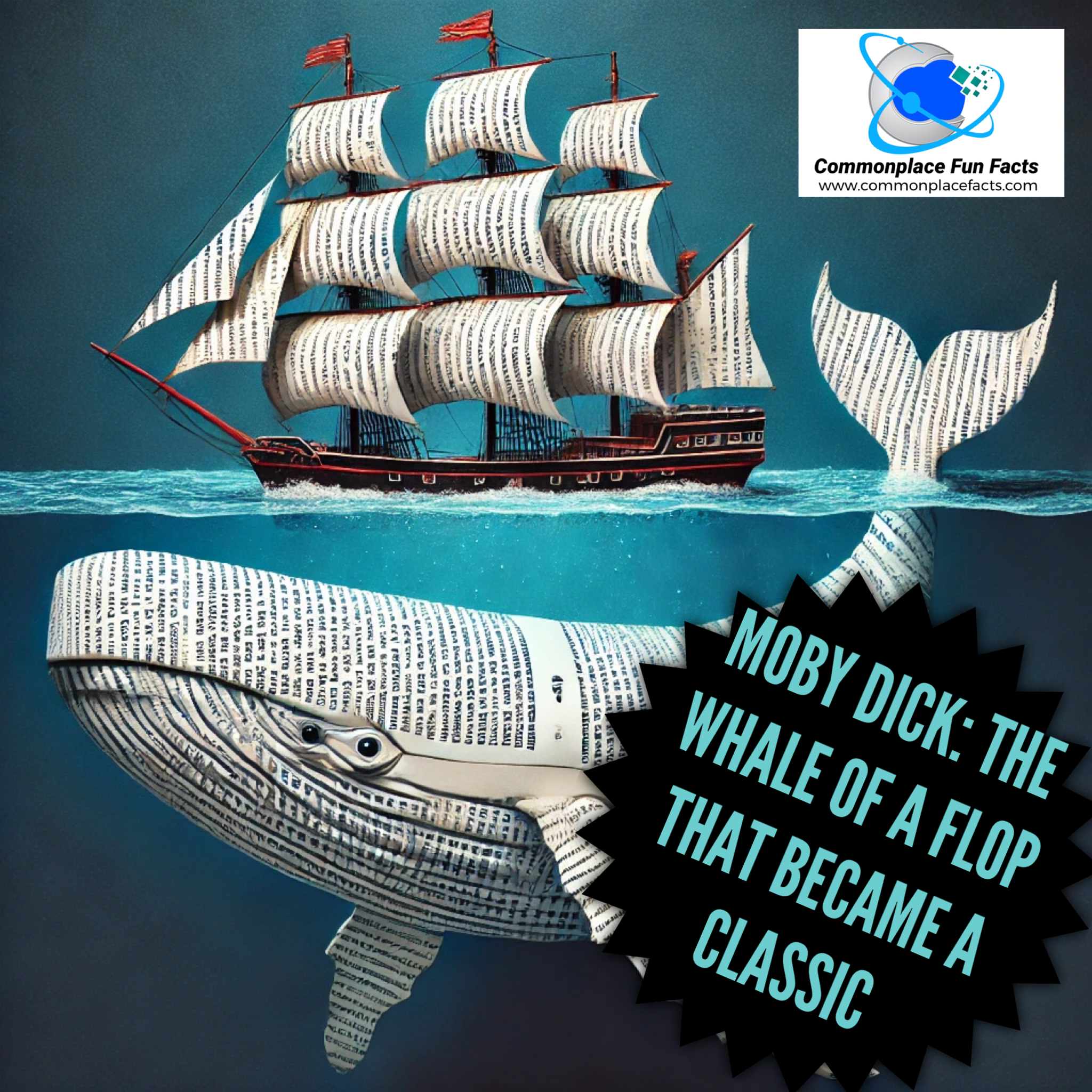

Moby-Dick: A Soggy Launch for a Big Fish Story (Yeah, we know a whale is really a mammal, but cut us some slack, ok?)
Moby-Dick. (Or is it supposed to be Moby Dick, without a hyphen? That’s a discussion for this article.) The novel most people claim to have read but probably just skimmed or watched in cartoon form. When Herman Melville released this massive tome in 1851, it flopped harder than anyone expected. How did Moby-Dick transform from an overlooked disaster into one of the greatest American novels of all time? Let’s dive into the journey.
A Soggy Launch: Why Moby-Dick Initially Failed
In 1851, Melville’s readers were expecting an adventure akin to Typee or Omoo. They longed for swashbuckling adventures with exotic locations, daring escapes, and maybe some palm trees. What they got was not what they were expecting. Instead, they got a 600-page philosophical deep dive into obsession and the human condition, starring a mad sea captain and a white whale. Instead of a fun adventure, they were handed a heavy, complex novel that many found slow and depressing. The London Athenaeum called it an “absurd book,” which, in today’s terms, translates to “What on earth did I just read?”
Don’t take our word for it. Here are just a few of the opinions of the literary critics of the day:
“This is an ill-compounded mixture of romance and matter-of-fact. The idea of a connected and collected story has obviously visited and abandoned its writer again and again in the course of composition. The style of his tale is in places disfigured by mad (rather than bad) English; and its catastrophe is hastily, weakly, and obscurely managed … The result is, at all events, a most provoking book,—neither so utterly extravagant as to be entirely comfortable, nor so instructively complete as to take place among documents on the subject of the Great Fish, his capabilities, his home and his capture. Our author must be henceforth numbered in the company of the incorrigibles who occasionally tantalize us with indications of genius, while they constantly summon us to endure monstrosities, carelessnesses, and other such harassing manifestations of bad taste as daring or disordered ingenuity can devise…
We have little more to say in reprobation or in recommendation of this absurd book … Mr. Melville has to thank himself only if his horrors and his heroics are flung aside by the general reader, as so much trash belonging to the worst school of Bedlam literature—since he seems not so much unable to learn as disdainful of learning the craft of an artist.” – Henry F. Chorley, London Athenaeum, October 25 1851

“Mr. Melville never writes naturally. His sentiment is forced, his wit is forced, and his enthusiasm is forced. And in his attempts to display to the utmost extent his powers of ‘fine writing,’ he has succeeded, we think, beyond his most sanguine expectations. The truth is, Mr. Melville has survived his reputation. If he had been contented with writing one or two books, he might have been famous, but his vanity has destroyed all his chances for immortality, or even of a good name with his own generation. For, in sober truth, Mr. Melville’s vanity is immeasurable. He will either be first among the book-making tribe, or he will be nowhere. He will centre all attention upon himself, or he will abandon the field of literature at once. From this morbid self-esteem, coupled with a most unbounded love of notoriety, spring all Mr. Melville’s efforts, all his rhetorical contortions, all his declamatory abuse of society, all his inflated sentiment, and all his insinuating licentiousness … We have no intention of quoting any passages just now from Moby Dick. The London journals, we understand, ‘have bestowed upon the work many flattering notices,’ and we should be loth to combat such high authority. But if there are any of our readers who wish to find examples of bad rhetoric, involved syntax, stilted sentiment and incoherent English, we will take the liberty of recommending to them this precious volume of Mr. Melville’s.” – New York United States Magazine and Democratic Review, January, 1852
“To convey an adequate idea of a book of such various merits as that which the author of Typee and Omoo has here placed before the reading public, is impossible in the scope of a review. High philosophy, liberal feeling, abstruse metaphysics popularly phrased, soaring speculation, a style as many-coloured as the theme, yet always good, and often admirable; fertile fancy, ingenious construction, playful learning, and an unusual power of enchaining the interest, and rising to the verge of the sublime, without overpassing that narrow boundary which plunges the ambitious penman into the ridiculous; all these are possessed by Herman Melville, and exemplified in these volumes.” – London Morning Advertiser, October 24 1851
The public felt the same, and Moby-Dick failed miserably. The British edition sold fewer than 300 copies in four months, and things didn’t get much better from there. Bentley, the British publisher, lost half of his £150 advance, while Melville earned a meager £38 (approximately £5,358 in 2024) from actual sales. On the USA side of the ocean, Harper’s sold 1,500 copies in just 11 days, but after that, sales slowed to a crawl. By 1853, a fire claimed nearly 300 unsold copies. Overall, Melville earned just $1,260 from the book—less than any of his previous five titles.
It’s no wonder Moby-Dick was out of print by the time Melville died. For 34 years, the book averaged sales of 27 copies a year—hardly the blockbuster it would later become. But hey, good things take time, right?
Good Things Come to Whales Who Wait
For 70 years, Moby-Dick seemed destined to sink as low as whale poop (but far less valuable). By the early 20th century, Herman Melville’s literary fortunes were finally turning around, with critics and artists alike recognizing the brilliance of Moby-Dick. In 1917, American author Carl Van Doren began championing Melville’s work, calling Moby-Dick the pinnacle of American Romanticism in his 1921 study The American Novel. A few years later, D.H. Lawrence praised Melville’s originality, describing Moby-Dick as a masterpiece, despite having read the expurgated English edition, which lacked the epilogue. As the novel gained traction, it was reissued by the Modern Library in 1926, and an illustrated edition by Rockwell Kent in 1930 only further cemented its status.
Adaptations of Moby-Dick began appearing in various forms, from film to television to comic books. The 1926 silent film The Sea Beast, starring John Barrymore, offered a romanticized take on the story, while the most famous adaptation, John Huston’s 1956 film, featured a screenplay by none other than Ray Bradbury. The enduring fascination with Moby-Dick extended beyond cinema—its influence can be seen in literature, art, and even music. Notably, American author Ralph Ellison paid tribute to Melville’s work in his 1952 novel Invisible Man, drawing thematic parallels between the two novels. Even Bob Dylan, in his 2017 Nobel Prize acceptance speech, acknowledged Moby-Dick as one of the three books that most influenced his songwriting. Melville’s once-forgotten masterpiece had truly become a cultural icon.
Plot Overview: What is Moby-Dick Really About?

What is Moby-Dick about? It’s about 625 pages. Honestly, we read the comic book version, and we’re still not entirely sure why it can’t be summed up as “Man loses his leg to a whale and never gets over it.” When we consult with those who are more learned and pointy-headed than we are, however, we glean the following: Moby-Dick follows the crew of the Pequod, a whaling ship captained by the obsessively vengeful Captain Ahab. The narrator, Ishmael, signs up for what he believes will be a standard whaling expedition. Little does he know that Ahab’s sole purpose is to hunt down Moby Dick, the giant white whale that took his leg. Ahab’s quest for revenge turns the voyage into an epic saga filled with allegory, symbolism, and deep existential themes.
At its core, Moby-Dick is about much more than hunting a whale. Melville uses Moby-Dick’s whiteness as a symbol for the unknown and the void—concepts that unsettle both the characters and readers. In one famous chapter, “The Whiteness of the Whale,” Melville explores how the color white isn’t just associated with purity but can also represent a blank, terrifying nothingness. Melville writes:
“…in essence, whiteness is not so much a color as the visible absence of color; is it for these reasons that there is such a dumb blankness, full of meaning, in that wide landscape of snows—a colorless, all-color of atheism from which we should shrink?”
This chilling idea adds depth to Ahab’s obsessive pursuit and highlights the novel’s existential themes.
Then again, you could just read the comic book. It worked for us.
Fun Facts About Moby-Dick That Will Make You Look Smart
- The novel is dedicated to Nathaniel Hawthorne, who encouraged Melville to write Moby-Dick.
- Captain Ahab’s first mate, Starbuck, inspired the name of the famous coffee chain.
- One real-life inspiration for Moby-Dick was the true story of the Essex, a whaling ship attacked by a sperm whale in 1820.
You might also enjoy…

Robert Heinlein: Quotes, Books, and the Sci-Fi Legacy That Still Shapes Us
Explore the life, quotes, and legacy of Robert Heinlein, the “Dean of Science Fiction.” From Starship Troopers to Stranger in a Strange Land, discover his most famous ideas and lasting cultural impact.

Titan vs. Titanic: How a 19th-Century Novel Foreshadowed the World’s Most Famous Shipwreck
A 19th-century novel eerily foreshadowed the Titanic disaster. Explore the uncanny similarities between Morgan Robertson’s Futility and the real-life tragedy of the “unsinkable” ship.

The Great Moon Hoax of 1835: Two-Legged Beavers, Winged Moon Men, and One Seriously Salty Edgar Allan Poe
Explore the bizarre 1835 Great Moon Hoax that captivated readers with tales of lunar beavers and bat-men—and discover why Edgar Allan Poe thought it was all a rip-off of his own sci-fi satire.




Leave a Reply