
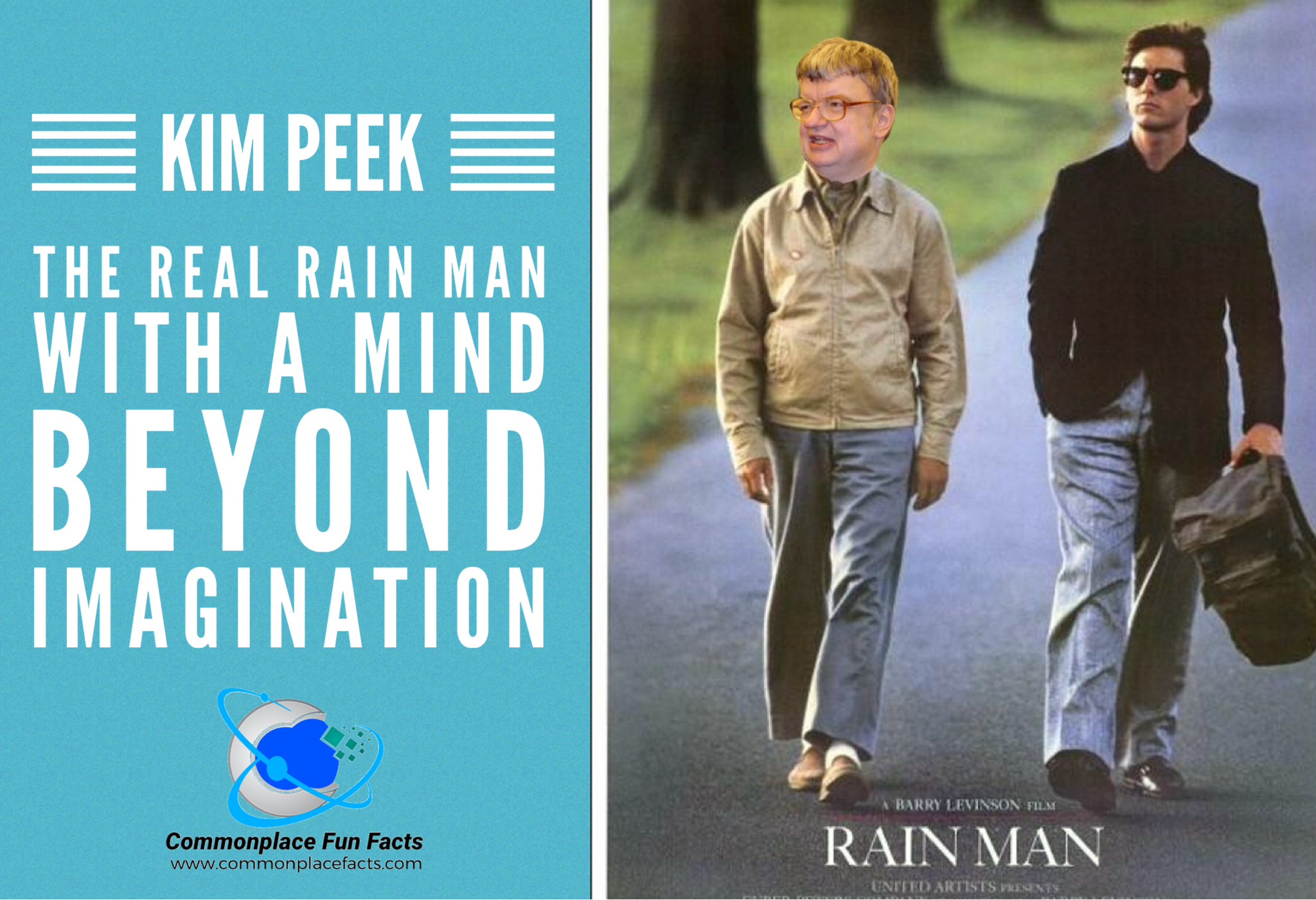

If you have seen the hit movie Rain Man, you it was about a man with extraordinary abilities. Dustin Hoffman portrayed Raymond Babbitt, a savant with a superhuman memory and math skills that seem so impossible that they must have been plucked from a sci-fi script. As amazing as Babbitt’s abilities are, would you believe that he was based on a very real person? Allow us to introduce you to the real Rain Man, Kim Peek — the man whose brain was so exceptional that abilities were so extraordinary that Hollywood had to tone things down just to make the movie believable.
The Boy With an Extraordinary Brain
Laurence Kim Peek entered the world on November 11, 1951, in Salt Lake City, Utah. It didn’t take long for doctors to determine that something was very different about him. Peek was born with macrocephaly (a fancy term for “big head”), a damaged cerebellum, and a rare condition called agenesis of the corpus callosum. Translation? The bundle of nerves that connects the two hemispheres of the brain was nowhere to be found.
Just to keep things extra interesting, Peek was also missing another brain connector, the anterior commissure. With all of these defects, the boy clearly had no real future ahead of him. By nine months, doctors were ready to write him off, advising his parents to institutionalize him. Later, someone even suggested a lobotomy. (You can read more about this horrifying medical practice in this article.)
Thankfully, his parents didn’t listen. To be sure, Kim struggled with developmental delays. He didn’t walk until he was nearly four and needed help with basic tasks like dressing. Psychologists determined that he had an IQ of 87 — more than enough to qualify as a disability. On the surface, it seemed that the doctors had known what they were talking about.
Kim’s parents saw something the doctors didn’t: behind those challenges was a brain capable of astonishing things. By the age of two, Kim could memorize entire books. By six, he had devoured an eight-volume encyclopedia set. By age 14? He had completed the equivalent of high school.
Professionals may have written the boy off. Fortunately, Kim and his parents missed the memo.
Kim Peek: Testing the Potential of the Human Brain
Nicknamed “Kimputer,” Peek’s brain seemed to operate on a completely different operating system from the rest of humanity. For starters, he could read two pages of a book at the same time—one with each eye—and remember every word. By the end of his life, he had read and memorized around 12,000 books.

Peek’s mental database wasn’t just a collection of random trivia; it was a full-fledged knowledge engine. He could provide driving directions to cities he’d never visited based solely on maps he glanced at years earlier. Memorizing phone books? A casual hobby. Need to know your neighbor’s name? Peek probably had it stored in the photographic memory of his mental Rolodex.
He was also a calendar wizard. Give him a date—past, present, or future—and he could instantly tell you what day of the week it was, along with major historical events that happened on that date. If you told him your birthday, he’d not only tell you what day you were born but also regale you with fun facts about what happened that day. (What we wouldn’t give to have him on the Commonplace Fun Facts staff!)
Peek mastered at least 14 subject areas, from history to sports to music. Unlike the character who would later be portrayed by Dustin Hoffman, Kim wasn’t austistic. As his father, Fran, once explained, Kim had “a warm, loving personality” and truly enjoyed connecting with others.
The Meeting That Changed Everything: Kim Peek and Rain Man
In 1984, a chance encounter with screenwriter Barry Morrow at a Texas conference changed Peek’s life forever. Morrow was blown away by Peek’s abilities and used him as inspiration for the character of Raymond Babbitt in Rain Man.
When the film hit theaters in 1988, it became a cultural phenomenon, winning four Oscars and putting Kim Peek in the spotlight. Though the movie took several creative liberties,the essence of Peek’s astonishing abilities shone through. Dustin Hoffman even spent time with Peek to prepare for the role.
The real star wasn’t the movie—it was Peek himself. The attention catapulted him and his father into the public eye, and the duo traveled extensively, speaking to millions about Peek’s life and abilities. By the end of his life, Peek had spoken to an estimated 64 million people, becoming a role model for anyone who felt “different.” We suspect he remembered the names of all the admirers he met.
The Science Behind the Savant
What made Kim Peek’s brain tick? Researchers have suggested that his lack of a corpus callosum allowed his brain to process information in ways that the rest of us mere mortals can’t. Essentially, Peek’s brain made unique connections that compensated for the missing ones, giving him his unparalleled memory and cognitive abilities.
While many savants display remarkable abilities, Peek’s skills were so diverse and expansive that they defied conventional understanding. He wasn’t just good at one thing—he was good at everything that required memory.
A Life Worth Celebrating
Kim Peek passed away in 2009 at the age of 58, but his legacy endures. Barry Morrow, who gave his Oscar to Peek as a tribute, once said, “I don’t think anybody could spend five minutes with Kim and not come away with a slightly altered view of themselves, the world, and our potential as human beings.”
For someone who was once told he’d never walk, talk, or contribute to society, Kim Peek didn’t just defy expectations—he obliterated them. His life reminds us that being “different” isn’t a limitation. Sometimes, it’s a superpower.
You may also enjoy…

The Knowledge: The Insane Test That Makes London Taxi Drivers Memorize 25,000 Streets
Discover how London black-cab drivers master the Knowledge, memorizing 25,000 streets in a test so demanding it can physically change the brain.

Troubadours: The Unbelievable Olympic Champions of Memory
Before books and Google, memory was everything—and troubadours were its rock stars. Discover how literacy rewired the human brain and why remembering used to be an art form.

Human Memory Began on Thursday, July 6, 1189
“Time immemorial.” That’s the term we use to describe anything that has been around for so long that no one knows when it started. It is older than human memory. It refers to how long we have had the practice of greeting each other by shaking hands. It describes the amount of time since the…


Leave a Reply